Jerreb rassek f l-national.

Examen national Physique-Chimie 2Bac PC (option anglaise) 2018, session de rattrapage

Physique-Chimie · Sciences Physiques · 7 pages

Le sujet en bref

  1. Exercice 17 pts

    Estérification et hydrolyse · Piles · Suivi temporel d’une transformation chimique

    La pile zinc-cuivre et l’hydrolyse de l’éthanoate de méthyle

  2. Exercice 22,5 pts

    Décroissance radioactive · Noyaux, masse et énergie

    La désintégration du plutonium 241

  3. Exercice 34,5 pts

    Dipôle RL · Ondes électromagnétiques et modulation d’amplitude

  4. Exercice 46 pts

    Mouvements plans · Aspects énergétiques des oscillations · Systèmes mécaniques oscillants

    Un spectromètre de masse et une balançoire modélisée par un pendule simple

Total : 20 points

Le sujet, page par page

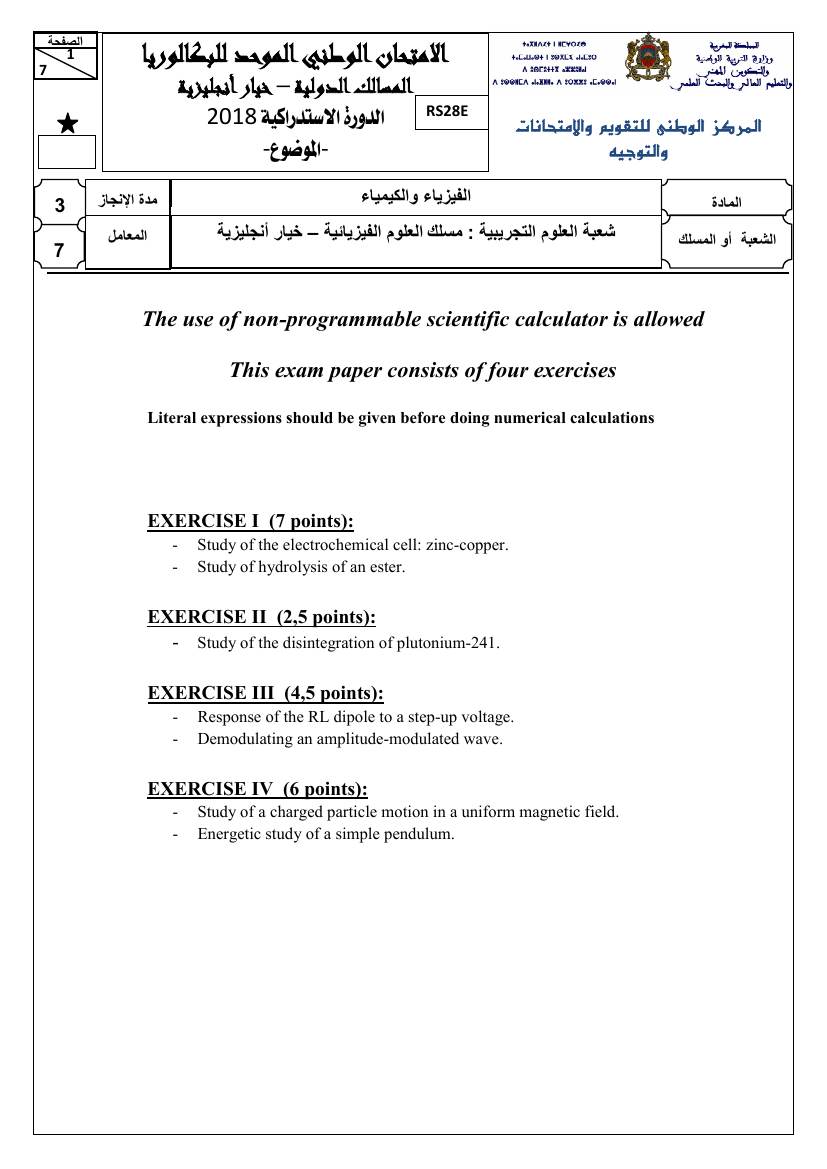
  1. Examen national Physique-Chimie 2Bac PC (option anglaise) 2018, session de rattrapage, page 1 sur 7
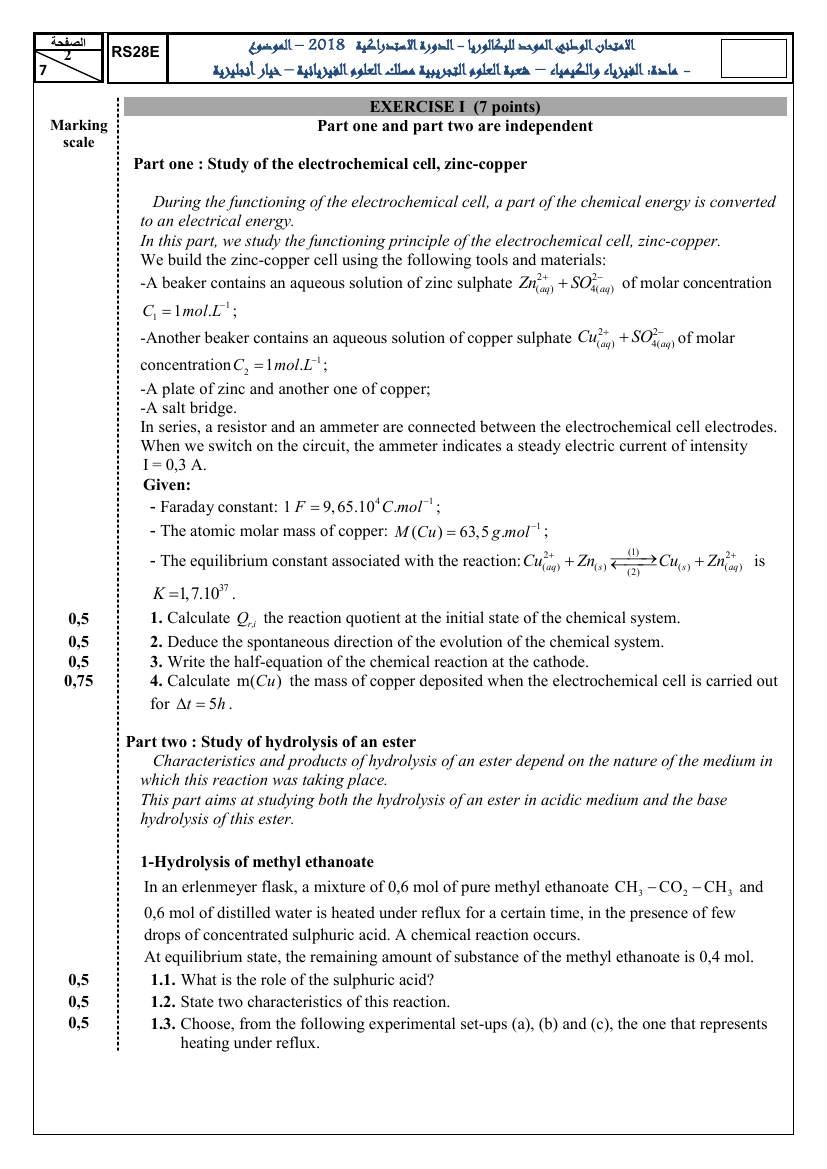
  2. Examen national Physique-Chimie 2Bac PC (option anglaise) 2018, session de rattrapage, page 2 sur 7
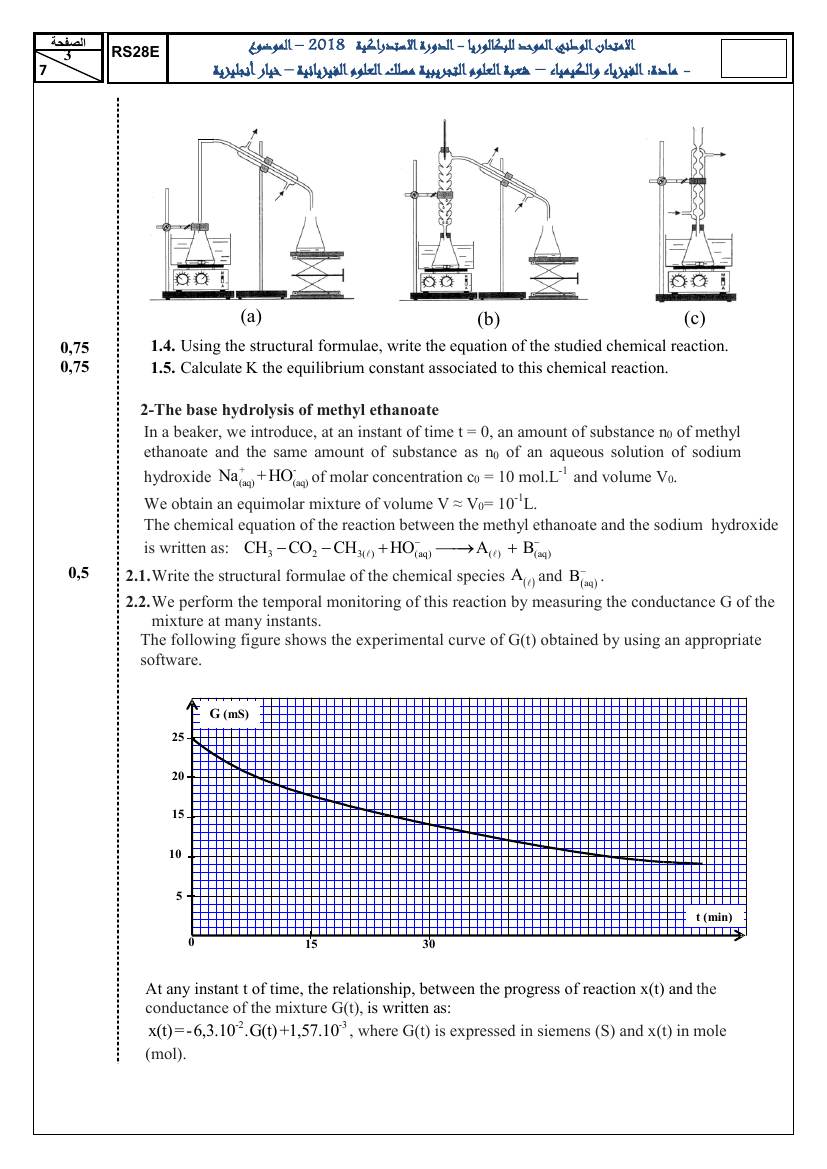
  3. Examen national Physique-Chimie 2Bac PC (option anglaise) 2018, session de rattrapage, page 3 sur 7
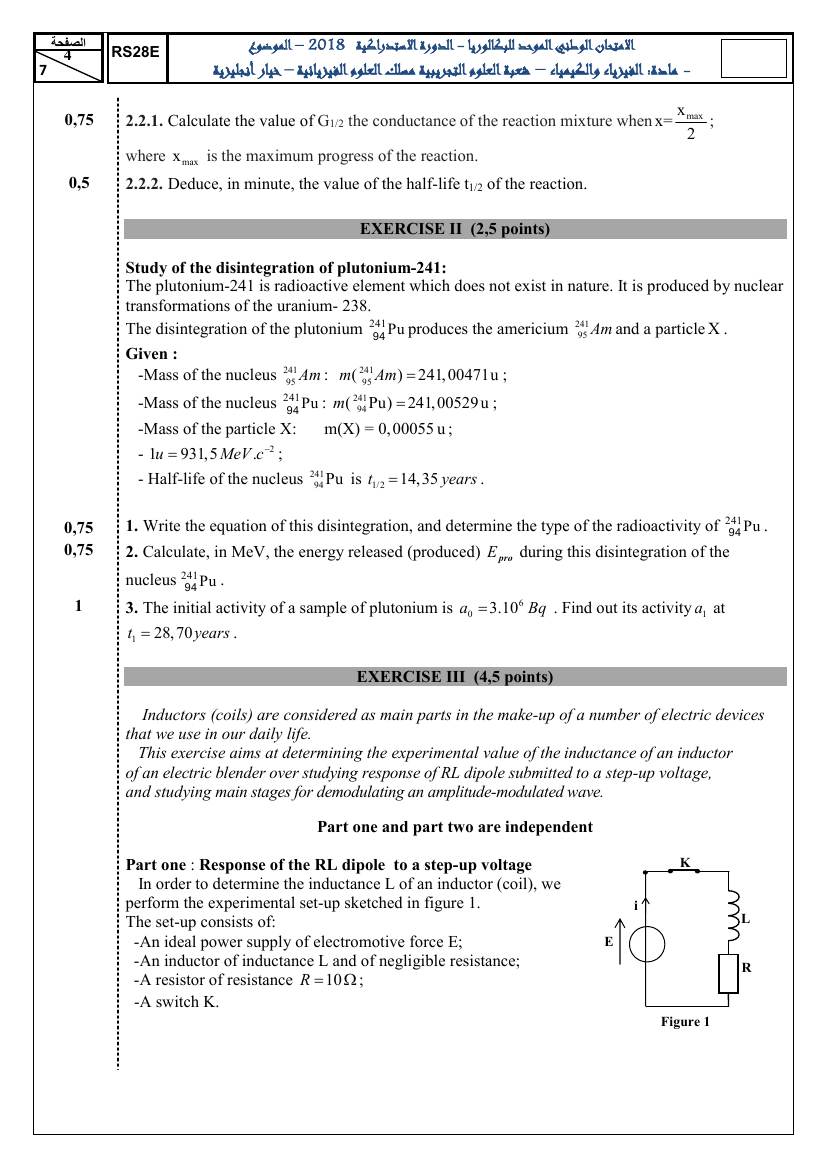
  4. Examen national Physique-Chimie 2Bac PC (option anglaise) 2018, session de rattrapage, page 4 sur 7
  5. Examen national Physique-Chimie 2Bac PC (option anglaise) 2018, session de rattrapage, page 5 sur 7
  6. Examen national Physique-Chimie 2Bac PC (option anglaise) 2018, session de rattrapage, page 6 sur 7
  7. Examen national Physique-Chimie 2Bac PC (option anglaise) 2018, session de rattrapage, page 7 sur 7

Sujet officiel de l’examen national unifié du baccalauréat, tel que publié par le Centre national de l’évaluation et des examens (Ministère de l’Éducation nationale).

L’énoncé en texte

Transcription du sujet officiel, pour le lire et le rechercher sur téléphone. Les figures restent sur les pages du sujet ; en cas de différence, le PDF officiel fait foi.

Exercice 17 pts

Part one and part two are independent

Part one : Study of the electrochemical cell, zinc-copper

During the functioning of the electrochemical cell, a part of the chemical energy is converted to an electrical energy.

In this part, we study the functioning principle of the electrochemical cell, zinc-copper.

We build the zinc-copper cell using the following tools and materials:

-A beaker contains an aqueous solution of zinc sulphate Zn(aq)2++SO4 (aq)2−\mathrm{Zn^{2+}_{(aq)} + SO_{4\,(aq)}^{2-}} of molar concentration C1=1 mol⋅L−1C_1 = 1\ \mathrm{mol\cdot L^{-1}} ;

-Another beaker contains an aqueous solution of copper sulphate Cu(aq)2++SO4 (aq)2−\mathrm{Cu^{2+}_{(aq)} + SO_{4\,(aq)}^{2-}} of molar concentration C2=1 mol⋅L−1C_2 = 1\ \mathrm{mol\cdot L^{-1}} ;

-A plate of zinc and another one of copper;

-A salt bridge.

In series, a resistor and an ammeter are connected between the electrochemical cell electrodes. When we switch on the circuit, the ammeter indicates a steady electric current of intensity I = 0,3 A.

Given:

- Faraday constant: 1 F=9,65⋅104 C⋅mol−11\ F = 9{,}65\cdot 10^{4}\ \mathrm{C\cdot mol^{-1}} ;

- The atomic molar mass of copper: M(Cu)=63,5 g⋅mol−1M(\mathrm{Cu}) = 63{,}5\ \mathrm{g\cdot mol^{-1}} ;

- The equilibrium constant associated with the reaction: Cu(aq)2++Zn(s)⇄(1)(2)Cu(s)+Zn(aq)2+\mathrm{Cu^{2+}_{(aq)} + Zn_{(s)}} \underset{(2)}{\overset{(1)}{\rightleftarrows}} \mathrm{Cu_{(s)} + Zn^{2+}_{(aq)}} is K=1,7⋅1037K = 1{,}7\cdot 10^{37} .

1.Calculate Qr,iQ_{r,i} the reaction quotient at the initial state of the chemical system.0,5 pt

2.Deduce the spontaneous direction of the evolution of the chemical system.0,5 pt

3.Write the half-equation of the chemical reaction at the cathode.0,5 pt

4.Calculate m(Cu)m(\mathrm{Cu}) the mass of copper deposited when the electrochemical cell is carried out for Δt=5 h\Delta t = 5\ \mathrm{h} .0,75 pt

Part two : Study of hydrolysis of an ester

Characteristics and products of hydrolysis of an ester depend on the nature of the medium in which this reaction was taking place.

This part aims at studying both the hydrolysis of an ester in acidic medium and the base hydrolysis of this ester.

1-Hydrolysis of methyl ethanoate

In an erlenmeyer flask, a mixture of 0,6 mol of pure methyl ethanoate CH3−CO2−CH3\mathrm{CH_3-CO_2-CH_3} and 0,6 mol of distilled water is heated under reflux for a certain time, in the presence of few drops of concentrated sulphuric acid. A chemical reaction occurs.

At equilibrium state, the remaining amount of substance of the methyl ethanoate is 0,4 mol.

1.1.What is the role of the sulphuric acid?0,5 pt

1.2.State two characteristics of this reaction.0,5 pt

1.3.Choose, from the following experimental set-ups (a), (b) and (c), the one that represents heating under reflux.0,5 pt

(a), (b), (c) : voir la page 3 du sujet

1.4.Using the structural formulae, write the equation of the studied chemical reaction.0,75 pt

1.5.Calculate K the equilibrium constant associated to this chemical reaction.0,75 pt

2-The base hydrolysis of methyl ethanoate

In a beaker, we introduce, at an instant of time t = 0, an amount of substance n0n_0 of methyl ethanoate and the same amount of substance as n0n_0 of an aqueous solution of sodium hydroxide Na(aq)++HO(aq)−\mathrm{Na^+_{(aq)} + HO^-_{(aq)}} of molar concentration c0=10 mol⋅L−1c_0 = 10\ \mathrm{mol\cdot L^{-1}} and volume V0V_0.

We obtain an equimolar mixture of volume V≈V0=10−1 LV \approx V_0 = 10^{-1}\ \mathrm{L}.

The chemical equation of the reaction between the methyl ethanoate and the sodium hydroxide is written as: CH3−CO2−CH3(ℓ)+HO(aq)−→A(ℓ)+B(aq)−\mathrm{CH_3-CO_2-CH_{3(\ell)} + HO^-_{(aq)} \rightarrow A_{(\ell)} + B^-_{(aq)}}

2.1.Write the structural formulae of the chemical species A(ℓ)\mathrm{A_{(\ell)}} and B(aq)−\mathrm{B^-_{(aq)}} .0,5 pt

2.2. We perform the temporal monitoring of this reaction by measuring the conductance G of the mixture at many instants.

The following figure shows the experimental curve of G(t) obtained by using an appropriate software.

Figure : voir la page 4 du sujet

At any instant t of time, the relationship, between the progress of reaction x(t) and the conductance of the mixture G(t), is written as: x(t)=−6,3⋅10−2⋅G(t)+1,57⋅10−3x(t) = -6{,}3\cdot 10^{-2}\cdot G(t) + 1{,}57\cdot 10^{-3} , where G(t) is expressed in siemens (S) and x(t) in mole (mol).

2.2.1.Calculate the value of G1/2G_{1/2} the conductance of the reaction mixture when x=xmax2x = \dfrac{x_{max}}{2} ; where xmaxx_{max} is the maximum progress of the reaction.0,75 pt

2.2.2.Deduce, in minute, the value of the half-life t1/2t_{1/2} of the reaction.0,5 pt

Revoir le cours : Suivi temporel d’une transformation chimique

Exercice 22,5 pts

Study of the disintegration of plutonium-241:

The plutonium-241 is radioactive element which does not exist in nature. It is produced by nuclear transformations of the uranium- 238.

The disintegration of the plutonium 94241Pu\mathrm{^{241}_{94}Pu} produces the americium 95241Am\mathrm{^{241}_{95}Am} and a particle X .

Given :

-Mass of the nucleus 95241Am\mathrm{^{241}_{95}Am} : m(95241Am)=241,00471 um(\mathrm{^{241}_{95}Am}) = 241{,}00471\ \mathrm{u} ;

-Mass of the nucleus 94241Pu\mathrm{^{241}_{94}Pu} : m(94241Pu)=241,00529 um(\mathrm{^{241}_{94}Pu}) = 241{,}00529\ \mathrm{u} ;

-Mass of the particle X: m(X)=0,00055 um(\mathrm{X}) = 0{,}00055\ \mathrm{u} ;

- 1u=931,5 MeV⋅c−21\mathrm{u} = 931{,}5\ \mathrm{MeV\cdot c^{-2}} ;

- Half-life of the nucleus 94241Pu\mathrm{^{241}_{94}Pu} is t1/2=14,35 yearst_{1/2} = 14{,}35\ \mathrm{years} .

1.Write the equation of this disintegration, and determine the type of the radioactivity of 94241Pu\mathrm{^{241}_{94}Pu} .0,75 pt

2.Calculate, in MeV, the energy released (produced) EproE_{pro} during this disintegration of the nucleus 94241Pu\mathrm{^{241}_{94}Pu} .0,75 pt

3.The initial activity of a sample of plutonium is a0=3⋅106 Bqa_0 = 3\cdot 10^{6}\ \mathrm{Bq} . Find out its activity a1a_1 at t1=28,70 yearst_1 = 28{,}70\ \mathrm{years} .1 pt

Revoir le cours : Décroissance radioactive · Noyaux, masse et énergie

Exercice 34,5 pts

Inductors (coils) are considered as main parts in the make-up of a number of electric devices that we use in our daily life.

This exercise aims at determining the experimental value of the inductance of an inductor of an electric blender over studying response of RL dipole submitted to a step-up voltage, and studying main stages for demodulating an amplitude-modulated wave.

Part one and part two are independent

Part one : Response of the RL dipole to a step-up voltage

In order to determine the inductance L of an inductor (coil), we perform the experimental set-up sketched in figure 1.

The set-up consists of:

-An ideal power supply of electromotive force E;

-An inductor of inductance L and of negligible resistance;

-A resistor of resistance R=10 ΩR = 10\ \Omega ;

-A switch K.

Figure 1 : voir la page 4 du sujet

At an instant of time t=0, we switch on the circuit. Using a datalogger to visualize the voltage uL(t)u_L(t) between terminals of the inductor.

The figure 2 shows the variation of uL(t)u_L(t) as a function of time.

Figure 2 : voir la page 5 du sujet

1.Copy the circuit in figure 1 (page 4) on your answer sheet and show there how to connect the datalogger to visualize the voltage uL(t)u_L(t) .0,25 pt

2.Find out the differential equation of the intensity i(t) of the current flowing through this circuit.0,5 pt

3.Knowing that the expression of the electric current intensity is: i(t)=ER(1−e−RL⋅t)i(t) = \dfrac{E}{R}\left(1 - e^{-\frac{R}{L}\cdot t}\right) . Find out the expression of the voltage uLu_L in terms of t, E, R and L.0,5 pt

4.Calculate the value of the voltage between terminals of the inductor at t=τt = \tau where τ\tau is the time-constant.0,5 pt

5.Determine graphically the value of τ\tau then deduce the value of the inductance L of the inductor.0,75 pt

6.Calculate the magnetic energy stored in the inductor at t=τt = \tau.0,75 pt

Part two : Demodulating an amplitude modulated wave

The figure 3 shows the simplified circuit scheme of an experimental set-up of a device (AM radio) to receive amplitude-modulated radio wave.

Figure 3 : voir la page 5 du sujet

Copy on your answer sheet, the number of question with the letter of the correct answer

1.The bung circuit (part 1) is consisted of an antenna and an inductor of inductance L=10 mHL = 10\ \mathrm{mH} and of negligible resistance. The inductor is connected in parallel to a capacitor of adaptable capacitance C. The capacitance C of the capacitor which allows to select the radio wave of frequency f0=530 kHzf_0 = 530\ \mathrm{kHz} is:0,5 pt

A9 μF9\ \mathrm{\mu F}B9 nF9\ \mathrm{nF}C9 pF9\ \mathrm{pF}D9 mF9\ \mathrm{mF}

2.Knowing that the value of the average frequency of the sound is 1kHz and the value of the resistance R1R_1 which permits to get a high quality of envelope detection of the studied radio wave is R1=35 ΩR_1 = 35\ \Omega. The value of the capacitance C2C_2 of the capacitor used in the part 2 of the set-up is :0,5 pt

A50 μF50\ \mathrm{\mu F}B20 μF20\ \mathrm{\mu F}C50 mF50\ \mathrm{mF}D20 nF20\ \mathrm{nF}

3.The role of part 3 of the set-up is:0,25 pt

AModulating the amplitudeBSelecting the wave frequencyCRemoving the DC voltageDDetecting the envelope

Exercice 46 pts

Part one and part two are independent

Part one : Study the motion of a charged particle in a uniform magnetic field

A mass spectrometer can be used to distinguish between charged particles according to their masses and their charges. How to work this device is based on the Lorentz force.

This part aims at determining the mass of a charge particle by studying its motion in a uniform magnetic field.

Two charged particles He2+\mathrm{He^{2+}} and O2−\mathrm{O^{2-}} , having the same initial velocity V⃗\vec{V} , enter at point A in a uniform magnetic field B⃗\vec{B} which is perpendicular to V⃗\vec{V} .

We assume that the Lorentz force is the only force acting up on both particles.

Given:

- The Lorentz force is F⃗=qV⃗∧B⃗\vec{F} = q\vec{V}\wedge\vec{B} ;

- The mass of He2+\mathrm{He^{2+}} is m(He2+)=6,68⋅10−27 kgm(\mathrm{He^{2+}}) = 6{,}68\cdot 10^{-27}\ \mathrm{kg} ;

- Figure 1 shows tracks of the two particles He2+\mathrm{He^{2+}} and O2−\mathrm{O^{2-}} inside the magnetic field B⃗\vec{B} .

Figure1 : voir la page 6 du sujet

1.Determine the track (path) of each particle.0,5 pt

2.Applying Newton's second law in a Galilean frame of reference, show that the motion of He2+\mathrm{He^{2+}} is uniform circular and its radius is given by: RHe2+=m(He2+)⋅V2⋅e⋅BR_{\mathrm{He^{2+}}} = \dfrac{m(\mathrm{He^{2+}})\cdot V}{2\cdot e\cdot B} .1 pt

3.Using figure 1, determine the ratio RO2−RHe2+\dfrac{R_{\mathrm{O^{2-}}}}{R_{\mathrm{He^{2+}}}} , where RO2−R_{\mathrm{O^{2-}}} is the radius of the track of O2−\mathrm{O^{2-}} .0,5 pt

4.Show that the mass of the particle O2−\mathrm{O^{2-}} is m(O2−)=2,67⋅10−26 kgm(\mathrm{O^{2-}}) = 2{,}67\cdot 10^{-26}\ \mathrm{kg} .1 pt

Part two : Energetic study of a simple pendulum

A girl oscillates back and forth using a swing hanged to a fixed support. The mechanical system (girl-swing) can be modelled on simple pendulum which is composed of a massless string of lenght L and of a solid (S) its mass is m and its dimensions are negligible to the lenght L.

The simple pendulum is a particular case of the physical pendulum.

In equilibrium, the simple pendulum is undisturbed (at rest).

At an instant of time t=0, the pendulum is launched from its equilibrium position by an initial velocity in the positive direction when the kinetic energy Ek0=13,33 JE_{k_0} = 13{,}33\ \mathrm{J} . The pendulum made a sinusoidal oscillatory motion; its amplitude is θmax=0,20 rad\theta_{max} = 0{,}20\ \mathrm{rad} .

We locate the position of the pendulum at an instant t of time by the angular displacement θ\theta .(see figure2)

Figure 2 : voir la page 7 du sujet

Assuming the gravitational potenial energy to be zero (Epg=0)(E_{pg} = 0) on the horizontal plane passing through the equilibrium position θ=0\theta = 0 (reference level).

The study concernes small oscillations in a Galilean frame of reference linked to the Earth.

All frictions are negligible.

Given:

- The length of the simple pendulum is L=2 mL = 2\ \mathrm{m} ;

- The strength of the gravitational field is g=9,8 m⋅s−2g = 9{,}8\ \mathrm{m\cdot s^{-2}} ;

- In the case of small oscillations: cos⁡θ≈1−θ22\cos\theta \approx 1 - \dfrac{\theta^2}{2} , where θ\theta is expressed in radians;

- Trigonometric formula: cos⁡2θ+sin⁡2θ=1\cos^2\theta + \sin^2\theta = 1 .

1.By using the dimensional analysis, show that the following expression T0=2π⋅LgT_0 = 2\pi\cdot\sqrt{\dfrac{L}{g}} is homogeneous to the time.0,5 pt

2.The equation of motion of the pendulum is expressed as: θ(t)=θmax⋅cos⁡(2πT0t+φ)\theta(t) = \theta_{max}\cdot\cos\left(\dfrac{2\pi}{T_0}t + \varphi\right) . Determine, in S.I units, the values of T0T_0 and φ\varphi .0,75 pt

3.Show that the expression of gravitational potential energy of the simple pendulum is given by: Epg(t)=12 m⋅g⋅L⋅θmax2⋅cos⁡2(2πT0t+φ).E_{pg}(t) = \dfrac{1}{2}\,m\cdot g\cdot L\cdot\theta_{max}^2\cdot\cos^2\left(\dfrac{2\pi}{T_0}t + \varphi\right) .0,5 pt

4.Show that the expression of the mechanical energy is given by: Em=12 m⋅g⋅L⋅θmax2E_m = \dfrac{1}{2}\,m\cdot g\cdot L\cdot\theta_{max}^2 .0,75 pt

5.By using the principle of conservation of the mechanical energy, calculate the mass m of the solid (S).0,5 pt

Entraîne-toi sur ces chapitres avec Kresco, gratuitement

Yallah, wa7d l-khtwa.

Le sujet, tu l’as. Maintenant, prépare-le.

Crée ton compte gratuit : une leçon offerte dans chaque chapitre, les quiz et ton suivi, matière par matière, jusqu’au national.