Jerreb rassek f l-national.

Examen national Physique-Chimie 2Bac PC (option anglaise) 2017, session normale

Physique-Chimie · Sciences Physiques · 7 pages

Le sujet en bref

  1. Exercice 17 pts

    Estérification et hydrolyse · Piles · Réactions acide-base

    La pile aluminium-cuivre et l’acide butanoïque

  2. Exercice 22,5 pts

    Ondes mécaniques progressives périodiques

    Une onde à la surface de l’eau

  3. Exercice 35 pts

    Dipôle RL · Ondes électromagnétiques et modulation d’amplitude

  4. Exercice 45,5 pts

    Lois de Newton · Aspects énergétiques des oscillations · Systèmes mécaniques oscillants

    Un skieur sur une piste et un pendule de torsion

Total : 20 points

Le sujet, page par page

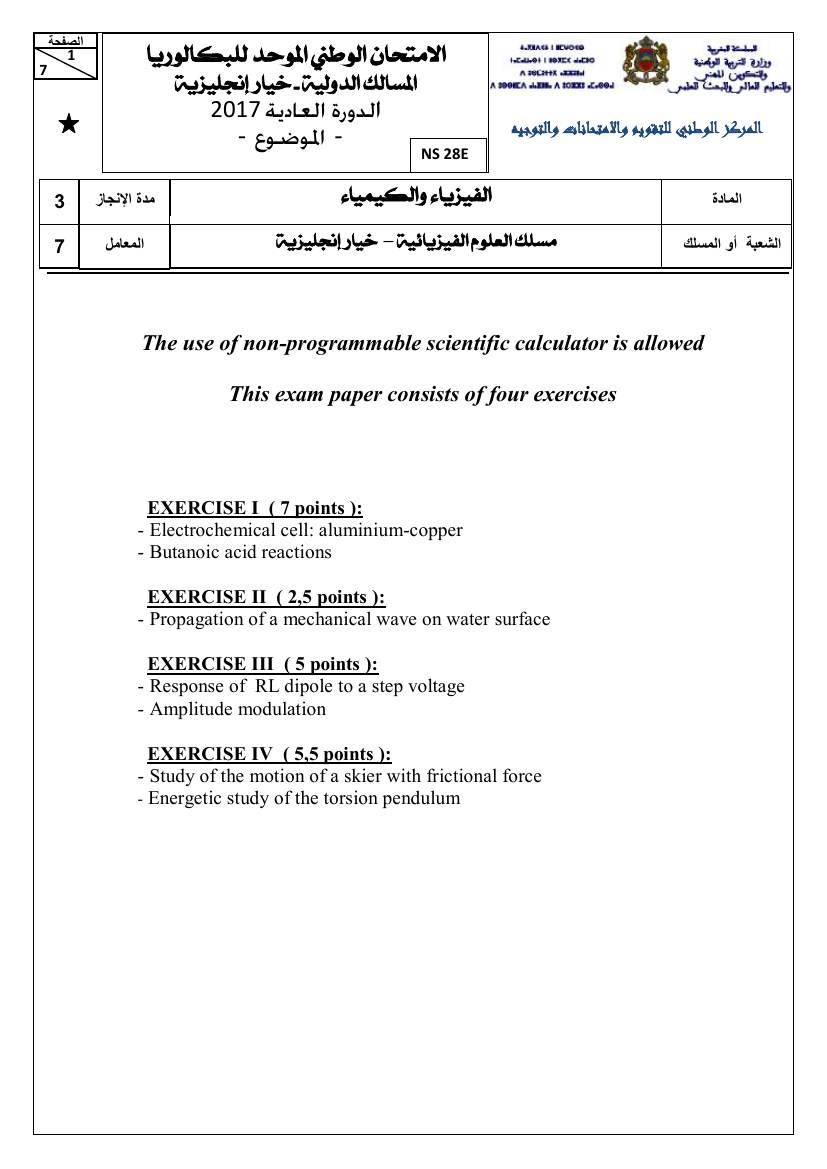
  1. Examen national Physique-Chimie 2Bac PC (option anglaise) 2017, session normale, page 1 sur 7
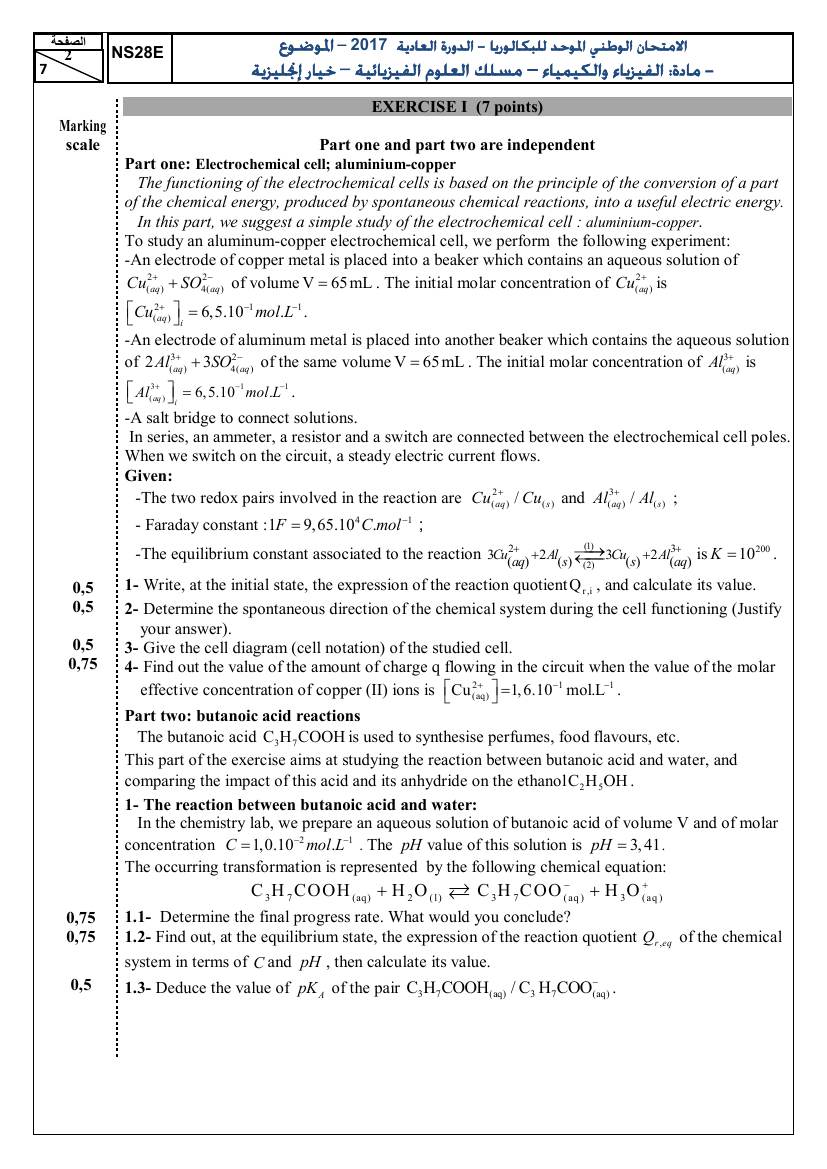
  2. Examen national Physique-Chimie 2Bac PC (option anglaise) 2017, session normale, page 2 sur 7
  3. Examen national Physique-Chimie 2Bac PC (option anglaise) 2017, session normale, page 3 sur 7
  4. Examen national Physique-Chimie 2Bac PC (option anglaise) 2017, session normale, page 4 sur 7
  5. Examen national Physique-Chimie 2Bac PC (option anglaise) 2017, session normale, page 5 sur 7
  6. Examen national Physique-Chimie 2Bac PC (option anglaise) 2017, session normale, page 6 sur 7
  7. Examen national Physique-Chimie 2Bac PC (option anglaise) 2017, session normale, page 7 sur 7

Sujet officiel de l’examen national unifié du baccalauréat, tel que publié par le Centre national de l’évaluation et des examens (Ministère de l’Éducation nationale).

L’énoncé en texte

Transcription du sujet officiel, pour le lire et le rechercher sur téléphone. Les figures restent sur les pages du sujet ; en cas de différence, le PDF officiel fait foi.

Exercice 17 pts

Part one and part two are independent

Part one: Electrochemical cell; aluminium-copper

The functioning of the electrochemical cells is based on the principle of the conversion of a part of the chemical energy, produced by spontaneous chemical reactions, into a useful electric energy.

In this part, we suggest a simple study of the electrochemical cell : aluminium-copper.

To study an aluminum-copper electrochemical cell, we perform the following experiment:

-An electrode of copper metal is placed into a beaker which contains an aqueous solution of Cu(aq)2++SO4(aq)2−\mathrm{Cu^{2+}_{(aq)} + SO_{4(aq)}^{2-}} of volume V=65 mLV = 65\ \mathrm{mL}. The initial molar concentration of Cu(aq)2+\mathrm{Cu^{2+}_{(aq)}} is [Cu(aq)2+]i=6,5⋅10−1 mol⋅L−1[\mathrm{Cu^{2+}_{(aq)}}]_i = 6{,}5\cdot 10^{-1}\ \mathrm{mol\cdot L^{-1}}.

-An electrode of aluminum metal is placed into another beaker which contains the aqueous solution of 2 Al(aq)3++3 SO4(aq)2−\mathrm{2\,Al^{3+}_{(aq)} + 3\,SO_{4(aq)}^{2-}} of the same volume V=65 mLV = 65\ \mathrm{mL}. The initial molar concentration of Al(aq)3+\mathrm{Al^{3+}_{(aq)}} is [Al(aq)3+]i=6,5⋅10−1 mol⋅L−1[\mathrm{Al^{3+}_{(aq)}}]_i = 6{,}5\cdot 10^{-1}\ \mathrm{mol\cdot L^{-1}}.

-A salt bridge to connect solutions.

In series, an ammeter, a resistor and a switch are connected between the electrochemical cell poles. When we switch on the circuit, a steady electric current flows.

Given:

-The two redox pairs involved in the reaction are Cu(aq)2+/Cu(s)\mathrm{Cu^{2+}_{(aq)}/Cu_{(s)}} and Al(aq)3+/Al(s)\mathrm{Al^{3+}_{(aq)}/Al_{(s)}} ;

- Faraday constant : 1F=9,65⋅104 C⋅mol−11F = 9{,}65\cdot 10^{4}\ \mathrm{C\cdot mol^{-1}} ;

-The equilibrium constant associated to the reaction 3 Cu(aq)2++2 Al(s) ⇄(1)(2) 3 Cu(s)+2 Al(aq)3+\mathrm{3\,Cu^{2+}_{(aq)} + 2\,Al_{(s)}}\ \underset{(2)}{\overset{(1)}{\rightleftarrows}}\ \mathrm{3\,Cu_{(s)} + 2\,Al^{3+}_{(aq)}} is K=10200K = 10^{200}.

1.Write, at the initial state, the expression of the reaction quotient Qr,iQ_{r,i}, and calculate its value.0,5 pt

2.Determine the spontaneous direction of the chemical system during the cell functioning (Justify your answer).0,5 pt

3.Give the cell diagram (cell notation) of the studied cell.0,5 pt

4.Find out the value of the amount of charge q flowing in the circuit when the value of the molar effective concentration of copper (II) ions is [Cu(aq)2+]=1,6⋅10−1 mol⋅L−1[\mathrm{Cu^{2+}_{(aq)}}] = 1{,}6\cdot 10^{-1}\ \mathrm{mol\cdot L^{-1}}.0,75 pt

Part two: butanoic acid reactions

The butanoic acid C3H7COOH\mathrm{C_3H_7COOH} is used to synthesise perfumes, food flavours, etc.

This part of the exercise aims at studying the reaction between butanoic acid and water, and comparing the impact of this acid and its anhydride on the ethanol C2H5OH\mathrm{C_2H_5OH}.

1- The reaction between butanoic acid and water:

In the chemistry lab, we prepare an aqueous solution of butanoic acid of volume V and of molar concentration C=1,0⋅10−2 mol⋅L−1C = 1{,}0\cdot 10^{-2}\ \mathrm{mol\cdot L^{-1}}. The pHpH value of this solution is pH=3,41pH = 3{,}41.

The occurring transformation is represented by the following chemical equation:

C3H7COOH(aq)+H2O(l)⇄C3H7COO(aq)−+H3O(aq)+\mathrm{C_3H_7COOH_{(aq)} + H_2O_{(l)} \rightleftarrows C_3H_7COO^-_{(aq)} + H_3O^+_{(aq)}}

1.1.Determine the final progress rate. What would you conclude?0,75 pt

1.2.Find out, at the equilibrium state, the expression of the reaction quotient Qr,eqQ_{r,eq} of the chemical system in terms of CC and pHpH, then calculate its value.0,75 pt

1.3.Deduce the value of pKApK_A of the pair C3H7COOH(aq)/C3H7COO(aq)−\mathrm{C_3H_7COOH_{(aq)}/C_3H_7COO^-_{(aq)}}.0,5 pt

2- The reactions of butanoic acid and butanoic anhydride with ethanol

To compare the impact of both butanoic acid and butanoic anhydride on the ethanol, we perform two separate experiments at the same temperature.

-The first experiment: In a flask, we prepare a mixture of the butanoic acid and the ethanol with the same amount of substance n0=0,3 moln_0 = 0{,}3\ \mathrm{mol} of each one, then we add some drops of concentrated sulphuric acid. Then we heat the reaction mixture under reflux. An esterification reaction occurs.

-The second experiment: In another flask, we prepare a mixture of the butanoic anhydride and the ethanol with the same amount of substance n0=0,3 moln_0 = 0{,}3\ \mathrm{mol} of each one, then we heat the reaction mixture under reflux. A chemical reaction occurs.

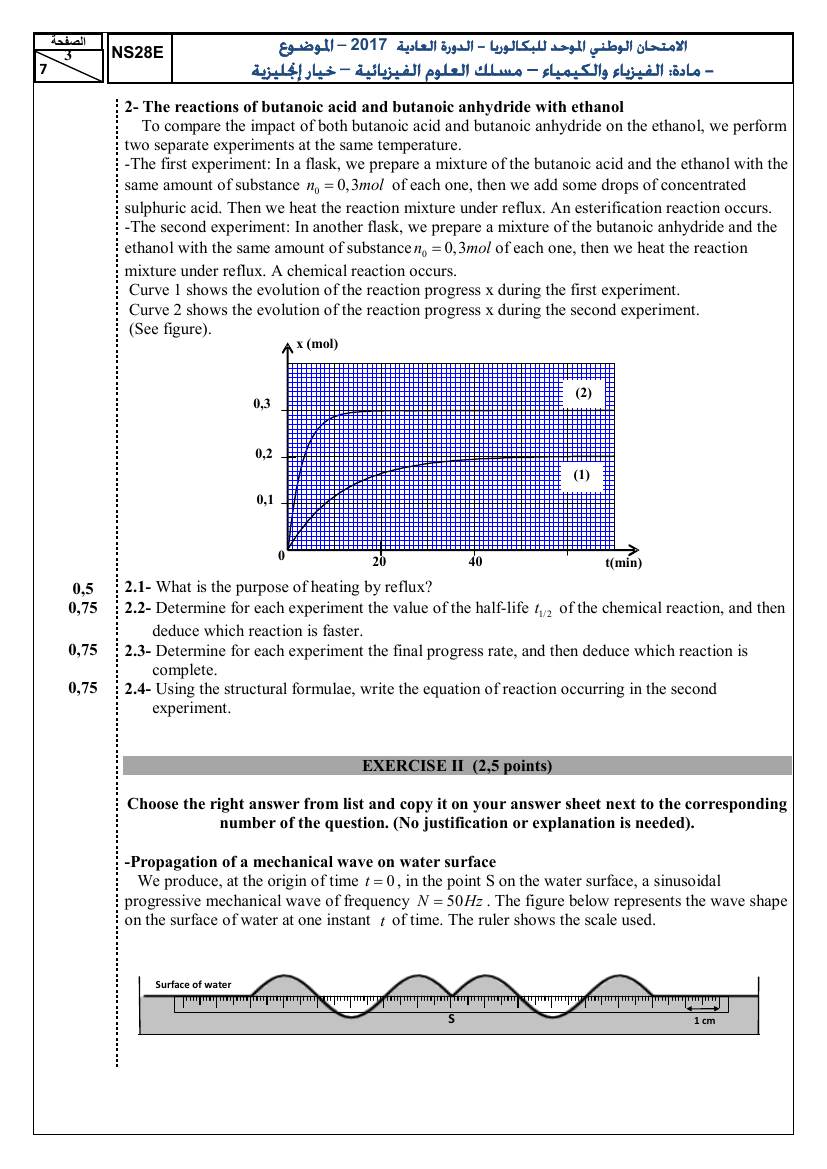
Curve 1 shows the evolution of the reaction progress x during the first experiment.

Curve 2 shows the evolution of the reaction progress x during the second experiment. (See figure).

Figure : voir la page 3 du sujet

2.1.What is the purpose of heating by reflux?0,5 pt

2.2.Determine for each experiment the value of the half-life t1/2t_{1/2} of the chemical reaction, and then deduce which reaction is faster.0,75 pt

2.3.Determine for each experiment the final progress rate, and then deduce which reaction is complete.0,75 pt

2.4.Using the structural formulae, write the equation of reaction occurring in the second experiment.0,75 pt

Exercice 22,5 pts

Choose the right answer from list and copy it on your answer sheet next to the corresponding number of the question. (No justification or explanation is needed).

-Propagation of a mechanical wave on water surface

We produce, at the origin of time t=0t = 0, in the point S on the water surface, a sinusoidal progressive mechanical wave of frequency N=50 HzN = 50\ \mathrm{Hz}. The figure below represents the wave shape on the surface of water at one instant tt of time. The ruler shows the scale used.

Figure : voir la page 3 du sujet

1.The wavelength is: λ=0,2 cm\lambda = 0{,}2\ \mathrm{cm} ; λ=4 cm\lambda = 4\ \mathrm{cm} ; λ=5 cm\lambda = 5\ \mathrm{cm} ; λ=6 cm\lambda = 6\ \mathrm{cm}0,5 pt

2.The speed of the wave is : v=2 m⋅s−1v = 2\ \mathrm{m\cdot s^{-1}} ; v=200 m⋅s−1v = 200\ \mathrm{m\cdot s^{-1}} ; v=3 m⋅s−1v = 3\ \mathrm{m\cdot s^{-1}} ; v=8⋅10−4 m⋅s−1v = 8\cdot 10^{-4}\ \mathrm{m\cdot s^{-1}}0,5 pt

3.the instant tt, at which the aspect of the surface of the water is represented, is: t=8 st = 8\ \mathrm{s} ; t=0,03 st = 0{,}03\ \mathrm{s} ; t=0,3 st = 0{,}3\ \mathrm{s} ; t=3 st = 3\ \mathrm{s}0,75 pt

4.We consider a point M, on the surface of water, far from S by SM = 6 cm. The point M repeats the same vibration as that of S with a time delay τ\tau. In this case, the relationship between the displacements of M and S is: yM(t)=yS(t−0,3)y_M(t) = y_S(t - 0{,}3) ; yM(t)=yS(t+0,03)y_M(t) = y_S(t + 0{,}03) ; yM(t)=yS(t−0,03)y_M(t) = y_S(t - 0{,}03) ; yM(t)=yS(t+0,3)y_M(t) = y_S(t + 0{,}3)0,75 pt

Revoir le cours : Ondes mécaniques progressives périodiques

Exercice 35 pts

In our everyday life we use a number of electric and electronic devices. The circuits of these devices contain resistors, inductors, capacitors and integrated circuits that perform different mathematical or logical operations.

The first part of this exercise aims at studying appearance and disappearance of the current in an inductor. The second part aims at studying the amplitude modulation.

Part one and part two are independent

Part one: Response of RL dipole to a step voltage

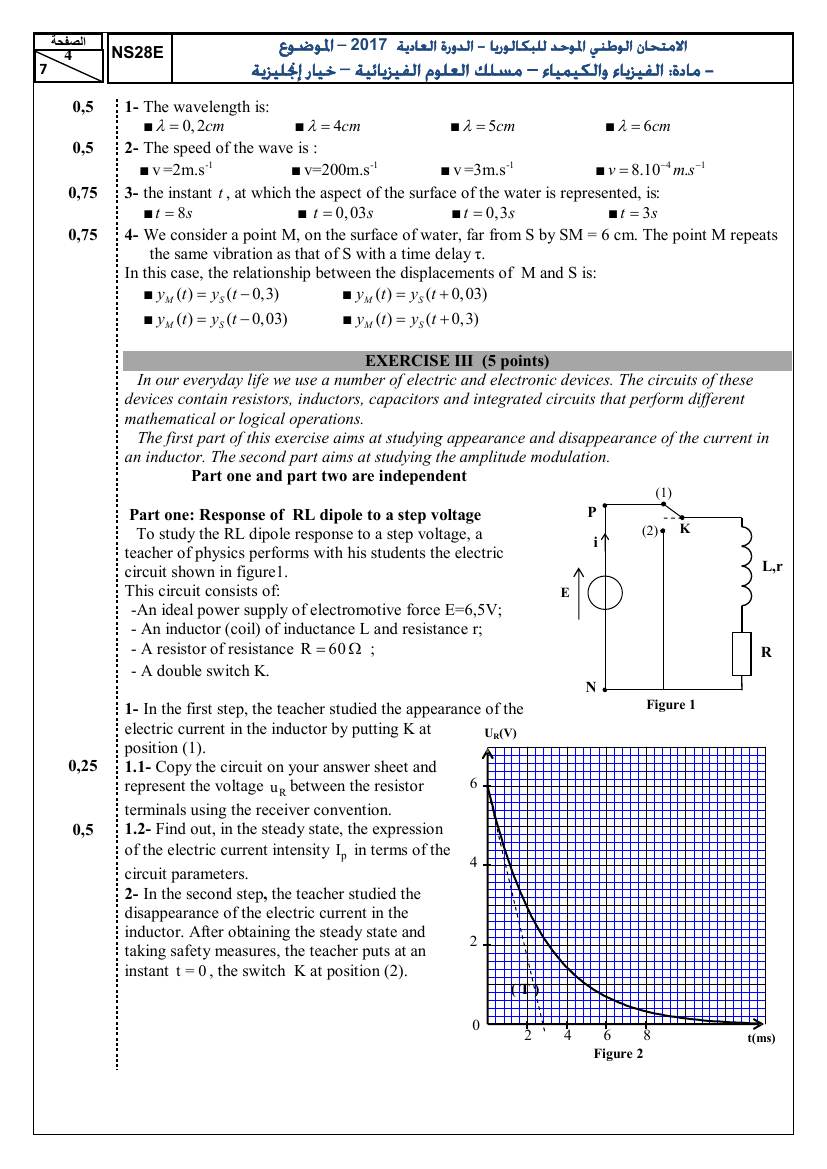
To study the RL dipole response to a step voltage, a teacher of physics performs with his students the electric circuit shown in figure1.

This circuit consists of:

-An ideal power supply of electromotive force E=6,5 VE = 6{,}5\ \mathrm{V};

- An inductor (coil) of inductance L and resistance r;

- A resistor of resistance R=60 ΩR = 60\ \Omega ;

- A double switch K.

Figure 1 : voir la page 4 du sujet

1- In the first step, the teacher studied the appearance of the electric current in the inductor by putting K at position (1).

1.1.Copy the circuit on your answer sheet and represent the voltage uRu_R between the resistor terminals using the receiver convention.0,25 pt

1.2.Find out, in the steady state, the expression of the electric current intensity IpI_p in terms of the circuit parameters.0,5 pt

2- In the second step, the teacher studied the disappearance of the electric current in the inductor. After obtaining the steady state and taking safety measures, the teacher puts at an instant t=0t = 0, the switch K at position (2).

Figure 2 : voir la page 4 du sujet

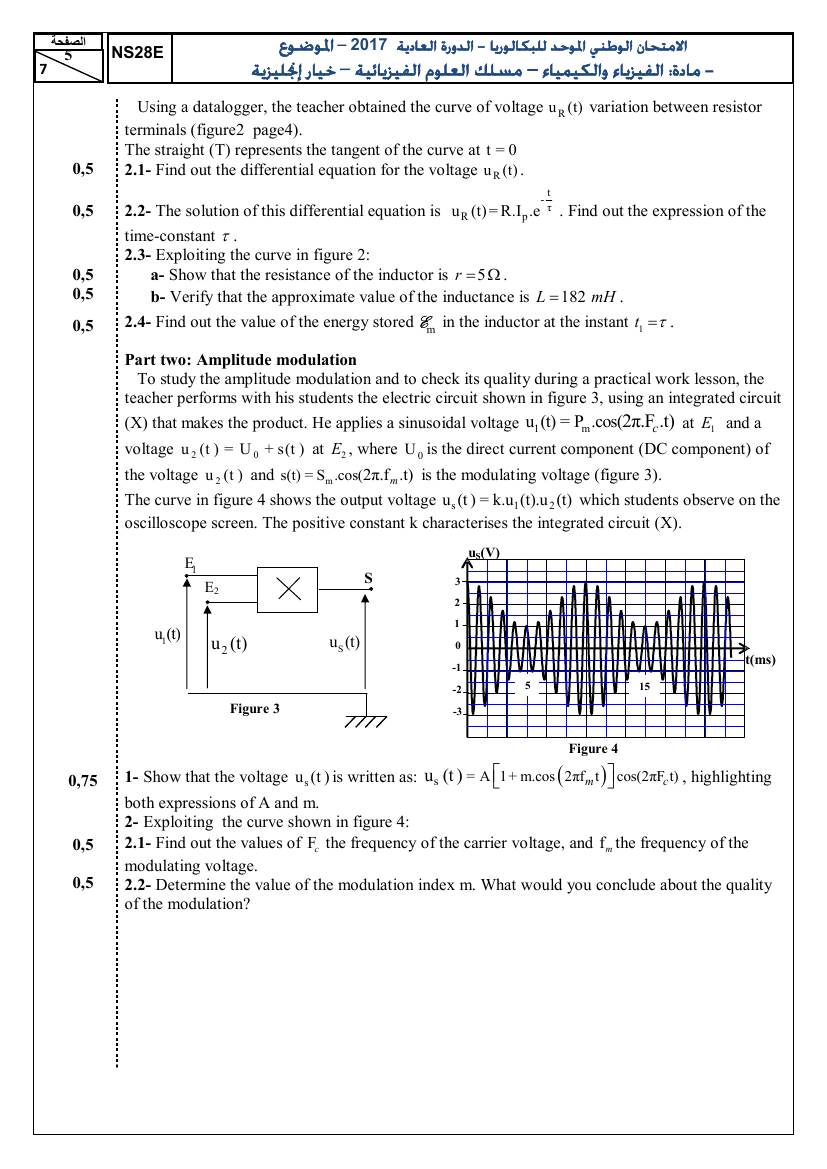
Using a datalogger, the teacher obtained the curve of voltage uR(t)u_R(t) variation between resistor terminals (figure2 page4).

The straight (T) represents the tangent of the curve at t=0t = 0

2.1.Find out the differential equation for the voltage uR(t)u_R(t).0,5 pt

2.2.The solution of this differential equation is uR(t)=R⋅Ip⋅e−tτu_R(t) = R\cdot I_p\cdot e^{-\frac{t}{\tau}}. Find out the expression of the time-constant τ\tau.0,5 pt

2.3- Exploiting the curve in figure 2:

2.3.a.Show that the resistance of the inductor is r=5 Ωr = 5\ \Omega.0,5 pt

2.3.b.Verify that the approximate value of the inductance is L=182 mHL = 182\ \mathrm{mH}.0,5 pt

2.4.Find out the value of the energy stored Em\mathscr{E}_m in the inductor at the instant t1=τt_1 = \tau.0,5 pt

Part two: Amplitude modulation

To study the amplitude modulation and to check its quality during a practical work lesson, the teacher performs with his students the electric circuit shown in figure 3, using an integrated circuit (X) that makes the product. He applies a sinusoidal voltage u1(t)=Pm⋅cos⁡(2π⋅Fc⋅t)u_1(t) = P_m\cdot\cos(2\pi\cdot F_c\cdot t) at E1E_1 and a voltage u2(t)=U0+s(t)u_2(t) = U_0 + s(t) at E2E_2, where U0U_0 is the direct current component (DC component) of the voltage u2(t)u_2(t) and s(t)=Sm⋅cos⁡(2π⋅fm⋅t)s(t) = S_m\cdot\cos(2\pi\cdot f_m\cdot t) is the modulating voltage (figure 3).

The curve in figure 4 shows the output voltage us(t)=k⋅u1(t)⋅u2(t)u_s(t) = k\cdot u_1(t)\cdot u_2(t) which students observe on the oscilloscope screen. The positive constant k characterises the integrated circuit (X).

Figure 3 : voir la page 5 du sujet

Figure 4 : voir la page 5 du sujet

1.Show that the voltage us(t)u_s(t) is written as: us(t)=A[1+m⋅cos⁡(2πfmt)]cos⁡(2πFct)u_s(t) = A\left[1 + m\cdot\cos(2\pi f_m t)\right]\cos(2\pi F_c t), highlighting both expressions of A and m.0,75 pt

2- Exploiting the curve shown in figure 4:

2.1.Find out the values of FcF_c the frequency of the carrier voltage, and fmf_m the frequency of the modulating voltage.0,5 pt

2.2.Determine the value of the modulation index m. What would you conclude about the quality of the modulation?0,5 pt

Exercice 45,5 pts

Part one and part two are independent

Part one: Study of the motion of a skier

In the winter, sliding down mountains is the best sport. It combines both adventure and fitness.

This part aims at studying the motion of the centre of inertia of the skier and his accessories on a ski-jump ramp.

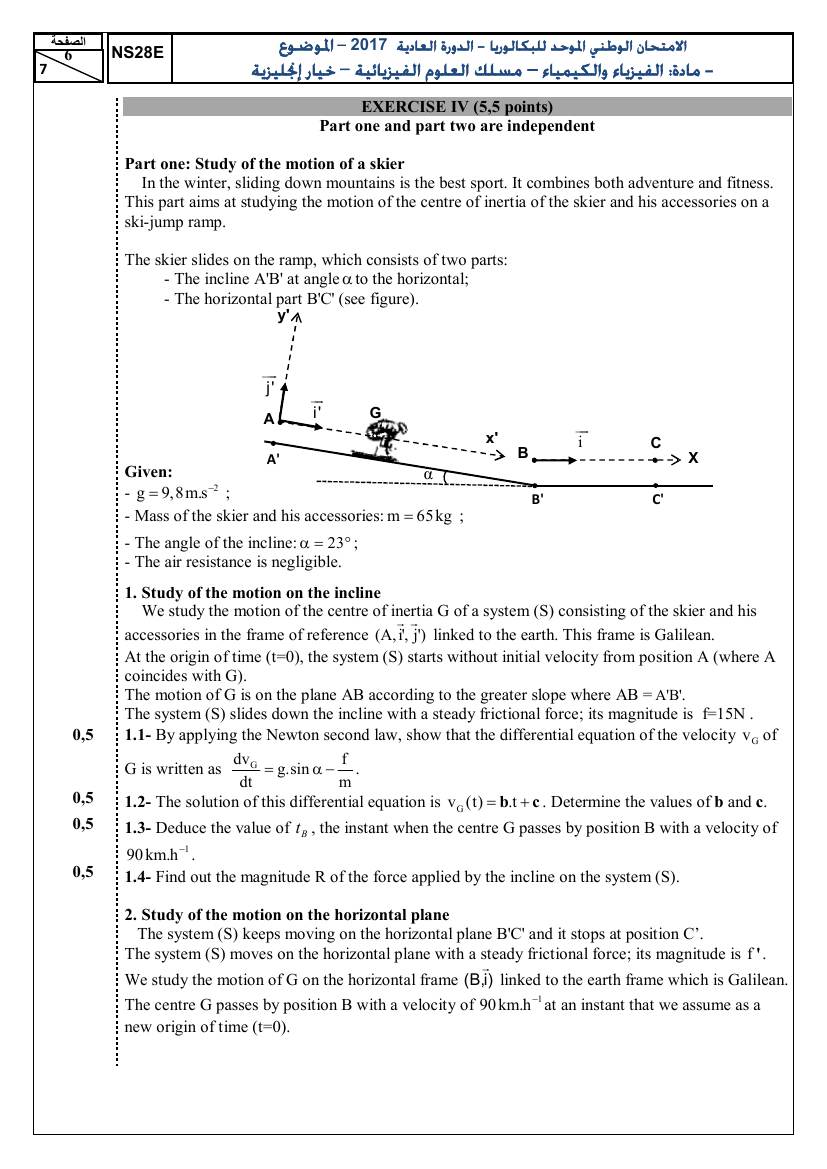
The skier slides on the ramp, which consists of two parts:

- The incline A'B' at angle α\alpha to the horizontal;

- The horizontal part B'C' (see figure).

Figure : voir la page 6 du sujet

Given:

- g=9,8 m⋅s−2g = 9{,}8\ \mathrm{m\cdot s^{-2}} ;

- Mass of the skier and his accessories: m=65 kgm = 65\ \mathrm{kg} ;

- The angle of the incline: α=23∘\alpha = 23^\circ ;

- The air resistance is negligible.

1. Study of the motion on the incline

We study the motion of the centre of inertia G of a system (S) consisting of the skier and his accessories in the frame of reference (A,i′⃗,j′⃗)(A, \vec{i'}, \vec{j'}) linked to the earth. This frame is Galilean.

At the origin of time (t=0), the system (S) starts without initial velocity from position A (where A coincides with G).

The motion of G is on the plane AB according to the greater slope where AB = A'B'.

The system (S) slides down the incline with a steady frictional force; its magnitude is f=15 Nf = 15\ \mathrm{N}.

1.1.By applying the Newton second law, show that the differential equation of the velocity vGv_G of G is written as dvGdt=g⋅sin⁡α−fm\dfrac{dv_G}{dt} = g\cdot\sin\alpha - \dfrac{f}{m}.0,5 pt

1.2.The solution of this differential equation is vG(t)=b⋅t+cv_G(t) = b\cdot t + c. Determine the values of b and c.0,5 pt

1.3.Deduce the value of tBt_B, the instant when the centre G passes by position B with a velocity of 90 km⋅h−190\ \mathrm{km\cdot h^{-1}}.0,5 pt

1.4.Find out the magnitude R of the force applied by the incline on the system (S).0,5 pt

2. Study of the motion on the horizontal plane

The system (S) keeps moving on the horizontal plane B'C' and it stops at position C'.

The system (S) moves on the horizontal plane with a steady frictional force; its magnitude is f′f'.

We study the motion of G on the horizontal frame (B,i⃗)(B, \vec{i}) linked to the earth frame which is Galilean.

The centre G passes by position B with a velocity of 90 km⋅h−190\ \mathrm{km\cdot h^{-1}} at an instant that we assume as a new origin of time (t=0).

2.1.By applying the Newton second law, find out the magnitude f′f' of the frictional force applied by the horizontal plane on the system (S), knowing that the x-component of acceleration of G is ax=−3 m⋅s−2a_x = -3\ \mathrm{m\cdot s^{-2}}.0,5 pt

2.2.Determine tCt_C the instant when the system (S) stops moving.0,5 pt

2.3.Deduce the value of the distance BC travelled.0,5 pt

Part two: Energetic study of a torsion pendulum

Historically, the torsion pendulum was used by Cavendish to determine the universal gravitation constant. The torsion pendulum can be used to determine the torsion constant of some deformable solids.

This part of exercise aims at determining both the torsion constant of a steel wire and the moment of inertia of a rod by exploiting the energy diagrams.

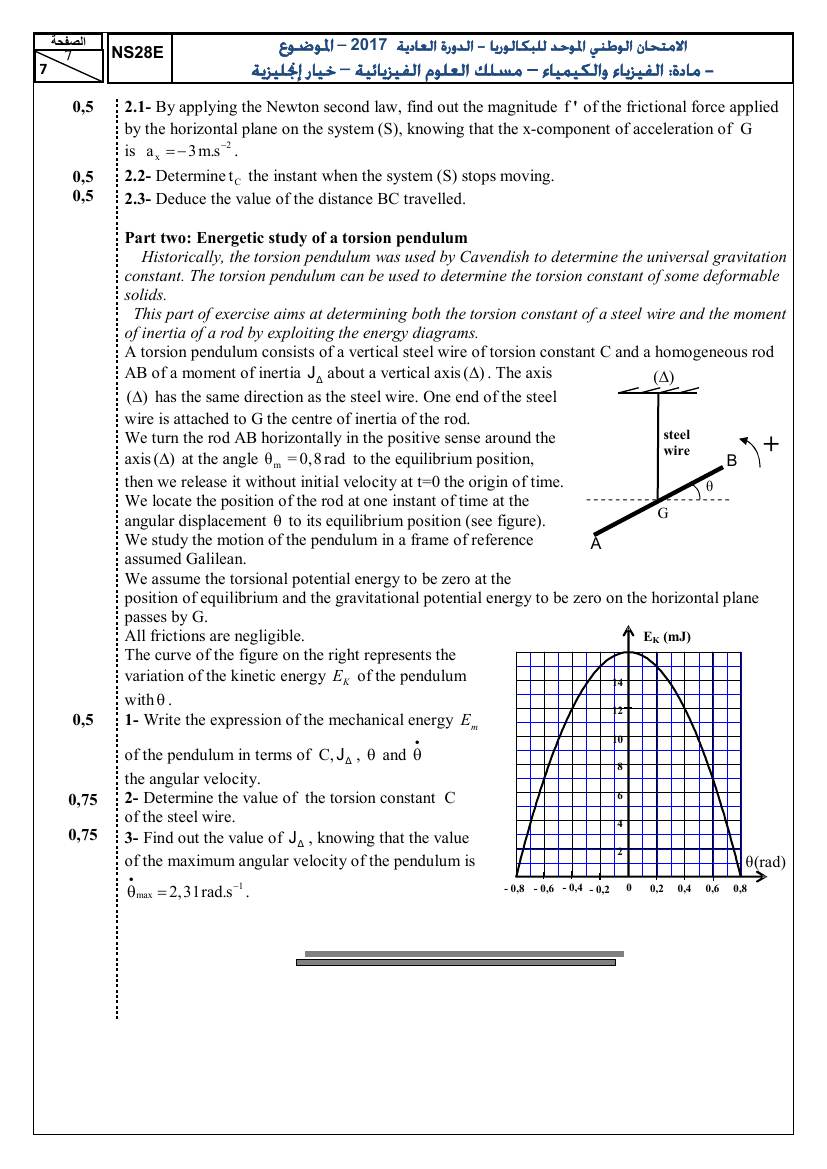
A torsion pendulum consists of a vertical steel wire of torsion constant C and a homogeneous rod AB of a moment of inertia JΔJ_\Delta about a vertical axis (Δ)(\Delta). The axis (Δ)(\Delta) has the same direction as the steel wire. One end of the steel wire is attached to G the centre of inertia of the rod.

We turn the rod AB horizontally in the positive sense around the axis (Δ)(\Delta) at the angle θm=0,8 rad\theta_m = 0{,}8\ \mathrm{rad} to the equilibrium position, then we release it without initial velocity at t=0 the origin of time.

We locate the position of the rod at one instant of time at the angular displacement θ\theta to its equilibrium position (see figure).

Figure : voir la page 7 du sujet

We study the motion of the pendulum in a frame of reference assumed Galilean.

We assume the torsional potential energy to be zero at the position of equilibrium and the gravitational potential energy to be zero on the horizontal plane passes by G.

All frictions are negligible.

The curve of the figure on the right represents the variation of the kinetic energy EKE_K of the pendulum with θ\theta.

Figure : voir la page 7 du sujet

1.Write the expression of the mechanical energy EmE_m of the pendulum in terms of CC, JΔJ_\Delta, θ\theta and θ˙\dot{\theta} the angular velocity.0,5 pt

2.Determine the value of the torsion constant C of the steel wire.0,75 pt

3.Find out the value of JΔJ_\Delta, knowing that the value of the maximum angular velocity of the pendulum is θ˙max=2,31 rad⋅s−1\dot{\theta}_{max} = 2{,}31\ \mathrm{rad\cdot s^{-1}}.0,75 pt

Entraîne-toi sur ces chapitres avec Kresco, gratuitement

Yallah, wa7d l-khtwa.

Le sujet, tu l’as. Maintenant, prépare-le.

Crée ton compte gratuit : une leçon offerte dans chaque chapitre, les quiz et ton suivi, matière par matière, jusqu’au national.