Jerreb rassek f l-national.

Examen national Physique-Chimie 2Bac PC (option anglaise) 2018, session normale

Physique-Chimie · Sciences Physiques · 8 pages

Le sujet en bref

  1. Exercice 17 pts

    Dosage acido-basique · Estérification et hydrolyse · Électrolyse (transformations forcées)

    L’électrolyse du bromure de plomb et l’acide lactique

  2. Exercice 22,5 pts

    Ondes mécaniques progressives

    Une onde ultrasonore dans le pétrole

  3. Exercice 35 pts

    Dipôle RC · Oscillations libres d’un circuit RLC série

  4. Exercice 45,5 pts

    Chute verticale d’un solide · Aspects énergétiques des oscillations · Systèmes mécaniques oscillants

    Une bille dans un liquide visqueux et un oscillateur solide-ressort

Total : 20 points

Le sujet, page par page

  1. Examen national Physique-Chimie 2Bac PC (option anglaise) 2018, session normale, page 1 sur 8
  2. Examen national Physique-Chimie 2Bac PC (option anglaise) 2018, session normale, page 2 sur 8
  3. Examen national Physique-Chimie 2Bac PC (option anglaise) 2018, session normale, page 3 sur 8
  4. Examen national Physique-Chimie 2Bac PC (option anglaise) 2018, session normale, page 4 sur 8
  5. Examen national Physique-Chimie 2Bac PC (option anglaise) 2018, session normale, page 5 sur 8
  6. Examen national Physique-Chimie 2Bac PC (option anglaise) 2018, session normale, page 6 sur 8
  7. Examen national Physique-Chimie 2Bac PC (option anglaise) 2018, session normale, page 7 sur 8
  8. Examen national Physique-Chimie 2Bac PC (option anglaise) 2018, session normale, page 8 sur 8

Sujet officiel de l’examen national unifié du baccalauréat, tel que publié par le Centre national de l’évaluation et des examens (Ministère de l’Éducation nationale).

L’énoncé en texte

Transcription du sujet officiel, pour le lire et le rechercher sur téléphone. Les figures restent sur les pages du sujet ; en cas de différence, le PDF officiel fait foi.

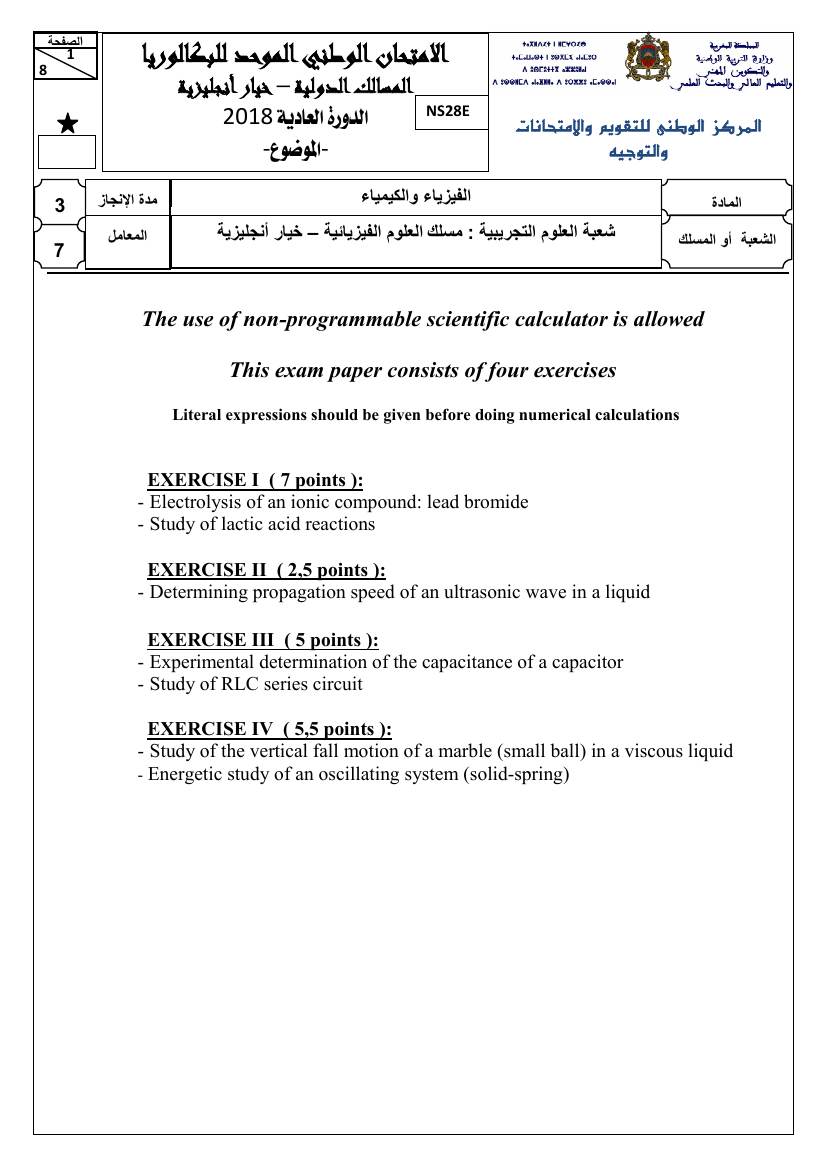
Exercice 17 pts

Part one and part two are independent

Part one: Electrolysis of an ionic compound: lead bromide

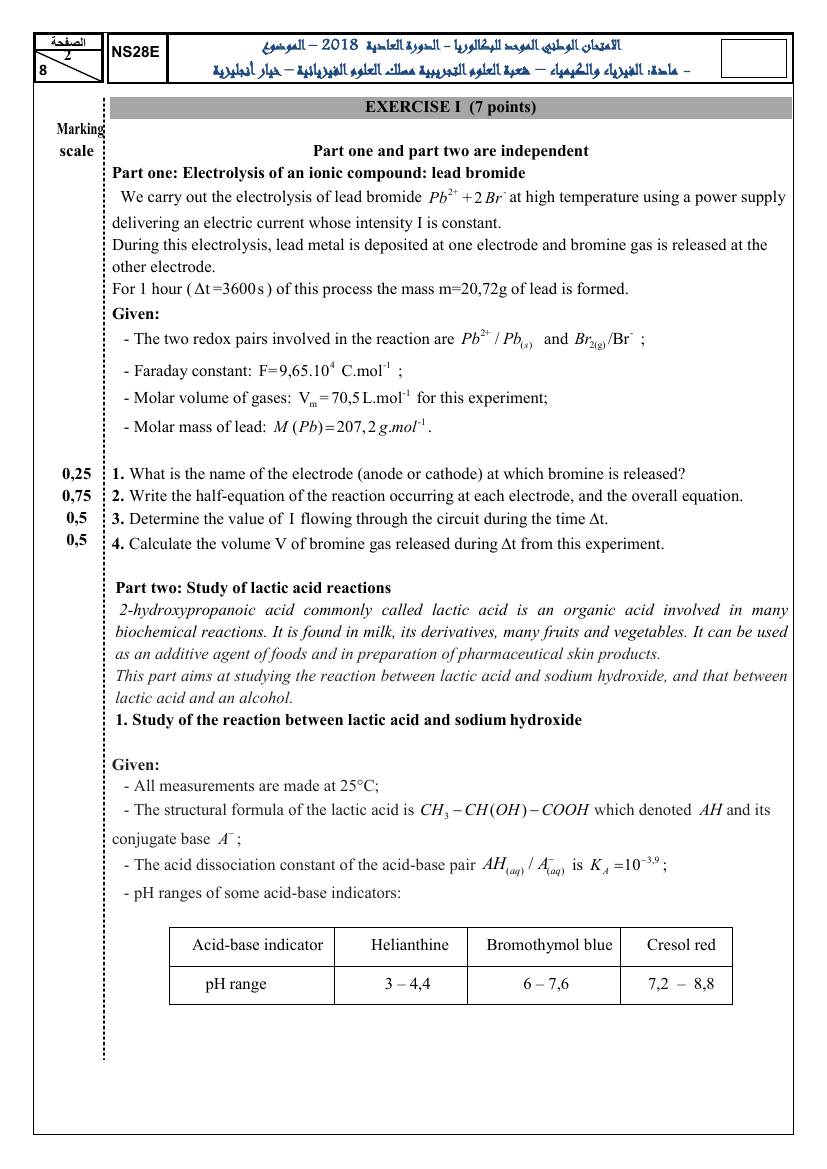
We carry out the electrolysis of lead bromide Pb2++2 Br−\mathrm{Pb^{2+} + 2\,Br^-} at high temperature using a power supply delivering an electric current whose intensity I is constant.

During this electrolysis, lead metal is deposited at one electrode and bromine gas is released at the other electrode.

For 1 hour (Δt=3600 s\Delta t = 3600\ \mathrm{s}) of this process the mass m=20,72 gm = 20{,}72\ \mathrm{g} of lead is formed.

Given:

- The two redox pairs involved in the reaction are Pb2+/Pb(s)\mathrm{Pb^{2+}/Pb_{(s)}} and Br2(g)/Br−\mathrm{Br_{2(g)}/Br^-} ;

- Faraday constant: F=9,65⋅104 C⋅mol−1F = 9{,}65\cdot 10^{4}\ \mathrm{C\cdot mol^{-1}} ;

- Molar volume of gases: Vm=70,5 L⋅mol−1V_m = 70{,}5\ \mathrm{L\cdot mol^{-1}} for this experiment;

- Molar mass of lead: M(Pb)=207,2 g⋅mol−1M(\mathrm{Pb}) = 207{,}2\ \mathrm{g\cdot mol^{-1}}.

1.What is the name of the electrode (anode or cathode) at which bromine is released?0,25 pt

2.Write the half-equation of the reaction occurring at each electrode, and the overall equation.0,75 pt

3.Determine the value of I flowing through the circuit during the time Δt\Delta t.0,5 pt

4.Calculate the volume V of bromine gas released during Δt\Delta t from this experiment.0,5 pt

Part two: Study of lactic acid reactions

2-hydroxypropanoic acid commonly called lactic acid is an organic acid involved in many biochemical reactions. It is found in milk, its derivatives, many fruits and vegetables. It can be used as an additive agent of foods and in preparation of pharmaceutical skin products.

This part aims at studying the reaction between lactic acid and sodium hydroxide, and that between lactic acid and an alcohol.

1. Study of the reaction between lactic acid and sodium hydroxide

Given:

- All measurements are made at 25°C;

- The structural formula of the lactic acid is CH3−CH(OH)−COOH\mathrm{CH_3 - CH(OH) - COOH} which denoted AH\mathrm{AH} and its conjugate base A−\mathrm{A^-} ;

- The acid dissociation constant of the acid-base pair AH(aq)/A(aq)−\mathrm{AH_{(aq)}/A^-_{(aq)}} is KA=10−3,9K_A = 10^{-3{,}9} ;

- pH ranges of some acid-base indicators:

Acid-base indicatorHelianthineBromothymol blueCresol red
pH range3 – 4,46 – 7,67,2 – 8,8

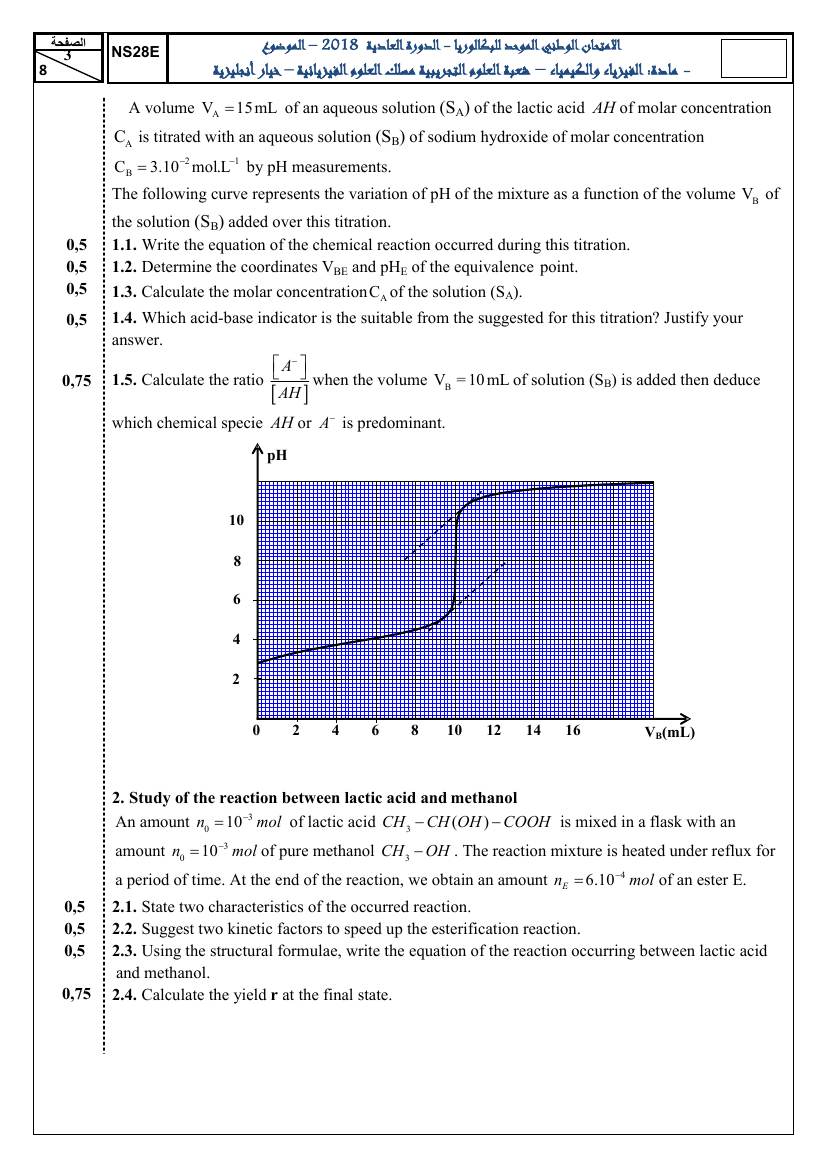
A volume VA=15 mLV_A = 15\ \mathrm{mL} of an aqueous solution (SA)(S_A) of the lactic acid AH of molar concentration CAC_A is titrated with an aqueous solution (SB)(S_B) of sodium hydroxide of molar concentration CB=3⋅10−2 mol⋅L−1C_B = 3\cdot 10^{-2}\ \mathrm{mol\cdot L^{-1}} by pH measurements.

The following curve represents the variation of pH of the mixture as a function of the volume VBV_B of the solution (SB)(S_B) added over this titration.

1.1.Write the equation of the chemical reaction occurred during this titration.0,5 pt

1.2.Determine the coordinates VBEV_{BE} and pHE\mathrm{pH}_E of the equivalence point.0,5 pt

1.3.Calculate the molar concentration CAC_A of the solution (SA)(S_A).0,5 pt

1.4.Which acid-base indicator is the suitable from the suggested for this titration? Justify your answer.0,5 pt

1.5.Calculate the ratio [A−][AH]\dfrac{[\mathrm{A^-}]}{[\mathrm{AH}]} when the volume VB=10 mLV_B = 10\ \mathrm{mL} of solution (SB)(S_B) is added then deduce which chemical specie AH or A−\mathrm{A^-} is predominant.0,75 pt

Figure : voir la page 3 du sujet

2. Study of the reaction between lactic acid and methanol

An amount n0=10−3 moln_0 = 10^{-3}\ \mathrm{mol} of lactic acid CH3−CH(OH)−COOH\mathrm{CH_3 - CH(OH) - COOH} is mixed in a flask with an amount n0=10−3 moln_0 = 10^{-3}\ \mathrm{mol} of pure methanol CH3−OH\mathrm{CH_3 - OH}. The reaction mixture is heated under reflux for a period of time. At the end of the reaction, we obtain an amount nE=6⋅10−4 moln_E = 6\cdot 10^{-4}\ \mathrm{mol} of an ester E.

2.1.State two characteristics of the occurred reaction.0,5 pt

2.2.Suggest two kinetic factors to speed up the esterification reaction.0,5 pt

2.3.Using the structural formulae, write the equation of the reaction occurring between lactic acid and methanol.0,5 pt

2.4.Calculate the yield r at the final state.0,75 pt

Exercice 22,5 pts

Determining propagation speed of an ultrasonic wave in a liquid

Mechanical waves travel only in material mediums. They propagate faster in material medium which has high relative density.

To determine the approximate value VpV_p of the propagation speed of an ultrasonic wave travelling in petroleum (liquid) we carry out the following experiment:

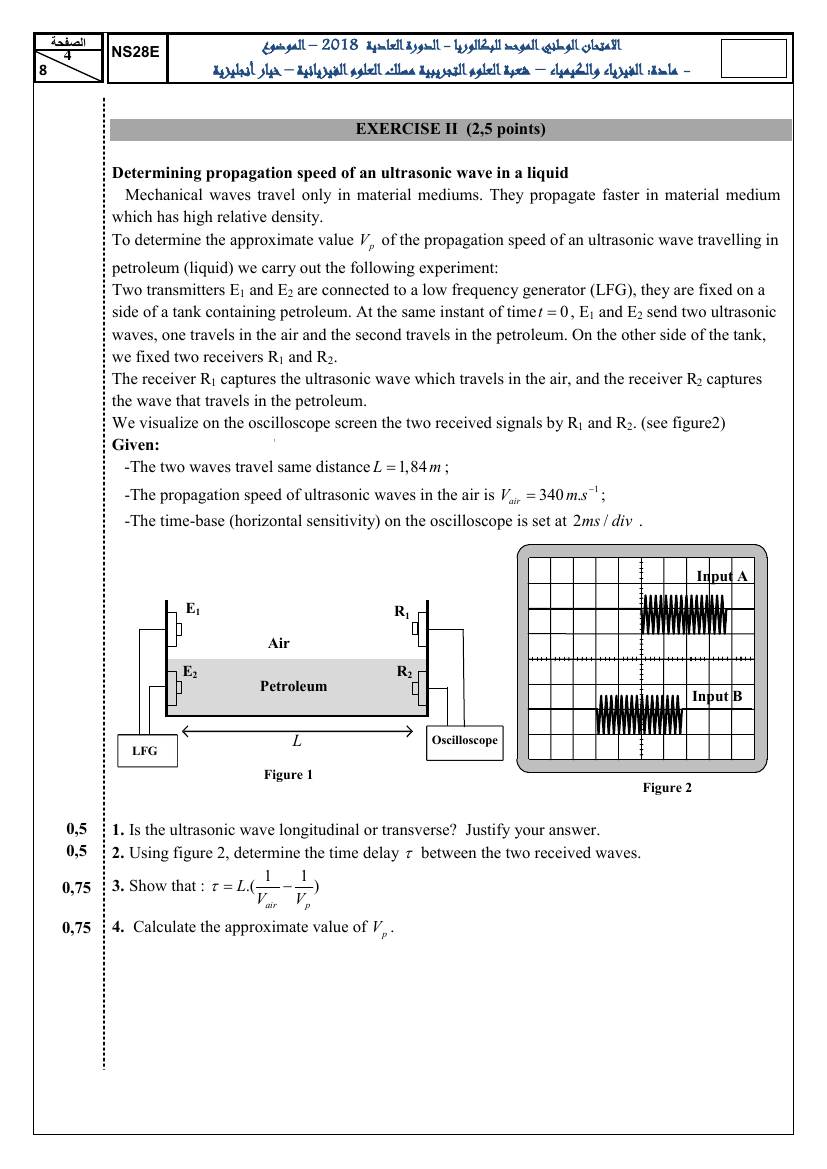
Two transmitters E1E_1 and E2E_2 are connected to a low frequency generator (LFG), they are fixed on a side of a tank containing petroleum. At the same instant of time t=0t = 0, E1E_1 and E2E_2 send two ultrasonic waves, one travels in the air and the second travels in the petroleum. On the other side of the tank, we fixed two receivers R1R_1 and R2R_2.

The receiver R1R_1 captures the ultrasonic wave which travels in the air, and the receiver R2R_2 captures the wave that travels in the petroleum.

We visualize on the oscilloscope screen the two received signals by R1R_1 and R2R_2. (see figure2)

Given:

-The two waves travel same distance L=1,84 mL = 1{,}84\ \mathrm{m} ;

-The propagation speed of ultrasonic waves in the air is Vair=340 m⋅s−1V_{air} = 340\ \mathrm{m\cdot s^{-1}} ;

-The time-base (horizontal sensitivity) on the oscilloscope is set at 2 ms/div2\ \mathrm{ms/div}.

Figure 1 : voir la page 4 du sujet

Figure 2 : voir la page 4 du sujet

1.Is the ultrasonic wave longitudinal or transverse? Justify your answer.0,5 pt

2.Using figure 2, determine the time delay τ\tau between the two received waves.0,5 pt

3.Show that : τ=L⋅(1Vair−1Vp)\tau = L\cdot\left(\dfrac{1}{V_{air}} - \dfrac{1}{V_p}\right)0,75 pt

4.Calculate the approximate value of VpV_p.0,75 pt

Revoir le cours : Ondes mécaniques progressives

Exercice 35 pts

A teacher devoted with his students a practical work session to determine capacitance of a capacitor by two different experimental methods and to study a RLC series circuit.

I-Experimental determination of the capacitance of a capacitor

1- By using an ideal generator of current

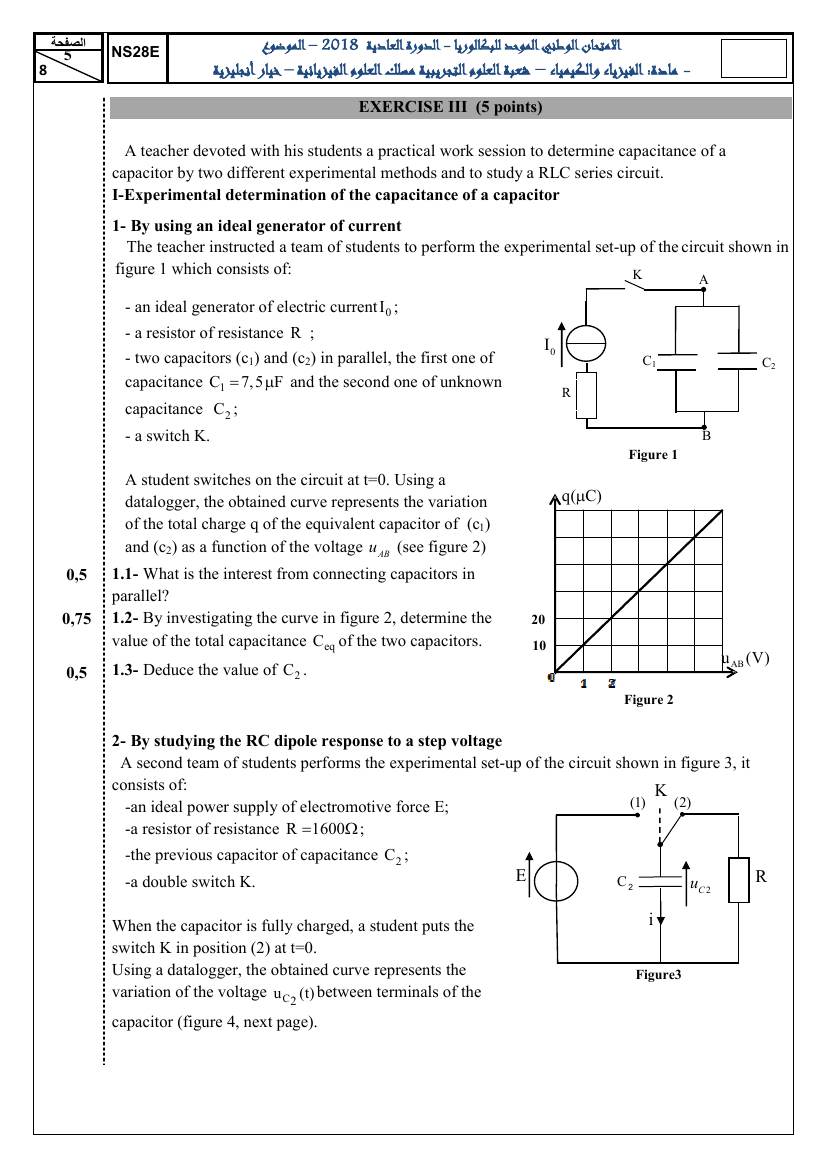
The teacher instructed a team of students to perform the experimental set-up of the circuit shown in figure 1 which consists of:

- an ideal generator of electric current I0I_0 ;

- a resistor of resistance R ;

- two capacitors (c1)(c_1) and (c2)(c_2) in parallel, the first one of capacitance C1=7,5 μFC_1 = 7{,}5\ \mu\mathrm{F} and the second one of unknown capacitance C2C_2 ;

- a switch K.

Figure 1 : voir la page 5 du sujet

A student switches on the circuit at t=0. Using a datalogger, the obtained curve represents the variation of the total charge q of the equivalent capacitor of (c1)(c_1) and (c2)(c_2) as a function of the voltage uABu_{AB} (see figure 2)

Figure 2 : voir la page 5 du sujet

1.1.What is the interest from connecting capacitors in parallel?0,5 pt

1.2.By investigating the curve in figure 2, determine the value of the total capacitance CeqC_{eq} of the two capacitors.0,75 pt

1.3.Deduce the value of C2C_2.0,5 pt

2- By studying the RC dipole response to a step voltage

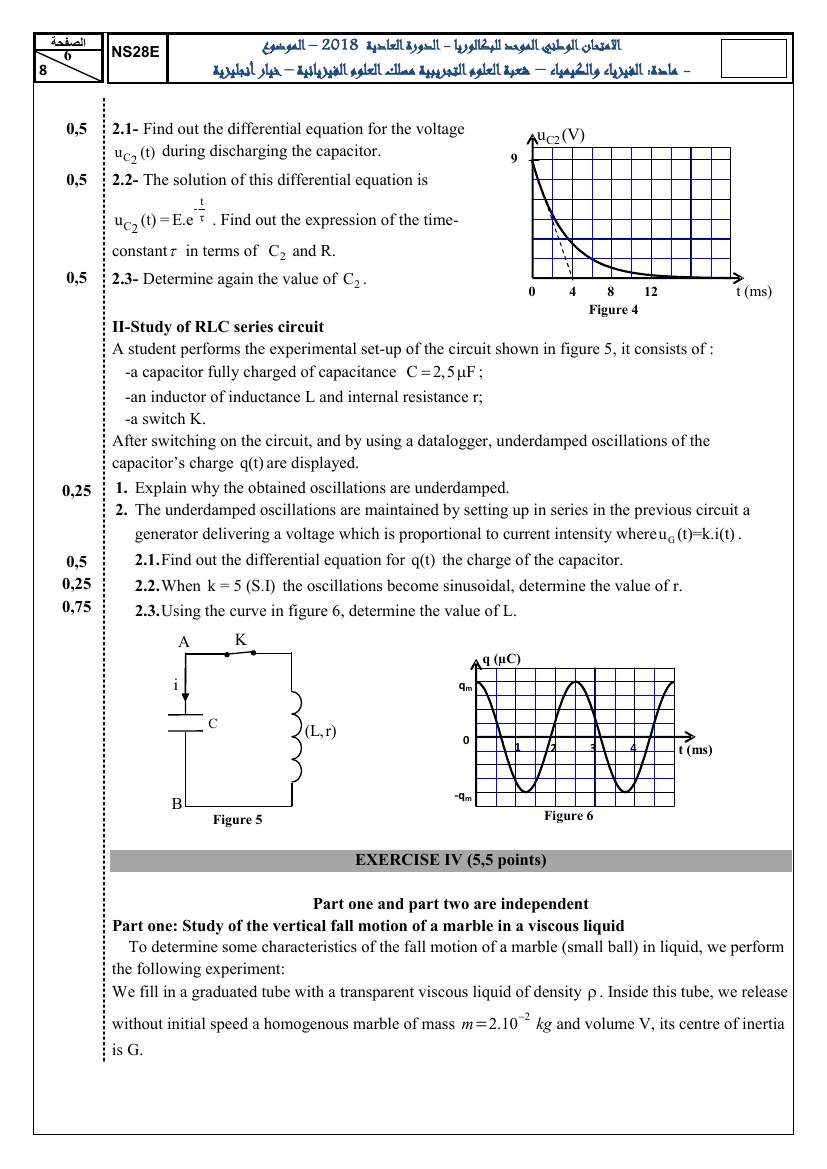
A second team of students performs the experimental set-up of the circuit shown in figure 3, it consists of:

-an ideal power supply of electromotive force E;

-a resistor of resistance R=1600 ΩR = 1600\ \Omega ;

-the previous capacitor of capacitance C2C_2 ;

-a double switch K.

Figure3 : voir la page 5 du sujet

When the capacitor is fully charged, a student puts the switch K in position (2) at t=0.

Using a datalogger, the obtained curve represents the variation of the voltage uC2(t)u_{C_2}(t) between terminals of the capacitor (figure 4, next page).

2.1.Find out the differential equation for the voltage uC2(t)u_{C_2}(t) during discharging the capacitor.0,5 pt

2.2.The solution of this differential equation is uC2(t)=E⋅e−tτu_{C_2}(t) = E\cdot e^{-\frac{t}{\tau}}. Find out the expression of the time-constant τ\tau in terms of C2C_2 and R.0,5 pt

2.3.Determine again the value of C2C_2.0,5 pt

Figure 4 : voir la page 6 du sujet

II-Study of RLC series circuit

A student performs the experimental set-up of the circuit shown in figure 5, it consists of :

-a capacitor fully charged of capacitance C=2,5 μFC = 2{,}5\ \mu\mathrm{F} ;

-an inductor of inductance L and internal resistance r;

-a switch K.

After switching on the circuit, and by using a datalogger, underdamped oscillations of the capacitor’s charge q(t) are displayed.

1.Explain why the obtained oscillations are underdamped.0,25 pt

2. The underdamped oscillations are maintained by setting up in series in the previous circuit a generator delivering a voltage which is proportional to current intensity where uG(t)=k⋅i(t)u_G(t) = k\cdot i(t).

2.1.Find out the differential equation for q(t) the charge of the capacitor.0,5 pt

2.2.When k = 5 (S.I) the oscillations become sinusoidal, determine the value of r.0,25 pt

2.3.Using the curve in figure 6, determine the value of L.0,75 pt

Figure 5 : voir la page 6 du sujet

Figure 6 : voir la page 6 du sujet

Exercice 45,5 pts

Part one and part two are independent

Part one: Study of the vertical fall motion of a marble in a viscous liquid

To determine some characteristics of the fall motion of a marble (small ball) in liquid, we perform the following experiment:

We fill in a graduated tube with a transparent viscous liquid of density ρ\rho. Inside this tube, we release without initial speed a homogenous marble of mass m=2⋅10−2 kgm = 2\cdot 10^{-2}\ \mathrm{kg} and volume V, its centre of inertia is G.

We study the motion of the centre of inertia G of the marble in a frame of reference (O,j⃗)(O, \vec{j}) assumed Galilean.

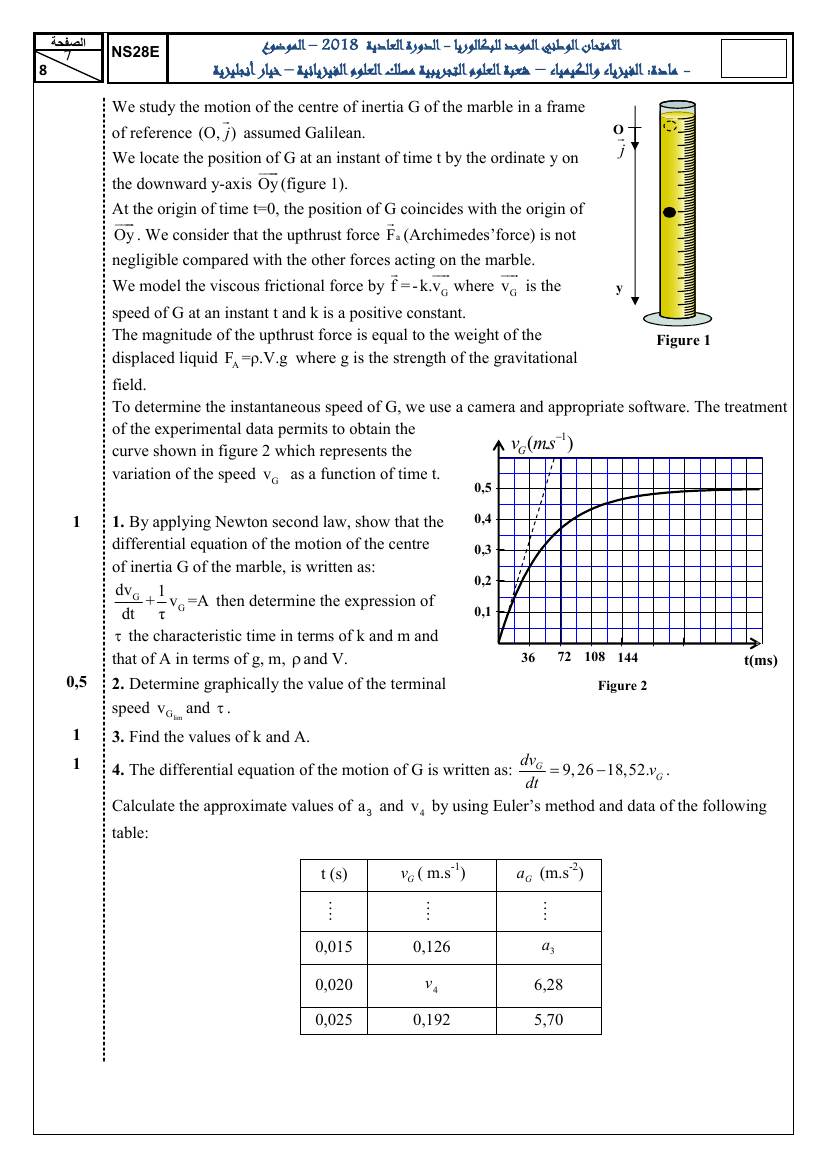
We locate the position of G at an instant of time t by the ordinate y on the downward y-axis Oy→\overrightarrow{Oy} (figure 1).

At the origin of time t=0, the position of G coincides with the origin of Oy→\overrightarrow{Oy}. We consider that the upthrust force F⃗a\vec{F}_a (Archimedes’force) is not negligible compared with the other forces acting on the marble.

We model the viscous frictional force by f⃗=−k⋅v⃗G\vec{f} = -k\cdot\vec{v}_G where v⃗G\vec{v}_G is the speed of G at an instant t and k is a positive constant.

The magnitude of the upthrust force is equal to the weight of the displaced liquid FA=ρ⋅V⋅gF_A = \rho\cdot V\cdot g where g is the strength of the gravitational field.

Figure 1 : voir la page 7 du sujet

To determine the instantaneous speed of G, we use a camera and appropriate software. The treatment of the experimental data permits to obtain the curve shown in figure 2 which represents the variation of the speed vGv_G as a function of time t.

Figure 2 : voir la page 7 du sujet

1.By applying Newton second law, show that the differential equation of the motion of the centre of inertia G of the marble, is written as: dvGdt+1τvG=A\dfrac{dv_G}{dt} + \dfrac{1}{\tau}v_G = A then determine the expression of τ\tau the characteristic time in terms of k and m and that of A in terms of g, m, ρ\rho and V.1 pt

2.Determine graphically the value of the terminal speed vGlimv_{G_{lim}} and τ\tau.0,5 pt

3.Find the values of k and A.1 pt

4.The differential equation of the motion of G is written as: dvGdt=9,26−18,52⋅vG\dfrac{dv_G}{dt} = 9{,}26 - 18{,}52\cdot v_G. Calculate the approximate values of a3a_3 and v4v_4 by using Euler’s method and data of the following table:1 pt

t (s)vGv_G (m.s−1^{-1})aGa_G (m.s−2^{-2})
………
0,0150,126a3a_3
0,020v4v_46,28
0,0250,1925,70

Part two : Energetic study of an oscillating system (solid-spring)

We model a piece of a mechanical machine by an oscillating system (S) consisting of a solid (S) of centre of inertia G and of mass m attached to one extremity of a horizontal spring with non-contiguous turns of spring constant K=35 N⋅m−1K = 35\ \mathrm{N\cdot m^{-1}} and its mass is negligible. The other extremity is attached to a fixed stand.

We displace the solid (S) by a distance XmX_m from its position of equilibrium then we release it without initial speed. The solid oscillates on a horizontal plane without friction.

We study the motion of the centre of inertia G in a Galilean frame of reference (O,i⃗)(O, \vec{i}) linked to the Earth.

At equilibrium, the position of G coincides with O the origin of the frame (O,i⃗)(O, \vec{i}).

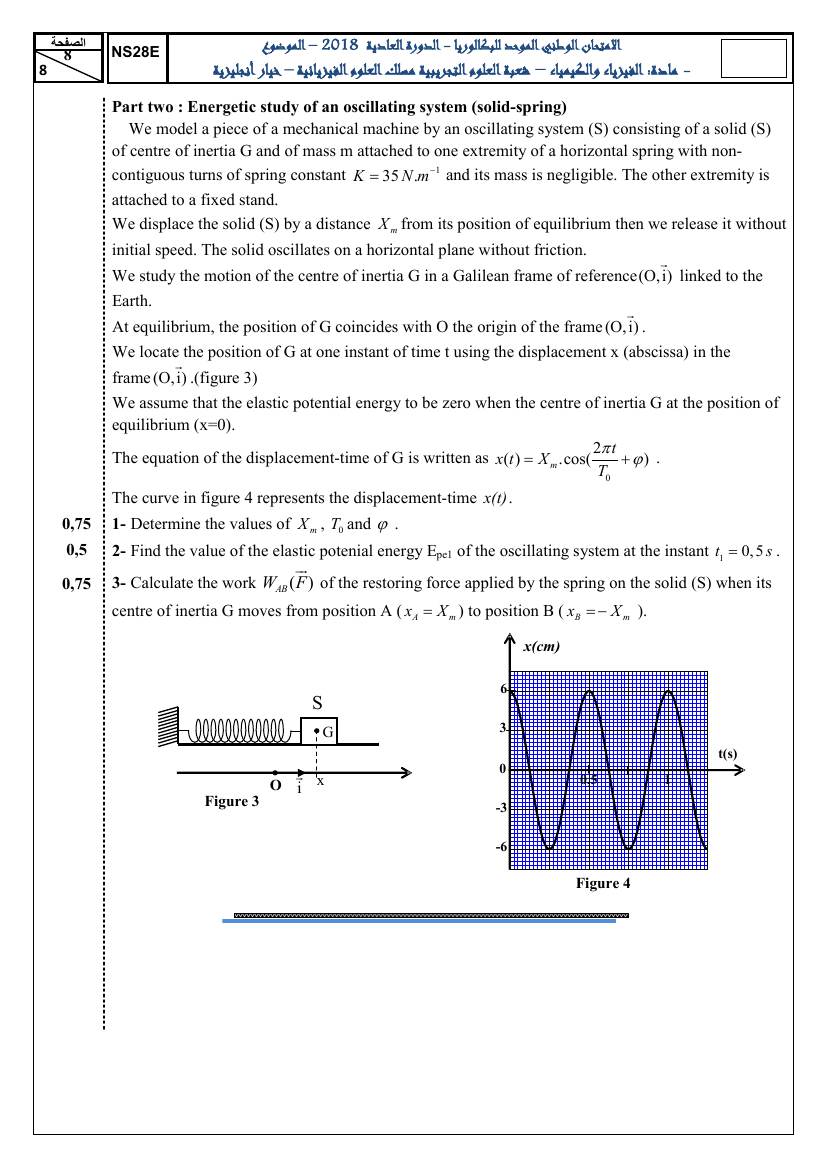
We locate the position of G at one instant of time t using the displacement x (abscissa) in the frame (O,i⃗)(O, \vec{i}).(figure 3)

We assume that the elastic potential energy to be zero when the centre of inertia G at the position of equilibrium (x=0).

The equation of the displacement-time of G is written as x(t)=Xm⋅cos⁡(2πtT0+φ)x(t) = X_m\cdot\cos\left(\dfrac{2\pi t}{T_0} + \varphi\right).

The curve in figure 4 represents the displacement-time x(t).

1.Determine the values of XmX_m, T0T_0 and φ\varphi.0,75 pt

2.Find the value of the elastic potenial energy Epe1E_{pe1} of the oscillating system at the instant t1=0,5 st_1 = 0{,}5\ \mathrm{s}.0,5 pt

3.Calculate the work WAB(F⃗)W_{AB}(\vec{F}) of the restoring force applied by the spring on the solid (S) when its centre of inertia G moves from position A (xA=Xmx_A = X_m) to position B (xB=−Xmx_B = -X_m).0,75 pt

Figure 3 : voir la page 8 du sujet

Figure 4 : voir la page 8 du sujet

Entraîne-toi sur ces chapitres avec Kresco, gratuitement

Yallah, wa7d l-khtwa.

Le sujet, tu l’as. Maintenant, prépare-le.

Crée ton compte gratuit : une leçon offerte dans chaque chapitre, les quiz et ton suivi, matière par matière, jusqu’au national.