Jerreb rassek f l-national.

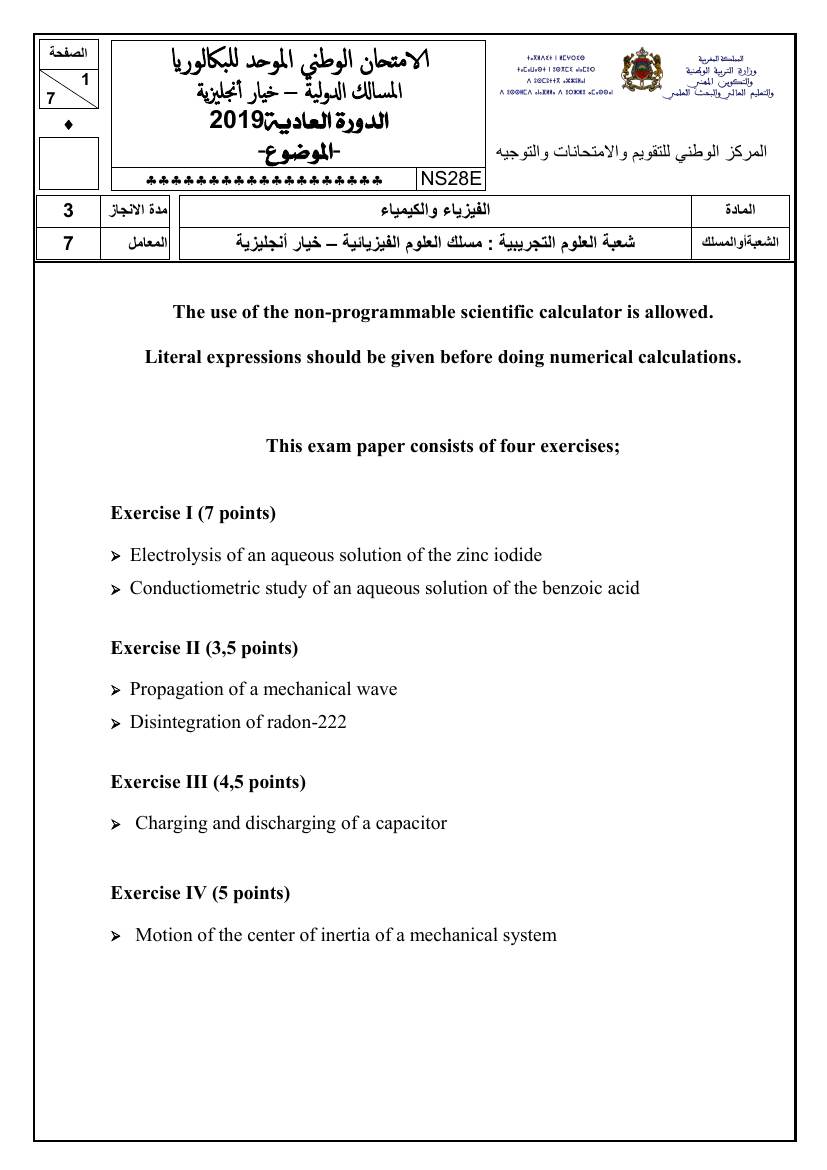
Examen national Physique-Chimie 2Bac PC (option anglaise) 2019, session normale

Physique-Chimie · Sciences Physiques · 7 pages

Le sujet en bref

  1. Exercice 17 pts

    Réactions acide-base · Électrolyse (transformations forcées)

    L’électrolyse de l’iodure de zinc et l’acide benzoïque

  2. Exercice 23,5 pts

    Ondes mécaniques progressives périodiques · Noyaux, masse et énergie · Décroissance radioactive

    Une onde dans une cuve à ondes et le radon 222

  3. Exercice 34,5 pts

    Oscillations libres d’un circuit RLC série · Dipôle RC

  4. Exercice 45 pts

    Lois de Newton · Mouvements plans

    Le saut en longueur d’une moto et de son pilote

Total : 20 points

Le sujet, page par page

  1. Examen national Physique-Chimie 2Bac PC (option anglaise) 2019, session normale, page 1 sur 7
  2. Examen national Physique-Chimie 2Bac PC (option anglaise) 2019, session normale, page 2 sur 7
  3. Examen national Physique-Chimie 2Bac PC (option anglaise) 2019, session normale, page 3 sur 7
  4. Examen national Physique-Chimie 2Bac PC (option anglaise) 2019, session normale, page 4 sur 7
  5. Examen national Physique-Chimie 2Bac PC (option anglaise) 2019, session normale, page 5 sur 7
  6. Examen national Physique-Chimie 2Bac PC (option anglaise) 2019, session normale, page 6 sur 7
  7. Examen national Physique-Chimie 2Bac PC (option anglaise) 2019, session normale, page 7 sur 7

Sujet officiel de l’examen national unifié du baccalauréat, tel que publié par le Centre national de l’évaluation et des examens (Ministère de l’Éducation nationale).

L’énoncé en texte

Transcription du sujet officiel, pour le lire et le rechercher sur téléphone. Les figures restent sur les pages du sujet ; en cas de différence, le PDF officiel fait foi.

Exercice 17 pts

Part 1 and Part 2 are independent

Part 1 – Electrolysis of an aqueous solution of the zinc iodide

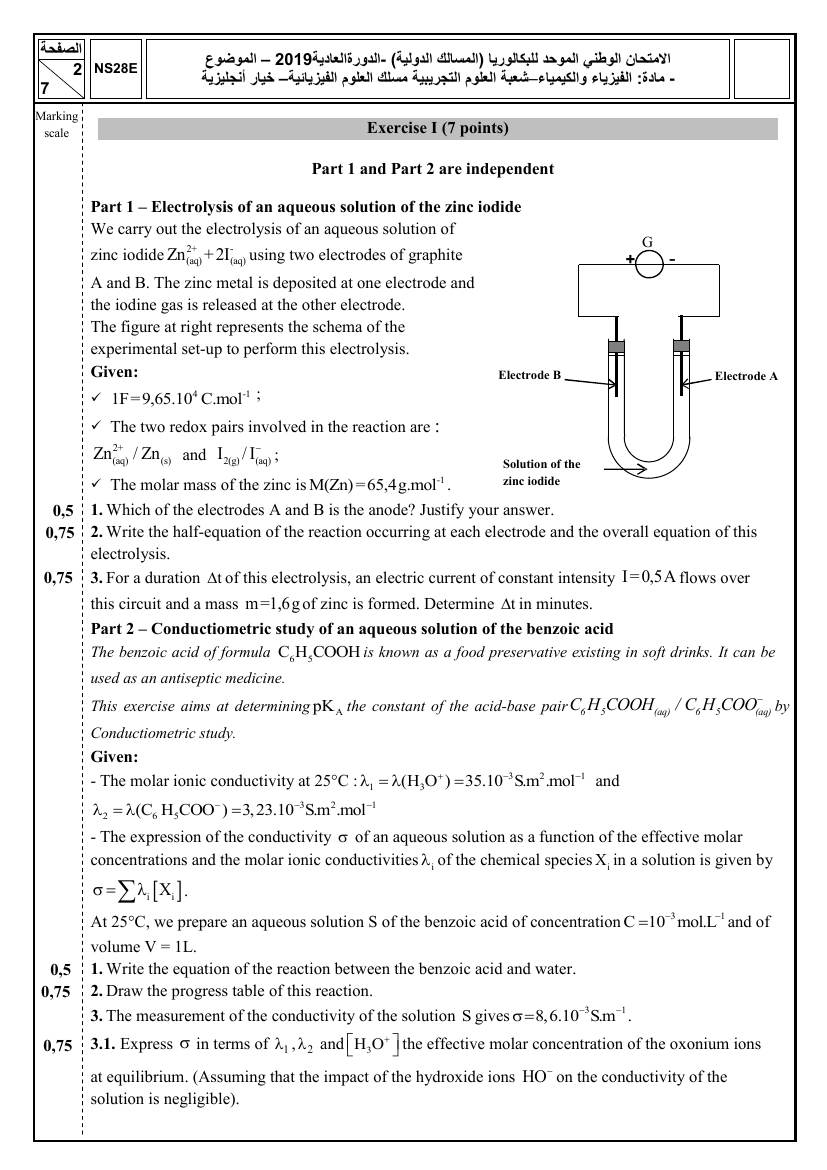
We carry out the electrolysis of an aqueous solution of zinc iodide Zn(aq)2++2I(aq)−\mathrm{Zn^{2+}_{(aq)} + 2I^{-}_{(aq)}} using two electrodes of graphite A and B. The zinc metal is deposited at one electrode and the iodine gas is released at the other electrode.

The figure at right represents the schema of the experimental set-up to perform this electrolysis.

Figure : voir la page 2 du sujet

Given:

1 F=9,65⋅104 C⋅mol−11\,\mathrm{F} = 9{,}65\cdot 10^{4}\ \mathrm{C\cdot mol^{-1}} ;

The two redox pairs involved in the reaction are : Zn(aq)2+/Zn(s)\mathrm{Zn^{2+}_{(aq)}/Zn_{(s)}} and I2(g)/I(aq)−\mathrm{I_{2(g)}/I^{-}_{(aq)}} ;

The molar mass of the zinc is M(Zn)=65,4 g⋅mol−1M(\mathrm{Zn}) = 65{,}4\ \mathrm{g\cdot mol^{-1}}.

1.Which of the electrodes A and B is the anode? Justify your answer.0,5 pt

2.Write the half-equation of the reaction occurring at each electrode and the overall equation of this electrolysis.0,75 pt

3.For a duration Δt\Delta t of this electrolysis, an electric current of constant intensity I=0,5 AI = 0{,}5\ \mathrm{A} flows over this circuit and a mass m=1,6 gm = 1{,}6\ \mathrm{g} of zinc is formed. Determine Δt\Delta t in minutes.0,75 pt

Part 2 – Conductiometric study of an aqueous solution of the benzoic acid

The benzoic acid of formula C6H5COOH\mathrm{C_6H_5COOH} is known as a food preservative existing in soft drinks. It can be used as an antiseptic medicine.

This exercise aims at determining pKA\mathrm{pK_A} the constant of the acid-base pair C6H5COOH(aq)/C6H5COO(aq)−\mathrm{C_6H_5COOH_{(aq)}/C_6H_5COO^{-}_{(aq)}} by Conductiometric study.

Given:

- The molar ionic conductivity at 25°C : λ1=λ(H3O+)=35⋅10−3 S⋅m2⋅mol−1\lambda_1 = \lambda(\mathrm{H_3O^+}) = 35\cdot 10^{-3}\ \mathrm{S\cdot m^2\cdot mol^{-1}} and λ2=λ(C6H5COO−)=3,23⋅10−3 S⋅m2⋅mol−1\lambda_2 = \lambda(\mathrm{C_6H_5COO^-}) = 3{,}23\cdot 10^{-3}\ \mathrm{S\cdot m^2\cdot mol^{-1}}

- The expression of the conductivity σ\sigma of an aqueous solution as a function of the effective molar concentrations and the molar ionic conductivities λi\lambda_i of the chemical species XiX_i in a solution is given by σ=∑λi[Xi]\sigma = \sum \lambda_i [X_i].

At 25°C, we prepare an aqueous solution S of the benzoic acid of concentration C=10−3 mol⋅L−1C = 10^{-3}\ \mathrm{mol\cdot L^{-1}} and of volume V = 1L.

1.Write the equation of the reaction between the benzoic acid and water.0,5 pt

2.Draw the progress table of this reaction.0,75 pt

3.The measurement of the conductivity of the solution S gives σ=8,6⋅10−3 S⋅m−1\sigma = 8{,}6\cdot 10^{-3}\ \mathrm{S\cdot m^{-1}}.

3.1.Express σ\sigma in terms of λ1\lambda_1, λ2\lambda_2 and [H3O+][\mathrm{H_3O^+}] the effective molar concentration of the oxonium ions at equilibrium. (Assuming that the impact of the hydroxide ions HO−\mathrm{HO^-} on the conductivity of the solution is negligible).0,75 pt

3.2.Show that the final progress rate τ\tau of the reaction is written as τ=σC(λ1+λ2)\tau = \dfrac{\sigma}{C(\lambda_1+\lambda_2)}. Calculate its value.0,75 pt

4.Find out the expression of K the equilibrium constant associated to the reaction between the benzoic acid and water, in terms of C and τ\tau.0,75 pt

5.What is represented by K the equilibrium constant corresponding to this reaction?0,25 pt

6.Deduce the value of pKA\mathrm{pK_A} of the pair C6H5COOH/C6H5COO−\mathrm{C_6H_5COOH/C_6H_5COO^-}.0,75 pt

7.Which of the two chemical species C6H5COOH\mathrm{C_6H_5COOH} and C6H5COO−\mathrm{C_6H_5COO^-} is predominant in the solution S ?0,5 pt

Exercice 23,5 pts

Part 1 and 2 are independent.

Part 1- Propagation of a mechanical wave

To study the propagation of mechanical waves on the surface of water, we use a ripple tank. The aim of this part is to determine some specific quantities of a mechanical wave.

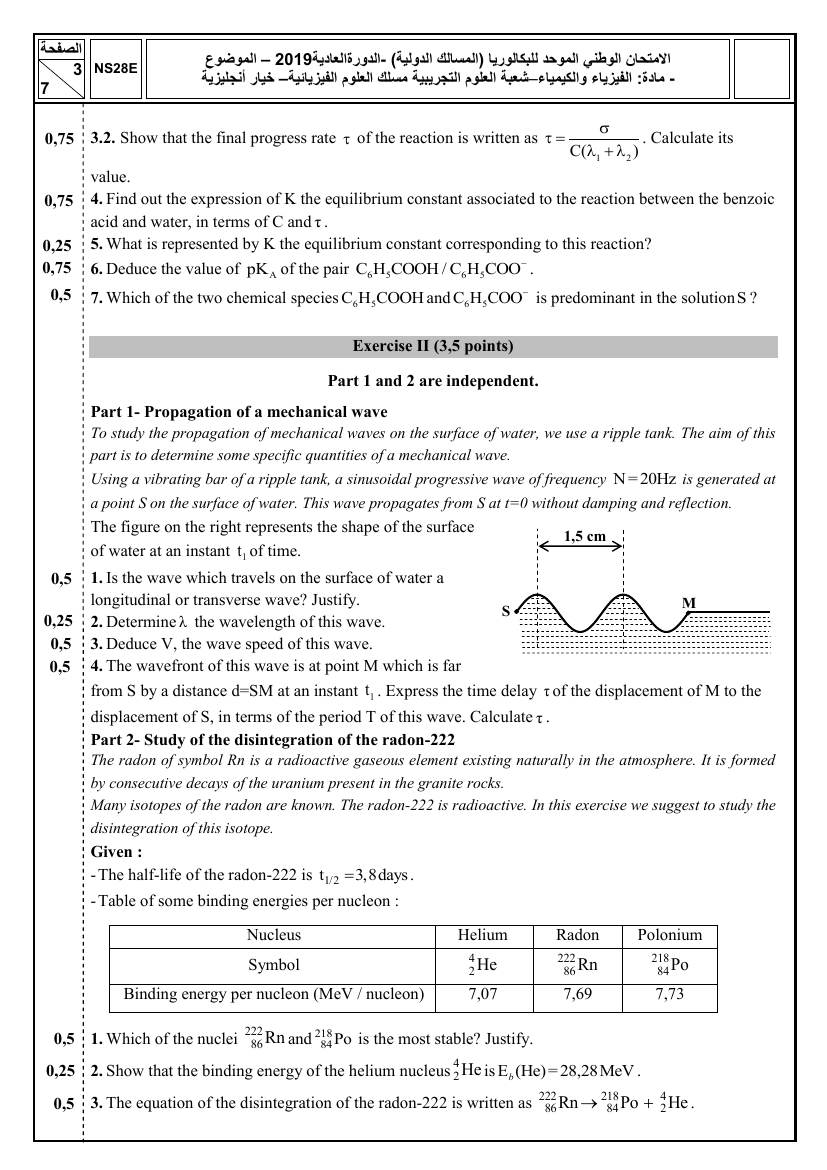
Using a vibrating bar of a ripple tank, a sinusoidal progressive wave of frequency N=20 HzN = 20\ \mathrm{Hz} is generated at a point S on the surface of water. This wave propagates from S at t=0 without damping and reflection.

The figure on the right represents the shape of the surface of water at an instant t1t_1 of time.

Figure : voir la page 3 du sujet

1.Is the wave which travels on the surface of water a longitudinal or transverse wave? Justify.0,5 pt

2.Determine λ\lambda the wavelength of this wave.0,25 pt

3.Deduce V, the wave speed of this wave.0,5 pt

4.The wavefront of this wave is at point M which is far from S by a distance d=SM at an instant t1t_1. Express the time delay τ\tau of the displacement of M to the displacement of S, in terms of the period T of this wave. Calculate τ\tau.0,5 pt

Part 2- Study of the disintegration of the radon-222

The radon of symbol Rn is a radioactive gaseous element existing naturally in the atmosphere. It is formed by consecutive decays of the uranium present in the granite rocks.

Many isotopes of the radon are known. The radon-222 is radioactive. In this exercise we suggest to study the disintegration of this isotope.

Given :

- The half-life of the radon-222 is t1/2=3,8 dayst_{1/2} = 3{,}8\ \mathrm{days}.

- Table of some binding energies per nucleon :

NucleusHeliumRadonPolonium
Symbol24He\mathrm{^{4}_{2}He}86222Rn\mathrm{^{222}_{86}Rn}84218Po\mathrm{^{218}_{84}Po}
Binding energy per nucleon (MeV / nucleon)7,077,697,73

1.Which of the nuclei 86222Rn\mathrm{^{222}_{86}Rn} and 84218Po\mathrm{^{218}_{84}Po} is the most stable? Justify.0,5 pt

2.Show that the binding energy of the helium nucleus 24He\mathrm{^{4}_{2}He} is Eb(He)=28,28 MeVE_b(\mathrm{He}) = 28{,}28\ \mathrm{MeV}.0,25 pt

3.The equation of the disintegration of the radon-222 is written as 86222Rn→ 84218Po+ 24He\mathrm{^{222}_{86}Rn \rightarrow\ ^{218}_{84}Po + \ ^{4}_{2}He}. Choose the right answer. The energy released (produced) over this disintegration of the nucleus radon-222 is :0,5 pt

■ Epro=7,11 MeVE_{pro} = 7{,}11\ \mathrm{MeV} ■ Epro=22,56 MeVE_{pro} = 22{,}56\ \mathrm{MeV} ■ Epro=6,24 MeVE_{pro} = 6{,}24\ \mathrm{MeV} ■ Epro=3420,6 MeVE_{pro} = 3420{,}6\ \mathrm{MeV}

4.We consider a0a_0 the activity of a sample of nuclei radon-222 at t = 0. Determine, in days unit, the instant t1t_1 at which the activity of this sample will be a1=a04a_1 = \dfrac{a_0}{4}.0,5 pt

Revoir le cours : Ondes mécaniques progressives périodiques · Noyaux, masse et énergie · Décroissance radioactive

Exercice 34,5 pts

Charging and discharging of a capacitor

Capacitors and inductors are the main components of many electric devices such as those used in emission and reception devices of the electromagnetic waves.

This exercise aims at studying the charging of a capacitor and its discharging in an inductor.

We set up the mounting sketched in figure 1. This mounting is consisted of these components:

- an ideal power supply of electromotive force E=10 VE = 10\ \mathrm{V} ;

- a capacitor of capacitance C initially discharged;

- a resistor of resistance R ;

- an inductor of inductance L and of negligible resistance ;

- a double switch K.

Figure 1 : voir la page 4 du sujet

I –Study of the charging of the capacitor

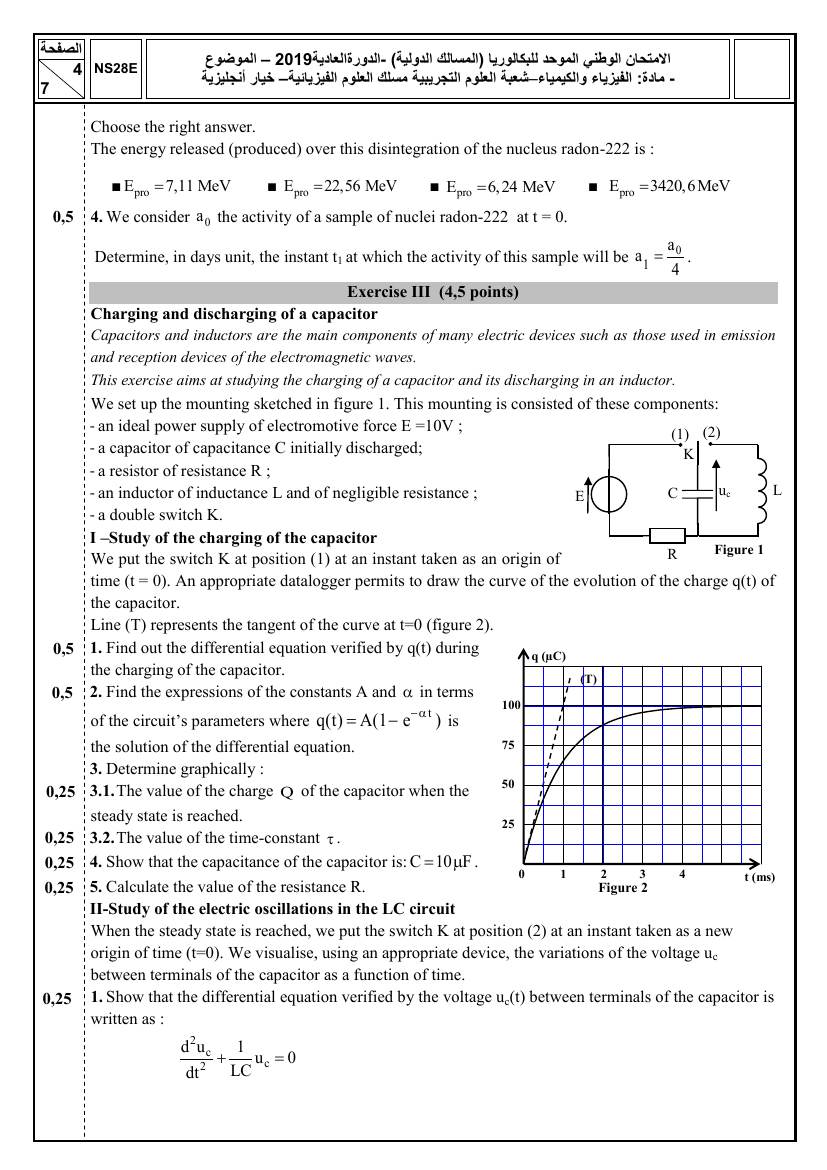
We put the switch K at position (1) at an instant taken as an origin of time (t = 0). An appropriate datalogger permits to draw the curve of the evolution of the charge q(t) of the capacitor.

Line (T) represents the tangent of the curve at t=0 (figure 2).

Figure 2 : voir la page 5 du sujet

1.Find out the differential equation verified by q(t) during the charging of the capacitor.0,5 pt

2.Find the expressions of the constants A and α\alpha in terms of the circuit’s parameters where q(t)=A(1−e−αt)q(t) = A(1-e^{-\alpha t}) is the solution of the differential equation.0,5 pt

3.Determine graphically :

3.1.The value of the charge Q of the capacitor when the steady state is reached.0,25 pt

3.2.The value of the time-constant τ\tau.0,25 pt

4.Show that the capacitance of the capacitor is: C=10 μFC = 10\ \mu\mathrm{F}.0,25 pt

5.Calculate the value of the resistance R.0,25 pt

II-Study of the electric oscillations in the LC circuit

When the steady state is reached, we put the switch K at position (2) at an instant taken as a new origin of time (t=0). We visualise, using an appropriate device, the variations of the voltage ucu_c between terminals of the capacitor as a function of time.

1.Show that the differential equation verified by the voltage uc(t)u_c(t) between terminals of the capacitor is written as :0,25 pt

d2ucdt2+1LCuc=0\dfrac{d^2u_c}{dt^2} + \dfrac{1}{LC}u_c = 0

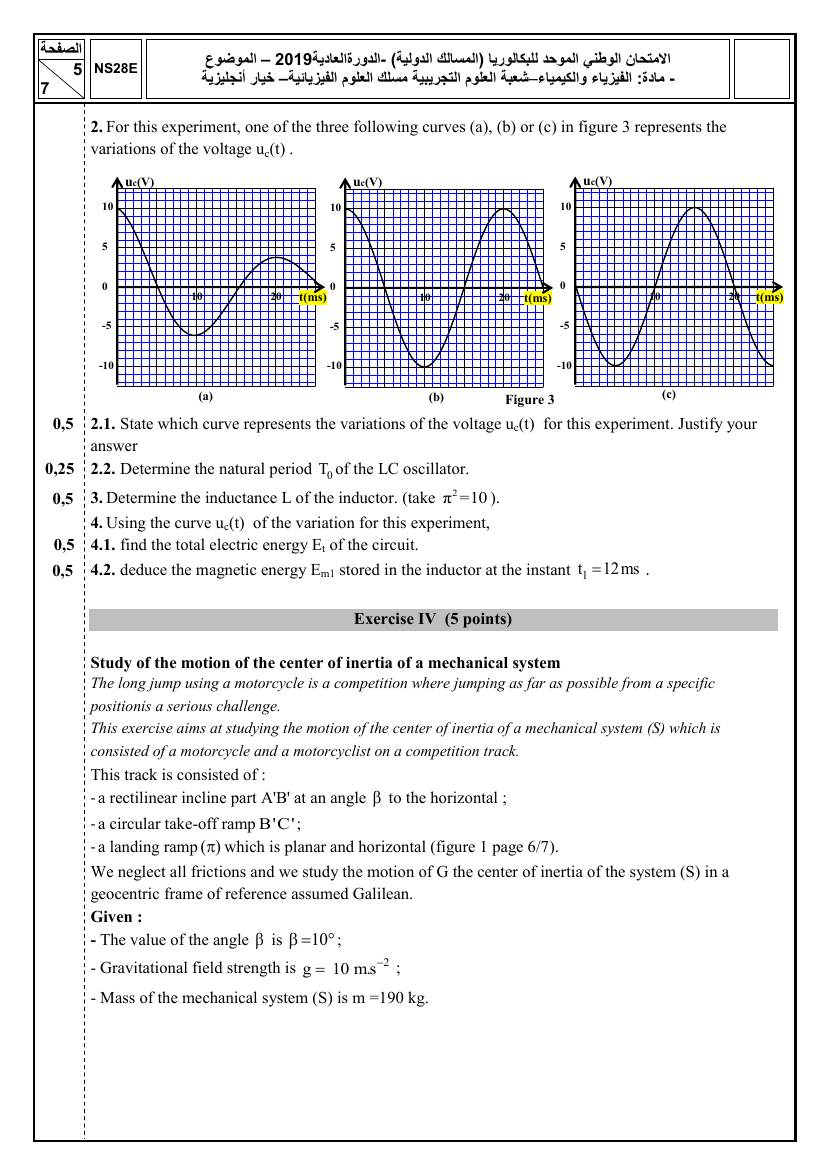
2.For this experiment, one of the three following curves (a), (b) or (c) in figure 3 represents the variations of the voltage uc(t)u_c(t) .

Figure 3 : voir la page 6 du sujet

2.1.State which curve represents the variations of the voltage uc(t)u_c(t) for this experiment. Justify your answer0,5 pt

2.2.Determine the natural period T0T_0 of the LC oscillator.0,25 pt

3.Determine the inductance L of the inductor. (take π2=10\pi^2 = 10 ).0,5 pt

4.Using the curve uc(t)u_c(t) of the variation for this experiment,

4.1.find the total electric energy EtE_t of the circuit.0,5 pt

4.2.deduce the magnetic energy Em1E_{m1} stored in the inductor at the instant t1=12 mst_1 = 12\ \mathrm{ms} .0,5 pt

Exercice 45 pts

Study of the motion of the center of inertia of a mechanical system

The long jump using a motorcycle is a competition where jumping as far as possible from a specific positionis a serious challenge.

This exercise aims at studying the motion of the center of inertia of a mechanical system (S) which is consisted of a motorcycle and a motorcyclist on a competition track.

This track is consisted of :

- a rectilinear incline part A'B' at an angle β\beta to the horizontal ;

- a circular take-off ramp B'C' ;

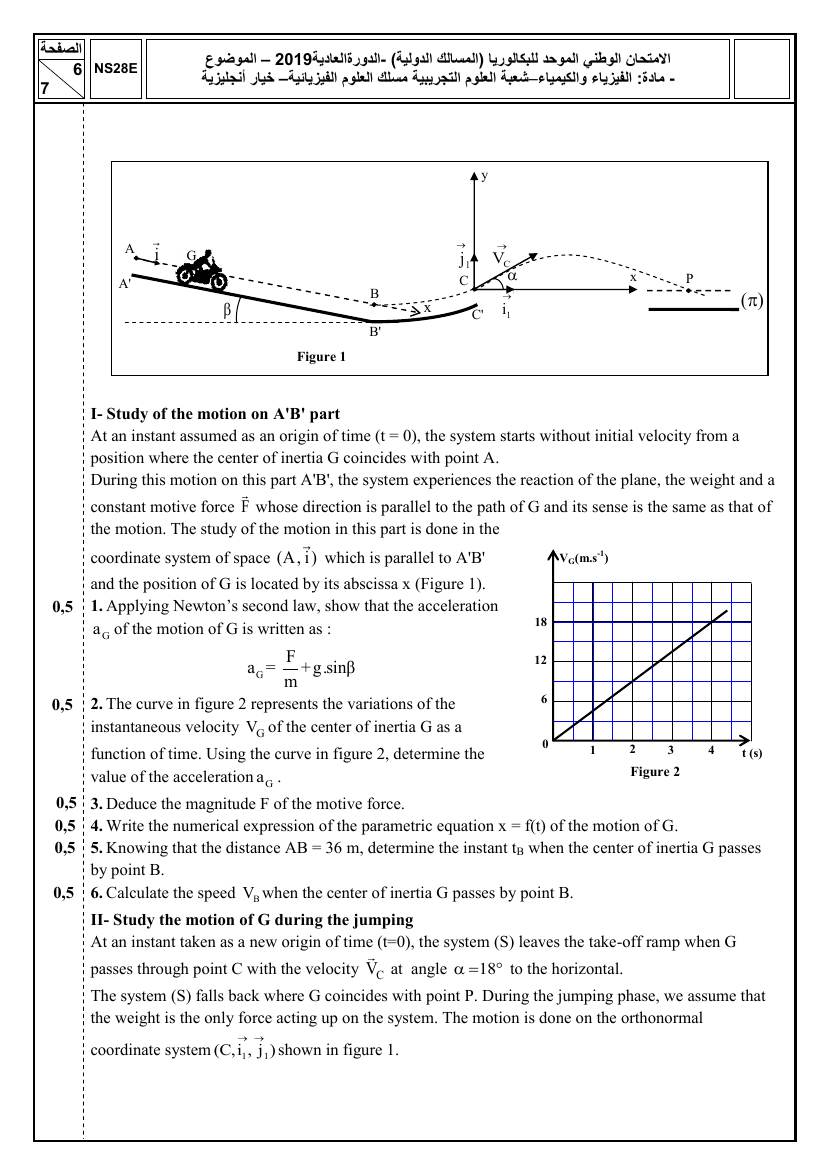
- a landing ramp (π)(\pi) which is planar and horizontal (figure 1 page 6/7).

We neglect all frictions and we study the motion of G the center of inertia of the system (S) in a geocentric frame of reference assumed Galilean.

Given :

- The value of the angle β\beta is β=10∘\beta = 10^{\circ} ;

- Gravitational field strength is g=10 m⋅s−2g = 10\ \mathrm{m\cdot s^{-2}} ;

- Mass of the mechanical system (S) is m=190 kgm = 190\ \mathrm{kg}.

Figure 1 : voir la page 6 du sujet

I- Study of the motion on A'B' part

At an instant assumed as an origin of time (t = 0), the system starts without initial velocity from a position where the center of inertia G coincides with point A.

During this motion on this part A'B', the system experiences the reaction of the plane, the weight and a constant motive force F⃗\vec{F} whose direction is parallel to the path of G and its sense is the same as that of the motion. The study of the motion in this part is done in the coordinate system of space (A,i⃗)(A, \vec{i}) which is parallel to A'B' and the position of G is located by its abscissa x (Figure 1).

1.Applying Newton’s second law, show that the acceleration aGa_G of the motion of G is written as :0,5 pt

aG=Fm+g⋅sin⁡βa_G = \dfrac{F}{m} + g\cdot\sin\beta

Figure 2 : voir la page 6 du sujet

2.The curve in figure 2 represents the variations of the instantaneous velocity VGV_G of the center of inertia G as a function of time. Using the curve in figure 2, determine the value of the acceleration aGa_G .0,5 pt

3.Deduce the magnitude F of the motive force.0,5 pt

4.Write the numerical expression of the parametric equation x = f(t) of the motion of G.0,5 pt

5.Knowing that the distance AB = 36 m, determine the instant tBt_B when the center of inertia G passes by point B.0,5 pt

6.Calculate the speed VBV_B when the center of inertia G passes by point B.0,5 pt

II- Study the motion of G during the jumping

At an instant taken as a new origin of time (t=0), the system (S) leaves the take-off ramp when G passes through point C with the velocity VC⃗\vec{V_C} at angle α=18∘\alpha = 18^{\circ} to the horizontal.

The system (S) falls back where G coincides with point P. During the jumping phase, we assume that the weight is the only force acting up on the system. The motion is done on the orthonormal coordinate system (C,i1⃗,j1⃗)(C, \vec{i_1}, \vec{j_1}) shown in figure 1.

1.Applying Newton’s second law, show that the differential equations verified by coordinates xG(t)x_G(t) and yG(t)y_G(t) of the center of inertia G in the coordinate system (C,i1⃗,j1⃗)(C, \vec{i_1}, \vec{j_1}) are written as:0,5 pt

dxGdt=VC⋅cos⁡αanddyGdt=−g⋅t+VC⋅sin⁡α\dfrac{dx_G}{dt} = V_C\cdot\cos\alpha \qquad \text{and} \qquad \dfrac{dy_G}{dt} = -g\cdot t + V_C\cdot\sin\alpha

2.Knowing that the numerical parametric equations xG(t)x_G(t) and yG(t)y_G(t) of the motion of G are: xG(t)=19,02⋅tx_G(t) = 19{,}02\cdot t and yG(t)=−5⋅t2+6,18⋅ty_G(t) = -5\cdot t^2 + 6{,}18\cdot t (xGx_G and yGy_G are expressed in meters and t in seconds) Verify that the speed of G at point C is VC=20 m⋅s−1V_C = 20\ \mathrm{m\cdot s^{-1}}.0,5 pt

3.A jump is considered succeful when CP≥30 mCP \geq 30\ \mathrm{m} .

3.1.Show that the jump of the motorcyclist in this case has failed.0,5 pt

3.2.Determine VminV_{min} the minimum speed in which the center of inertia G must be passing by point C for the jump to be succeful.0,5 pt

Entraîne-toi sur ces chapitres avec Kresco, gratuitement

Yallah, wa7d l-khtwa.

Le sujet, tu l’as. Maintenant, prépare-le.

Crée ton compte gratuit : une leçon offerte dans chaque chapitre, les quiz et ton suivi, matière par matière, jusqu’au national.