Jerreb rassek f l-national.

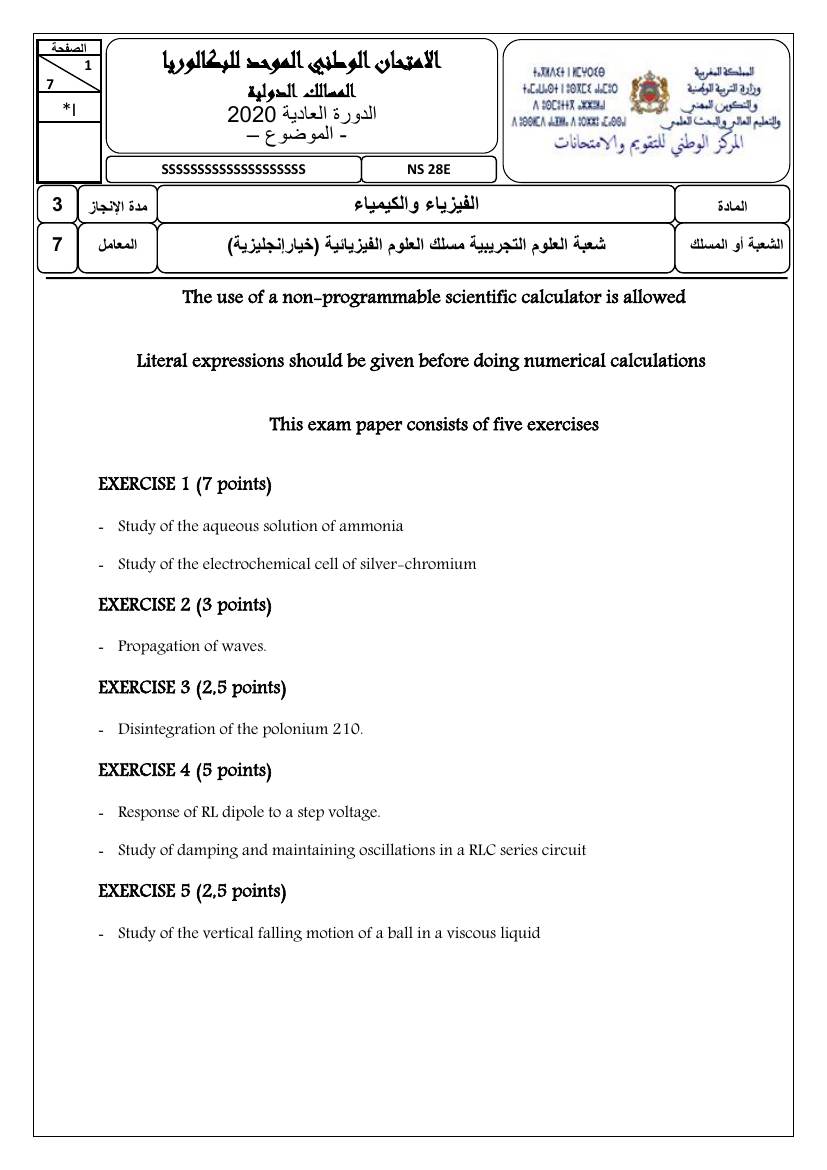
Examen national Physique-Chimie 2Bac PC (option anglaise) 2020, session normale

Physique-Chimie · Sciences Physiques · 7 pages

Le sujet en bref

  1. Exercice 17 pts

    Dosage acido-basique · Réactions acide-base · Piles

    La solution aqueuse d’ammoniac et la pile argent-chrome

  2. Exercice 23 pts

    Ondes mécaniques progressives périodiques · Ondes mécaniques progressives

    Une onde progressive sinusoïdale à la surface de l’eau

  3. Exercice 32,5 pts

    Décroissance radioactive · Noyaux, masse et énergie

    La désintégration du polonium 210

  4. Exercice 45 pts

    Dipôle RL · Oscillations libres d’un circuit RLC série

  5. Exercice 52,5 pts

    Chute verticale d’un solide

    Une bille dans un liquide visqueux

Total : 20 points

Le sujet, page par page

  1. Examen national Physique-Chimie 2Bac PC (option anglaise) 2020, session normale, page 1 sur 7
  2. Examen national Physique-Chimie 2Bac PC (option anglaise) 2020, session normale, page 2 sur 7
  3. Examen national Physique-Chimie 2Bac PC (option anglaise) 2020, session normale, page 3 sur 7
  4. Examen national Physique-Chimie 2Bac PC (option anglaise) 2020, session normale, page 4 sur 7
  5. Examen national Physique-Chimie 2Bac PC (option anglaise) 2020, session normale, page 5 sur 7
  6. Examen national Physique-Chimie 2Bac PC (option anglaise) 2020, session normale, page 6 sur 7
  7. Examen national Physique-Chimie 2Bac PC (option anglaise) 2020, session normale, page 7 sur 7

Sujet officiel de l’examen national unifié du baccalauréat, tel que publié par le Centre national de l’évaluation et des examens (Ministère de l’Éducation nationale).

L’énoncé en texte

Transcription du sujet officiel, pour le lire et le rechercher sur téléphone. Les figures restent sur les pages du sujet ; en cas de différence, le PDF officiel fait foi.

Exercice 17 pts

Part 1 and part 2 are independent

Part 1 : Study of the aqueous solution of ammonia

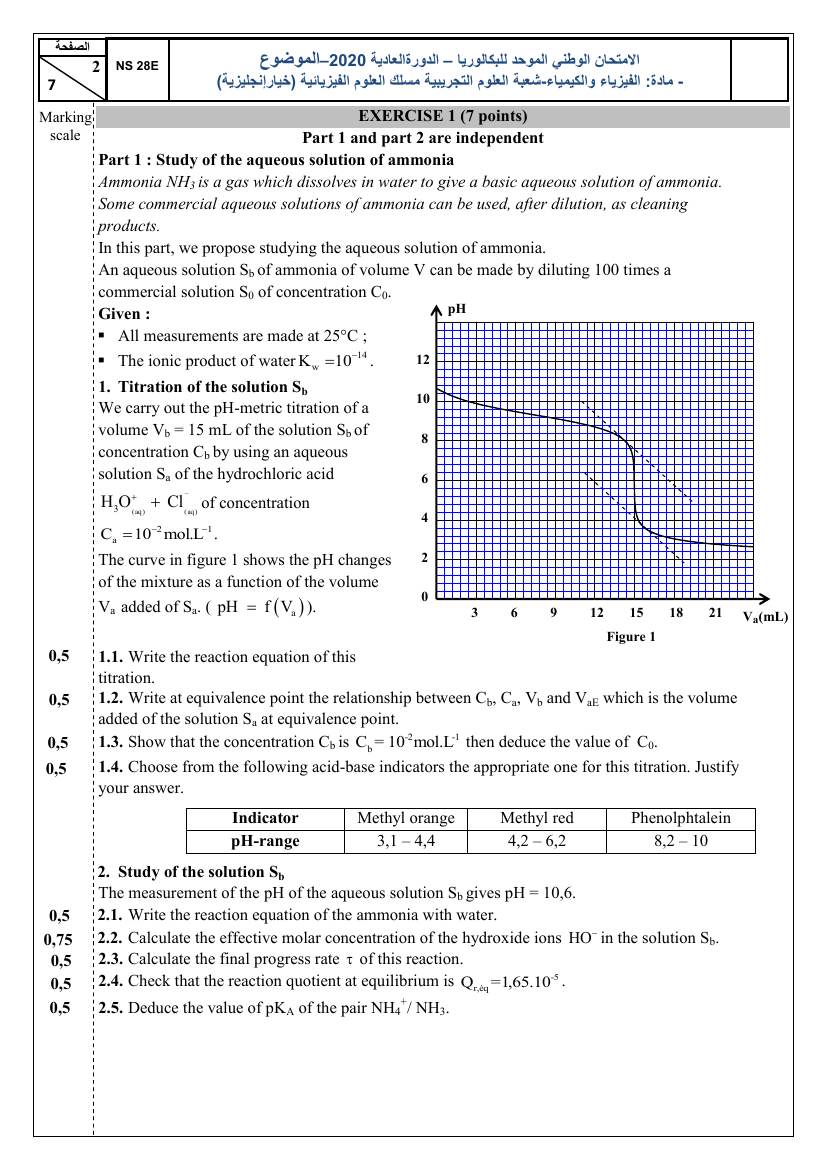
Ammonia NH3\mathrm{NH_3} is a gas which dissolves in water to give a basic aqueous solution of ammonia. Some commercial aqueous solutions of ammonia can be used, after dilution, as cleaning products.

In this part, we propose studying the aqueous solution of ammonia.

An aqueous solution SbS_b of ammonia of volume VV can be made by diluting 100 times a commercial solution S0S_0 of concentration C0C_0.

Given :

All measurements are made at 25°C ;

The ionic product of water Kw=10−14K_w = 10^{-14}.

1. Titration of the solution SbS_b

We carry out the pH-metric titration of a volume Vb=15 mLV_b = 15\ \mathrm{mL} of the solution SbS_b of concentration CbC_b by using an aqueous solution SaS_a of the hydrochloric acid (H3O(aq)++Cl(aq)−)\mathrm{(H_3O^+_{(aq)} + Cl^-_{(aq)})} of concentration Ca=10−2 mol⋅L−1C_a = 10^{-2}\ \mathrm{mol\cdot L^{-1}}.

The curve in figure 1 shows the pH changes of the mixture as a function of the volume VaV_a added of SaS_a. (pH=f(Va)\mathrm{pH} = f(V_a)).

Figure 1 : voir la page 2 du sujet

1.1.Write the reaction equation of this titration.0,5 pt

1.2.Write at equivalence point the relationship between CbC_b, CaC_a, VbV_b and VaEV_{aE} which is the volume added of the solution SaS_a at equivalence point.0,5 pt

1.3.Show that the concentration CbC_b is Cb=10−2 mol⋅L−1C_b = 10^{-2}\ \mathrm{mol\cdot L^{-1}} then deduce the value of C0C_0.0,5 pt

1.4.Choose from the following acid-base indicators the appropriate one for this titration. Justify your answer.0,5 pt

IndicatorMethyl orangeMethyl redPhenolphtalein
pH-range3,1 – 4,44,2 – 6,28,2 – 10

2. Study of the solution SbS_b

The measurement of the pH of the aqueous solution SbS_b gives pH=10,6\mathrm{pH} = 10{,}6.

2.1.Write the reaction equation of the ammonia with water.0,5 pt

2.2.Calculate the effective molar concentration of the hydroxide ions HO−\mathrm{HO^-} in the solution SbS_b.0,75 pt

2.3.Calculate the final progress rate τ\tau of this reaction.0,5 pt

2.4.Check that the reaction quotient at equilibrium is Qr,eˊq=1,65⋅10−5Q_{r,\acute{e}q} = 1{,}65\cdot 10^{-5}.0,5 pt

2.5.Deduce the value of pKA\mathrm{p}K_A of the pair NH4+/NH3\mathrm{NH_4^+/NH_3}.0,5 pt

Part 2 : Study of the electrochemical cell silver-chromium

In this part, we propose studying an electrochemical cell.

This electrochemical cell consists of :

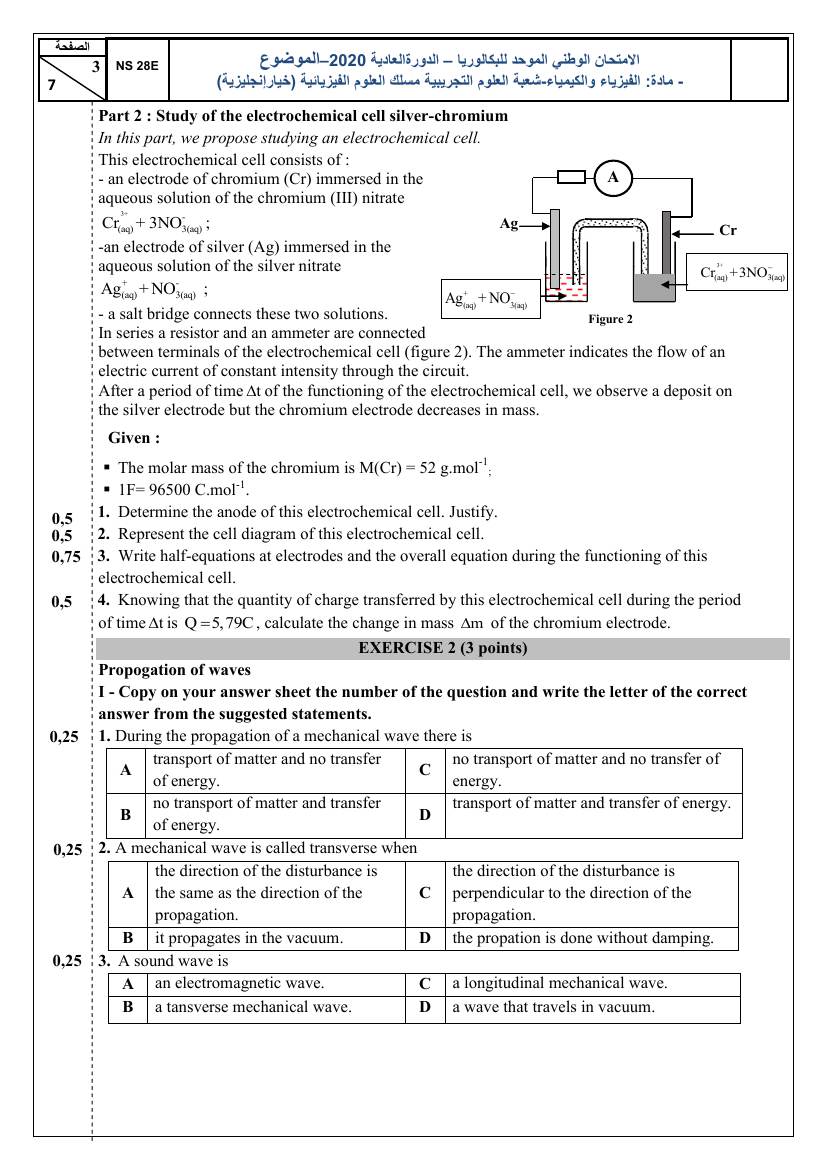
- an electrode of chromium (Cr) immersed in the aqueous solution of the chromium (III) nitrate Cr(aq)3++3NO3(aq)−\mathrm{Cr^{3+}_{(aq)} + 3NO^-_{3(aq)}} ;

- an electrode of silver (Ag) immersed in the aqueous solution of the silver nitrate Ag(aq)++NO3(aq)−\mathrm{Ag^+_{(aq)} + NO^-_{3(aq)}} ;

- a salt bridge connects these two solutions.

In series a resistor and an ammeter are connected between terminals of the electrochemical cell (figure 2). The ammeter indicates the flow of an electric current of constant intensity through the circuit.

Figure 2 : voir la page 3 du sujet

After a period of time Δt\Delta t of the functioning of the electrochemical cell, we observe a deposit on the silver electrode but the chromium electrode decreases in mass.

Given :

The molar mass of the chromium is M(Cr)=52 g⋅mol−1M(\mathrm{Cr}) = 52\ \mathrm{g\cdot mol^{-1}} ;

1 F=96500 C⋅mol−11\,\mathrm{F} = 96500\ \mathrm{C\cdot mol^{-1}}.

1.Determine the anode of this electrochemical cell. Justify.0,5 pt

2.Represent the cell diagram of this electrochemical cell.0,5 pt

3.Write half-equations at electrodes and the overall equation during the functioning of this electrochemical cell.0,75 pt

4.Knowing that the quantity of charge transferred by this electrochemical cell during the period of time Δt\Delta t is Q=5,79 CQ = 5{,}79\ \mathrm{C}, calculate the change in mass Δm\Delta m of the chromium electrode.0,5 pt

Exercice 23 pts

Propogation of waves

I - Copy on your answer sheet the number of the question and write the letter of the correct answer from the suggested statements.

1.During the propagation of a mechanical wave there is0,25 pt

Atransport of matter and no transfer of energy.
Bno transport of matter and transfer of energy.
Cno transport of matter and no transfer of energy.
Dtransport of matter and transfer of energy.

2.A mechanical wave is called transverse when0,25 pt

Athe direction of the disturbance is the same as the direction of the propagation.
Bit propagates in the vacuum.
Cthe direction of the disturbance is perpendicular to the direction of the propagation.
Dthe propation is done without damping.

3.A sound wave is0,25 pt

Aan electromagnetic wave.
Ba tansverse mechanical wave.
Ca longitudinal mechanical wave.
Da wave that travels in vacuum.

4.During the diffraction of a wave,0,25 pt

Athere is a change in the frequency.
Bthere is a change in the wavelength.
Cthere is a change in the wave speed.
Dthere are no changes in the frequency, in the wavelength and in the wave speed.

5.We consider a point M from the surface of the water where a progressive wave propagates. This point M repeats the same motion of the source S with a time delay τ\tau. The relationship between the elongation of M and the elongation of S is:0,25 pt

AyM(t)=ys(t+τ)y_M(t) = y_s(t+\tau)
ByM(t)=ys(t−2τ)y_M(t) = y_s(t-2\tau)
CyM(t)=ys(t+2τ)y_M(t) = y_s(t+2\tau)
DyM(t)=ys(t−τ)y_M(t) = y_s(t-\tau)

II – The source S of a vibrator produces a sinusoidal progressive wave of frequency NN across the surface of the water.

The wave propagates without damping and without reflection with a wave speed v=0,25 m⋅s−1v = 0{,}25\ \mathrm{m\cdot s^{-1}}.

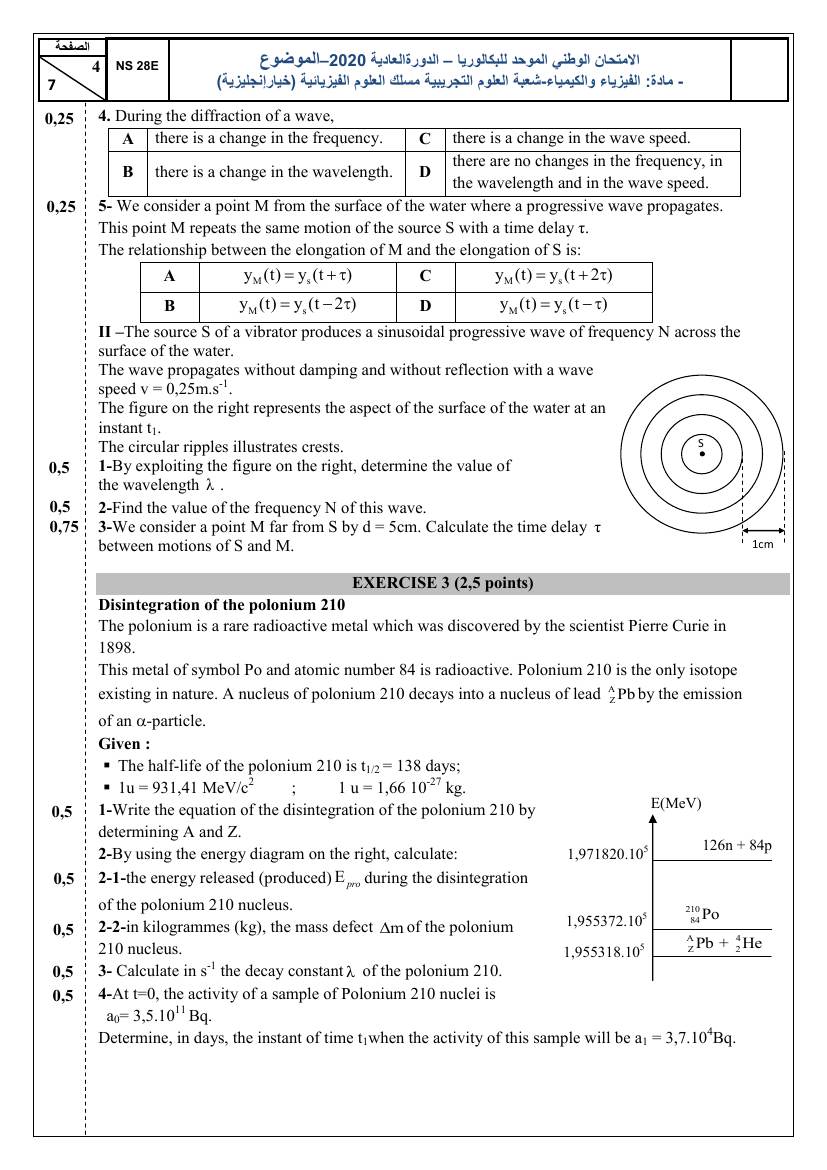
The figure on the right represents the aspect of the surface of the water at an instant t1t_1. The circular ripples illustrates crests.

Figure : voir la page 4 du sujet

1.By exploiting the figure on the right, determine the value of the wavelength λ\lambda.0,5 pt

2.Find the value of the frequency NN of this wave.0,5 pt

3.We consider a point M far from S by d=5 cmd = 5\ \mathrm{cm}. Calculate the time delay τ\tau between motions of S and M.0,75 pt

Revoir le cours : Ondes mécaniques progressives périodiques · Ondes mécaniques progressives

Exercice 32,5 pts

Disintegration of the polonium 210

The polonium is a rare radioactive metal which was discovered by the scientist Pierre Curie in 1898.

This metal of symbol Po and atomic number 84 is radioactive. Polonium 210 is the only isotope existing in nature. A nucleus of polonium 210 decays into a nucleus of lead ZAPb\mathrm{^{A}_{Z}Pb} by the emission of an α\alpha-particle.

Given :

The half-life of the polonium 210 is t1/2=138t_{1/2} = 138 days ;

1 u=931,41 MeV/c21\,\mathrm{u} = 931{,}41\ \mathrm{MeV/c^2} ; 1 u=1,66⋅10−27 kg1\,\mathrm{u} = 1{,}66\cdot 10^{-27}\ \mathrm{kg}.

Figure : voir la page 5 du sujet

1.Write the equation of the disintegration of the polonium 210 by determining A and Z.0,5 pt

2- By using the energy diagram on the right, calculate:

2-1.the energy released (produced) EproE_{pro} during the disintegration of the polonium 210 nucleus.0,5 pt

2-2.in kilogrammes (kg), the mass defect Δm\Delta m of the polonium 210 nucleus.0,5 pt

3.Calculate in s−1\mathrm{s^{-1}} the decay constant λ\lambda of the polonium 210.0,5 pt

4.At t=0t=0, the activity of a sample of Polonium 210 nuclei is a0=3,5⋅1011 Bqa_0 = 3{,}5\cdot 10^{11}\ \mathrm{Bq}. Determine, in days, the instant of time t1t_1 when the activity of this sample will be a1=3,7⋅104 Bqa_1 = 3{,}7\cdot 10^{4}\ \mathrm{Bq}.0,5 pt

Revoir le cours : Décroissance radioactive · Noyaux, masse et énergie

Exercice 45 pts

Many electric and electronic devices are made of capacitors and inductors as essential components.

This exercise aims at studying:

- the response of RL dipole to a step voltage.

- the discharging of a capacitor in a RL dipole

- the maintaining of oscillations in a RLC series circuit

I- The response of RL dipole to a step voltage.

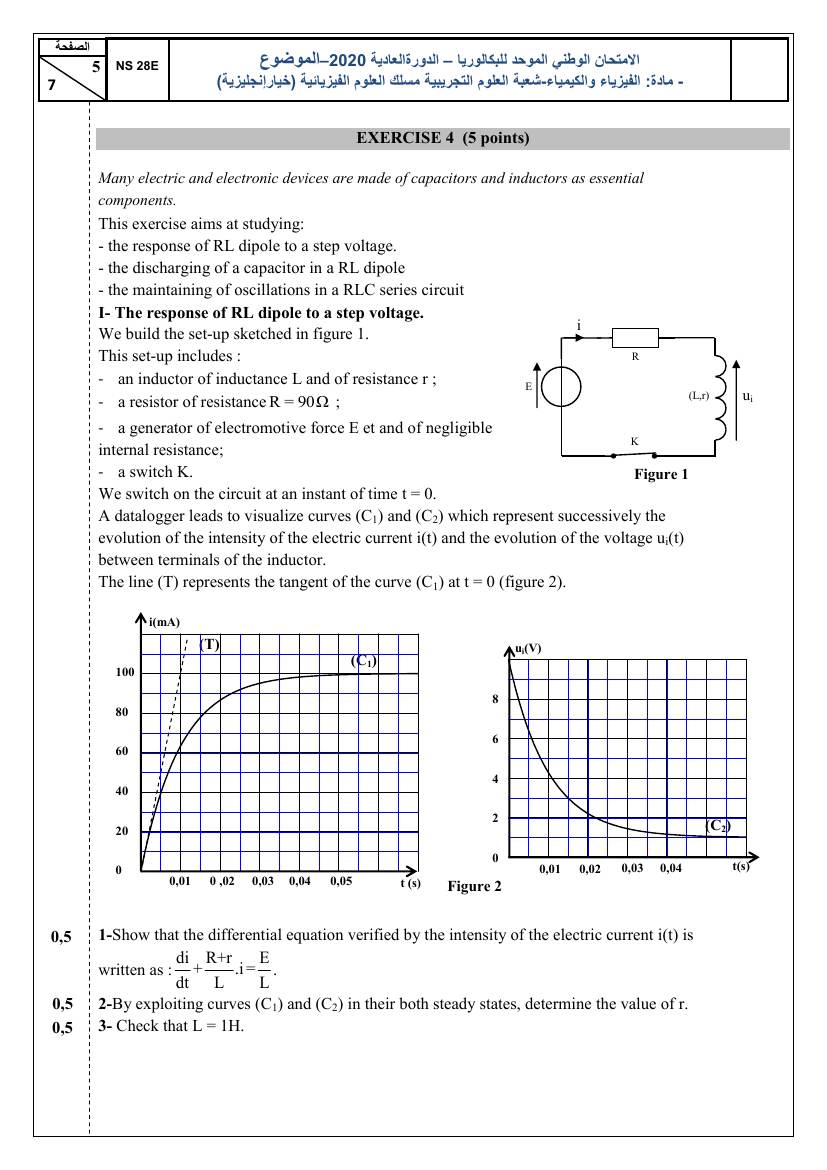
We build the set-up sketched in figure 1.

This set-up includes :

- an inductor of inductance LL and of resistance rr ;

- a resistor of resistance R=90 ΩR = 90\ \Omega ;

- a generator of electromotive force EE et and of negligible internal resistance;

- a switch K.

Figure 1 : voir la page 5 du sujet

We switch on the circuit at an instant of time t=0t = 0.

A datalogger leads to visualize curves (C1)(C_1) and (C2)(C_2) which represent successively the evolution of the intensity of the electric current i(t)i(t) and the evolution of the voltage ui(t)u_i(t) between terminals of the inductor.

The line (T)(T) represents the tangent of the curve (C1)(C_1) at t=0t = 0 (figure 2).

Figure 2 : voir la page 5 du sujet

1.Show that the differential equation verified by the intensity of the electric current i(t)i(t) is written as : didt+R+rL⋅i=EL\dfrac{di}{dt} + \dfrac{R+r}{L}\cdot i = \dfrac{E}{L}.0,5 pt

2.By exploiting curves (C1)(C_1) and (C2)(C_2) in their both steady states, determine the value of rr.0,5 pt

3.Check that L=1 HL = 1\ \mathrm{H}.0,5 pt

II - Discharging a capacitor in a RL dipole

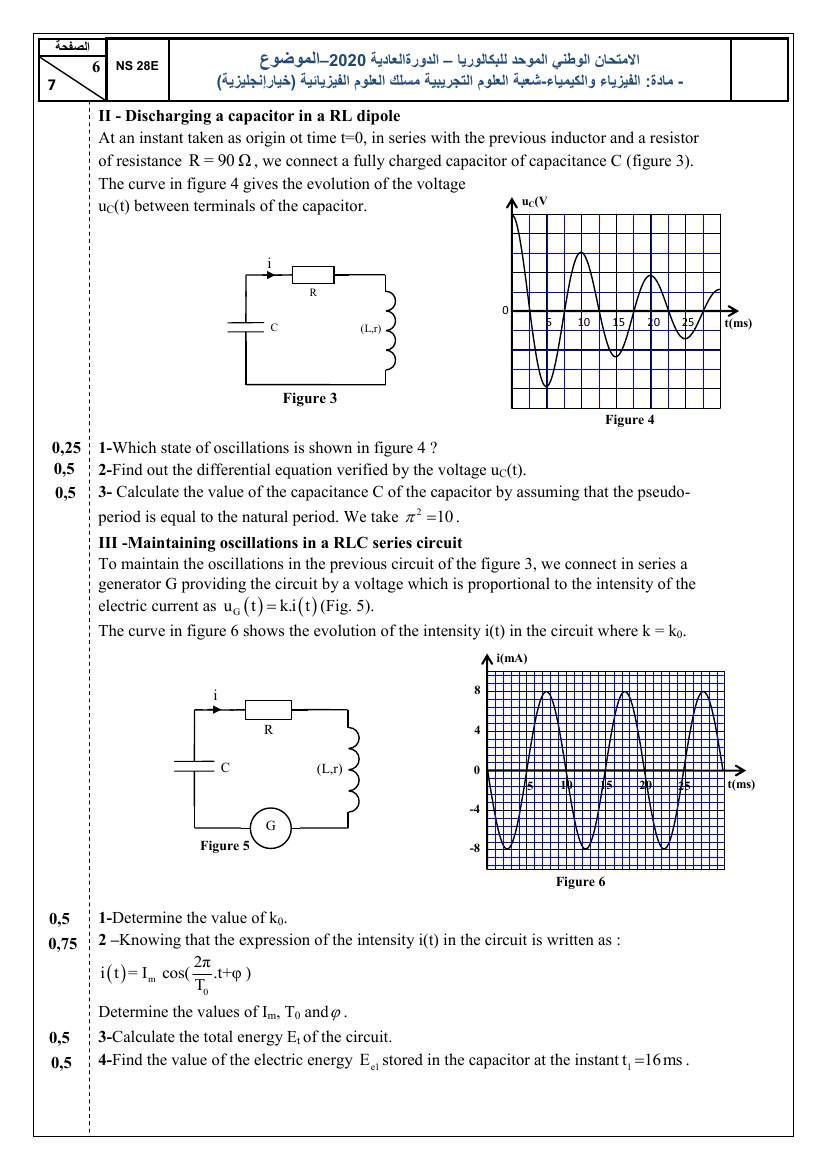
At an instant taken as origin ot time t=0t=0, in series with the previous inductor and a resistor of resistance R=90 ΩR = 90\ \Omega, we connect a fully charged capacitor of capacitance CC (figure 3).

The curve in figure 4 gives the evolution of the voltage uC(t)u_C(t) between terminals of the capacitor.

Figure 3 : voir la page 6 du sujet

Figure 4 : voir la page 6 du sujet

1.Which state of oscillations is shown in figure 4 ?0,25 pt

2.Find out the differential equation verified by the voltage uC(t)u_C(t).0,5 pt

3.Calculate the value of the capacitance CC of the capacitor by assuming that the pseudo-period is equal to the natural period. We take π2=10\pi^2 = 10.0,5 pt

III - Maintaining oscillations in a RLC series circuit

To maintain the oscillations in the previous circuit of the figure 3, we connect in series a generator G providing the circuit by a voltage which is proportional to the intensity of the electric current as uG(t)=k⋅i(t)u_G(t) = k\cdot i(t) (Fig. 5).

The curve in figure 6 shows the evolution of the intensity i(t)i(t) in the circuit where k=k0k = k_0.

Figure 5 : voir la page 6 du sujet

Figure 6 : voir la page 6 du sujet

1.Determine the value of k0k_0.0,5 pt

2.Knowing that the expression of the intensity i(t)i(t) in the circuit is written as : i(t)=Imcos⁡(2πT0⋅t+φ)i(t) = I_m \cos\left(\dfrac{2\pi}{T_0}\cdot t + \varphi\right). Determine the values of ImI_m, T0T_0 and φ\varphi.0,75 pt

3.Calculate the total energy EtE_t of the circuit.0,5 pt

4.Find the value of the electric energy Ee1E_{e1} stored in the capacitor at the instant t1=16 mst_1 = 16\ \mathrm{ms}.0,5 pt

Exercice 52,5 pts

Study of the vertical falling motion of a ball in a viscous liquid

We suggest studying the vertical falling motion with friction in a viscous liquid of a homogeneous ball of mass mm.

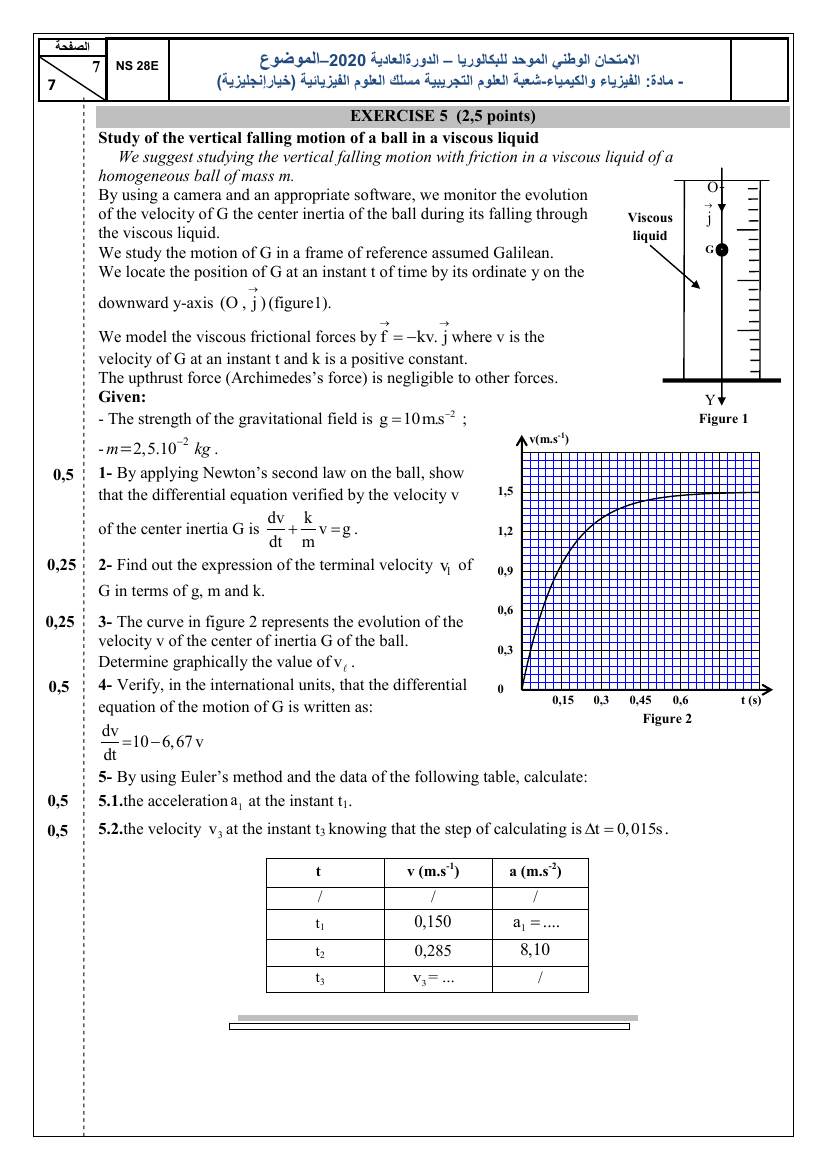
By using a camera and an appropriate software, we monitor the evolution of the velocity of G the center inertia of the ball during its falling through the viscous liquid.

We study the motion of G in a frame of reference assumed Galilean.

We locate the position of G at an instant tt of time by its ordinate yy on the downward y-axis (O,j⃗)(O, \vec{j}) (figure1).

Figure 1 : voir la page 7 du sujet

We model the viscous frictional forces by f⃗=−kv⋅j⃗\vec{f} = -kv\cdot\vec{j} where vv is the velocity of G at an instant tt and kk is a positive constant.

The upthrust force (Archimedes’s force) is negligible to other forces.

Given:

- The strength of the gravitational field is g=10 m⋅s−2g = 10\ \mathrm{m\cdot s^{-2}} ;

- m=2,5⋅10−2 kgm = 2{,}5\cdot 10^{-2}\ \mathrm{kg}.

Figure 2 : voir la page 7 du sujet

1.By applying Newton’s second law on the ball, show that the differential equation verified by the velocity vv of the center inertia G is dvdt+kmv=g\dfrac{dv}{dt} + \dfrac{k}{m}v = g.0,5 pt

2.Find out the expression of the terminal velocity vℓv_\ell of G in terms of gg, mm and kk.0,25 pt

3.The curve in figure 2 represents the evolution of the velocity vv of the center of inertia G of the ball. Determine graphically the value of vℓv_\ell.0,25 pt

4.Verify, in the international units, that the differential equation of the motion of G is written as: dvdt=10−6,67 v\dfrac{dv}{dt} = 10 - 6{,}67\,v0,5 pt

5- By using Euler’s method and the data of the following table, calculate:

5.1.the acceleration a1a_1 at the instant t1t_1.0,5 pt

5.2.the velocity v3v_3 at the instant t3t_3 knowing that the step of calculating is Δt=0,015 s\Delta t = 0{,}015\ \mathrm{s}.0,5 pt

ttv (m⋅s−1)v\ (\mathrm{m\cdot s^{-1}})a (m⋅s−2)a\ (\mathrm{m\cdot s^{-2}})
///
t1t_10,150a1=…a_1 = \ldots
t2t_20,2858,10
t3t_3v3=…v_3 = \ldots/
Entraîne-toi sur ces chapitres avec Kresco, gratuitement

Yallah, wa7d l-khtwa.

Le sujet, tu l’as. Maintenant, prépare-le.

Crée ton compte gratuit : une leçon offerte dans chaque chapitre, les quiz et ton suivi, matière par matière, jusqu’au national.