Jerreb rassek f l-national.

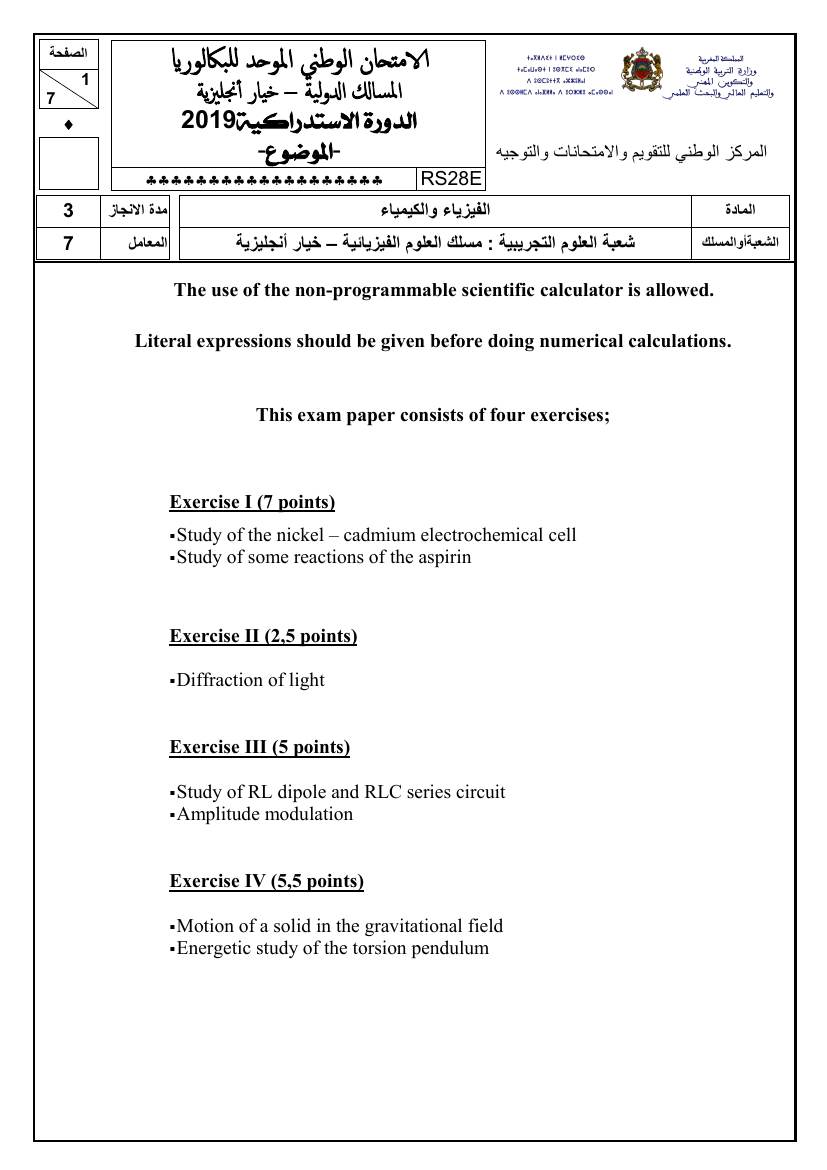
Examen national Physique-Chimie 2Bac PC (option anglaise) 2019, session de rattrapage

Physique-Chimie · Sciences Physiques · 7 pages

Le sujet en bref

  1. Exercice 17 pts

    Piles · Dosage acido-basique · Suivi temporel d’une transformation chimique

    La pile nickel-cadmium et des réactions de l’aspirine

  2. Exercice 22,5 pts

    Propagation des ondes lumineuses

    La diffraction d’un rayonnement laser rouge par une fente

  3. Exercice 35 pts

    Dipôle RL · Oscillations libres d’un circuit RLC série · Ondes électromagnétiques et modulation d’amplitude

    La détermination des caractéristiques d’un condensateur et d’une bobine

  4. Exercice 45,5 pts

    Chute verticale d’un solide · Aspects énergétiques des oscillations

    Une balle lancée verticalement vers le haut et un pendule de torsion

Total : 20 points

Le sujet, page par page

  1. Examen national Physique-Chimie 2Bac PC (option anglaise) 2019, session de rattrapage, page 1 sur 7
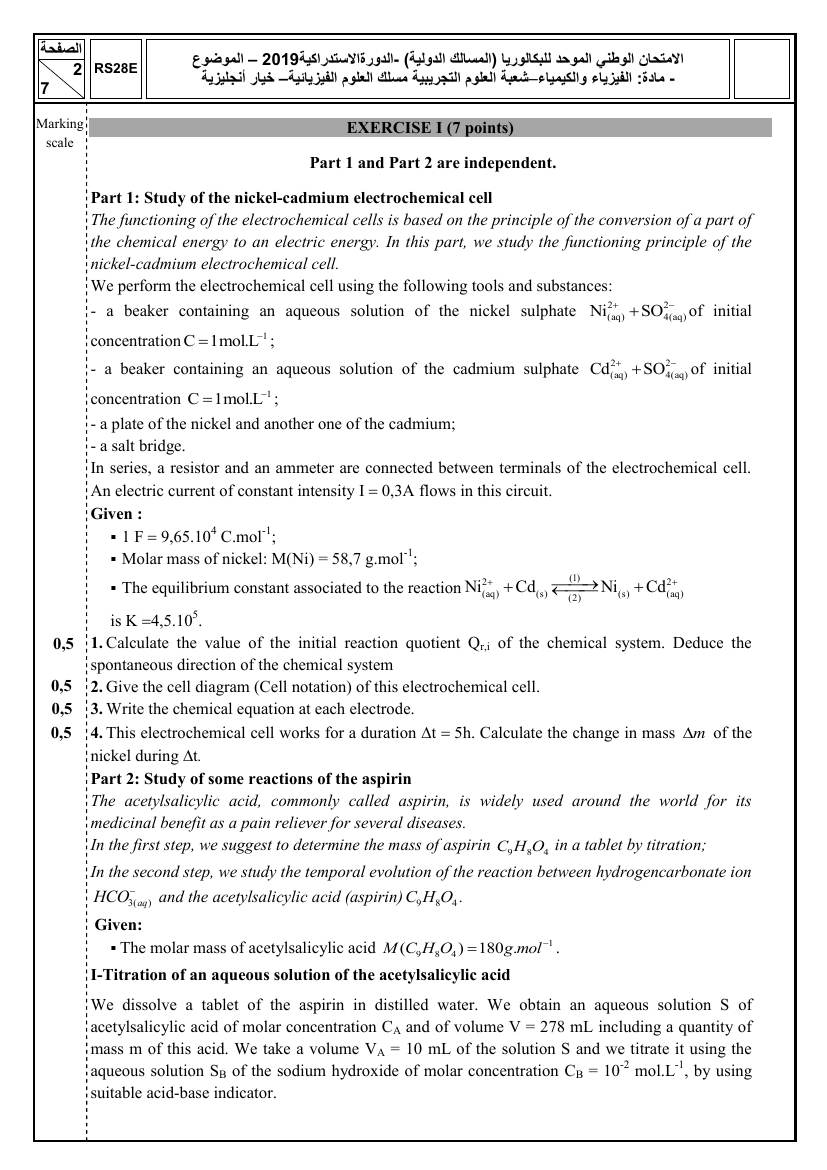
  2. Examen national Physique-Chimie 2Bac PC (option anglaise) 2019, session de rattrapage, page 2 sur 7
  3. Examen national Physique-Chimie 2Bac PC (option anglaise) 2019, session de rattrapage, page 3 sur 7
  4. Examen national Physique-Chimie 2Bac PC (option anglaise) 2019, session de rattrapage, page 4 sur 7
  5. Examen national Physique-Chimie 2Bac PC (option anglaise) 2019, session de rattrapage, page 5 sur 7
  6. Examen national Physique-Chimie 2Bac PC (option anglaise) 2019, session de rattrapage, page 6 sur 7
  7. Examen national Physique-Chimie 2Bac PC (option anglaise) 2019, session de rattrapage, page 7 sur 7

Sujet officiel de l’examen national unifié du baccalauréat, tel que publié par le Centre national de l’évaluation et des examens (Ministère de l’Éducation nationale).

L’énoncé en texte

Transcription du sujet officiel, pour le lire et le rechercher sur téléphone. Les figures restent sur les pages du sujet ; en cas de différence, le PDF officiel fait foi.

Exercice 17 pts

Part 1 and Part 2 are independent.

Part 1: Study of the nickel-cadmium electrochemical cell

The functioning of the electrochemical cells is based on the principle of the conversion of a part of the chemical energy to an electric energy. In this part, we study the functioning principle of the nickel-cadmium electrochemical cell.

We perform the electrochemical cell using the following tools and substances:

- a beaker containing an aqueous solution of the nickel sulphate Ni(aq)2++SO4(aq)2−\mathrm{Ni^{2+}_{(aq)} + SO_{4(aq)}^{2-}} of initial concentration C=1 mol⋅L−1C = 1\ \mathrm{mol\cdot L^{-1}} ;

- a beaker containing an aqueous solution of the cadmium sulphate Cd(aq)2++SO4(aq)2−\mathrm{Cd^{2+}_{(aq)} + SO_{4(aq)}^{2-}} of initial concentration C=1 mol⋅L−1C = 1\ \mathrm{mol\cdot L^{-1}} ;

- a plate of the nickel and another one of the cadmium;

- a salt bridge.

In series, a resistor and an ammeter are connected between terminals of the electrochemical cell. An electric current of constant intensity I=0,3 AI = 0{,}3\ \mathrm{A} flows in this circuit.

Given :

- 1 F=9,65⋅104 C⋅mol−11\ \mathrm{F} = 9{,}65\cdot 10^{4}\ \mathrm{C\cdot mol^{-1}} ;

- Molar mass of nickel: M(Ni)=58,7 g⋅mol−1M(\mathrm{Ni}) = 58{,}7\ \mathrm{g\cdot mol^{-1}} ;

- The equilibrium constant associated to the reaction Ni(aq)2++Cd(s)⇄Ni(s)+Cd(aq)2+\mathrm{Ni^{2+}_{(aq)} + Cd_{(s)} \rightleftarrows Ni_{(s)} + Cd^{2+}_{(aq)}} (direct reaction labelled (1), reverse reaction labelled (2)) is K=4,5⋅105K = 4{,}5\cdot 10^{5}.

1.Calculate the value of the initial reaction quotient Qr,iQ_{r,i} of the chemical system. Deduce the spontaneous direction of the chemical system0,5 pt

2.Give the cell diagram (Cell notation) of this electrochemical cell.0,5 pt

3.Write the chemical equation at each electrode.0,5 pt

4.This electrochemical cell works for a duration Δt=5 h\Delta t = 5\ \mathrm{h}. Calculate the change in mass Δm\Delta m of the nickel during Δt\Delta t.0,5 pt

Part 2: Study of some reactions of the aspirin

The acetylsalicylic acid, commonly called aspirin, is widely used around the world for its medicinal benefit as a pain reliever for several diseases.

In the first step, we suggest to determine the mass of aspirin C9H8O4\mathrm{C_9H_8O_4} in a tablet by titration;

In the second step, we study the temporal evolution of the reaction between hydrogencarbonate ion HCO3(aq)−\mathrm{HCO^-_{3(aq)}} and the acetylsalicylic acid (aspirin) C9H8O4\mathrm{C_9H_8O_4}.

Given:

- The molar mass of acetylsalicylic acid M(C9H8O4)=180 g⋅mol−1M(\mathrm{C_9H_8O_4}) = 180\ \mathrm{g\cdot mol^{-1}}.

I-Titration of an aqueous solution of the acetylsalicylic acid

We dissolve a tablet of the aspirin in distilled water. We obtain an aqueous solution S of acetylsalicylic acid of molar concentration CAC_A and of volume V=278 mLV = 278\ \mathrm{mL} including a quantity of mass mm of this acid. We take a volume VA=10 mLV_A = 10\ \mathrm{mL} of the solution S and we titrate it using the aqueous solution SBS_B of the sodium hydroxide of molar concentration CB=10−2 mol⋅L−1C_B = 10^{-2}\ \mathrm{mol\cdot L^{-1}}, by using suitable acid-base indicator.

1.Write the equation of titration.(We denote by AH the acetylsalicylic acid C9H8O4\mathrm{C_9H_8O_4} and by A−\mathrm{A^-} its conjugate base)0,5 pt

2. The equivalence point is obtained by pouring a volume VBE=10 mLV_{BE} = 10\ \mathrm{mL} of the solution SBS_B.

2.1.Determine the concentration CAC_A of the solution S.0,5 pt

2.2.Show that m=0,5 gm = 0{,}5\ \mathrm{g}.0,5 pt

3.Which acid-base indicator of the ones given in the table below is the suitable for this acid-base titration? Justify0,5 pt

Acid-base indicatorMethyl yellowHelianthineCresol red
pH range2,9 – 43,1 – 4,47,2 – 8,8

II-Study of the reaction between the hydrogencarbonate ion and the acetylsalicylic acid

The equation of the reaction between the hydrogencarbonate ion HCO3(aq)−\mathrm{HCO^-_{3(aq)}} and the acetylsalicylic acid is written as:

C9H8O4(aq)+HCO3(aq)−→C9H7O4(aq)−+CO2(g)+H2O(l)\mathrm{C_9H_8O_{4(aq)} + HCO^-_{3(aq)} \rightarrow C_9H_7O^-_{4(aq)} + CO_{2(g)} + H_2O_{(l)}}

To perform the temporal monitoring of this chemical reaction we pour into a flask, V=10 mLV = 10\ \mathrm{mL} of the aqueous solution of the sodium hydrogencarbonate Na(aq)++HCO3(aq)−\mathrm{Na^+_{(aq)} + HCO^-_{3(aq)}} ; its molar concentration is [HCO3−]0=C=0,5 mol⋅L−1[\mathrm{HCO_3^-}]_0 = C = 0{,}5\ \mathrm{mol\cdot L^{-1}} then at t=0, we add a quantity of mass m=0,5 gm = 0{,}5\ \mathrm{g} of the acetylsalicylic acid. (The volume of the reaction mixture is considered constant V=10 mLV = 10\ \mathrm{mL}).

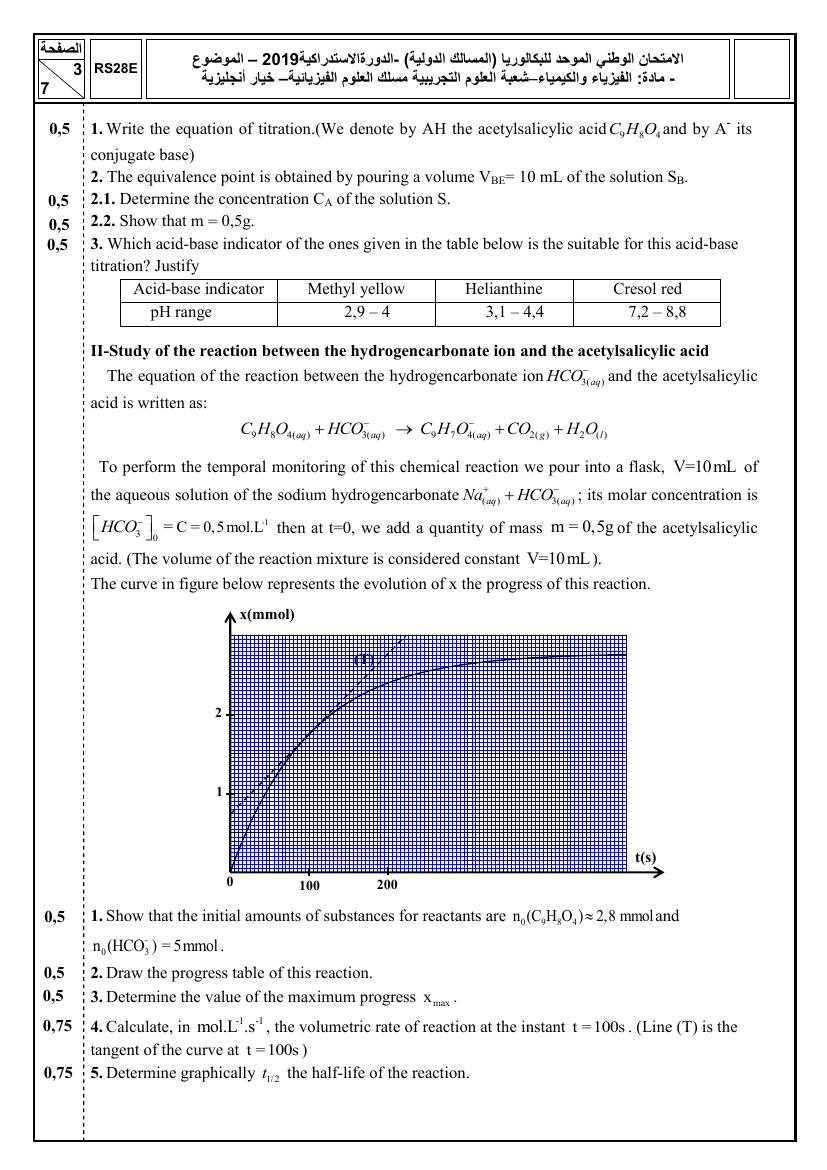
The curve in figure below represents the evolution of x the progress of this reaction.

Figure : voir la page 3 du sujet

1.Show that the initial amounts of substances for reactants are n0(C9H8O4)≈2,8 mmoln_0(\mathrm{C_9H_8O_4}) \approx 2{,}8\ \mathrm{mmol} and n0(HCO3−)=5 mmoln_0(\mathrm{HCO_3^-}) = 5\ \mathrm{mmol}.0,5 pt

2.Draw the progress table of this reaction.0,5 pt

3.Determine the value of the maximum progress xmaxx_{max}.0,5 pt

4.Calculate, in mol⋅L−1⋅s−1\mathrm{mol\cdot L^{-1}\cdot s^{-1}}, the volumetric rate of reaction at the instant t=100 st = 100\ \mathrm{s}. (Line (T) is the tangent of the curve at t=100 st = 100\ \mathrm{s})0,75 pt

5.Determine graphically t1/2t_{1/2} the half-life of the reaction.0,75 pt

Revoir le cours : Suivi temporel d’une transformation chimique

Exercice 22,5 pts

Study of the diffraction of light

The diffraction phenomenon highlights the wave aspect of the light. Many applications in different fields are based on this phenomenon such as in the industry, the new technology, etc

This exercise aims at determining the wavelength of an emitted radiation by a Laser source.

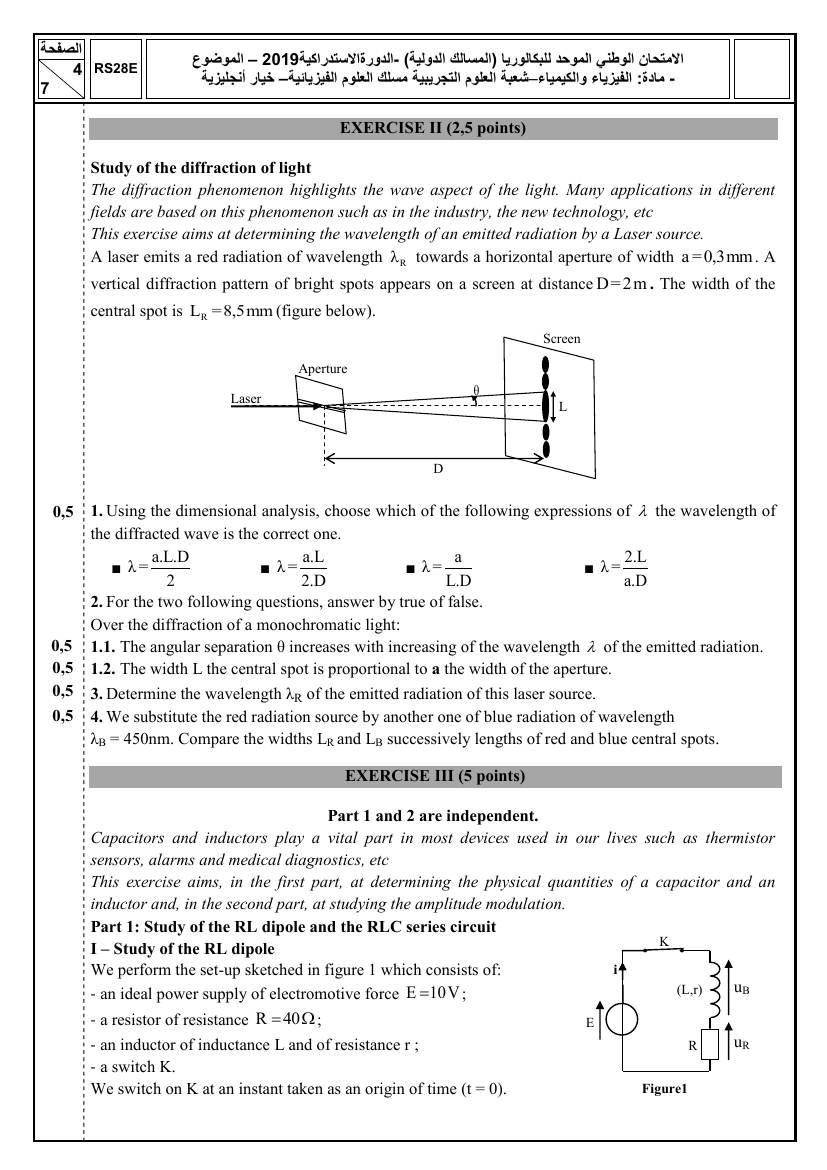
A laser emits a red radiation of wavelength λR\lambda_R towards a horizontal aperture of width a=0,3 mma = 0{,}3\ \mathrm{mm}. A vertical diffraction pattern of bright spots appears on a screen at distance D=2 mD = 2\ \mathrm{m}. The width of the central spot is LR=8,5 mmL_R = 8{,}5\ \mathrm{mm} (figure below).

Figure : voir la page 4 du sujet

1.Using the dimensional analysis, choose which of the following expressions of λ\lambda the wavelength of the diffracted wave is the correct one.0,5 pt

■ λ=a.L.D2\lambda = \dfrac{a.L.D}{2} ■ λ=a.L2.D\lambda = \dfrac{a.L}{2.D} ■ λ=aL.D\lambda = \dfrac{a}{L.D} ■ λ=2.La.D\lambda = \dfrac{2.L}{a.D}

2. For the two following questions, answer by true of false.

Over the diffraction of a monochromatic light:

1.1.The angular separation θ\theta increases with increasing of the wavelength λ\lambda of the emitted radiation.0,5 pt

1.2.The width L the central spot is proportional to aa the width of the aperture.0,5 pt

3.Determine the wavelength λR\lambda_R of the emitted radiation of this laser source.0,5 pt

4.We substitute the red radiation source by another one of blue radiation of wavelength λB=450 nm\lambda_B = 450\ \mathrm{nm}. Compare the widths LRL_R and LBL_B successively lengths of red and blue central spots.0,5 pt

Revoir le cours : Propagation des ondes lumineuses

Exercice 35 pts

Part 1 and 2 are independent.

Capacitors and inductors play a vital part in most devices used in our lives such as thermistor sensors, alarms and medical diagnostics, etc

This exercise aims, in the first part, at determining the physical quantities of a capacitor and an inductor and, in the second part, at studying the amplitude modulation.

Part 1: Study of the RL dipole and the RLC series circuit

I – Study of the RL dipole

We perform the set-up sketched in figure 1 which consists of:

- an ideal power supply of electromotive force E=10 VE = 10\ \mathrm{V} ;

- a resistor of resistance R=40 ΩR = 40\ \Omega ;

- an inductor of inductance L and of resistance r ;

- a switch K.

We switch on K at an instant taken as an origin of time (t = 0).

Figure1 : voir la page 4 du sujet

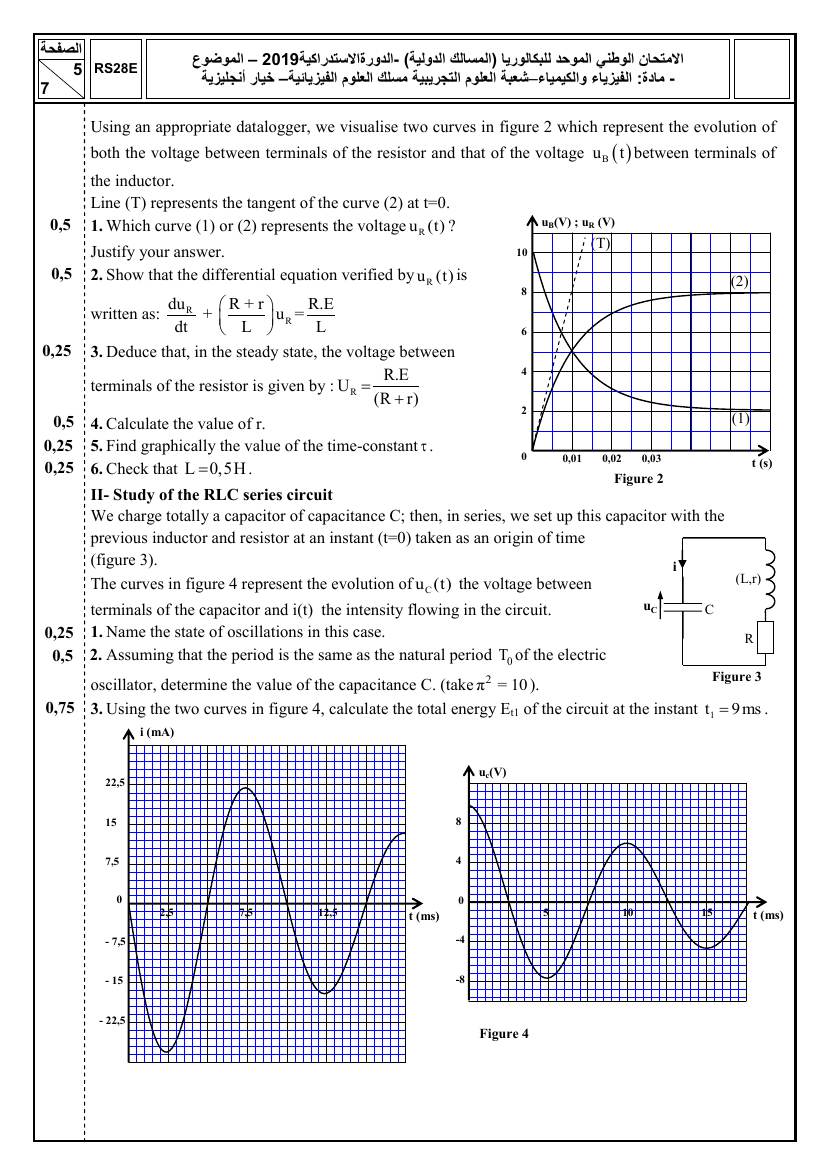
Using an appropriate datalogger, we visualise two curves in figure 2 which represent the evolution of both the voltage between terminals of the resistor and that of the voltage uB(t)u_B(t) between terminals of the inductor.

Line (T) represents the tangent of the curve (2) at t=0.

Figure 2 : voir la page 5 du sujet

1.Which curve (1) or (2) represents the voltage uR(t)u_R(t) ? Justify your answer.0,5 pt

2.Show that the differential equation verified by uR(t)u_R(t) is written as: duRdt+(R+rL)uR=R.EL\dfrac{du_R}{dt} + \left(\dfrac{R+r}{L}\right)u_R = \dfrac{R.E}{L}0,5 pt

3.Deduce that, in the steady state, the voltage between terminals of the resistor is given by : UR=R.E(R+r)U_R = \dfrac{R.E}{(R+r)}0,25 pt

4.Calculate the value of r.0,5 pt

5.Find graphically the value of the time-constant τ\tau.0,25 pt

6.Check that L=0,5 HL = 0{,}5\ \mathrm{H}.0,25 pt

II- Study of the RLC series circuit

We charge totally a capacitor of capacitance C; then, in series, we set up this capacitor with the previous inductor and resistor at an instant (t=0) taken as an origin of time (figure 3).

Figure 3 : voir la page 5 du sujet

The curves in figure 4 represent the evolution of uC(t)u_C(t) the voltage between terminals of the capacitor and i(t) the intensity flowing in the circuit.

1.Name the state of oscillations in this case.0,25 pt

2.Assuming that the period is the same as the natural period T0T_0 of the electric oscillator, determine the value of the capacitance C. (take π2=10\pi^2 = 10).0,5 pt

3.Using the two curves in figure 4, calculate the total energy Et1E_{t1} of the circuit at the instant t1=9 mst_1 = 9\ \mathrm{ms}.0,75 pt

Figure 4 : voir la page 5 du sujet

Part 2: Amplitude modulation

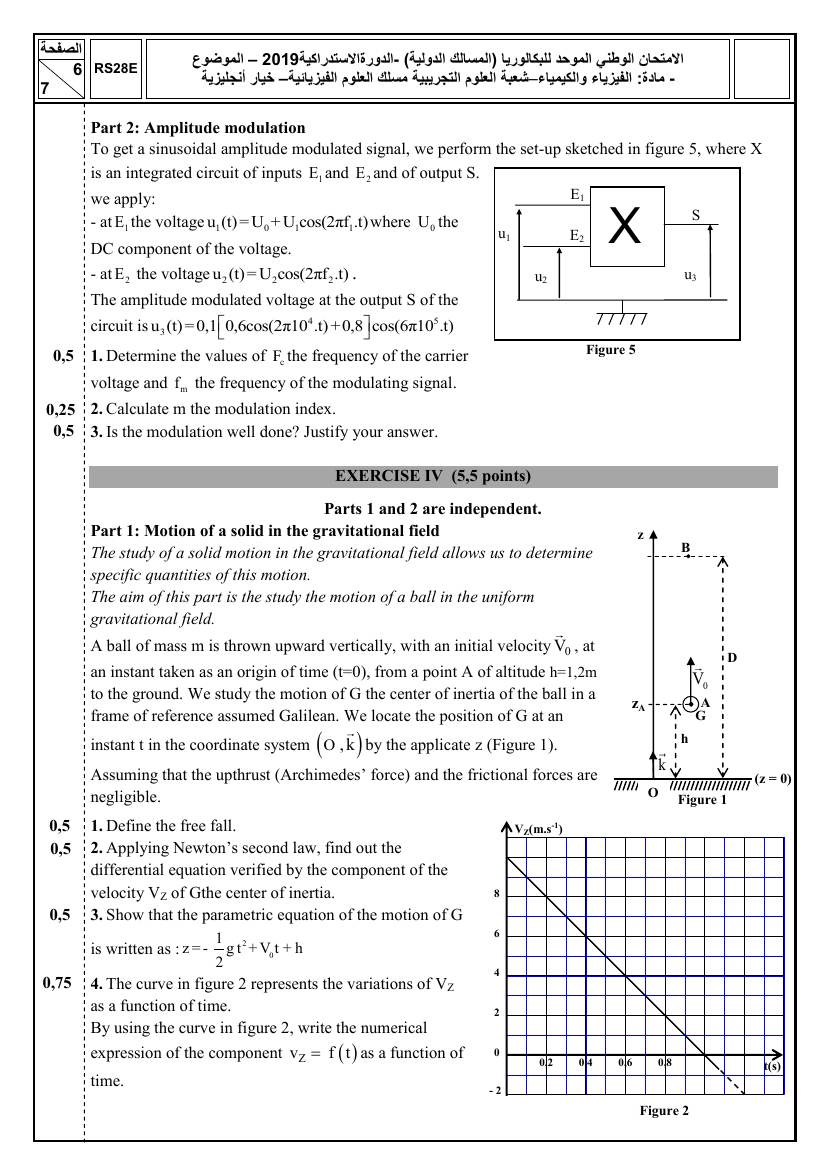
To get a sinusoidal amplitude modulated signal, we perform the set-up sketched in figure 5, where X is an integrated circuit of inputs E1E_1 and E2E_2 and of output S.

Figure 5 : voir la page 6 du sujet

we apply:

- at E1E_1 the voltage u1(t)=U0+U1cos⁡(2πf1.t)u_1(t) = U_0 + U_1\cos(2\pi f_1.t) where U0U_0 the DC component of the voltage.

- at E2E_2 the voltage u2(t)=U2cos⁡(2πf2.t)u_2(t) = U_2\cos(2\pi f_2.t).

The amplitude modulated voltage at the output S of the circuit is u3(t)=0,1[0,6cos⁡(2π104.t)+0,8]cos⁡(6π105.t)u_3(t) = 0{,}1\left[0{,}6\cos(2\pi 10^{4}.t) + 0{,}8\right]\cos(6\pi 10^{5}.t)

1.Determine the values of FcF_c the frequency of the carrier voltage and fmf_m the frequency of the modulating signal.0,5 pt

2.Calculate m the modulation index.0,25 pt

3.Is the modulation well done? Justify your answer.0,5 pt

Exercice 45,5 pts

Parts 1 and 2 are independent.

Part 1: Motion of a solid in the gravitational field

The study of a solid motion in the gravitational field allows us to determine specific quantities of this motion.

The aim of this part is the study the motion of a ball in the uniform gravitational field.

A ball of mass m is thrown upward vertically, with an initial velocity V0⃗\vec{V_0}, at an instant taken as an origin of time (t=0), from a point A of altitude h=1,2 mh = 1{,}2\ \mathrm{m} to the ground. We study the motion of G the center of inertia of the ball in a frame of reference assumed Galilean. We locate the position of G at an instant t in the coordinate system (O,k⃗)(O, \vec{k}) by the applicate z (Figure 1).

Assuming that the upthrust (Archimedes’ force) and the frictional forces are negligible.

Figure 1 : voir la page 6 du sujet

1.Define the free fall.0,5 pt

2.Applying Newton’s second law, find out the differential equation verified by the component of the velocity VZV_Z of G the center of inertia.0,5 pt

3.Show that the parametric equation of the motion of G is written as : z=−12g t2+V0 t+hz = -\dfrac{1}{2}g\,t^{2} + V_0\,t + h0,5 pt

4.The curve in figure 2 represents the variations of VZV_Z as a function of time. By using the curve in figure 2, write the numerical expression of the component vZ=f(t)v_Z = f(t) as a function of time.0,75 pt

Figure 2 : voir la page 6 du sujet

5.Over this upward motion the center of inertia G passes by the point B of altitude D to the ground with the speed VB=3 m⋅s−1V_B = 3\ \mathrm{m\cdot s^{-1}} (Figure1). Show that D=5,75 mD = 5{,}75\ \mathrm{m}.0,5 pt

6.The ball is thrown now upward vertically, but with another initial velocity of V0′=8 m⋅s−1V_0' = 8\ \mathrm{m\cdot s^{-1}}, at an instant taken as a new origin of time (t=0), from the same point A. Does the ball reach the point B? Justify your answer.0,75 pt

Part 2: Energetic study of the torsion pendulum

This part aims at determining the torsion constant of the metal wire using the energetic study of the torsion pendulum.

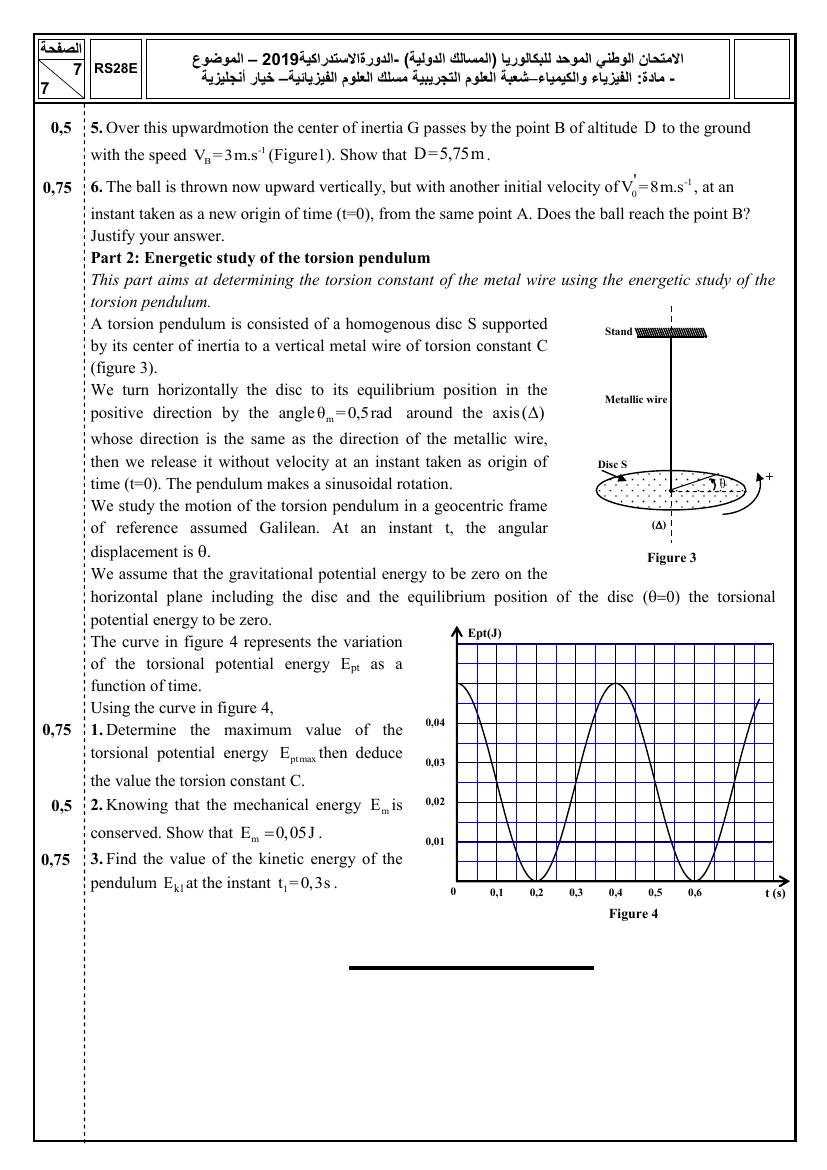
A torsion pendulum is consisted of a homogenous disc S supported by its center of inertia to a vertical metal wire of torsion constant C (figure 3).

Figure 3 : voir la page 7 du sujet

We turn horizontally the disc to its equilibrium position in the positive direction by the angle θm=0,5 rad\theta_m = 0{,}5\ \mathrm{rad} around the axis (Δ)(\Delta) whose direction is the same as the direction of the metallic wire, then we release it without velocity at an instant taken as origin of time (t=0). The pendulum makes a sinusoidal rotation.

We study the motion of the torsion pendulum in a geocentric frame of reference assumed Galilean. At an instant t, the angular displacement is θ\theta.

We assume that the gravitational potential energy to be zero on the horizontal plane including the disc and the equilibrium position of the disc (θ=0\theta = 0) the torsional potential energy to be zero.

The curve in figure 4 represents the variation of the torsional potential energy EptE_{pt} as a function of time.

Figure 4 : voir la page 7 du sujet

Using the curve in figure 4,

1.Determine the maximum value of the torsional potential energy Ept maxE_{pt\,max} then deduce the value the torsion constant C.0,75 pt

2.Knowing that the mechanical energy EmE_m is conserved. Show that Em=0,05 JE_m = 0{,}05\ \mathrm{J}.0,5 pt

3.Find the value of the kinetic energy of the pendulum Ek1E_{k1} at the instant t1=0,3 st_1 = 0{,}3\ \mathrm{s}.0,75 pt

Entraîne-toi sur ces chapitres avec Kresco, gratuitement

Yallah, wa7d l-khtwa.

Le sujet, tu l’as. Maintenant, prépare-le.

Crée ton compte gratuit : une leçon offerte dans chaque chapitre, les quiz et ton suivi, matière par matière, jusqu’au national.