Jerreb rassek f l-national.

Examen national Maths 2Bac SM (option anglaise) 2017, session de rattrapage

Mathématiques · Sciences Mathématiques A, Sciences Mathématiques B · 4 pages

Le sujet en bref

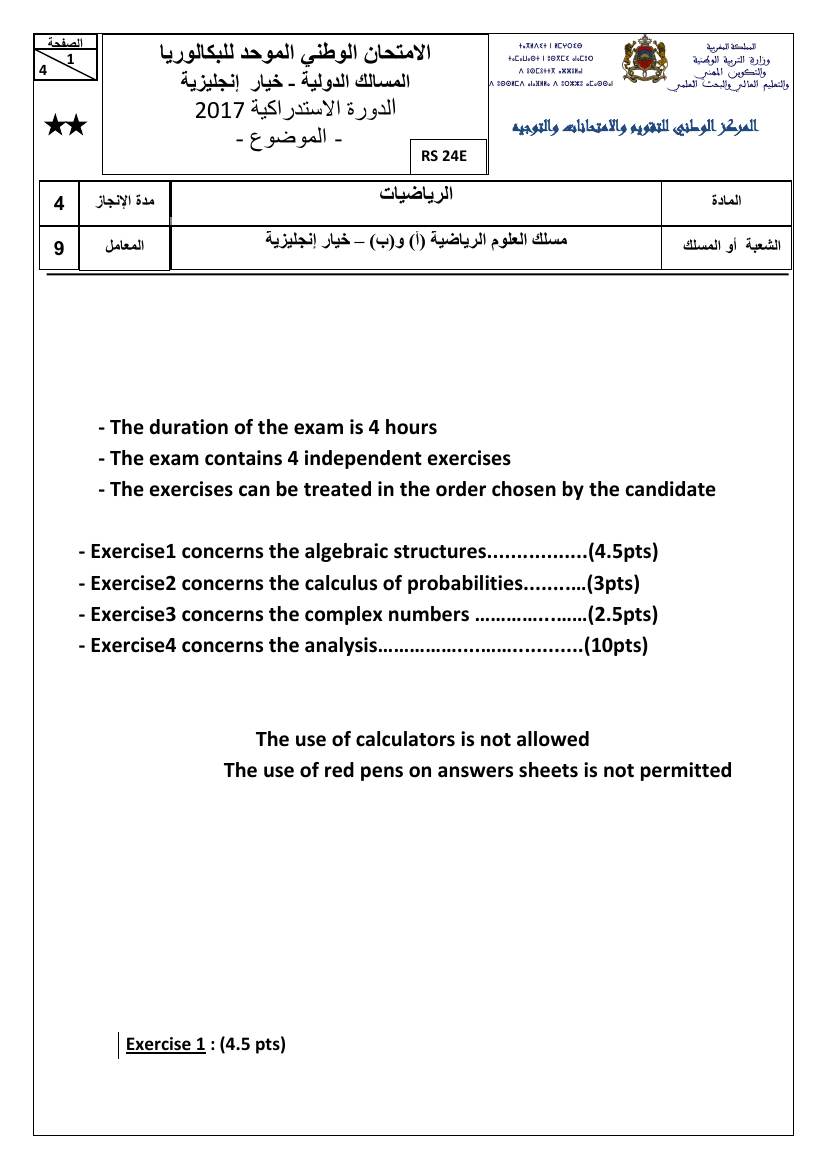
  1. Exercice 14,5 pts

    Structures algébriques

  2. Exercice 23 pts

    Calcul des probabilités

    Un jeu de deux tirages avec remise dans un sac de boules blanches et noires

  3. Exercice 32,5 pts

    Nombres complexes

  4. Exercice 410 pts

    Dérivation et étude de fonctions · Calcul intégral · Suites numériques

Total : 20 points

Le sujet, page par page

  1. Examen national Maths 2Bac SM (option anglaise) 2017, session de rattrapage, page 1 sur 4
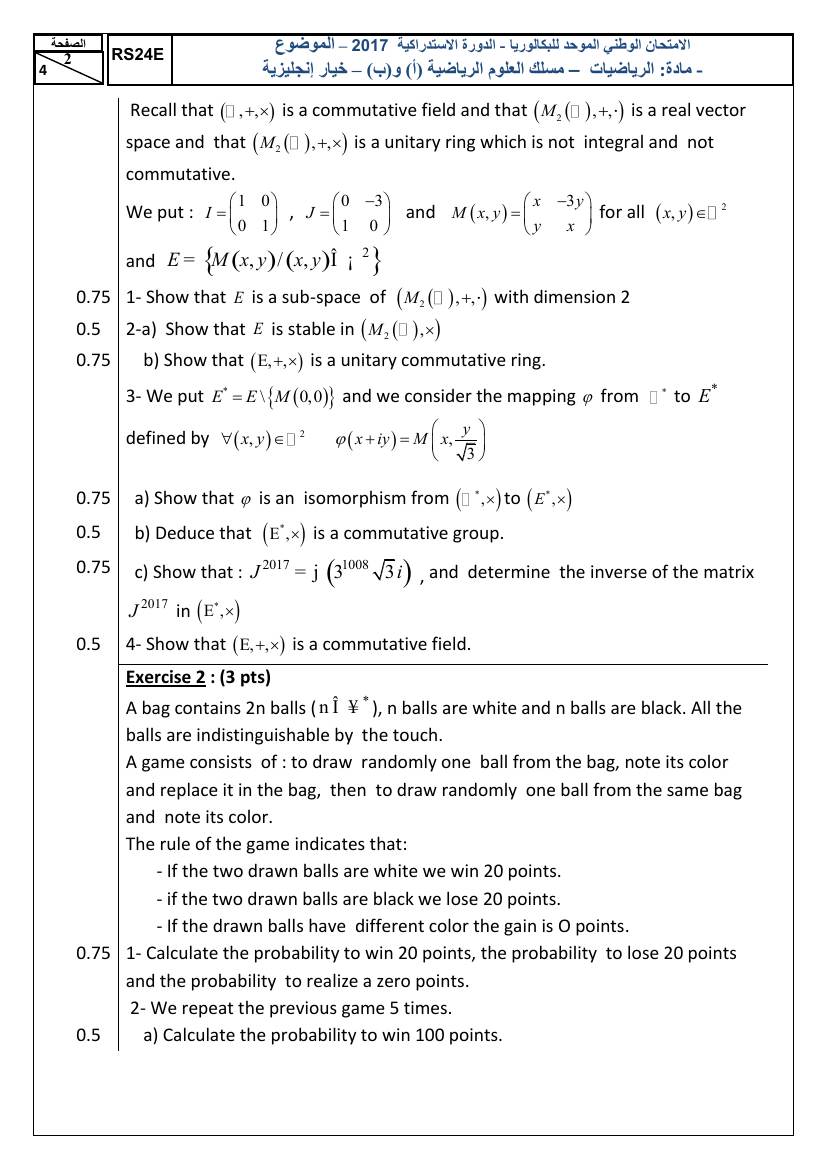
  2. Examen national Maths 2Bac SM (option anglaise) 2017, session de rattrapage, page 2 sur 4
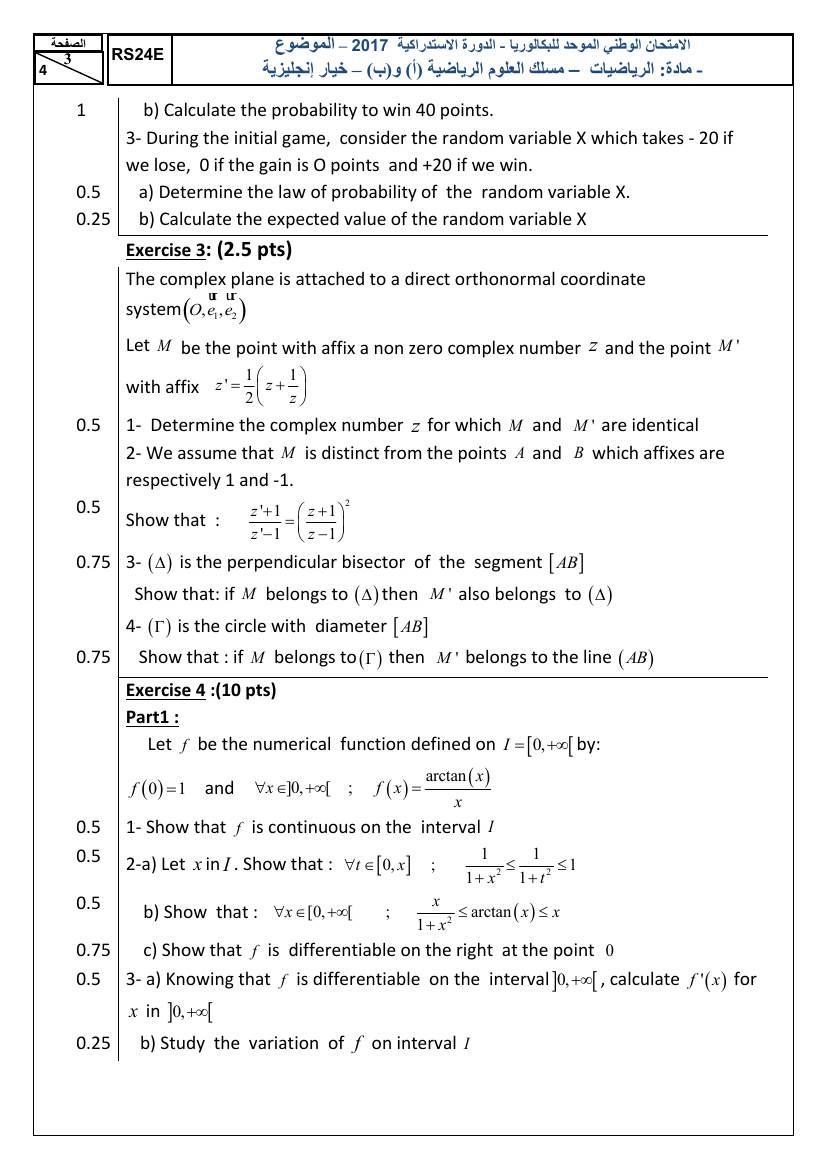
  3. Examen national Maths 2Bac SM (option anglaise) 2017, session de rattrapage, page 3 sur 4
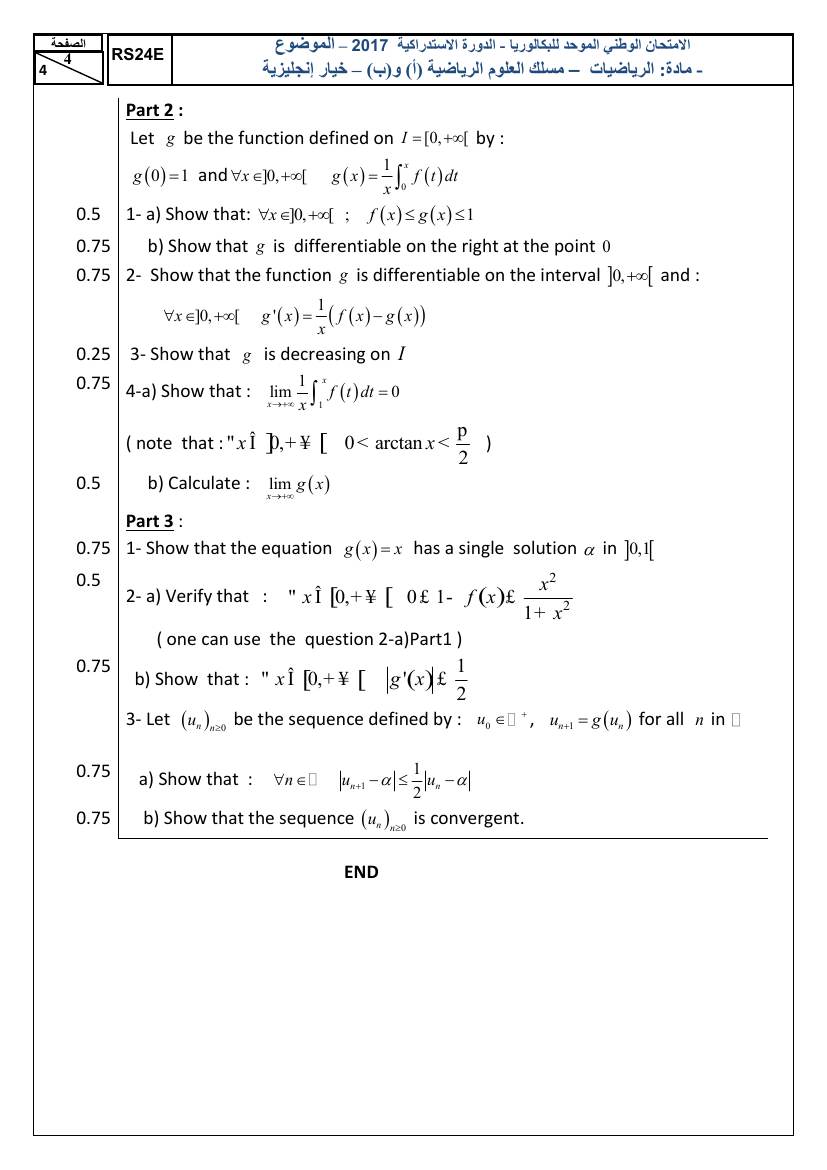
  4. Examen national Maths 2Bac SM (option anglaise) 2017, session de rattrapage, page 4 sur 4

Sujet officiel de l’examen national unifié du baccalauréat, tel que publié par le Centre national de l’évaluation et des examens (Ministère de l’Éducation nationale).

L’énoncé en texte

Transcription du sujet officiel, pour le lire et le rechercher sur téléphone. Les figures restent sur les pages du sujet ; en cas de différence, le PDF officiel fait foi.

Exercice 14,5 pts

Recall that (C,+,×)(\mathbb{C},+,\times) is a commutative field and that (M2(R),+,⋅)(M_2(\mathbb{R}),+,\cdot) is a real vector space and that (M2(R),+,×)(M_2(\mathbb{R}),+,\times) is a unitary ring which is not integral and not commutative.

We put : I=(1001)I=\begin{pmatrix}1&0\\0&1\end{pmatrix} , J=(0−310)J=\begin{pmatrix}0&-3\\1&0\end{pmatrix} and M(x,y)=(x−3yyx)M(x,y)=\begin{pmatrix}x&-3y\\y&x\end{pmatrix} for all (x,y)∈R2(x,y)\in\mathbb{R}^2 and E={M(x,y) / (x,y)∈R2}E=\{M(x,y)\,/\,(x,y)\in\mathbb{R}^2\}

1.Show that EE is a sub-space of (M2(R),+,⋅)(M_2(\mathbb{R}),+,\cdot) with dimension 20,75 pt

2.a.Show that EE is stable in (M2(R),×)(M_2(\mathbb{R}),\times)0,5 pt

2.b.Show that (E,+,×)(E,+,\times) is a unitary commutative ring.0,75 pt

3- We put E∗=E∖{M(0,0)}E^*=E\setminus\{M(0,0)\} and we consider the mapping φ\varphi from C∗\mathbb{C}^* to E∗E^* defined by ∀(x,y)∈R2\forall(x,y)\in\mathbb{R}^2 φ(x+iy)=M(x,y3)\varphi(x+iy)=M\left(x,\dfrac{y}{\sqrt{3}}\right)

3.a.Show that φ\varphi is an isomorphism from (C∗,×)(\mathbb{C}^*,\times) to (E∗,×)(E^*,\times)0,75 pt

3.b.Deduce that (E∗,×)(E^*,\times) is a commutative group.0,5 pt

3.c.Show that : J2017=φ(310083 i)J^{2017}=\varphi\left(3^{1008}\sqrt{3}\,i\right) , and determine the inverse of the matrix J2017J^{2017} in (E∗,×)(E^*,\times)0,75 pt

4.Show that (E,+,×)(E,+,\times) is a commutative field.0,5 pt

Exercice 23 pts

A bag contains 2n2n balls (n∈N∗n\in\mathbb{N}^*), n balls are white and n balls are black. All the balls are indistinguishable by the touch.

A game consists of : to draw randomly one ball from the bag, note its color and replace it in the bag, then to draw randomly one ball from the same bag and note its color.

The rule of the game indicates that:

- If the two drawn balls are white we win 20 points.

- if the two drawn balls are black we lose 20 points.

- If the drawn balls have different color the gain is O points.

1.Calculate the probability to win 20 points, the probability to lose 20 points and the probability to realize a zero points.0,75 pt

2- We repeat the previous game 5 times.

2.a.Calculate the probability to win 100 points.0,5 pt

2.b.Calculate the probability to win 40 points.1 pt

3- During the initial game, consider the random variable X which takes - 20 if we lose, 0 if the gain is O points and +20 if we win.

3.a.Determine the law of probability of the random variable X.0,5 pt

3.b.Calculate the expected value of the random variable X0,25 pt

Exercice 32,5 pts

The complex plane is attached to a direct orthonormal coordinate system (O,e1⃗,e2⃗)(O,\vec{e_1},\vec{e_2})

Let MM be the point with affix a non zero complex number zz and the point M′M' with affix z′=12(z+1z)z'=\dfrac{1}{2}\left(z+\dfrac{1}{z}\right)

1.Determine the complex number zz for which MM and M′M' are identical0,5 pt

2- We assume that MM is distinct from the points AA and BB which affixes are respectively 1 and -1.

2.Show that : z′+1z′−1=(z+1z−1)2\dfrac{z'+1}{z'-1}=\left(\dfrac{z+1}{z-1}\right)^20,5 pt

3- (Δ)(\Delta) is the perpendicular bisector of the segment [AB][AB]

3.Show that: if MM belongs to (Δ)(\Delta) then M′M' also belongs to (Δ)(\Delta)0,75 pt

4- (Γ)(\Gamma) is the circle with diameter [AB][AB]

4.Show that : if MM belongs to (Γ)(\Gamma) then M′M' belongs to the line (AB)(AB)0,75 pt

Exercice 410 pts

Part1 :

Let ff be the numerical function defined on I=[0,+∞[I=[0,+\infty[ by:

f(0)=1f(0)=1 and ∀x∈]0,+∞[\forall x\in]0,+\infty[ ; f(x)=arctan⁡(x)xf(x)=\dfrac{\arctan(x)}{x}

1.Show that ff is continuous on the interval II0,5 pt

2.a.Let xx in II. Show that : ∀t∈[0,x]\forall t\in[0,x] ; 11+x2≤11+t2≤1\dfrac{1}{1+x^2}\le\dfrac{1}{1+t^2}\le 10,5 pt

2.b.Show that : ∀x∈[0,+∞[\forall x\in[0,+\infty[ ; x1+x2≤arctan⁡(x)≤x\dfrac{x}{1+x^2}\le\arctan(x)\le x0,5 pt

2.c.Show that ff is differentiable on the right at the point 000,75 pt

3.a.Knowing that ff is differentiable on the interval ]0,+∞[]0,+\infty[, calculate f′(x)f'(x) for xx in ]0,+∞[]0,+\infty[0,5 pt

3.b.Study the variation of ff on interval II0,25 pt

Part 2 :

Let gg be the function defined on I=[0,+∞[I=[0,+\infty[ by :

g(0)=1g(0)=1 and ∀x∈]0,+∞[\forall x\in]0,+\infty[ g(x)=1x∫0xf(t) dtg(x)=\dfrac{1}{x}\displaystyle\int_0^x f(t)\,dt

1.a.Show that: ∀x∈]0,+∞[\forall x\in]0,+\infty[ ; f(x)≤g(x)≤1f(x)\le g(x)\le 10,5 pt

1.b.Show that gg is differentiable on the right at the point 000,75 pt

2.Show that the function gg is differentiable on the interval ]0,+∞[]0,+\infty[ and : ∀x∈]0,+∞[\forall x\in]0,+\infty[ g′(x)=1x(f(x)−g(x))g'(x)=\dfrac{1}{x}\left(f(x)-g(x)\right)0,75 pt

3.Show that gg is decreasing on II0,25 pt

4.a.Show that : lim⁡x→+∞1x∫1xf(t) dt=0\lim_{x\to+\infty}\dfrac{1}{x}\displaystyle\int_1^x f(t)\,dt=0 ( note that : ∀x∈]0,+∞[\forall x\in]0,+\infty[ 0<arctan⁡x<π20<\arctan x<\dfrac{\pi}{2} )0,75 pt

4.b.Calculate : lim⁡x→+∞g(x)\lim_{x\to+\infty}g(x)0,5 pt

Part 3 :

1.Show that the equation g(x)=xg(x)=x has a single solution α\alpha in ]0,1[]0,1[0,75 pt

2.a.Verify that : ∀x∈[0,+∞[\forall x\in[0,+\infty[ 0≤1−f(x)≤x21+x20\le 1-f(x)\le\dfrac{x^2}{1+x^2} ( one can use the question 2-a)Part1 )0,5 pt

2.b.Show that : ∀x∈[0,+∞[\forall x\in[0,+\infty[ ∣g′(x)∣≤12|g'(x)|\le\dfrac{1}{2}0,75 pt

3- Let (un)n≥0(u_n)_{n\ge0} be the sequence defined by : u0∈R+u_0\in\mathbb{R}^+, un+1=g(un)u_{n+1}=g(u_n) for all nn in N\mathbb{N}

3.a.Show that : ∀n∈N\forall n\in\mathbb{N} ∣un+1−α∣≤12∣un−α∣|u_{n+1}-\alpha|\le\dfrac{1}{2}|u_n-\alpha|0,75 pt

3.b.Show that the sequence (un)n≥0(u_n)_{n\ge0} is convergent.0,75 pt

Revoir le cours : Dérivation et étude de fonctions · Suites numériques

Entraîne-toi sur ces chapitres avec Kresco, gratuitement

Yallah, wa7d l-khtwa.

Le sujet, tu l’as. Maintenant, prépare-le.

Crée ton compte gratuit : une leçon offerte dans chaque chapitre, les quiz et ton suivi, matière par matière, jusqu’au national.