Jerreb rassek f l-national.

Examen national Maths 2Bac SM (option anglaise) 2017, session normale

Mathématiques · Sciences Mathématiques A, Sciences Mathématiques B · 5 pages

Le sujet en bref

  1. Exercice 13,5 pts

    Structures algébriques

  2. Exercice 23,5 pts

    Nombres complexes

  3. Exercice 33 pts

    Arithmétique

    Le nombre premier 2017

  4. Exercice 410 pts

    Fonctions exponentielles · Suites numériques · Calcul intégral

Total : 20 points

Le sujet, page par page

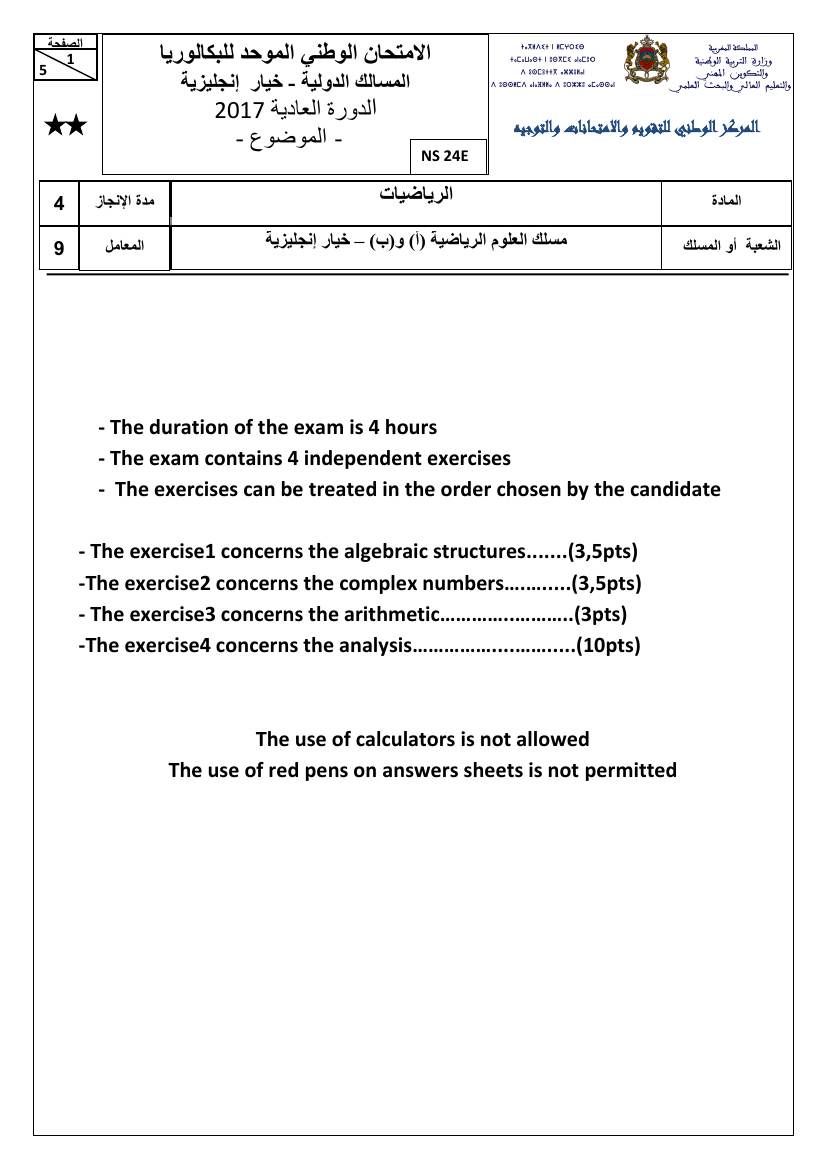
  1. Examen national Maths 2Bac SM (option anglaise) 2017, session normale, page 1 sur 5
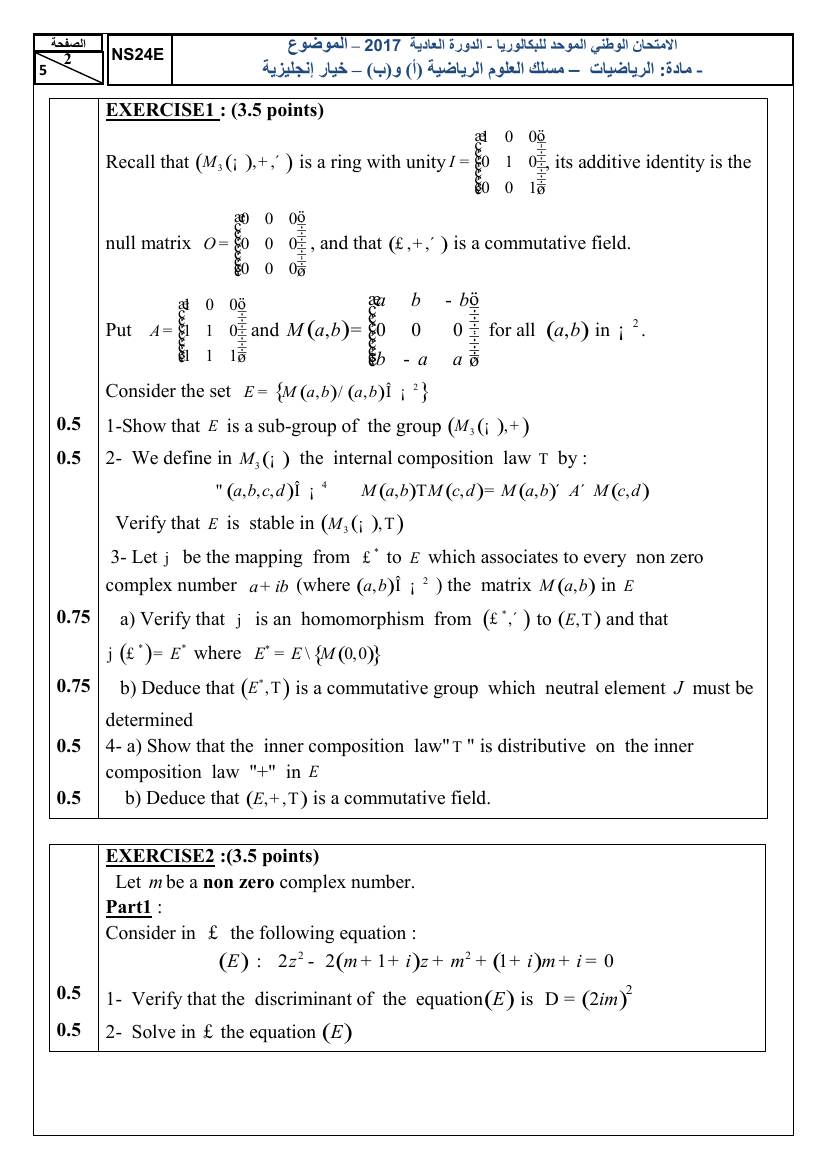
  2. Examen national Maths 2Bac SM (option anglaise) 2017, session normale, page 2 sur 5
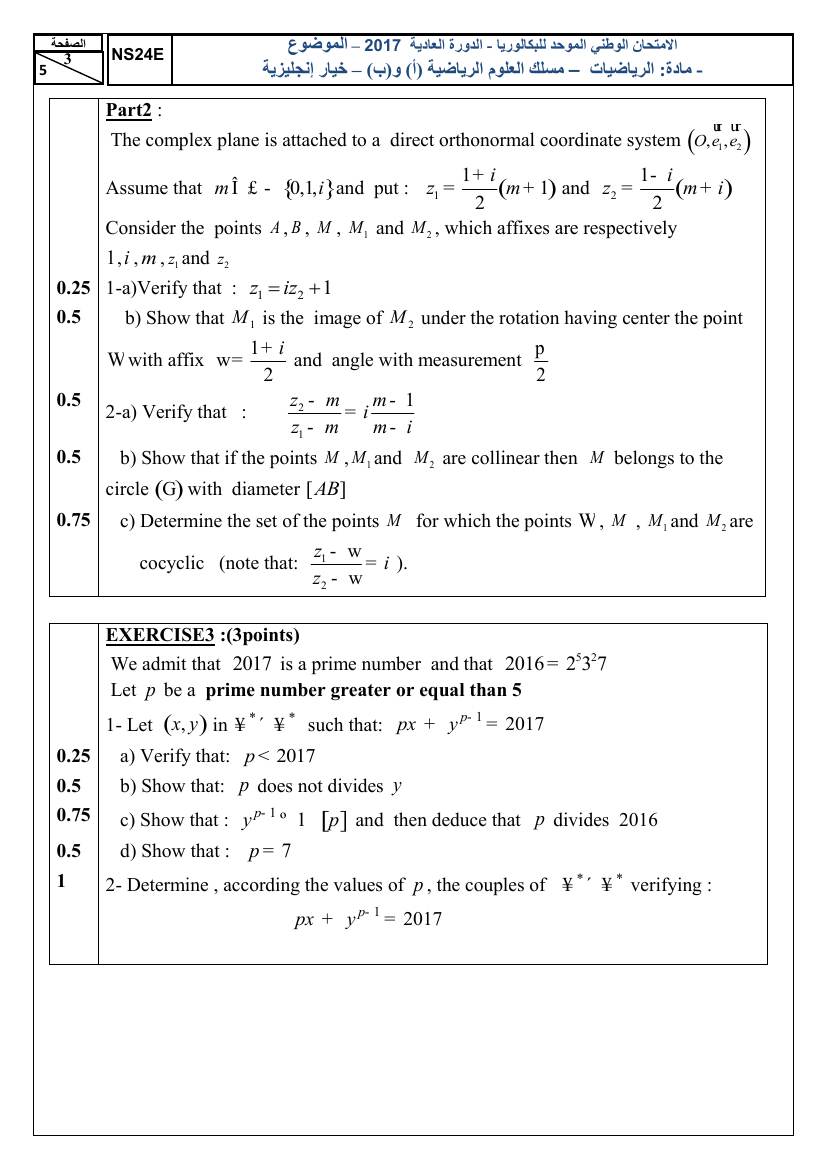
  3. Examen national Maths 2Bac SM (option anglaise) 2017, session normale, page 3 sur 5
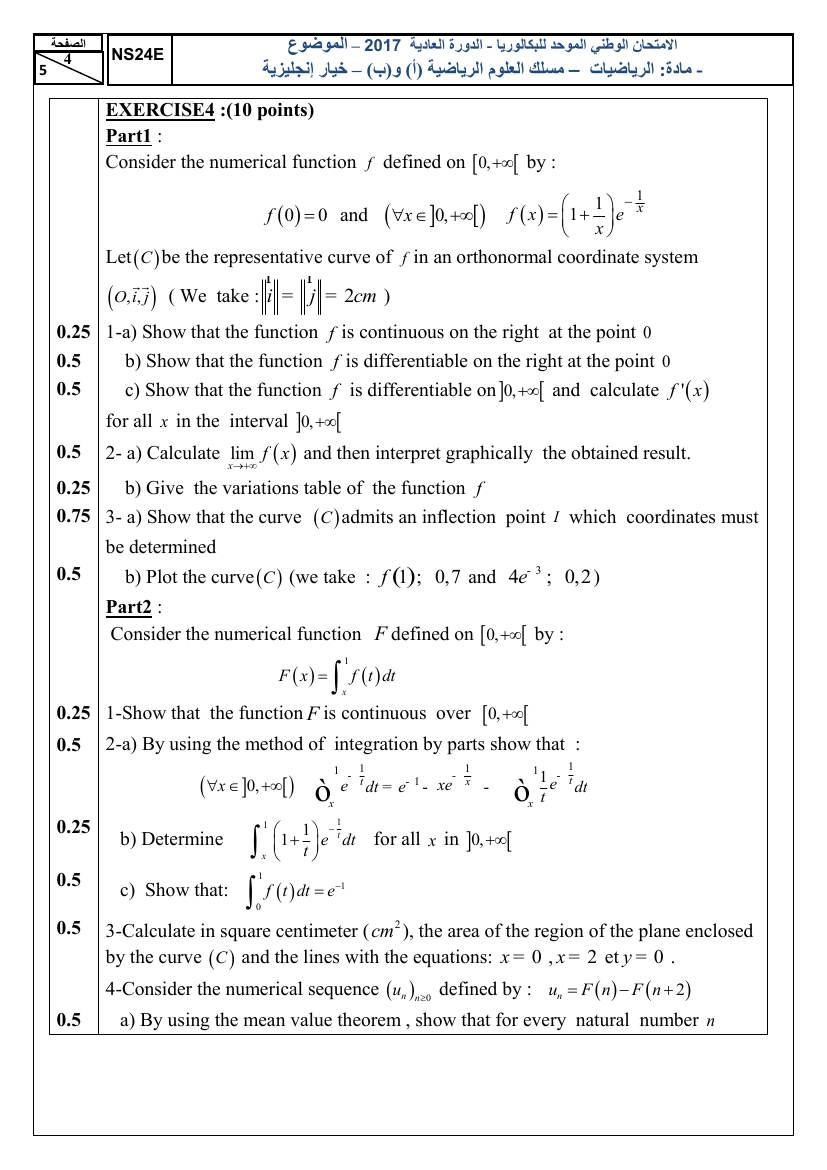
  4. Examen national Maths 2Bac SM (option anglaise) 2017, session normale, page 4 sur 5
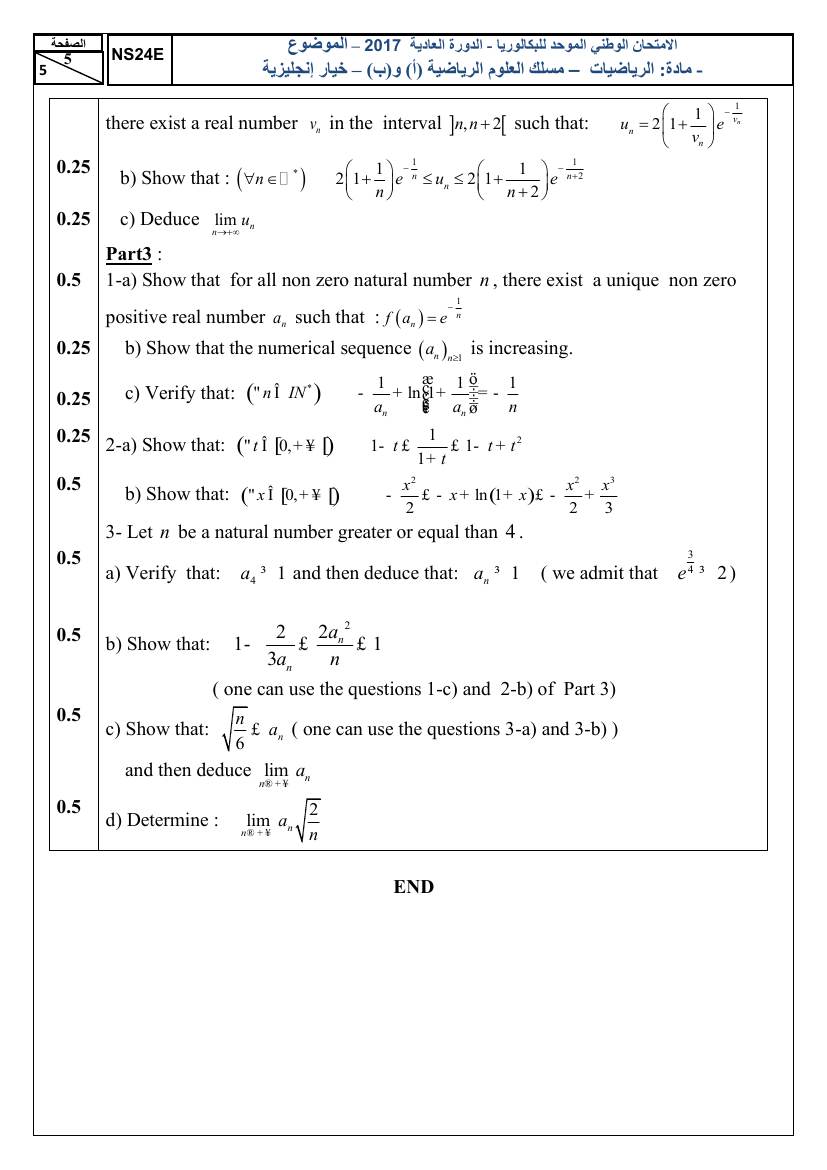
  5. Examen national Maths 2Bac SM (option anglaise) 2017, session normale, page 5 sur 5

Sujet officiel de l’examen national unifié du baccalauréat, tel que publié par le Centre national de l’évaluation et des examens (Ministère de l’Éducation nationale).

L’énoncé en texte

Transcription du sujet officiel, pour le lire et le rechercher sur téléphone. Les figures restent sur les pages du sujet ; en cas de différence, le PDF officiel fait foi.

Exercice 13,5 pts

EXERCISE1 : (3.5 points)

Recall that (M3(R),+,×)(M_3(\mathbb{R}),+,\times) is a ring with unity I=(100010001)I = \begin{pmatrix} 1 & 0 & 0 \\ 0 & 1 & 0 \\ 0 & 0 & 1 \end{pmatrix}, its additive identity is the null matrix O=(000000000)O = \begin{pmatrix} 0 & 0 & 0 \\ 0 & 0 & 0 \\ 0 & 0 & 0 \end{pmatrix}, and that (C,+,×)(\mathbb{C},+,\times) is a commutative field.

Put A=(100110111)A = \begin{pmatrix} 1 & 0 & 0 \\ 1 & 1 & 0 \\ 1 & 1 & 1 \end{pmatrix} and M(a,b)=(ab−b000b−aa)M(a,b) = \begin{pmatrix} a & b & -b \\ 0 & 0 & 0 \\ b & -a & a \end{pmatrix} for all (a,b)(a,b) in R2\mathbb{R}^2.

Consider the set E={M(a,b) / (a,b)∈R2}E = \{M(a,b)\,/\,(a,b)\in\mathbb{R}^2\}

1.Show that EE is a sub-group of the group (M3(R),+)(M_3(\mathbb{R}),+)0,5 pt

2.We define in M3(R)M_3(\mathbb{R}) the internal composition law TT by : (∀(a,b,c,d)∈R4)M(a,b) T M(c,d)=M(a,b)×A×M(c,d)(\forall (a,b,c,d)\in\mathbb{R}^4)\quad M(a,b)\,T\,M(c,d) = M(a,b)\times A\times M(c,d). Verify that EE is stable in (M3(R),T)(M_3(\mathbb{R}),T)0,5 pt

3- Let φ\varphi be the mapping from C∗\mathbb{C}^* to EE which associates to every non zero complex number a+iba+ib (where (a,b)∈R2(a,b)\in\mathbb{R}^2) the matrix M(a,b)M(a,b) in EE

3.a.Verify that φ\varphi is an homomorphism from (C∗,×)(\mathbb{C}^*,\times) to (E,T)(E,T) and that φ(C∗)=E∗\varphi(\mathbb{C}^*) = E^* where E∗=E∖{M(0,0)}E^* = E\setminus\{M(0,0)\}0,75 pt

3.b.Deduce that (E∗,T)(E^*,T) is a commutative group which neutral element JJ must be determined0,75 pt

4.a.Show that the inner composition law "TT" is distributive on the inner composition law "+" in EE0,5 pt

4.b.Deduce that (E,+,T)(E,+,T) is a commutative field.0,5 pt

Exercice 23,5 pts

EXERCISE2 : (3.5 points)

Let mm be a non zero complex number.

Part1 :

Consider in C\mathbb{C} the following equation :

(E):2z2−2(m+1+i)z+m2+(1+i)m+i=0(E) : \quad 2z^2 - 2(m+1+i)z + m^2 + (1+i)m + i = 0

1.Verify that the discriminant of the equation (E)(E) is Δ=(2im)2\Delta = (2im)^20,5 pt

2.Solve in C\mathbb{C} the equation (E)(E)0,5 pt

Part2 :

The complex plane is attached to a direct orthonormal coordinate system (O,e1⃗,e2⃗)(O,\vec{e_1},\vec{e_2})

Assume that m∈C−{0,1,i}m\in\mathbb{C}-\{0,1,i\} and put : z1=1+i2(m+1)z_1 = \dfrac{1+i}{2}(m+1) and z2=1−i2(m+i)z_2 = \dfrac{1-i}{2}(m+i)

Consider the points AA, BB, MM, M1M_1 and M2M_2, which affixes are respectively 11, ii, mm, z1z_1 and z2z_2

1.a.Verify that : z1=iz2+1z_1 = iz_2 + 10,25 pt

1.b.Show that M1M_1 is the image of M2M_2 under the rotation having center the point WW with affix w=1+i2w = \dfrac{1+i}{2} and angle with measurement π2\dfrac{\pi}{2}0,5 pt

2.a.Verify that : z2−mz1−m=i m−1m−i\dfrac{z_2 - m}{z_1 - m} = i\,\dfrac{m-1}{m-i}0,5 pt

2.b.Show that if the points MM, M1M_1 and M2M_2 are collinear then MM belongs to the circle (Γ)(\Gamma) with diameter [AB][AB]0,5 pt

2.c.Determine the set of the points MM for which the points WW, MM, M1M_1 and M2M_2 are cocyclic (note that: z1−wz2−w=i\dfrac{z_1 - w}{z_2 - w} = i).0,75 pt

Exercice 33 pts

EXERCISE3 : (3points)

We admit that 20172017 is a prime number and that 2016=253272016 = 2^5 3^2 7

Let pp be a prime number greater or equal than 5

1- Let (x,y)(x,y) in N∗×N∗\mathbb{N}^*\times\mathbb{N}^* such that: px+yp−1=2017px + y^{p-1} = 2017

1.a.Verify that: p<2017p < 20170,25 pt

1.b.Show that: pp does not divides yy0,5 pt

1.c.Show that : yp−1≡1 [p]y^{p-1} \equiv 1\ [p] and then deduce that pp divides 201620160,75 pt

1.d.Show that : p=7p = 70,5 pt

2.Determine, according the values of pp, the couples of N∗×N∗\mathbb{N}^*\times\mathbb{N}^* verifying : px+yp−1=2017px + y^{p-1} = 20171 pt

Exercice 410 pts

EXERCISE4 : (10 points)

Part1 :

Consider the numerical function ff defined on [0,+∞[[0,+\infty[ by :

f(0)=0and(∀x∈]0,+∞[)f(x)=(1+1x)e−1xf(0) = 0 \quad\text{and}\quad (\forall x\in]0,+\infty[)\quad f(x) = \left(1+\frac{1}{x}\right)e^{-\frac{1}{x}}

Let (C)(C) be the representative curve of ff in an orthonormal coordinate system (O,i⃗,j⃗)(O,\vec{i},\vec{j}) (We take : ∥i⃗∥=∥j⃗∥=2 cm\|\vec{i}\| = \|\vec{j}\| = 2\,\mathrm{cm})

1.a.Show that the function ff is continuous on the right at the point 000,25 pt

1.b.Show that the function ff is differentiable on the right at the point 000,5 pt

1.c.Show that the function ff is differentiable on ]0,+∞[]0,+\infty[ and calculate f′(x)f'(x) for all xx in the interval ]0,+∞[]0,+\infty[0,5 pt

2.a.Calculate lim⁡x→+∞f(x)\lim_{x\to+\infty} f(x) and then interpret graphically the obtained result.0,5 pt

2.b.Give the variations table of the function ff0,25 pt

3.a.Show that the curve (C)(C) admits an inflection point II which coordinates must be determined0,75 pt

3.b.Plot the curve (C)(C) (we take : f(1)≈0,7f(1)\approx 0{,}7 and 4e−3≈0,24e^{-3}\approx 0{,}2)0,5 pt

Part2 :

Consider the numerical function FF defined on [0,+∞[[0,+\infty[ by :

F(x)=∫x1f(t) dtF(x) = \int_x^1 f(t)\,dt

1.Show that the function FF is continuous over [0,+∞[[0,+\infty[0,25 pt

2.a.By using the method of integration by parts show that : (∀x∈]0,+∞[)∫x1e−1tdt=e−1−xe−1x−∫x11te−1tdt(\forall x\in]0,+\infty[)\quad \int_x^1 e^{-\frac{1}{t}}dt = e^{-1} - xe^{-\frac{1}{x}} - \int_x^1 \frac{1}{t}e^{-\frac{1}{t}}dt0,5 pt

2.b.Determine ∫x1(1+1t)e−1tdt\int_x^1 \left(1+\dfrac{1}{t}\right)e^{-\frac{1}{t}}dt for all xx in ]0,+∞[]0,+\infty[0,25 pt

2.c.Show that: ∫01f(t) dt=e−1\int_0^1 f(t)\,dt = e^{-1}0,5 pt

3.Calculate in square centimeter (cm2\mathrm{cm}^2), the area of the region of the plane enclosed by the curve (C)(C) and the lines with the equations: x=0x = 0, x=2x = 2 et y=0y = 0.0,5 pt

4-Consider the numerical sequence (un)n≥0(u_n)_{n\geq 0} defined by : un=F(n)−F(n+2)u_n = F(n) - F(n+2)

4.a.By using the mean value theorem, show that for every natural number nn there exist a real number vnv_n in the interval ]n,n+2[]n,n+2[ such that: un=2(1+1vn)e−1vnu_n = 2\left(1+\dfrac{1}{v_n}\right)e^{-\frac{1}{v_n}}0,5 pt

4.b.Show that : (∀n∈N∗)2(1+1n)e−1n≤un≤2(1+1n+2)e−1n+2(\forall n\in\mathbb{N}^*)\quad 2\left(1+\dfrac{1}{n}\right)e^{-\frac{1}{n}} \leq u_n \leq 2\left(1+\dfrac{1}{n+2}\right)e^{-\frac{1}{n+2}}0,25 pt

4.c.Deduce lim⁡n→+∞un\lim_{n\to+\infty} u_n0,25 pt

Part3 :

1.a.Show that for all non zero natural number nn, there exist a unique non zero positive real number ana_n such that : f(an)=e−1nf(a_n) = e^{-\frac{1}{n}}0,5 pt

1.b.Show that the numerical sequence (an)n≥1(a_n)_{n\geq 1} is increasing.0,25 pt

1.c.Verify that: (∀n∈N∗)−1an+ln⁡(1+1an)=−1n(\forall n\in\mathbb{N}^*)\quad -\dfrac{1}{a_n} + \ln\left(1+\dfrac{1}{a_n}\right) = -\dfrac{1}{n}0,25 pt

2.a.Show that: (∀t∈[0,+∞[)1−t≤11+t≤1−t+t2(\forall t\in[0,+\infty[)\quad 1-t \leq \dfrac{1}{1+t} \leq 1-t+t^20,25 pt

2.b.Show that: (∀x∈[0,+∞[)−x22≤−x+ln⁡(1+x)≤−x22+x33(\forall x\in[0,+\infty[)\quad -\dfrac{x^2}{2} \leq -x+\ln(1+x) \leq -\dfrac{x^2}{2}+\dfrac{x^3}{3}0,5 pt

3- Let nn be a natural number greater or equal than 44.

3.a.Verify that: a4≥1a_4 \geq 1 and then deduce that: an≥1a_n \geq 1 (we admit that e34≥2e^{\frac{3}{4}} \geq 2)0,5 pt

3.b.Show that: 1−23an≤2an2n≤11-\dfrac{2}{3a_n} \leq \dfrac{2a_n^2}{n} \leq 1 (one can use the questions 1-c) and 2-b) of Part 3)0,5 pt

3.c.Show that: n6≤an\sqrt{\dfrac{n}{6}} \leq a_n (one can use the questions 3-a) and 3-b) ) and then deduce lim⁡n→+∞an\lim_{n\to+\infty} a_n0,5 pt

3.d.Determine : lim⁡n→+∞an2n\lim_{n\to+\infty} a_n\sqrt{\dfrac{2}{n}}0,5 pt

Revoir le cours : Suites numériques

Entraîne-toi sur ces chapitres avec Kresco, gratuitement

Yallah, wa7d l-khtwa.

Le sujet, tu l’as. Maintenant, prépare-le.

Crée ton compte gratuit : une leçon offerte dans chaque chapitre, les quiz et ton suivi, matière par matière, jusqu’au national.