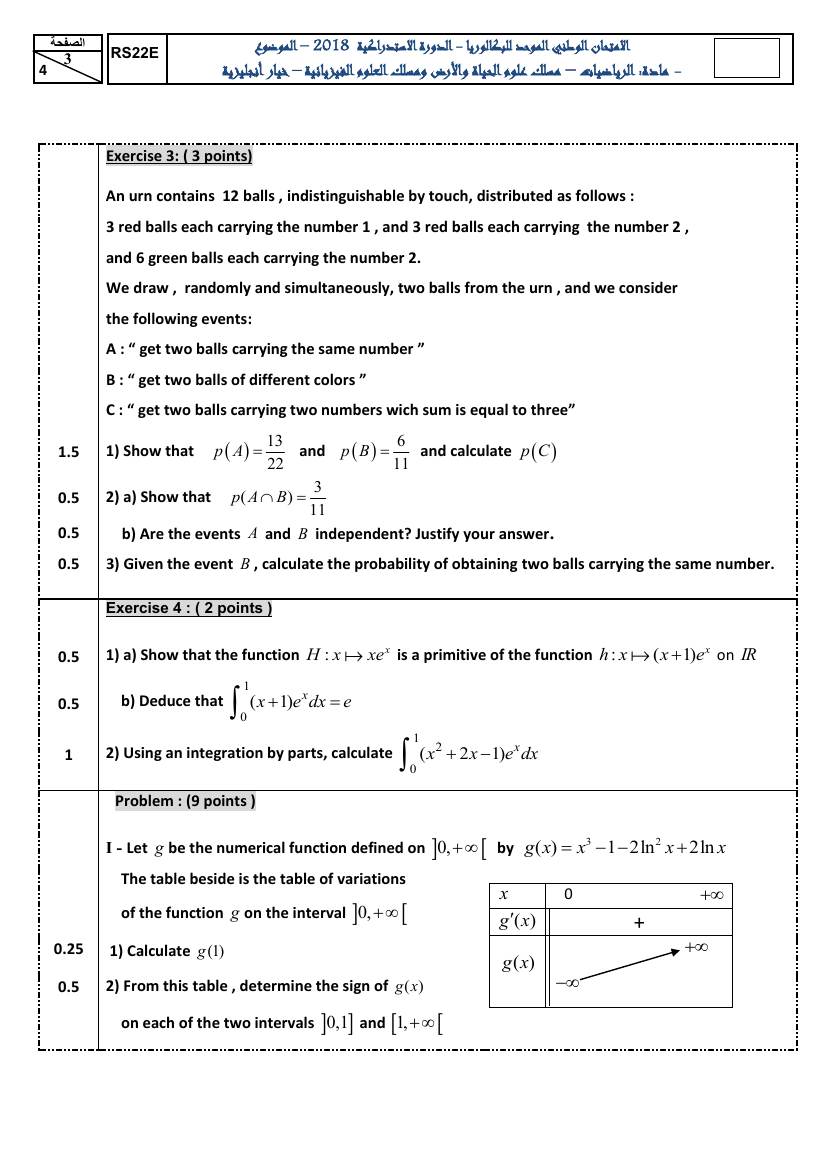
I - Let be the numerical function defined on by
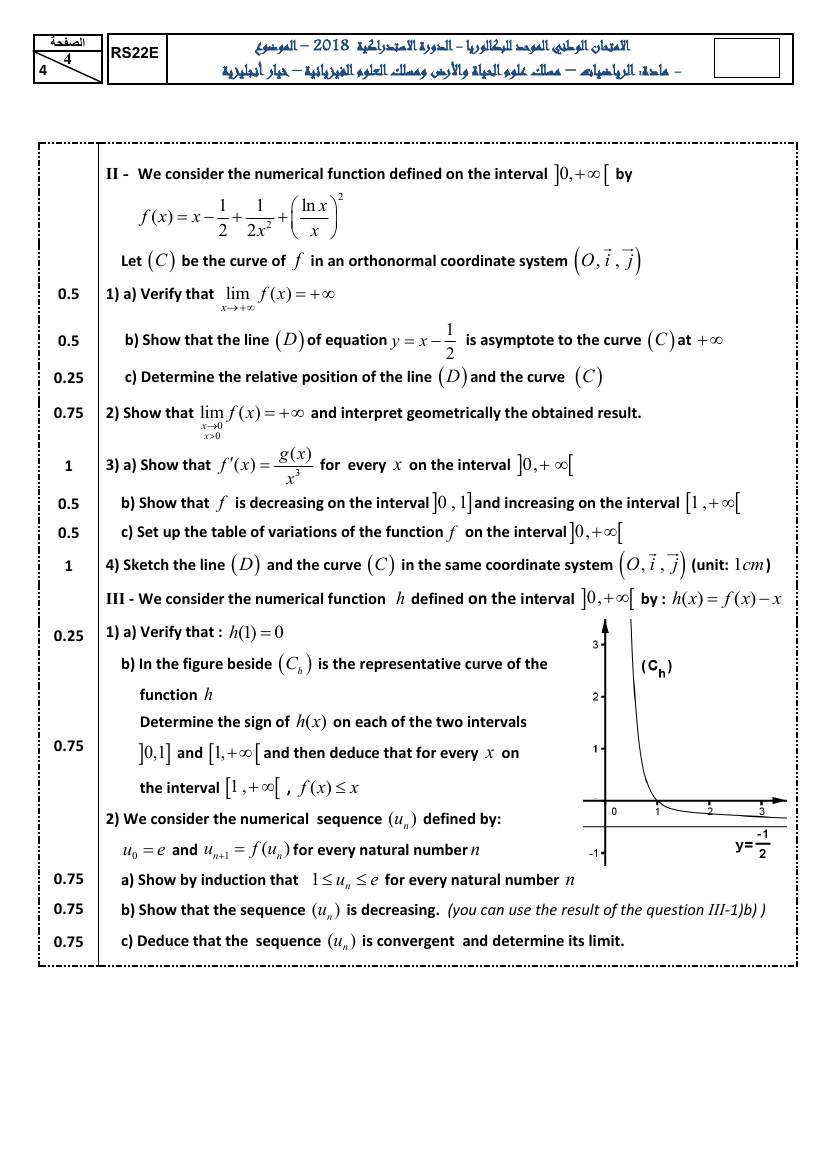
The table beside is the table of variations of the function on the interval
| | |
| | |
| | |
I.1.Calculate 0,25 pt
I.2.From this table, determine the sign of on each of the two intervals and 0,5 pt
II - We consider the numerical function defined on the interval by Let be the curve of in an orthonormal coordinate system
II.1.a.Verify that 0,5 pt
II.1.b.Show that the line of equation is asymptote to the curve at 0,5 pt
II.1.c.Determine the relative position of the line and the curve 0,25 pt
II.2.Show that and interpret geometrically the obtained result.0,75 pt
II.3.a.Show that for every on the interval 1 pt
II.3.b.Show that is decreasing on the interval and increasing on the interval 0,5 pt
II.3.c.Set up the table of variations of the function on the interval 0,5 pt
II.4.Sketch the line and the curve in the same coordinate system (unit: )1 pt
III - We consider the numerical function defined on the interval by :
III.1.a.Verify that : 0,25 pt
Figure : voir la page 4 du sujet
III.1.b.In the figure beside is the representative curve of the function . Determine the sign of on each of the two intervals and and then deduce that for every on the interval , 0,75 pt
2) We consider the numerical sequence defined by: and for every natural number
III.2.a.Show by induction that for every natural number 0,75 pt
III.2.b.Show that the sequence is decreasing. (you can use the result of the question III-1)b) )0,75 pt
III.2.c.Deduce that the sequence is convergent and determine its limit.0,75 pt