Jerreb rassek f l-national.

Examen national Maths 2Bac PC/SVT (option anglaise) 2018, session normale

Mathématiques · Sciences Physiques, Sciences de la Vie et de la Terre · 4 pages

Le sujet en bref

  1. Exercice 13 pts

    Géométrie dans l’espace

  2. Exercice 23 pts

    Nombres complexes

  3. Exercice 33 pts

    Calcul des probabilités

    Le tirage simultané de trois boules colorées et numérotées d’une urne

  4. Problème11 pts

    Fonctions exponentielles · Calcul intégral · Suites numériques

Total : 20 points

Le sujet, page par page

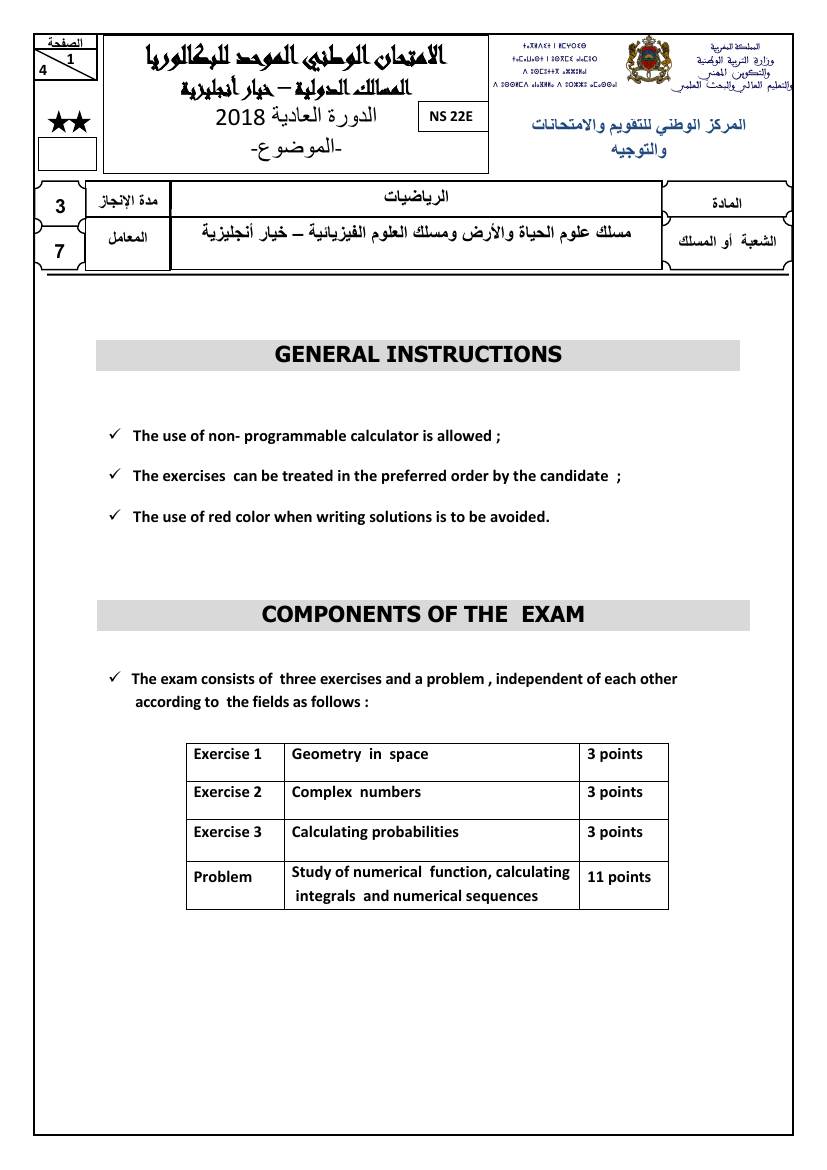
  1. Examen national Maths 2Bac PC/SVT (option anglaise) 2018, session normale, page 1 sur 4
  2. Examen national Maths 2Bac PC/SVT (option anglaise) 2018, session normale, page 2 sur 4
  3. Examen national Maths 2Bac PC/SVT (option anglaise) 2018, session normale, page 3 sur 4
  4. Examen national Maths 2Bac PC/SVT (option anglaise) 2018, session normale, page 4 sur 4

Sujet officiel de l’examen national unifié du baccalauréat, tel que publié par le Centre national de l’évaluation et des examens (Ministère de l’Éducation nationale).

L’énoncé en texte

Transcription du sujet officiel, pour le lire et le rechercher sur téléphone. Les figures restent sur les pages du sujet ; en cas de différence, le PDF officiel fait foi.

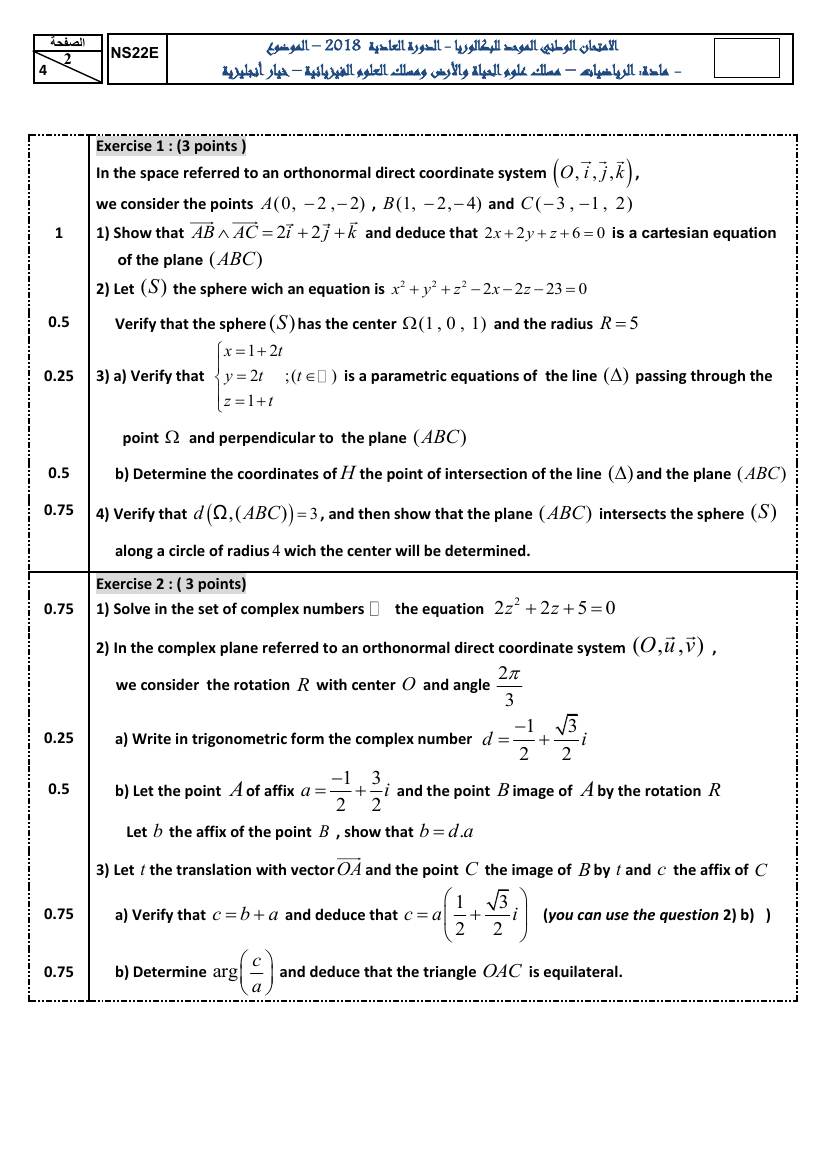
Exercice 13 pts

In the space referred to an orthonormal direct coordinate system (O,i⃗,j⃗,k⃗)(O,\vec{i},\vec{j},\vec{k}), we consider the points A(0,−2,−2)A(0,-2,-2), B(1,−2,−4)B(1,-2,-4) and C(−3,−1,2)C(-3,-1,2)

1.Show that AB→∧AC→=2i⃗+2j⃗+k⃗\overrightarrow{AB}\wedge\overrightarrow{AC}=2\vec{i}+2\vec{j}+\vec{k} and deduce that 2x+2y+z+6=02x+2y+z+6=0 is a cartesian equation of the plane (ABC)(ABC)1 pt

2) Let (S)(S) the sphere wich an equation is x2+y2+z2−2x−2z−23=0x^2+y^2+z^2-2x-2z-23=0

2.Verify that the sphere (S)(S) has the center Ω(1,0,1)\Omega(1,0,1) and the radius R=5R=50,5 pt

3.a.Verify that {x=1+2ty=2tz=1+t\begin{cases}x=1+2t\\ y=2t\\ z=1+t\end{cases} ; (t∈R)(t\in\mathbb{R}) is a parametric equations of the line (Δ)(\Delta) passing through the point Ω\Omega and perpendicular to the plane (ABC)(ABC)0,25 pt

3.b.Determine the coordinates of HH the point of intersection of the line (Δ)(\Delta) and the plane (ABC)(ABC)0,5 pt

4.Verify that d(Ω,(ABC))=3d(\Omega,(ABC))=3, and then show that the plane (ABC)(ABC) intersects the sphere (S)(S) along a circle of radius 44 wich the center will be determined.0,75 pt

Exercice 23 pts

1.Solve in the set of complex numbers C\mathbb{C} the equation 2z2+2z+5=02z^2+2z+5=00,75 pt

2) In the complex plane referred to an orthonormal direct coordinate system (O,u⃗,v⃗)(O,\vec{u},\vec{v}), we consider the rotation RR with center OO and angle 2π3\dfrac{2\pi}{3}

2.a.Write in trigonometric form the complex number d=−12+32id=\dfrac{-1}{2}+\dfrac{\sqrt{3}}{2}i0,25 pt

2.b.Let the point AA of affix a=−12+32ia=\dfrac{-1}{2}+\dfrac{3}{2}i and the point BB image of AA by the rotation RR. Let bb the affix of the point BB, show that b=d.ab=d.a0,5 pt

3) Let tt the translation with vector OA→\overrightarrow{OA} and the point CC the image of BB by tt and cc the affix of CC

3.a.Verify that c=b+ac=b+a and deduce that c=a(12+32i)c=a\left(\dfrac{1}{2}+\dfrac{\sqrt{3}}{2}i\right) (you can use the question 2) b) )0,75 pt

3.b.Determine arg⁡(ca)\arg\left(\dfrac{c}{a}\right) and deduce that the triangle OACOAC is equilateral.0,75 pt

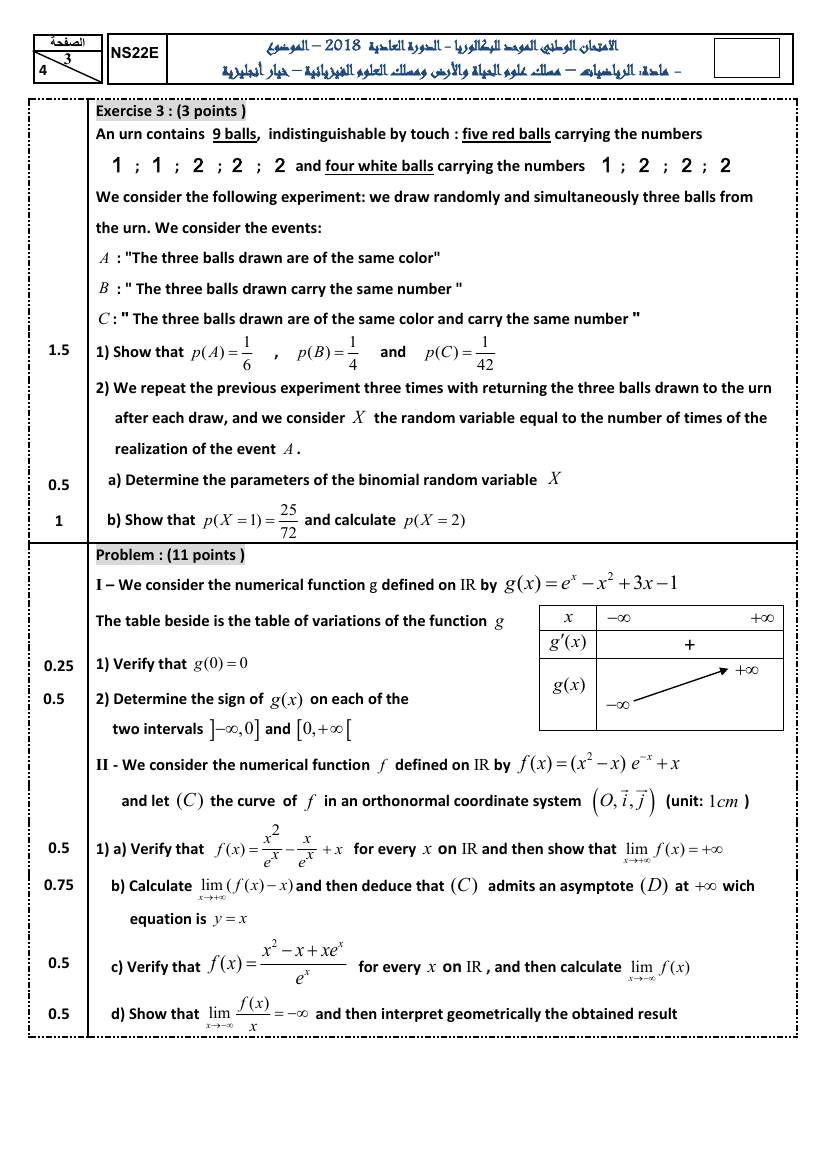
Exercice 33 pts

An urn contains 9 balls, indistinguishable by touch : five red balls carrying the numbers 1 ; 1 ; 2 ; 2 ; 21\ ;\ 1\ ;\ 2\ ;\ 2\ ;\ 2 and four white balls carrying the numbers 1 ; 2 ; 2 ; 21\ ;\ 2\ ;\ 2\ ;\ 2

We consider the following experiment: we draw randomly and simultaneously three balls from the urn. We consider the events:

AA : "The three balls drawn are of the same color"

BB : " The three balls drawn carry the same number "

CC : " The three balls drawn are of the same color and carry the same number "

1.Show that p(A)=16p(A)=\dfrac{1}{6} , p(B)=14p(B)=\dfrac{1}{4} and p(C)=142p(C)=\dfrac{1}{42}1,5 pts

2) We repeat the previous experiment three times with returning the three balls drawn to the urn after each draw, and we consider XX the random variable equal to the number of times of the realization of the event AA .

2.a.Determine the parameters of the binomial random variable XX0,5 pt

2.b.Show that p(X=1)=2572p(X=1)=\dfrac{25}{72} and calculate p(X=2)p(X=2)1 pt

Problème11 pts

I

We consider the numerical function gg defined on IR by g(x)=ex−x2+3x−1g(x)=e^x-x^2+3x-1

The table beside is the table of variations of the function gg

Figure : voir la page 3 du sujet

I.1.Verify that g(0)=0g(0)=00,25 pt

I.2.Determine the sign of g(x)g(x) on each of the two intervals ]−∞,0]]-\infty,0] and [0,+∞[[0,+\infty[0,5 pt

II

We consider the numerical function ff defined on IR by f(x)=(x2−x) e−x+xf(x)=(x^2-x)\,e^{-x}+x and let (C)(C) the curve of ff in an orthonormal coordinate system (O,i⃗,j⃗)(O,\vec{i},\vec{j}) (unit: 1 cm1\ \mathrm{cm})

II.1.a.Verify that f(x)=x2ex−xex+xf(x)=\dfrac{x^2}{e^x}-\dfrac{x}{e^x}+x for every xx on IR and then show that lim⁡x→+∞f(x)=+∞\lim_{x\to+\infty}f(x)=+\infty0,5 pt

II.1.b.Calculate lim⁡x→+∞(f(x)−x)\lim_{x\to+\infty}(f(x)-x) and then deduce that (C)(C) admits an asymptote (D)(D) at +∞+\infty wich equation is y=xy=x0,75 pt

II.1.c.Verify that f(x)=x2−x+xexexf(x)=\dfrac{x^2-x+xe^x}{e^x} for every xx on IR , and then calculate lim⁡x→−∞f(x)\lim_{x\to-\infty}f(x)0,5 pt

II.1.d.Show that lim⁡x→−∞f(x)x=−∞\lim_{x\to-\infty}\dfrac{f(x)}{x}=-\infty and then interpret geometrically the obtained result0,5 pt

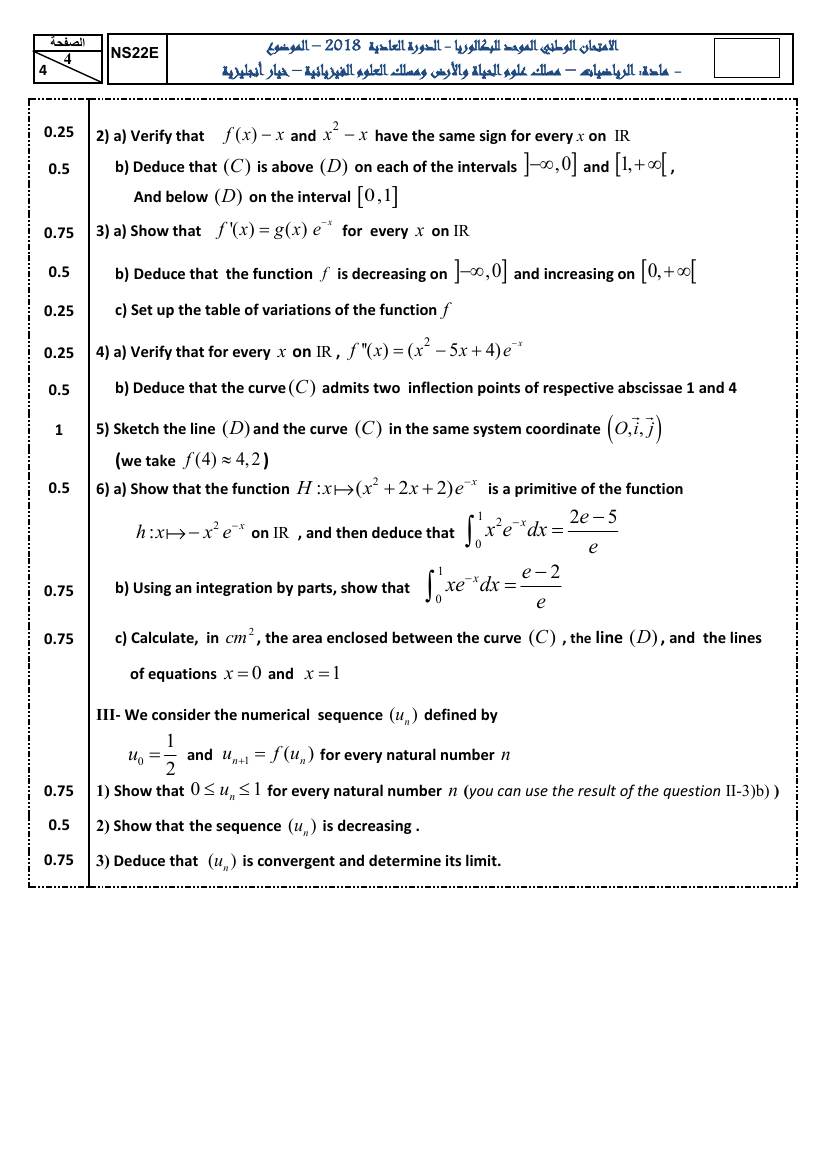
II.2.a.Verify that f(x)−xf(x)-x and x2−xx^2-x have the same sign for every xx on IR0,25 pt

II.2.b.Deduce that (C)(C) is above (D)(D) on each of the intervals ]−∞,0]]-\infty,0] and [1,+∞[[1,+\infty[, And below (D)(D) on the interval [0,1][0,1]0,5 pt

II.3.a.Show that f′(x)=g(x) e−xf'(x)=g(x)\,e^{-x} for every xx on IR0,75 pt

II.3.b.Deduce that the function ff is decreasing on ]−∞,0]]-\infty,0] and increasing on [0,+∞[[0,+\infty[0,5 pt

II.3.c.Set up the table of variations of the function ff0,25 pt

II.4.a.Verify that for every xx on IR , f′′(x)=(x2−5x+4) e−xf''(x)=(x^2-5x+4)\,e^{-x}0,25 pt

II.4.b.Deduce that the curve (C)(C) admits two inflection points of respective abscissae 1 and 40,5 pt

II.5.Sketch the line (D)(D) and the curve (C)(C) in the same system coordinate (O,i⃗,j⃗)(O,\vec{i},\vec{j}) (we take f(4)≈4,2f(4)\approx 4{,}2)1 pt

II.6.a.Show that the function H:x↦(x2+2x+2) e−xH:x\mapsto(x^2+2x+2)\,e^{-x} is a primitive of the function h:x↦−x2e−xh:x\mapsto-x^2e^{-x} on IR , and then deduce that ∫01x2e−xdx=2e−5e\displaystyle\int_0^1 x^2e^{-x}dx=\dfrac{2e-5}{e}0,5 pt

II.6.b.Using an integration by parts, show that ∫01xe−xdx=e−2e\displaystyle\int_0^1 xe^{-x}dx=\dfrac{e-2}{e}0,75 pt

II.6.c.Calculate, in cm2\mathrm{cm}^2, the area enclosed between the curve (C)(C) , the line (D)(D), and the lines of equations x=0x=0 and x=1x=10,75 pt

III

We consider the numerical sequence (un)(u_n) defined by u0=12u_0=\dfrac{1}{2} and un+1=f(un)u_{n+1}=f(u_n) for every natural number nn

III.1.Show that 0≤un≤10\le u_n\le 1 for every natural number nn (you can use the result of the question II-3)b) )0,75 pt

III.2.Show that the sequence (un)(u_n) is decreasing .0,5 pt

III.3.Deduce that (un)(u_n) is convergent and determine its limit.0,75 pt
Revoir le cours : Suites numériques

Entraîne-toi sur ces chapitres avec Kresco, gratuitement

Yallah, wa7d l-khtwa.

Le sujet, tu l’as. Maintenant, prépare-le.

Crée ton compte gratuit : une leçon offerte dans chaque chapitre, les quiz et ton suivi, matière par matière, jusqu’au national.