Jerreb rassek f l-national.

Examen national SVT 2Bac SVT (option anglaise) 2018, session normale

SVT · Sciences de la Vie et de la Terre · 6 pages

Le sujet en bref

  1. Partie I5 pts

    Consommation de la matière organique et flux d’énergie · Le muscle strié squelettique

  2. Partie II – Exercice 16 pts

    Nature et expression de l’information génétique · Génétique humaine · Génétique des populations

    La polykystose rénale

  3. Partie II – Exercice 23 pts

    Lois statistiques de la transmission des caractères

    La forme des ailes, la couleur des yeux et du corps chez la drosophile

  4. Partie II – Exercice 33 pts

    Immunologie

    L’effet de la vaccination contre le tétanos

  5. Partie II – Exercice 43 pts

    Formation des chaînes de montagnes

    Le métamorphisme des roches du massif de l’Agly dans les Pyrénées

Total : 20 points

Le sujet, page par page

  1. Examen national SVT 2Bac SVT (option anglaise) 2018, session normale, page 1 sur 6
  2. Examen national SVT 2Bac SVT (option anglaise) 2018, session normale, page 2 sur 6
  3. Examen national SVT 2Bac SVT (option anglaise) 2018, session normale, page 3 sur 6
  4. Examen national SVT 2Bac SVT (option anglaise) 2018, session normale, page 4 sur 6
  5. Examen national SVT 2Bac SVT (option anglaise) 2018, session normale, page 5 sur 6
  6. Examen national SVT 2Bac SVT (option anglaise) 2018, session normale, page 6 sur 6

Sujet officiel de l’examen national unifié du baccalauréat, tel que publié par le Centre national de l’évaluation et des examens (Ministère de l’Éducation nationale).

L’énoncé en texte

Transcription du sujet officiel, pour le lire et le rechercher sur téléphone. Les figures restent sur les pages du sujet ; en cas de différence, le PDF officiel fait foi.

Partie I5 pts

Section I : Knowledge Retrieval (5 pts)

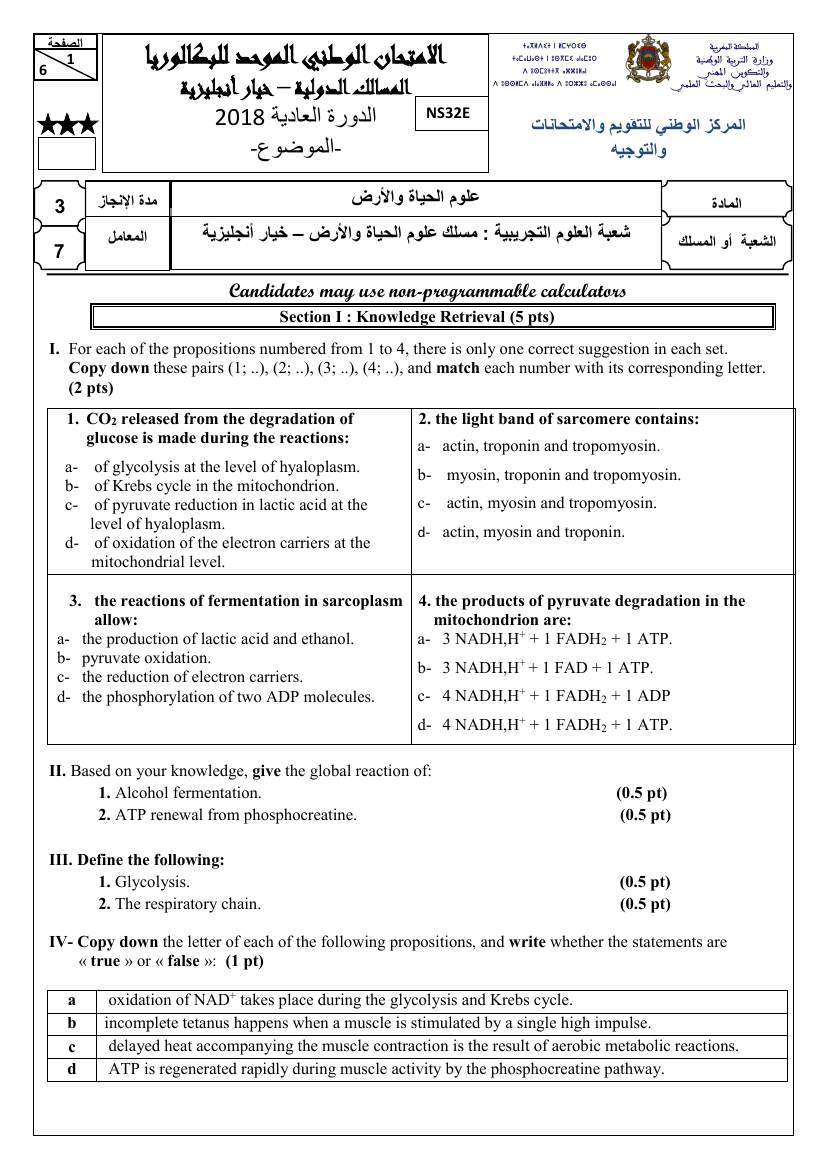
I.For each of the propositions numbered from 1 to 4, there is only one correct suggestion in each set. Copy down these pairs (1; ..), (2; ..), (3; ..), (4; ..), and match each number with its corresponding letter.2 pts

1. CO2\mathrm{CO_2} released from the degradation of glucose is made during the reactions:

a- of glycolysis at the level of hyaloplasm.

b- of Krebs cycle in the mitochondrion.

c- of pyruvate reduction in lactic acid at the level of hyaloplasm.

d- of oxidation of the electron carriers at the mitochondrial level.

2. the light band of sarcomere contains:

a- actin, troponin and tropomyosin.

b- myosin, troponin and tropomyosin.

c- actin, myosin and tropomyosin.

d- actin, myosin and troponin.

3. the reactions of fermentation in sarcoplasm allow:

a- the production of lactic acid and ethanol.

b- pyruvate oxidation.

c- the reduction of electron carriers.

d- the phosphorylation of two ADP molecules.

4. the products of pyruvate degradation in the mitochondrion are:

a- 3 NADH,H++1 FADH2+1 ATP\mathrm{3\ NADH,H^+ + 1\ FADH_2 + 1\ ATP}.

b- 3 NADH,H++1 FAD+1 ATP\mathrm{3\ NADH,H^+ + 1\ FAD + 1\ ATP}.

c- 4 NADH,H++1 FADH2+1 ADP\mathrm{4\ NADH,H^+ + 1\ FADH_2 + 1\ ADP}

d- 4 NADH,H++1 FADH2+1 ATP\mathrm{4\ NADH,H^+ + 1\ FADH_2 + 1\ ATP}.

II. Based on your knowledge, give the global reaction of:

II.1.Alcohol fermentation.0,5 pt

II.2.ATP renewal from phosphocreatine.0,5 pt

III. Define the following:

III.1.Glycolysis.0,5 pt

III.2.The respiratory chain.0,5 pt

IV.Copy down the letter of each of the following propositions, and write whether the statements are « true » or « false » :1 pt

aoxidation of NAD+\mathrm{NAD^+} takes place during the glycolysis and Krebs cycle.
bincomplete tetanus happens when a muscle is stimulated by a single high impulse.
cdelayed heat accompanying the muscle contraction is the result of aerobic metabolic reactions.
dATP is regenerated rapidly during muscle activity by the phosphocreatine pathway.

Revoir le cours : Consommation de la matière organique et flux d’énergie · Le muscle strié squelettique

Partie II – Exercice 16 pts

Section II: Scientific reasoning and communication in graphic and written modes (15 pts)

Exercise 1 ( 6 pts)

Polycystic kidney disease is the most common genetic disease affecting the kidneys; it is characterised by progressive development of multiple cysts in the kidneys that cause renal failure. This disease is also accompanied by other symptoms like arterial hypertension, appearance of blood in urine, and liver polycystic …To determine its genetic origin and its transmission mode, the following data are presented:

Data 1 :

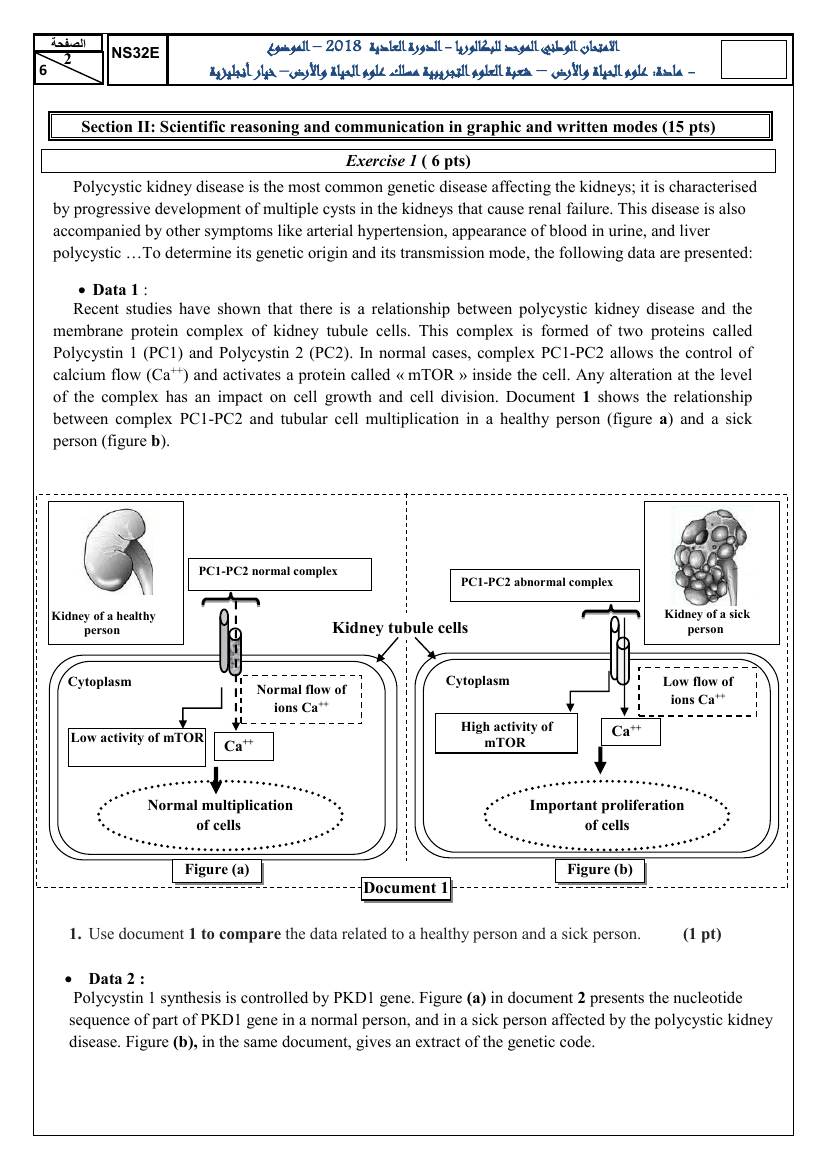
Recent studies have shown that there is a relationship between polycystic kidney disease and the membrane protein complex of kidney tubule cells. This complex is formed of two proteins called Polycystin 1 (PC1) and Polycystin 2 (PC2). In normal cases, complex PC1-PC2 allows the control of calcium flow (Ca++\mathrm{Ca^{++}}) and activates a protein called « mTOR » inside the cell. Any alteration at the level of the complex has an impact on cell growth and cell division. Document 1 shows the relationship between complex PC1-PC2 and tubular cell multiplication in a healthy person (figure a) and a sick person (figure b).

Document 1 : voir la page 2 du sujet

1.Use document 1 to compare the data related to a healthy person and a sick person.1 pt

Data 2 :

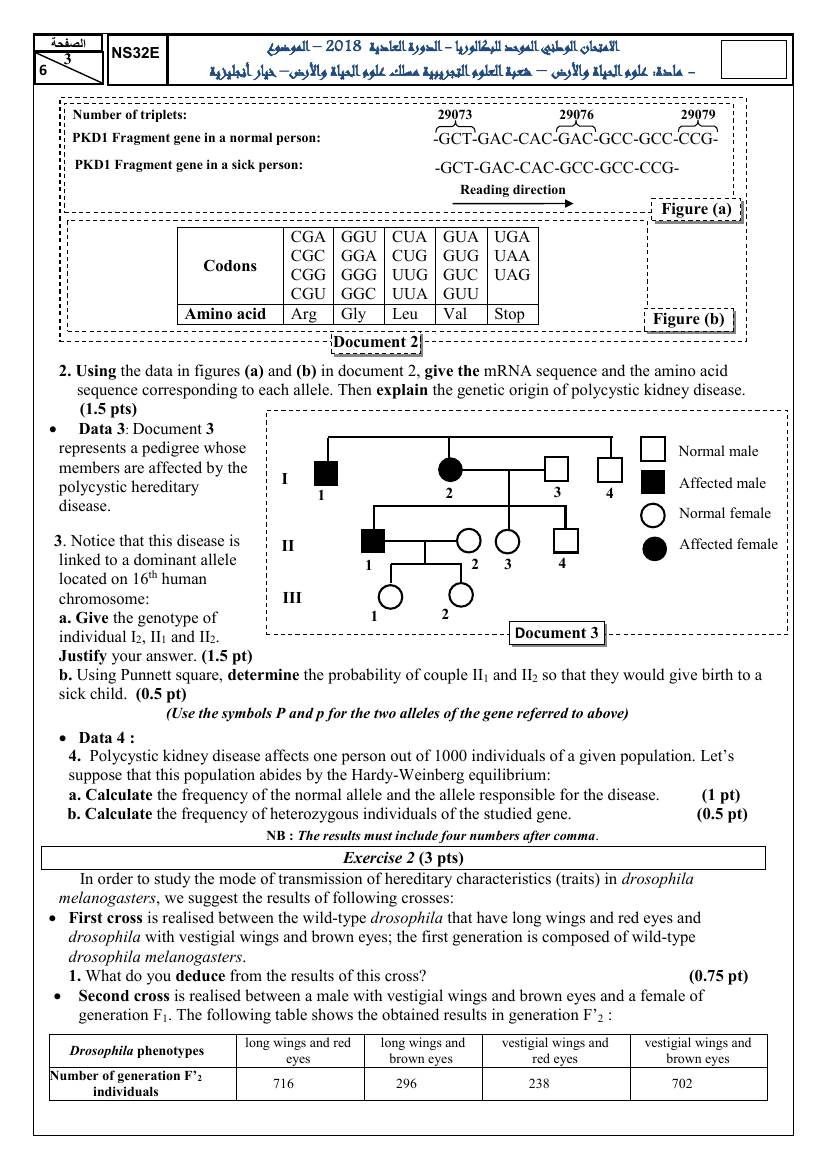
Polycystin 1 synthesis is controlled by PKD1 gene. Figure (a) in document 2 presents the nucleotide sequence of part of PKD1 gene in a normal person, and in a sick person affected by the polycystic kidney disease. Figure (b), in the same document, gives an extract of the genetic code.

Document 2, Figure (a). Number of triplets: 29073, 29076, 29079 (marked above the triplets GAC, GAC, CCG respectively of the normal sequence, as printed in the figure).

PKD1 Fragment gene in a normal person: -GCT-GAC-CAC-GAC-GCC-GCC-CCG-

PKD1 Fragment gene in a sick person: -GCT-GAC-CAC-GCC-GCC-CCG-

Reading direction (arrow pointing right)

Document 2, Figure (b)

CodonsCGA, CGC, CGG, CGUGGU, GGA, GGG, GGCCUA, CUG, UUG, UUAGUA, GUG, GUC, GUUUGA, UAA, UAG
Amino acidArgGlyLeuValStop

2.Using the data in figures (a) and (b) in document 2, give the mRNA sequence and the amino acid sequence corresponding to each allele. Then explain the genetic origin of polycystic kidney disease.1,5 pts

Data 3: Document 3 represents a pedigree whose members are affected by the polycystic hereditary disease.

Document 3 : voir la page 3 du sujet

Legend: Normal male, Affected male, Normal female, Affected female.

3. Notice that this disease is linked to a dominant allele located on 16th human chromosome:

3.a.Give the genotype of individual I2\mathrm{I_2}, II1\mathrm{II_1} and II2\mathrm{II_2}. Justify your answer.1,5 pts

3.b.Using Punnett square, determine the probability of couple II1\mathrm{II_1} and II2\mathrm{II_2} so that they would give birth to a sick child.0,5 pt

(Use the symbols P and p for the two alleles of the gene referred to above)

Data 4 :

4. Polycystic kidney disease affects one person out of 1000 individuals of a given population. Let’s suppose that this population abides by the Hardy-Weinberg equilibrium:

4.a.Calculate the frequency of the normal allele and the allele responsible for the disease.1 pt

4.b.Calculate the frequency of heterozygous individuals of the studied gene.0,5 pt

NB : The results must include four numbers after comma.

Partie II – Exercice 23 pts

Exercise 2 (3 pts)

In order to study the mode of transmission of hereditary characteristics (traits) in drosophila melanogasters, we suggest the results of following crosses:

First cross is realised between the wild-type drosophila that have long wings and red eyes and drosophila with vestigial wings and brown eyes; the first generation is composed of wild-type drosophila melanogasters.

1.What do you deduce from the results of this cross?0,75 pt

Second cross is realised between a male with vestigial wings and brown eyes and a female of generation F1\mathrm{F_1}. The following table shows the obtained results in generation F2′\mathrm{F'_2} :

Drosophila phenotypeslong wings and red eyeslong wings and brown eyesvestigial wings and red eyesvestigial wings and brown eyes
Number of generation F2′\mathrm{F'_2} individuals716296238702

2.a.Are the two genes independent or linked? Justify your answer.0,5 pt

2.b.Interpret and Use Punnett square to explain the results obtained in the second cross.1 pt

Use the following symbols: -L and l for alleles responsible for the form of the wings; -R and r for alleles responsible for the colour of the eyes.

Third cross is realised between double heterozygous female drosophila with clear body and red eyes and male drosophila with black body and brown eyes. This cross gives recombinant individuals representing a percentage of 7.51%.

3.a.Based on the results of the second and third crosses results, draw the two possible gene maps that present the relative location of the three genes studied.0,5 pt

3.b.Suggest a cross that allows to determine the distance between the gene responsible for the colour of the body and the gene responsible for the form of the wings. Justify your answer.0,25 pt

Use the symbols: N and n for alleles responsible for the colour of the body.

Partie II – Exercice 33 pts

Exercise 3 (3 pts)

Vaccination, which is a major public health issue, allows the organism to acquire immunity against infectious diseases. To study the immune mechanisms allowing to explain the effect of vaccination, we suggest the following data:

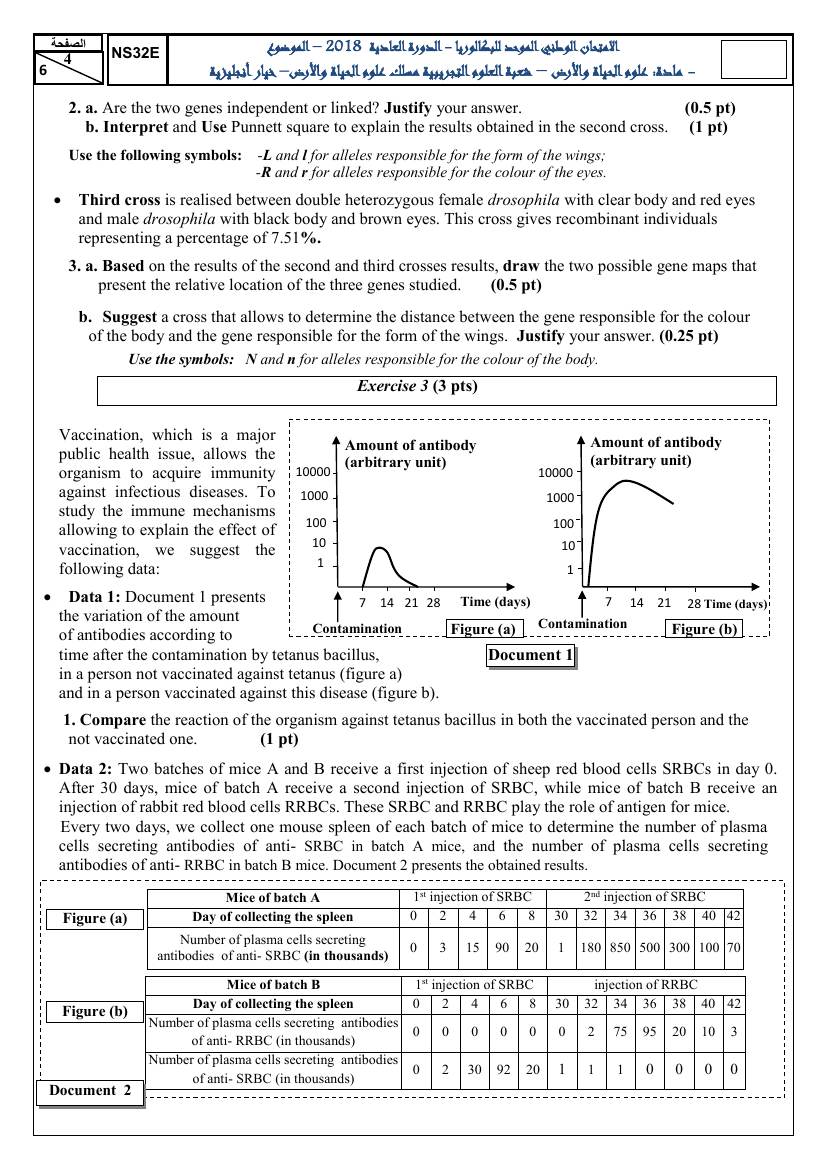
Data 1: Document 1 presents the variation of the amount of antibodies according to time after the contamination by tetanus bacillus, in a person not vaccinated against tetanus (figure a) and in a person vaccinated against this disease (figure b).

Document 1 : voir la page 4 du sujet

1.Compare the reaction of the organism against tetanus bacillus in both the vaccinated person and the not vaccinated one.1 pt

Data 2: Two batches of mice A and B receive a first injection of sheep red blood cells SRBCs in day 0. After 30 days, mice of batch A receive a second injection of SRBC, while mice of batch B receive an injection of rabbit red blood cells RRBCs. These SRBC and RRBC play the role of antigen for mice. Every two days, we collect one mouse spleen of each batch of mice to determine the number of plasma cells secreting antibodies of anti- SRBC in batch A mice, and the number of plasma cells secreting antibodies of anti- RRBC in batch B mice. Document 2 presents the obtained results.

Document 2, Figure (a). Mice of batch A: days 0 to 8 follow the 1st injection of SRBC; days 30 to 42 follow the 2nd injection of SRBC.

Day of collecting the spleen0246830323436384042
Number of plasma cells secreting antibodies of anti- SRBC (in thousands)03159020118085050030010070

Document 2, Figure (b). Mice of batch B: days 0 to 8 follow the 1st injection of SRBC; days 30 to 42 follow the injection of RRBC.

Day of collecting the spleen0246830323436384042
Number of plasma cells secreting antibodies of anti- RRBC (in thousands)0000002759520103
Number of plasma cells secreting antibodies of anti- SRBC (in thousands)023092201110000

2.Deduce the two characteristics of the immune responses highlighted from the results presented in document 2, justify your answer.1 pt

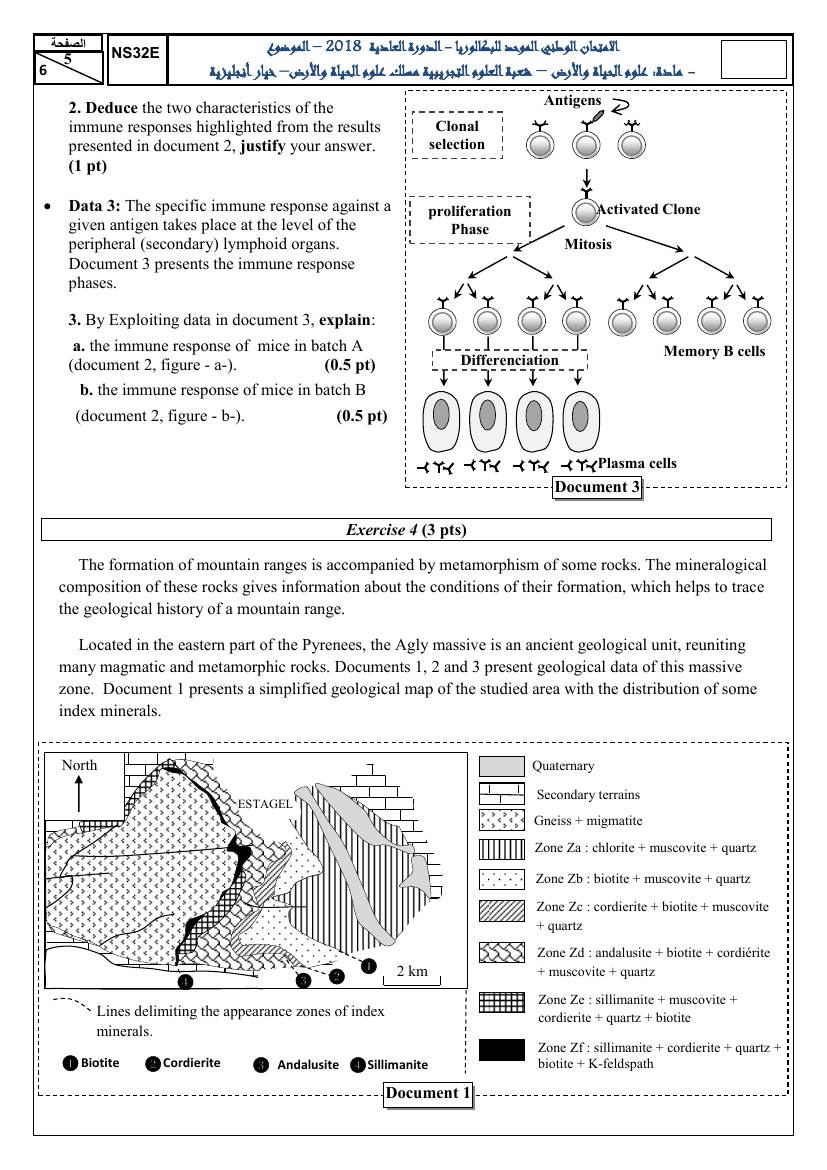
Data 3: The specific immune response against a given antigen takes place at the level of the peripheral (secondary) lymphoid organs. Document 3 presents the immune response phases.

Document 3 : voir la page 5 du sujet

3. By Exploiting data in document 3, explain:

3.a.the immune response of mice in batch A (document 2, figure - a-).0,5 pt

3.b.the immune response of mice in batch B (document 2, figure - b-).0,5 pt

Partie II – Exercice 43 pts

Exercise 4 (3 pts)

The formation of mountain ranges is accompanied by metamorphism of some rocks. The mineralogical composition of these rocks gives information about the conditions of their formation, which helps to trace the geological history of a mountain range.

Located in the eastern part of the Pyrenees, the Agly massive is an ancient geological unit, reuniting many magmatic and metamorphic rocks. Documents 1, 2 and 3 present geological data of this massive zone. Document 1 presents a simplified geological map of the studied area with the distribution of some index minerals.

Document 1 : voir la page 5 du sujet

Legend: Quaternary; Secondary terrains; Gneiss + migmatite; Zone Za : chlorite + muscovite + quartz; Zone Zb : biotite + muscovite + quartz; Zone Zc : cordierite + biotite + muscovite + quartz; Zone Zd : andalusite + biotite + cordiérite + muscovite + quartz; Zone Ze : sillimanite + muscovite + cordierite + quartz + biotite; Zone Zf : sillimanite + cordierite + quartz + biotite + K-feldspath.

Lines delimiting the appearance zones of index minerals. 1 Biotite, 2 Cordierite, 3 Andalusite, 4 Sillimanite.

1.Based on data in document 1, determine the mineralogical changes when moving from Zb zone to Zd zone and from Ze zone to Zf zone.0,5 pt

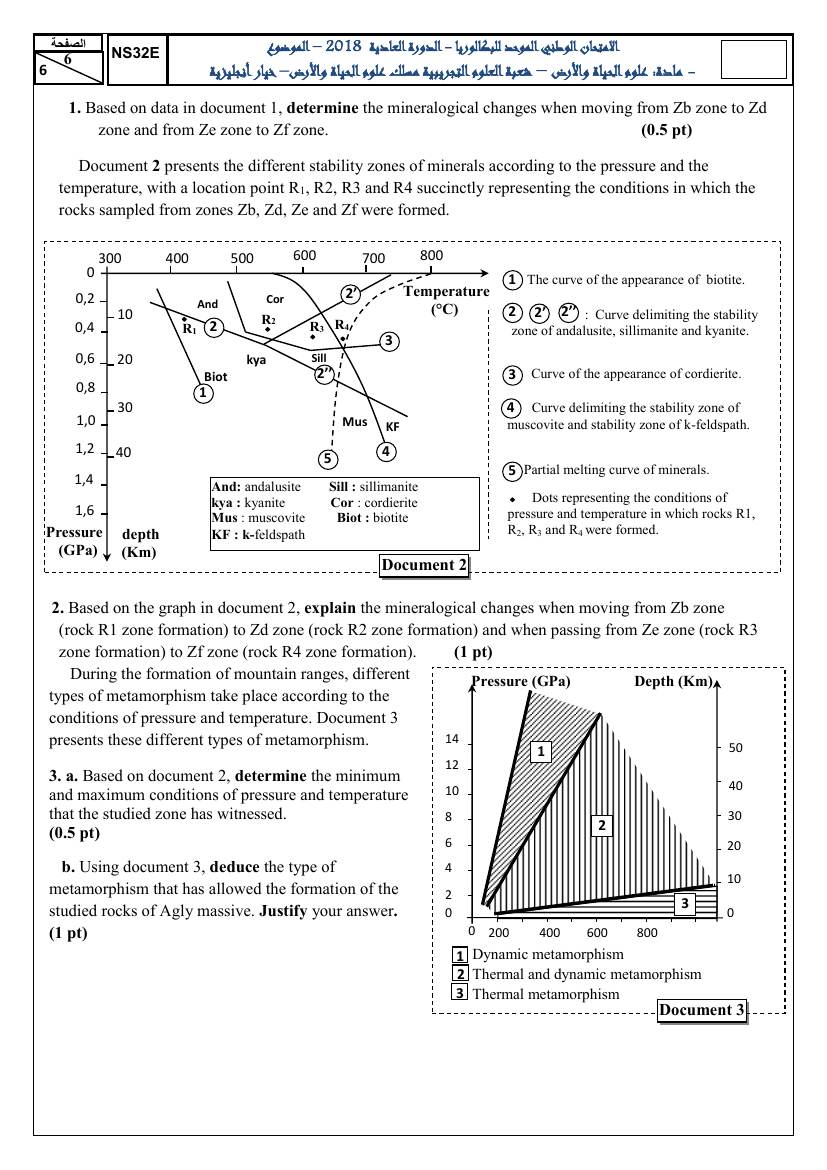
Document 2 presents the different stability zones of minerals according to the pressure and the temperature, with a location point R1\mathrm{R_1}, R2, R3 and R4\mathrm{R_4} succinctly representing the conditions in which the rocks sampled from zones Zb, Zd, Ze and Zf were formed.

Document 2 : voir la page 6 du sujet

1 The curve of the appearance of biotite. 2, 2’, 2’’ : Curve delimiting the stability zone of andalusite, sillimanite and kyanite. 3 Curve of the appearance of cordierite. 4 Curve delimiting the stability zone of muscovite and stability zone of k-feldspath. 5 Partial melting curve of minerals. Dots representing the conditions of pressure and temperature in which rocks R1, R2, R3 and R4 were formed.

And: andalusite; kya : kyanite; Mus : muscovite; KF : k-feldspath; Sill : sillimanite; Cor : cordierite; Biot : biotite

2.Based on the graph in document 2, explain the mineralogical changes when moving from Zb zone (rock R1 zone formation) to Zd zone (rock R2 zone formation) and when passing from Ze zone (rock R3 zone formation) to Zf zone (rock R4 zone formation).1 pt

During the formation of mountain ranges, different types of metamorphism take place according to the conditions of pressure and temperature. Document 3 presents these different types of metamorphism.

Document 3 : voir la page 6 du sujet

1 Dynamic metamorphism; 2 Thermal and dynamic metamorphism; 3 Thermal metamorphism

3.a.Based on document 2, determine the minimum and maximum conditions of pressure and temperature that the studied zone has witnessed.0,5 pt

3.b.Using document 3, deduce the type of metamorphism that has allowed the formation of the studied rocks of Agly massive. Justify your answer.1 pt

Entraîne-toi sur ces chapitres avec Kresco, gratuitement

Yallah, wa7d l-khtwa.

Le sujet, tu l’as. Maintenant, prépare-le.

Crée ton compte gratuit : une leçon offerte dans chaque chapitre, les quiz et ton suivi, matière par matière, jusqu’au national.