Jerreb rassek f l-national.

Examen national SVT 2Bac SVT (option anglaise) 2018, session de rattrapage

SVT · Sciences de la Vie et de la Terre · 6 pages

Le sujet en bref

  1. Partie I5 pts

    Formation des chaînes de montagnes

  2. Partie II – Exercice 13 pts

    Consommation de la matière organique et flux d’énergie

    L’action de l’antimycine A sur la respiration cellulaire

  3. Partie II – Exercice 25 pts

    Nature et expression de l’information génétique · Génie génétique

    Le syndrome de progeria et la lamine A

  4. Partie II – Exercice 34 pts

    Lois statistiques de la transmission des caractères · Génétique des populations

    La couleur et les bandes de la coquille de l’escargot Cepaea nemoralis

  5. Partie II – Exercice 43 pts

    Immunologie

    Le rôle des lymphocytes T4 et l’infection par le VIH

Total : 20 points

Le sujet, page par page

  1. Examen national SVT 2Bac SVT (option anglaise) 2018, session de rattrapage, page 1 sur 6
  2. Examen national SVT 2Bac SVT (option anglaise) 2018, session de rattrapage, page 2 sur 6
  3. Examen national SVT 2Bac SVT (option anglaise) 2018, session de rattrapage, page 3 sur 6
  4. Examen national SVT 2Bac SVT (option anglaise) 2018, session de rattrapage, page 4 sur 6
  5. Examen national SVT 2Bac SVT (option anglaise) 2018, session de rattrapage, page 5 sur 6
  6. Examen national SVT 2Bac SVT (option anglaise) 2018, session de rattrapage, page 6 sur 6

Sujet officiel de l’examen national unifié du baccalauréat, tel que publié par le Centre national de l’évaluation et des examens (Ministère de l’Éducation nationale).

L’énoncé en texte

Transcription du sujet officiel, pour le lire et le rechercher sur téléphone. Les figures restent sur les pages du sujet ; en cas de différence, le PDF officiel fait foi.

Partie I5 pts

Section I : Knowledge Retrieval (5 pts)

I.For each of the propositions numbered from 1 to 4, there is only one correct suggestion in each set. Copy down these pairs (1; ..), (2; ..), (3; ..), (4; ..), and match each number with its corresponding letter.2 pts

1-the reverse fault is a structure :

a. that results from extensional tectonic stresses.

b. characterised by two blocks one distancing from the other.

c. characterised by a vertical fault plane.

d. characterised by the two blocks one getting closer to the other.

2- the andesite is a magmatic rock that :

a. results from rapid cooling of magma in the depth.

b. results from slow cooling of magma on the surface.

c. has a microlite structure characterised by microlites and glass.

d. has a coarse-grained structure characterised by large-size crystals.

3-subduction chains result from the burial of:

e. a less-dense oceanic lithosphere under a denser continental lithosphere.

f. a less-dense continental lithosphere under a denser continental lithosphere.

g. a denser oceanic lithosphere under a less dense continental lithosphere.

h. a less dense continental lithosphere under a less dense oceanic lithosphere.

4- metamorphic aureole is a zone surrounding :

a. intrusive granite and resulting from contact metamorphism.

b. anatectic granite and resulting from contact metamorphism.

c. intrusive granite and resulting from regional metamorphism.

d. anatectic granite and resulting from regional metamorphism.

II. Define the following notions:

II.1.anatexis0,5 pt

II.2.metamorphic facies.0,5 pt

III.Copy down the letter of each of following propositions, and write whether these statements are “true” or “false”.1 pt

a. The andesitic magma results from the partial melting of the pre- existing rocks under the action of a metamorphism of high temperature and low pressure.

b. Metamorphism of the subduction zones is characterised by a dynamic metamorphism.

c. A metamorphic sequence corresponds to all the rocks that have been formed in the same conditions of pressure and temperature.

d. schistosity and foliation are two structures characterising metamorphic and magmatic rocks.

IV. Give:

IV.1.two characteristics of collisional mountain range.0,5 pt

IV.2.two characteristics of obductional mountain range.0,5 pt

Partie II – Exercice 13 pts

Section II: Scientific reasoning and communication in graphic and written modes (15 pts) – Exercise 1 (3 pts)

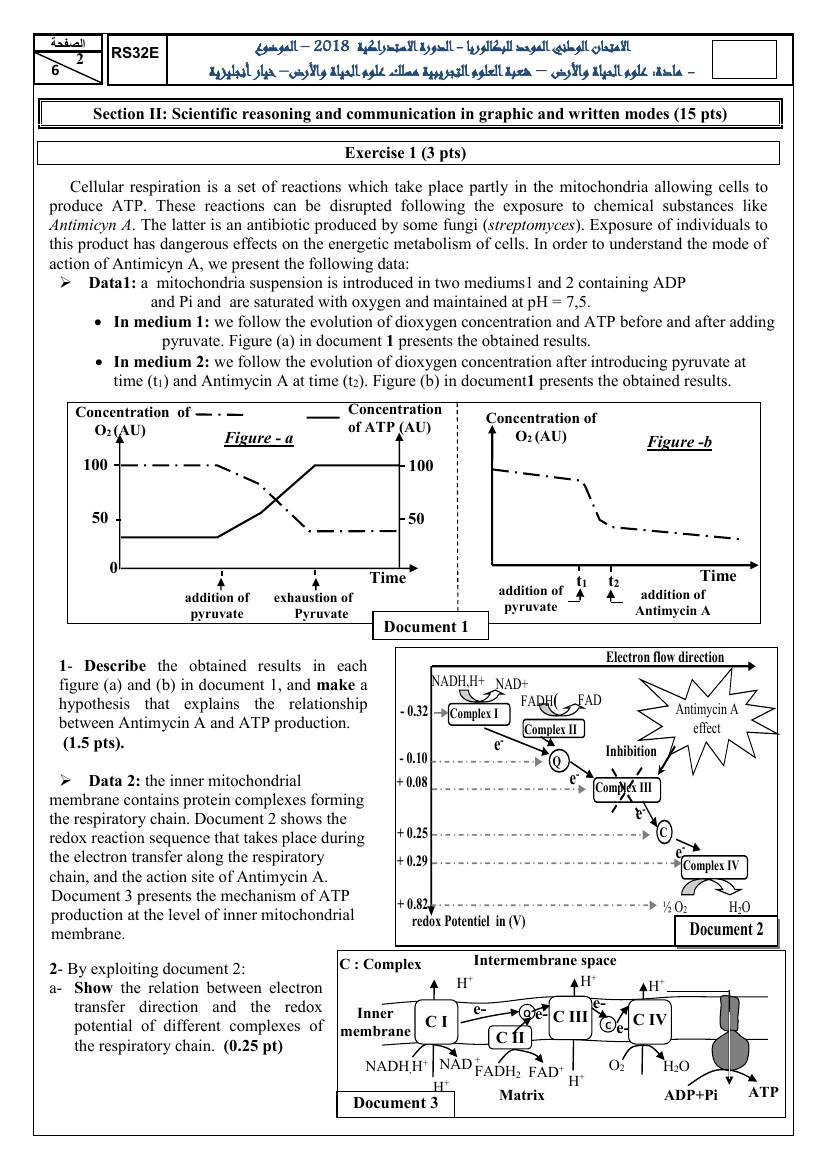
Cellular respiration is a set of reactions which take place partly in the mitochondria allowing cells to produce ATP. These reactions can be disrupted following the exposure to chemical substances like Antimicyn A. The latter is an antibiotic produced by some fungi (streptomyces). Exposure of individuals to this product has dangerous effects on the energetic metabolism of cells. In order to understand the mode of action of Antimicyn A, we present the following data:

Data1: a mitochondria suspension is introduced in two mediums1 and 2 containing ADP and Pi and are saturated with oxygen and maintained at pH = 7,5.

In medium 1: we follow the evolution of dioxygen concentration and ATP before and after adding pyruvate. Figure (a) in document 1 presents the obtained results.

In medium 2: we follow the evolution of dioxygen concentration after introducing pyruvate at time (t1) and Antimycin A at time (t2). Figure (b) in document1 presents the obtained results.

Document 1 : voir la page 2 du sujet

1.Describe the obtained results in each figure (a) and (b) in document 1, and make a hypothesis that explains the relationship between Antimycin A and ATP production.1,5 pts

Data 2: the inner mitochondrial membrane contains protein complexes forming the respiratory chain. Document 2 shows the redox reaction sequence that takes place during the electron transfer along the respiratory chain, and the action site of Antimycin A. Document 3 presents the mechanism of ATP production at the level of inner mitochondrial membrane.

Document 2 : voir la page 2 du sujet

Document 3 : voir la page 2 du sujet

2- By exploiting document 2:

2.a.Show the relation between electron transfer direction and the redox potential of different complexes of the respiratory chain.0,25 pt

2.b.Explain the effect of Antimycin A addition on the dioxygen concentration presented in figure (b) in document 1.0,5 pt

3.Using documents 2 and 3, explain the effect of Antimycin A on the production of ATP by the cells.0,75 pt

Revoir le cours : Consommation de la matière organique et flux d’énergie

Partie II – Exercice 25 pts

Exercise 2 ( 5 pts)

To study the transmission of genetic information and mechanisms of its expression, we suggest the following data:

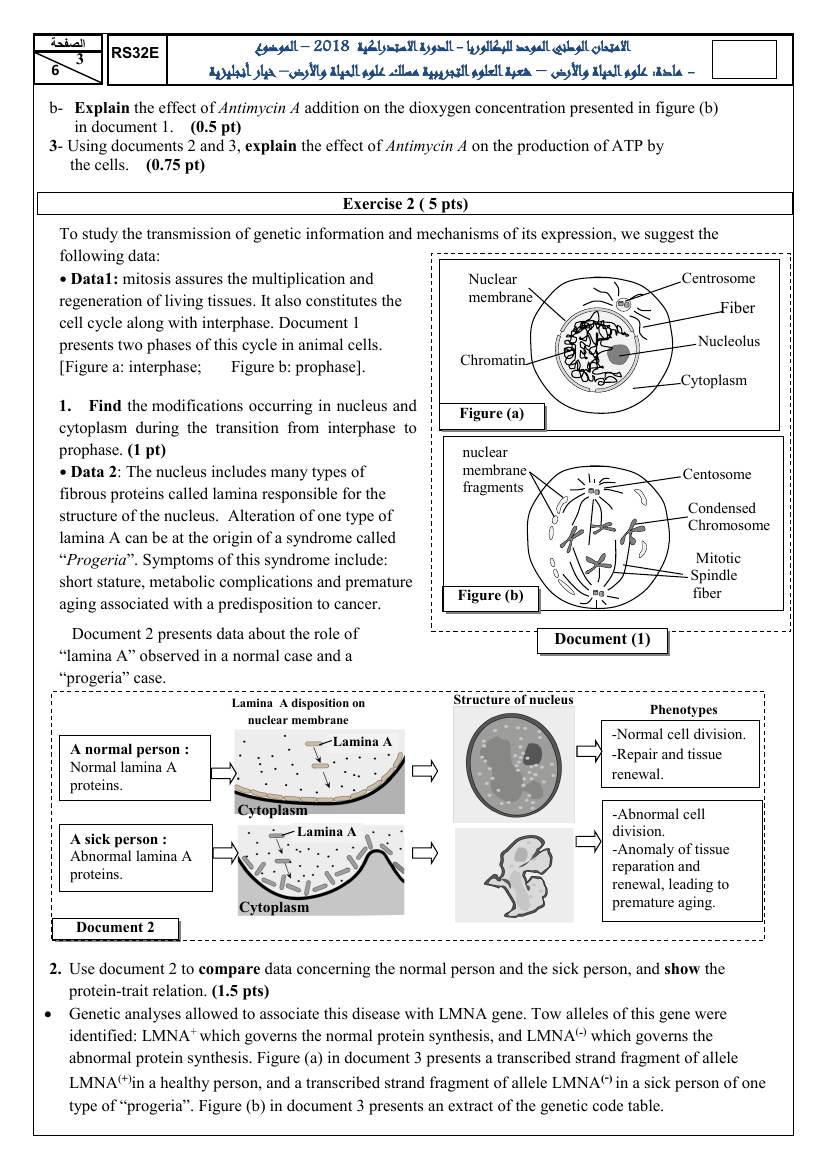
Data1: mitosis assures the multiplication and regeneration of living tissues. It also constitutes the cell cycle along with interphase. Document 1 presents two phases of this cycle in animal cells. [Figure a: interphase; Figure b: prophase].

Document (1) : voir la page 3 du sujet

1.Find the modifications occurring in nucleus and cytoplasm during the transition from interphase to prophase.1 pt

Data 2: The nucleus includes many types of fibrous proteins called lamina responsible for the structure of the nucleus. Alteration of one type of lamina A can be at the origin of a syndrome called “Progeria”. Symptoms of this syndrome include: short stature, metabolic complications and premature aging associated with a predisposition to cancer.

Document 2 presents data about the role of “lamina A” observed in a normal case and a “progeria” case.

Document 2 : voir la page 3 du sujet

2.Use document 2 to compare data concerning the normal person and the sick person, and show the protein-trait relation.1,5 pts

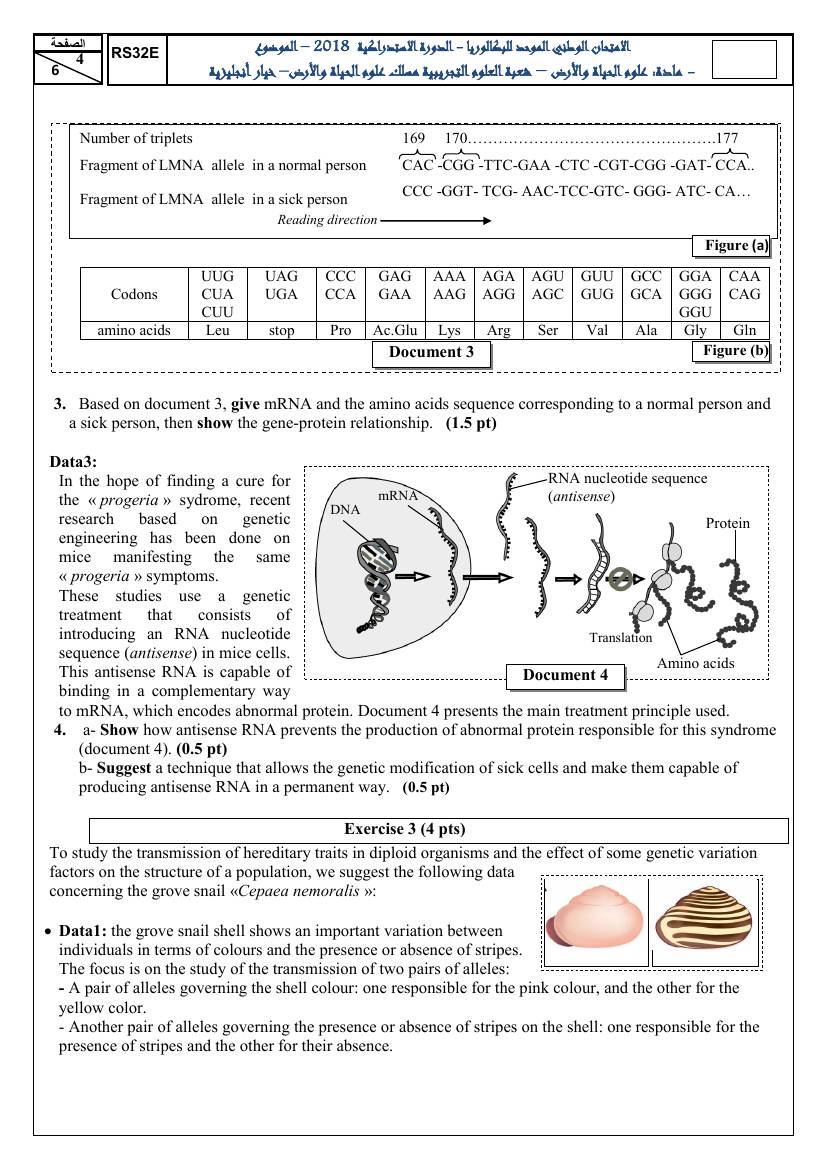
Genetic analyses allowed to associate this disease with LMNA gene. Tow alleles of this gene were identified: LMNA+^{+} which governs the normal protein synthesis, and LMNA(−)^{(-)} which governs the abnormal protein synthesis. Figure (a) in document 3 presents a transcribed strand fragment of allele LMNA(+)^{(+)} in a healthy person, and a transcribed strand fragment of allele LMNA(−)^{(-)} in a sick person of one type of “progeria”. Figure (b) in document 3 presents an extract of the genetic code table.

Figure (a) – Number of triplets: 169, 170 ……… 177. Reading direction: left to right.

Fragment of LMNA allele in a normal person: CAC -CGG -TTC-GAA -CTC -CGT-CGG -GAT- CCA..

Fragment of LMNA allele in a sick person: CCC -GGT- TCG- AAC-TCC-GTC- GGG- ATC- CA…

Figure (b)

CodonsUUG CUA CUUUAG UGACCC CCAGAG GAAAAA AAGAGA AGGAGU AGCGUU GUGGCC GCAGGA GGG GGUCAA CAG
amino acidsLeustopProAc.GluLysArgSerValAlaGlyGln

Document 3 : voir la page 4 du sujet

3.Based on document 3, give mRNA and the amino acids sequence corresponding to a normal person and a sick person, then show the gene-protein relationship.1,5 pts

Data3: In the hope of finding a cure for the « progeria » sydrome, recent research based on genetic engineering has been done on mice manifesting the same « progeria » symptoms. These studies use a genetic treatment that consists of introducing an RNA nucleotide sequence (antisense) in mice cells. This antisense RNA is capable of binding in a complementary way to mRNA, which encodes abnormal protein. Document 4 presents the main treatment principle used.

Document 4 : voir la page 4 du sujet

4.a.Show how antisense RNA prevents the production of abnormal protein responsible for this syndrome (document 4).0,5 pt

4.b.Suggest a technique that allows the genetic modification of sick cells and make them capable of producing antisense RNA in a permanent way.0,5 pt

Partie II – Exercice 34 pts

Exercise 3 (4 pts)

To study the transmission of hereditary traits in diploid organisms and the effect of some genetic variation factors on the structure of a population, we suggest the following data concerning the grove snail «Cepaea nemoralis »:

Figure : voir la page 4 du sujet

Data1: the grove snail shell shows an important variation between individuals in terms of colours and the presence or absence of stripes. The focus is on the study of the transmission of two pairs of alleles:

- A pair of alleles governing the shell colour: one responsible for the pink colour, and the other for the yellow color.

- Another pair of alleles governing the presence or absence of stripes on the shell: one responsible for the presence of stripes and the other for their absence.

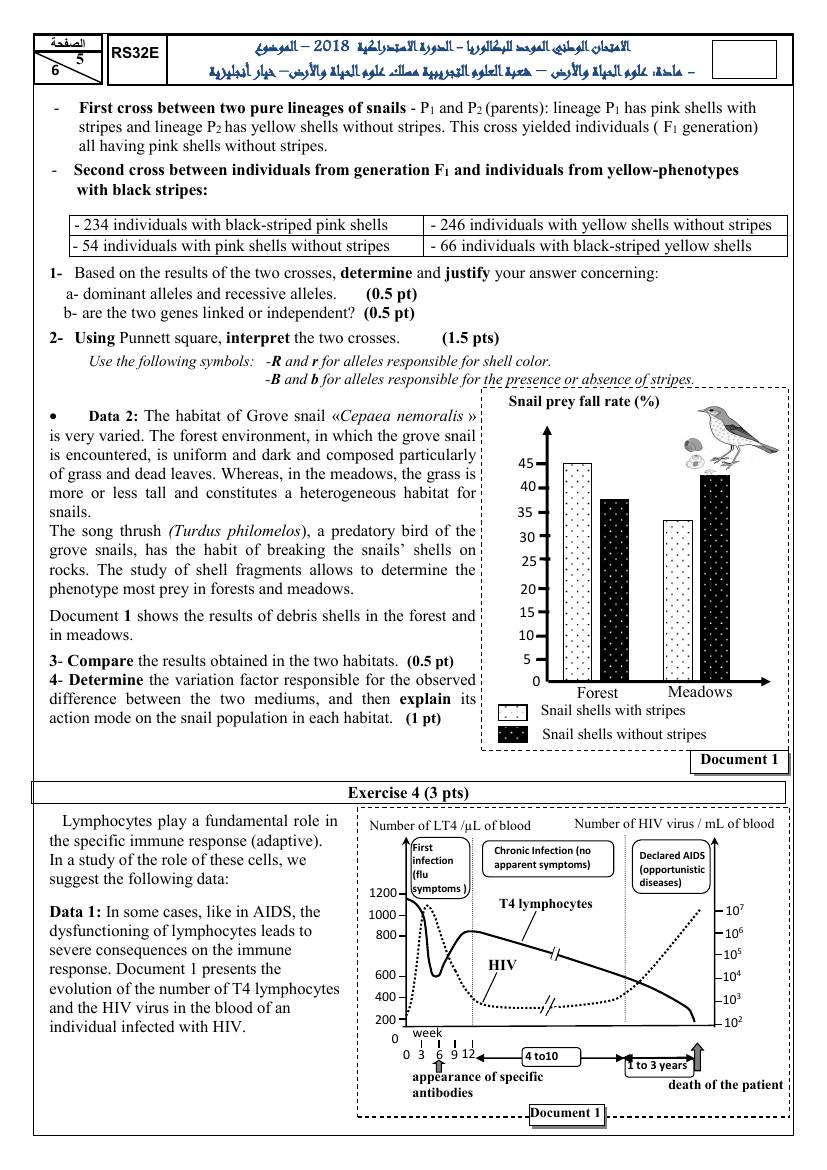
- First cross between two pure lineages of snails - P1_1 and P2_2 (parents): lineage P1_1 has pink shells with stripes and lineage P2_2 has yellow shells without stripes. This cross yielded individuals ( F1_1 generation) all having pink shells without stripes.

- Second cross between individuals from generation F1_1 and individuals from yellow-phenotypes with black stripes:

- 234 individuals with black-striped pink shells- 246 individuals with yellow shells without stripes
- 54 individuals with pink shells without stripes- 66 individuals with black-striped yellow shells

1.Based on the results of the two crosses, determine and justify your answer concerning:

1.a.dominant alleles and recessive alleles.0,5 pt

1.b.are the two genes linked or independent?0,5 pt

2.Using Punnett square, interpret the two crosses.1,5 pts

Use the following symbols: -R and r for alleles responsible for shell color. -B and b for alleles responsible for the presence or absence of stripes.

Data 2: The habitat of Grove snail «Cepaea nemoralis » is very varied. The forest environment, in which the grove snail is encountered, is uniform and dark and composed particularly of grass and dead leaves. Whereas, in the meadows, the grass is more or less tall and constitutes a heterogeneous habitat for snails.

The song thrush (Turdus philomelos), a predatory bird of the grove snails, has the habit of breaking the snails’ shells on rocks. The study of shell fragments allows to determine the phenotype most prey in forests and meadows.

Document 1 shows the results of debris shells in the forest and in meadows.

Document 1 : voir la page 5 du sujet

Snail prey fall rate (%) – Forest, Meadows – Legend: Snail shells with stripes; Snail shells without stripes.

3.Compare the results obtained in the two habitats.0,5 pt

4.Determine the variation factor responsible for the observed difference between the two mediums, and then explain its action mode on the snail population in each habitat.1 pt

Partie II – Exercice 43 pts

Exercise 4 (3 pts)

Lymphocytes play a fundamental role in the specific immune response (adaptive). In a study of the role of these cells, we suggest the following data:

Data 1: In some cases, like in AIDS, the dysfunctioning of lymphocytes leads to severe consequences on the immune response. Document 1 presents the evolution of the number of T4 lymphocytes and the HIV virus in the blood of an individual infected with HIV.

Document 1 : voir la page 5 du sujet

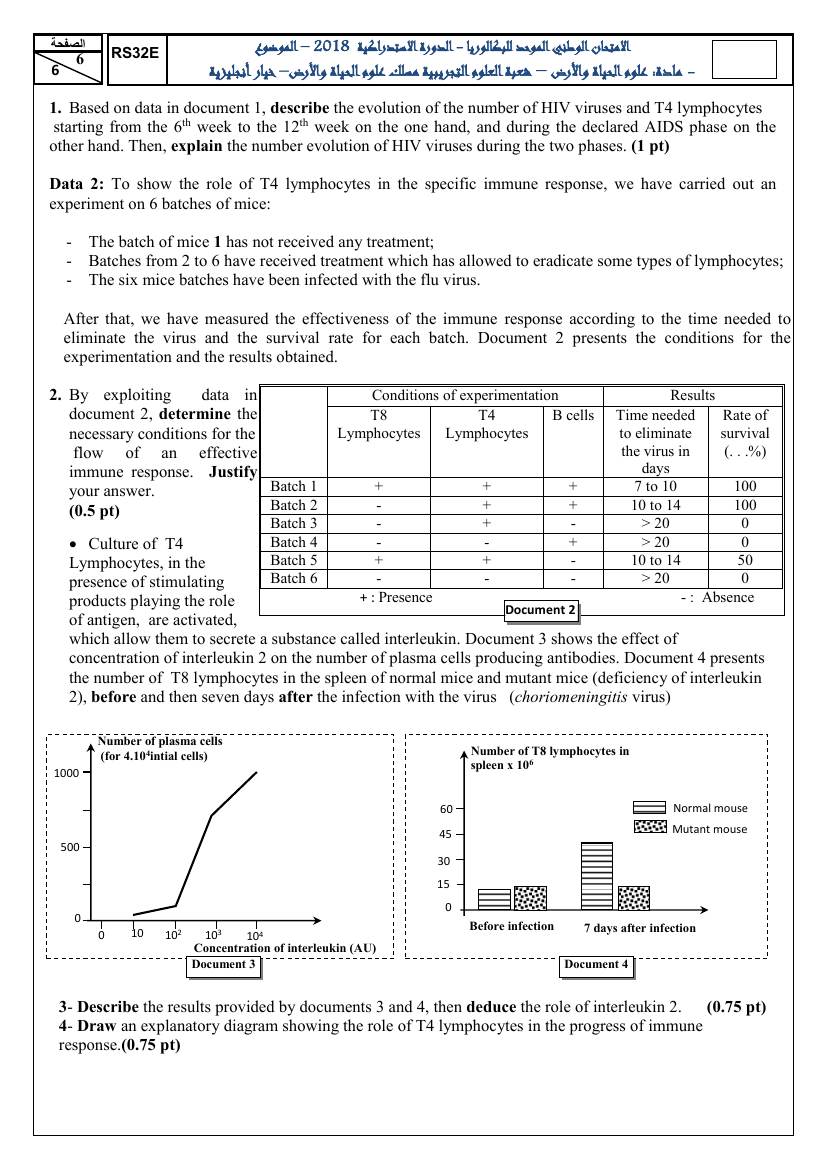
1.Based on data in document 1, describe the evolution of the number of HIV viruses and T4 lymphocytes starting from the 6th^{th} week to the 12th^{th} week on the one hand, and during the declared AIDS phase on the other hand. Then, explain the number evolution of HIV viruses during the two phases.1 pt

Data 2: To show the role of T4 lymphocytes in the specific immune response, we have carried out an experiment on 6 batches of mice:

- The batch of mice 1 has not received any treatment;

- Batches from 2 to 6 have received treatment which has allowed to eradicate some types of lymphocytes;

- The six mice batches have been infected with the flu virus.

After that, we have measured the effectiveness of the immune response according to the time needed to eliminate the virus and the survival rate for each batch. Document 2 presents the conditions for the experimentation and the results obtained.

T8 LymphocytesT4 LymphocytesB cellsTime needed to eliminate the virus in daysRate of survival (. . .%)
Batch 1+++7 to 10100
Batch 2-++10 to 14100
Batch 3-+-> 200
Batch 4--+> 200
Batch 5++-10 to 1450
Batch 6---> 200

Conditions of experimentation: T8 Lymphocytes, T4 Lymphocytes, B cells. Results: Time needed to eliminate the virus in days, Rate of survival. + : Presence; - : Absence

Document 2 : voir la page 6 du sujet

2.By exploiting data in document 2, determine the necessary conditions for the flow of an effective immune response. Justify your answer.0,5 pt

Culture of T4 Lymphocytes, in the presence of stimulating products playing the role of antigen, are activated, which allow them to secrete a substance called interleukin. Document 3 shows the effect of concentration of interleukin 2 on the number of plasma cells producing antibodies. Document 4 presents the number of T8 lymphocytes in the spleen of normal mice and mutant mice (deficiency of interleukin 2), before and then seven days after the infection with the virus (choriomeningitis virus)

Document 3 : voir la page 6 du sujet

Document 4 : voir la page 6 du sujet

3.Describe the results provided by documents 3 and 4, then deduce the role of interleukin 2.0,75 pt

4.Draw an explanatory diagram showing the role of T4 lymphocytes in the progress of immune response.0,75 pt

Entraîne-toi sur ces chapitres avec Kresco, gratuitement

Yallah, wa7d l-khtwa.

Le sujet, tu l’as. Maintenant, prépare-le.

Crée ton compte gratuit : une leçon offerte dans chaque chapitre, les quiz et ton suivi, matière par matière, jusqu’au national.