Jerreb rassek f l-national.

Examen national SVT 2Bac SVT (option anglaise) 2019, session de rattrapage

SVT · Sciences de la Vie et de la Terre · 6 pages

Le sujet en bref

  1. Partie I5 pts

    Consommation de la matière organique et flux d’énergie · Le muscle strié squelettique

  2. Partie II – Exercice 14,5 pts

    Nature et expression de l’information génétique · Génétique humaine

    La bronchopneumopathie chronique obstructive et la protéine alpha-1 antitrypsine

  3. Partie II – Exercice 24 pts

    Lois statistiques de la transmission des caractères · Génétique des populations

    L’aspect des yeux et la nageoire caudale de poissons, et les guppys face aux prédateurs

  4. Partie II – Exercice 33,5 pts

    Immunologie

    La réponse immunitaire contre le virus de la grippe

  5. Partie II – Exercice 43 pts

    Formation des chaînes de montagnes

    L’histoire géologique du Massif armoricain

Total : 20 points

Le sujet, page par page

  1. Examen national SVT 2Bac SVT (option anglaise) 2019, session de rattrapage, page 1 sur 6
  2. Examen national SVT 2Bac SVT (option anglaise) 2019, session de rattrapage, page 2 sur 6
  3. Examen national SVT 2Bac SVT (option anglaise) 2019, session de rattrapage, page 3 sur 6
  4. Examen national SVT 2Bac SVT (option anglaise) 2019, session de rattrapage, page 4 sur 6
  5. Examen national SVT 2Bac SVT (option anglaise) 2019, session de rattrapage, page 5 sur 6
  6. Examen national SVT 2Bac SVT (option anglaise) 2019, session de rattrapage, page 6 sur 6

Sujet officiel de l’examen national unifié du baccalauréat, tel que publié par le Centre national de l’évaluation et des examens (Ministère de l’Éducation nationale).

L’énoncé en texte

Transcription du sujet officiel, pour le lire et le rechercher sur téléphone. Les figures restent sur les pages du sujet ; en cas de différence, le PDF officiel fait foi.

Partie I5 pts

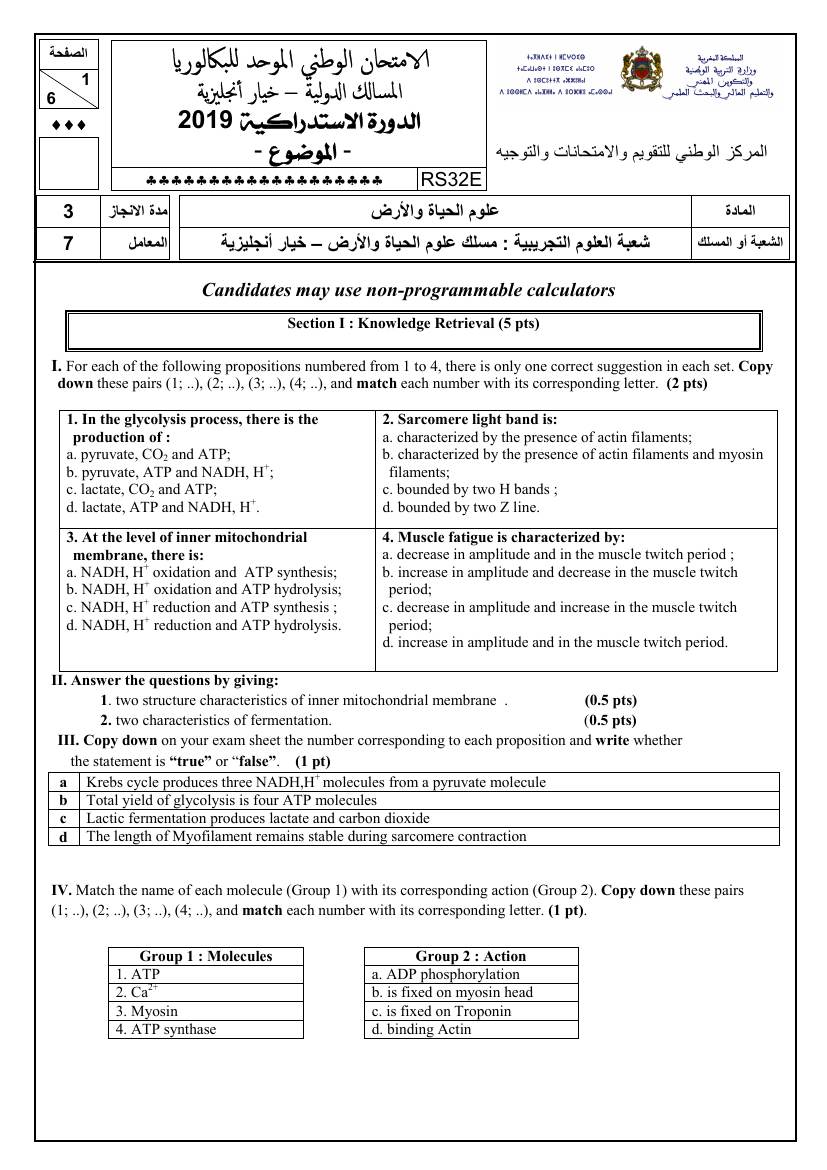
Section I : Knowledge Retrieval (5 pts)

I.For each of the following propositions numbered from 1 to 4, there is only one correct suggestion in each set. Copy down these pairs (1; ..), (2; ..), (3; ..), (4; ..), and match each number with its corresponding letter.2 pts

1. In the glycolysis process, there is the production of :

a. pyruvate, CO2\mathrm{CO_2} and ATP;

b. pyruvate, ATP and NADH,H+\mathrm{NADH,H^+};

c. lactate, CO2\mathrm{CO_2} and ATP;

d. lactate, ATP and NADH,H+\mathrm{NADH,H^+}.

2. Sarcomere light band is:

a. characterized by the presence of actin filaments;

b. characterized by the presence of actin filaments and myosin filaments;

c. bounded by two H bands ;

d. bounded by two Z line.

3. At the level of inner mitochondrial membrane, there is:

a. NADH,H+\mathrm{NADH,H^+} oxidation and ATP synthesis;

b. NADH,H+\mathrm{NADH,H^+} oxidation and ATP hydrolysis;

c. NADH,H+\mathrm{NADH,H^+} reduction and ATP synthesis ;

d. NADH,H+\mathrm{NADH,H^+} reduction and ATP hydrolysis.

4. Muscle fatigue is characterized by:

a. decrease in amplitude and in the muscle twitch period ;

b. increase in amplitude and decrease in the muscle twitch period;

c. decrease in amplitude and increase in the muscle twitch period;

d. increase in amplitude and in the muscle twitch period.

II. Answer the questions by giving:

II.1.two structure characteristics of inner mitochondrial membrane .0,5 pt

II.2.two characteristics of fermentation.0,5 pt

III.Copy down on your exam sheet the number corresponding to each proposition and write whether the statement is “true” or “false”.1 pt

aKrebs cycle produces three NADH,H+\mathrm{NADH,H^+} molecules from a pyruvate molecule
bTotal yield of glycolysis is four ATP molecules
cLactic fermentation produces lactate and carbon dioxide
dThe length of Myofilament remains stable during sarcomere contraction

IV.Match the name of each molecule (Group 1) with its corresponding action (Group 2). Copy down these pairs (1; ..), (2; ..), (3; ..), (4; ..), and match each number with its corresponding letter.1 pt

Group 1 : MoleculesGroup 2 : Action
1. ATPa. ADP phosphorylation
2. Ca2+\mathrm{Ca^{2+}}b. is fixed on myosin head
3. Myosinc. is fixed on Troponin
4. ATP synthased. binding Actin

Revoir le cours : Consommation de la matière organique et flux d’énergie · Le muscle strié squelettique

Partie II – Exercice 14,5 pts

Section II: Scientific reasoning and communication in graphic and written modes (15 pts)

Exercise 1 (4.5 pts)

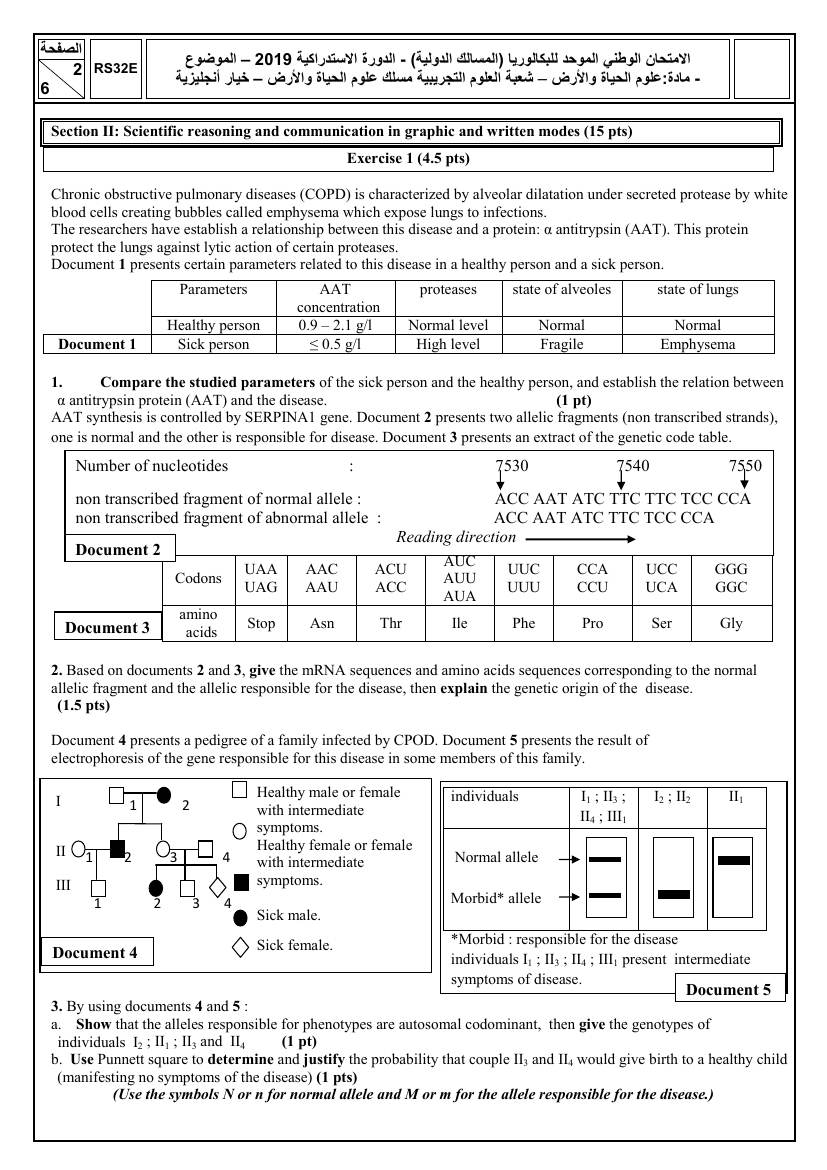
Chronic obstructive pulmonary diseases (COPD) is characterized by alveolar dilatation under secreted protease by white blood cells creating bubbles called emphysema which expose lungs to infections.

The researchers have establish a relationship between this disease and a protein: α antitrypsin (AAT). This protein protect the lungs against lytic action of certain proteases.

Document 1 presents certain parameters related to this disease in a healthy person and a sick person.

Document 1ParametersAAT concentrationproteasesstate of alveolesstate of lungs
Healthy person0.9 – 2.1 g/lNormal levelNormalNormal
Sick person≤ 0.5 g/lHigh levelFragileEmphysema

1.Compare the studied parameters of the sick person and the healthy person, and establish the relation between α antitrypsin protein (AAT) and the disease.1 pt

AAT synthesis is controlled by SERPINA1 gene. Document 2 presents two allelic fragments (non transcribed strands), one is normal and the other is responsible for disease. Document 3 presents an extract of the genetic code table.

Document 2 – Number of nucleotides : 7530 7540 7550

non transcribed fragment of normal allele : ACC AAT ATC TTC TTC TCC CCA

non transcribed fragment of abnormal allele : ACC AAT ATC TTC TCC CCA

Reading direction →

Document 3CodonsUAA UAGAAC AAUACU ACCAUC AUU AUAUUC UUUCCA CCUUCC UCAGGG GGC
amino acidsStopAsnThrIlePheProSerGly

2.Based on documents 2 and 3, give the mRNA sequences and amino acids sequences corresponding to the normal allelic fragment and the allelic responsible for the disease, then explain the genetic origin of the disease.1,5 pts

Document 4 presents a pedigree of a family infected by CPOD. Document 5 presents the result of electrophoresis of the gene responsible for this disease in some members of this family.

Document 4 : voir la page 2 du sujet

Healthy male or female with intermediate symptoms.

Healthy female or female with intermediate symptoms.

Sick male.

Sick female.

Document 5 : voir la page 2 du sujet

individuals I1\mathrm{I_1} ; II3\mathrm{II_3} ; II4\mathrm{II_4} ; III1\mathrm{III_1} | I2\mathrm{I_2} ; II2\mathrm{II_2} | II1\mathrm{II_1} (lanes of the electrophoresis, rows: Normal allele, Morbid* allele)

*Morbid : responsible for the disease

individuals I1\mathrm{I_1} ; II3\mathrm{II_3} ; II4\mathrm{II_4} ; III1\mathrm{III_1} present intermediate symptoms of disease.

3. By using documents 4 and 5 :

3.a.Show that the alleles responsible for phenotypes are autosomal codominant, then give the genotypes of individuals I2\mathrm{I_2} ; II1\mathrm{II_1} ; II3\mathrm{II_3} and II4\mathrm{II_4}1 pt

3.b.Use Punnett square to determine and justify the probability that couple II3\mathrm{II_3} and II4\mathrm{II_4} would give birth to a healthy child (manifesting no symptoms of the disease)1 pt

(Use the symbols N or n for normal allele and M or m for the allele responsible for the disease.)

Partie II – Exercice 24 pts

Exercise 2 (4 pts)

I. On a fish farming, the breeders made fish crosses to obtain commercially attractive phenotypes. Among the targeted hereditary traits: eyes aspect and height of caudal fin.

1st cross: between males with funny eyes and fancy caudal fins and females with normal eyes and normal caudal fins. Individuals of F1\mathrm{F_1} from this cross have normal eyes and normal caudal fins.

2nd cross: among individuals of generation F1\mathrm{F_1}. Generation F2\mathrm{F_2} from this cross is composed of the following phenotypes :

- 57 % fish with normal eyes and normal caudal fins.

- 18 % fish with normal eyes and fancy caudal fins.

- 19.5 % fish with funny eyes and normal caudal fins.

- 6.5% fish with funny eyes and fancy caudal fins.

1.What do you deduce from the first and the second crosses?1 pt

To meet the needs, providing the fish market with funny eyes and fancy caudal fins, the breeder realized crosses among generation F2\mathrm{F_2}: he has made crosses between fishes with funny eyes and normal caudal fins and fishes with funny eyes and fancy caudal fins.

2.Use Punnett Square to give the percentages of the targeted phenotypes of this cross.1,25 pts

(Use the symbols D and d for alleles responsible for eyes color and N and n responsible for alleles height of caudal fin.)

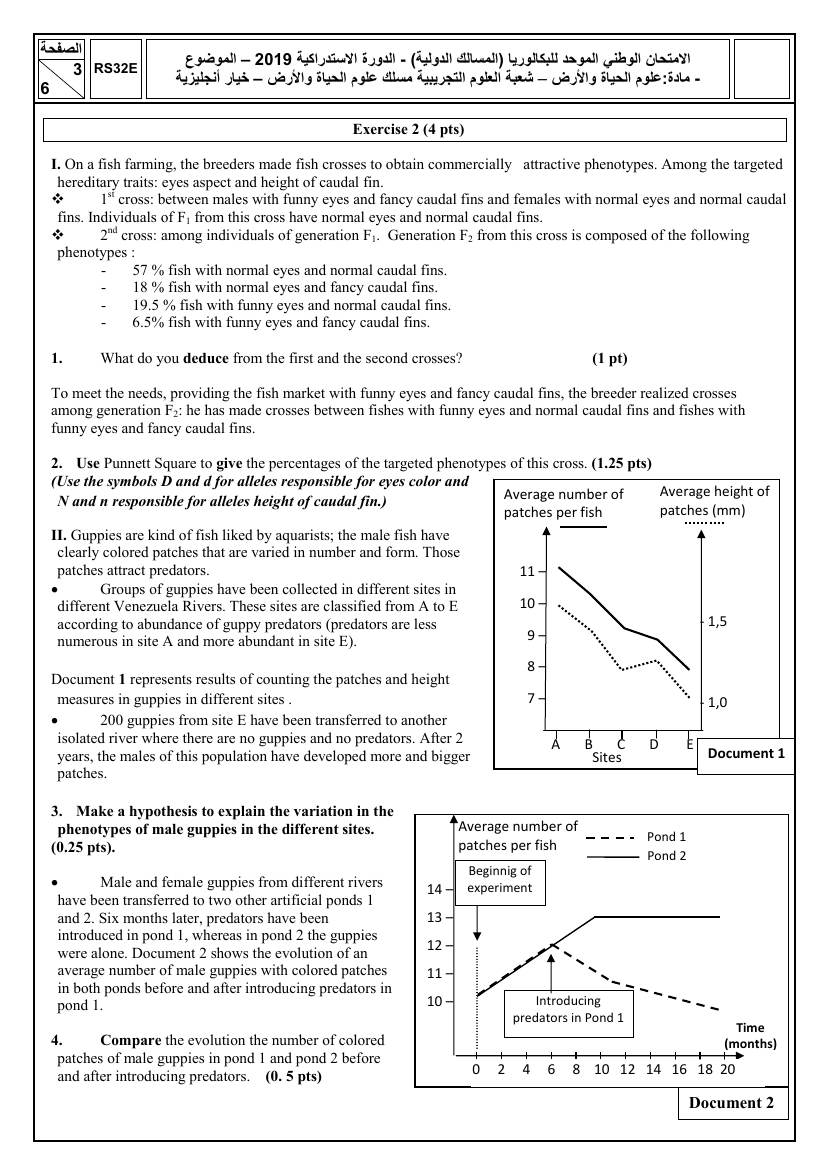
II. Guppies are kind of fish liked by aquarists; the male fish have clearly colored patches that are varied in number and form. Those patches attract predators.

• Groups of guppies have been collected in different sites in different Venezuela Rivers. These sites are classified from A to E according to abundance of guppy predators (predators are less numerous in site A and more abundant in site E).

Document 1 represents results of counting the patches and height measures in guppies in different sites .

Document 1 : voir la page 3 du sujet

• 200 guppies from site E have been transferred to another isolated river where there are no guppies and no predators. After 2 years, the males of this population have developed more and bigger patches.

3.Make a hypothesis to explain the variation in the phenotypes of male guppies in the different sites.0,25 pt

• Male and female guppies from different rivers have been transferred to two other artificial ponds 1 and 2. Six months later, predators have been introduced in pond 1, whereas in pond 2 the guppies were alone. Document 2 shows the evolution of an average number of male guppies with colored patches in both ponds before and after introducing predators in pond 1.

Document 2 : voir la page 3 du sujet

4.Compare the evolution the number of colored patches of male guppies in pond 1 and pond 2 before and after introducing predators.0,5 pt

5.Based on previous data, find the variation factor affecting the phenotypes in guppies. Justify your answer and verify the hypothesis suggested in question 3.1 pt

Partie II – Exercice 33,5 pts

Exercise 3 (3,5 pts)

To highlight some aspect of immune response against the flu virus, we suggest the following data:

The flu is viral infection having as main symptoms fiver, fatigue, runny and stuffy nose, headaches.

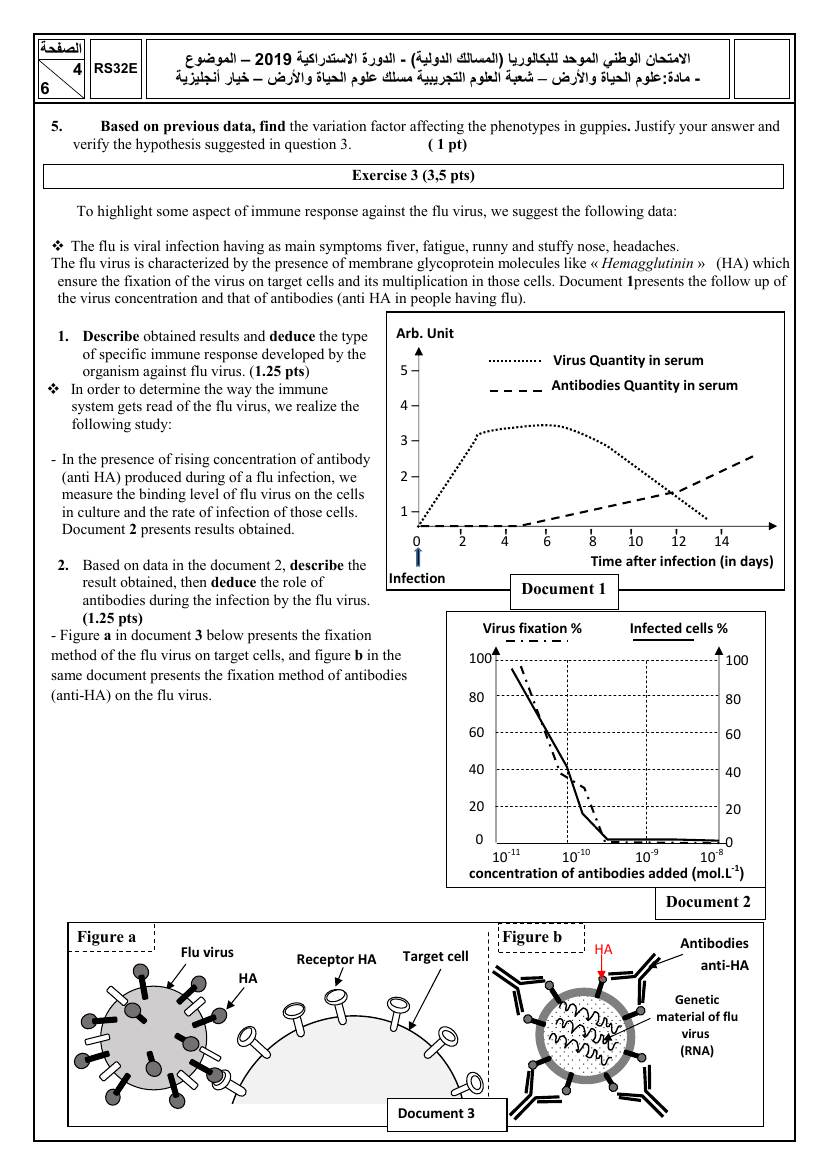
The flu virus is characterized by the presence of membrane glycoprotein molecules like « Hemagglutinin » (HA) which ensure the fixation of the virus on target cells and its multiplication in those cells. Document 1 presents the follow up of the virus concentration and that of antibodies (anti HA in people having flu).

Document 1 : voir la page 4 du sujet

1.Describe obtained results and deduce the type of specific immune response developed by the organism against flu virus.1,25 pts

In order to determine the way the immune system gets read of the flu virus, we realize the following study:

- In the presence of rising concentration of antibody (anti HA) produced during of a flu infection, we measure the binding level of flu virus on the cells in culture and the rate of infection of those cells. Document 2 presents results obtained.

Document 2 : voir la page 4 du sujet

2.Based on data in the document 2, describe the result obtained, then deduce the role of antibodies during the infection by the flu virus.1,25 pts

- Figure a in document 3 below presents the fixation method of the flu virus on target cells, and figure b in the same document presents the fixation method of antibodies (anti-HA) on the flu virus.

Document 3 : voir la page 4 du sujet

3.Based on your answer to question 2 and data in document 3, explain how the flu virus is eliminated1 pt

Partie II – Exercice 43 pts

Exercise 4 (3 pts)

In the light of studies dealing with geological phenomena about the formation of mountain ranges, we suggest the following data:

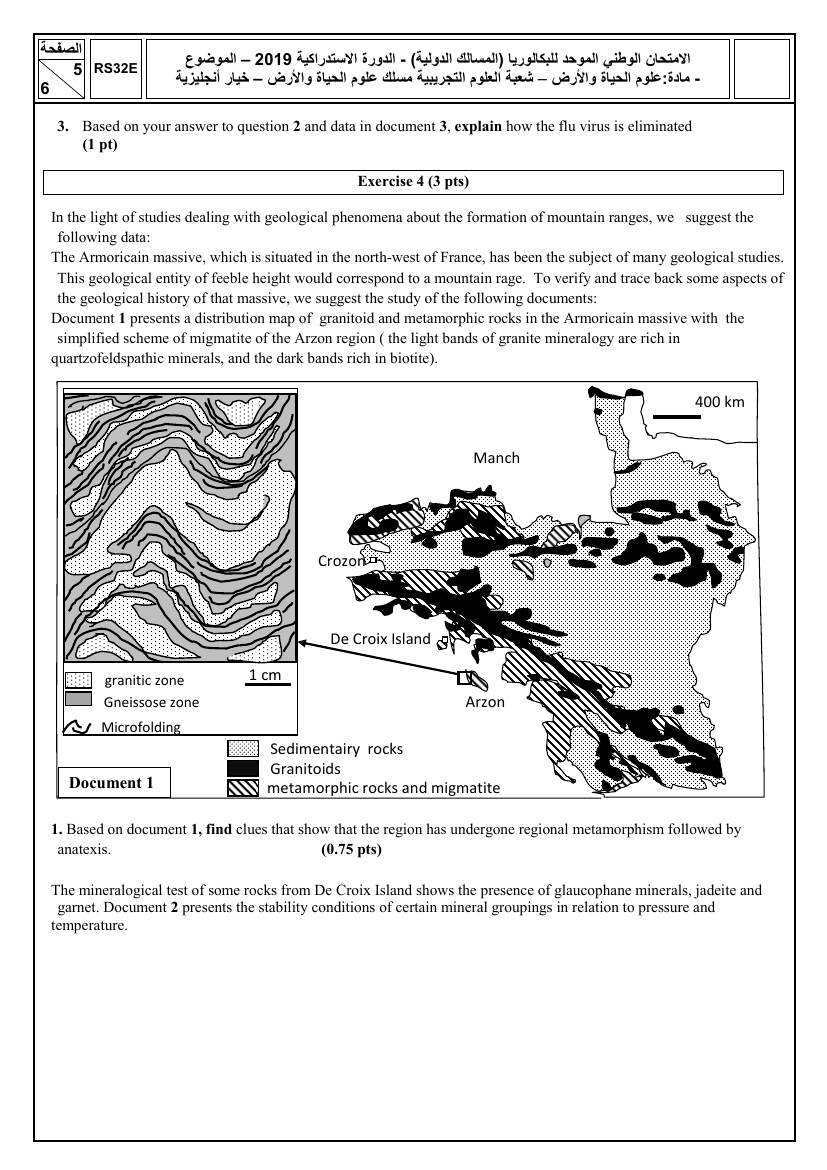
The Armoricain massive, which is situated in the north-west of France, has been the subject of many geological studies. This geological entity of feeble height would correspond to a mountain rage. To verify and trace back some aspects of the geological history of that massive, we suggest the study of the following documents:

Document 1 presents a distribution map of granitoid and metamorphic rocks in the Armoricain massive with the simplified scheme of migmatite of the Arzon region ( the light bands of granite mineralogy are rich in quartzofeldspathic minerals, and the dark bands rich in biotite).

Document 1 : voir la page 5 du sujet

1.Based on document 1, find clues that show that the region has undergone regional metamorphism followed by anatexis.0,75 pt

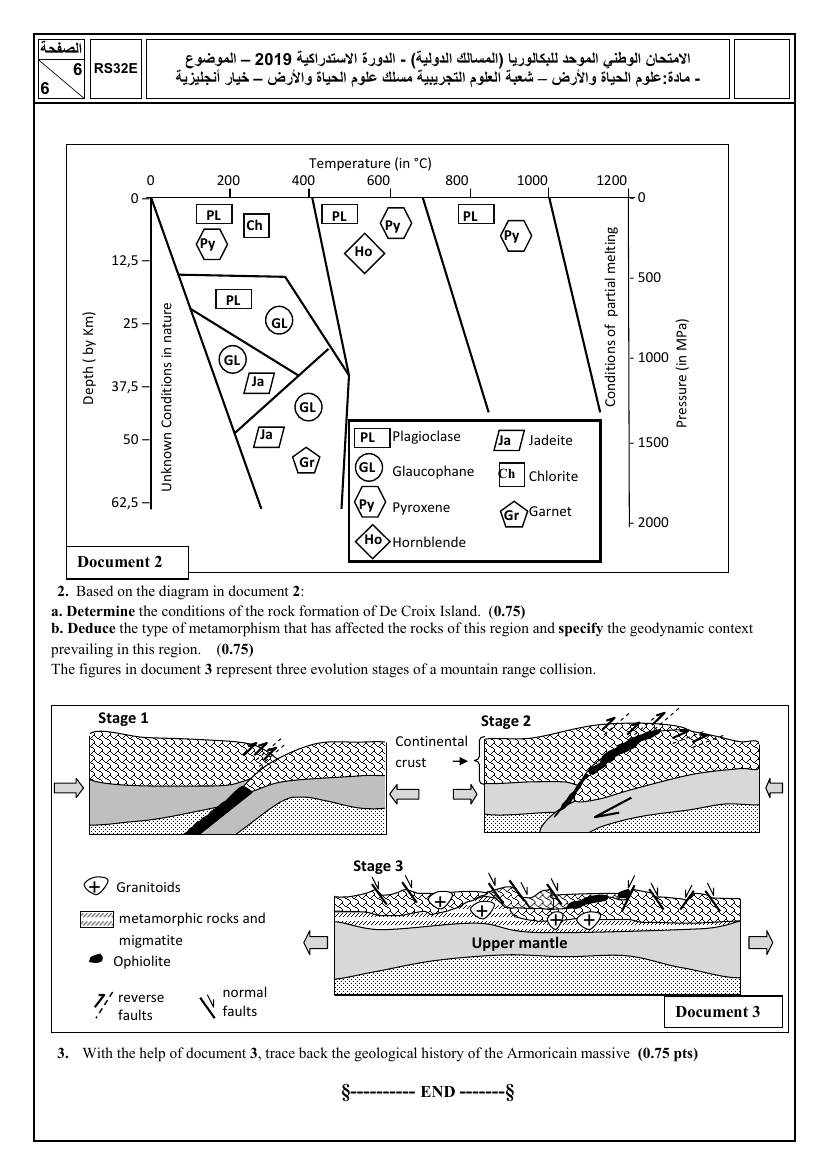
The mineralogical test of some rocks from De Croix Island shows the presence of glaucophane minerals, jadeite and garnet. Document 2 presents the stability conditions of certain mineral groupings in relation to pressure and temperature.

Document 2 : voir la page 6 du sujet

2. Based on the diagram in document 2:

2.a.Determine the conditions of the rock formation of De Croix Island.0,75 pt

2.b.Deduce the type of metamorphism that has affected the rocks of this region and specify the geodynamic context prevailing in this region.0,75 pt

The figures in document 3 represent three evolution stages of a mountain range collision.

Document 3 : voir la page 6 du sujet

3.With the help of document 3, trace back the geological history of the Armoricain massive0,75 pt

Entraîne-toi sur ces chapitres avec Kresco, gratuitement

Yallah, wa7d l-khtwa.

Le sujet, tu l’as. Maintenant, prépare-le.

Crée ton compte gratuit : une leçon offerte dans chaque chapitre, les quiz et ton suivi, matière par matière, jusqu’au national.