Partie I5 pts
Section I : Knowledge Retrieval (5 pts)
I.Define the following notions: (a) allele; (b) mutation.1 pt
II. Chromosome characteristics (form and disposition) change according to the phases of mitosis and meiosis. Give two characteristics for each of the two phases:
II.a.anaphase I of meiosis0,5 pt
II.b.anaphase of mitosis0,5 pt
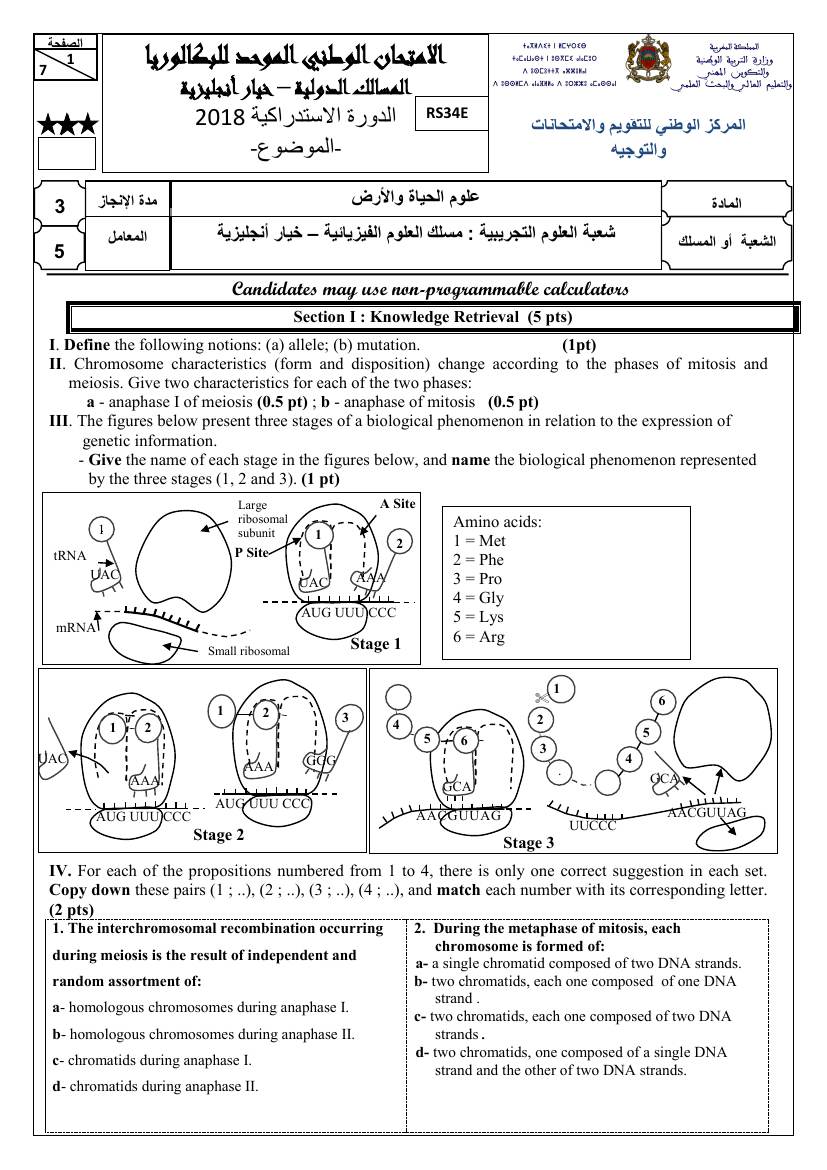
III. The figures below present three stages of a biological phenomenon in relation to the expression of genetic information.
III.Give the name of each stage in the figures below, and name the biological phenomenon represented by the three stages (1, 2 and 3).1 pt
Stage 1 : voir la page 1 du sujet
Amino acids: 1 = Met ; 2 = Phe ; 3 = Pro ; 4 = Gly ; 5 = Lys ; 6 = Arg
Stage 2 : voir la page 1 du sujet
Stage 3 : voir la page 1 du sujet
IV.For each of the propositions numbered from 1 to 4, there is only one correct suggestion in each set. Copy down these pairs (1 ; ..), (2 ; ..), (3 ; ..), (4 ; ..), and match each number with its corresponding letter.2 pts
IV.1.The interchromosomal recombination occurring during meiosis is the result of independent and random assortment of: a- homologous chromosomes during anaphase I. b- homologous chromosomes during anaphase II. c- chromatids during anaphase I. d- chromatids during anaphase II.
IV.2.During the metaphase of mitosis, each chromosome is formed of: a- a single chromatid composed of two DNA strands. b- two chromatids, each one composed of one DNA strand. c- two chromatids, each one composed of two DNA strands. d- two chromatids, one composed of a single DNA strand and the other of two DNA strands.
IV.3.In case of monohybridism, the cross between a homozygous recessive individual and a heterozygous individual gives: a- 25% recessive phenotype and 75% dominant phenotype. b- 75% recessive phenotype and 25% dominant phenotype. c- 25% recessive phenotype, 50% intermediate phenotype and 25% dominant phenotype. d- 50% recessive phenotype and 50% dominant phenotype.
IV.4.During the replication of DNA: a- the parental double helix remains intact and a completely new second copy is synthesised. b- each strand of the two new DNA molecules contains a mixture of old fragments and newly synthesised ones. c- the two strands of the parental double helix separate and each serves as a model for the synthesis of a new complementary strand. d- the parental double helix is not used for the synthesis of two new copies of DNA.