Jerreb rassek f l-national.

Examen national SVT 2Bac PC (option anglaise) 2018, session normale

SVT · Sciences Physiques · 6 pages

Le sujet en bref

  1. Partie I5 pts

    Consommation de la matière organique et flux d’énergie · Le muscle strié squelettique

  2. Partie II – Exercice 12,5 pts

    Nature et expression de l’information génétique

    Le diabète MODY-2 et l’activité de la glucokinase hépatique

  3. Partie II – Exercice 22,5 pts

    Lois statistiques de la transmission des caractères

    La transmission de la longueur et de la couleur du pelage chez le lapin

  4. Partie II – Exercice 35 pts

    Utilisation des matières organiques et inorganiques

    La pollution des eaux de l’oued Za, affluent de la Moulouya, à Taourirt

  5. Partie II – Exercice 45 pts

    Formation des chaînes de montagnes

    La formation des Alpes occidentales

Total : 20 points

Le sujet, page par page

  1. Examen national SVT 2Bac PC (option anglaise) 2018, session normale, page 1 sur 6
  2. Examen national SVT 2Bac PC (option anglaise) 2018, session normale, page 2 sur 6
  3. Examen national SVT 2Bac PC (option anglaise) 2018, session normale, page 3 sur 6
  4. Examen national SVT 2Bac PC (option anglaise) 2018, session normale, page 4 sur 6
  5. Examen national SVT 2Bac PC (option anglaise) 2018, session normale, page 5 sur 6
  6. Examen national SVT 2Bac PC (option anglaise) 2018, session normale, page 6 sur 6

Sujet officiel de l’examen national unifié du baccalauréat, tel que publié par le Centre national de l’évaluation et des examens (Ministère de l’Éducation nationale).

L’énoncé en texte

Transcription du sujet officiel, pour le lire et le rechercher sur téléphone. Les figures restent sur les pages du sujet ; en cas de différence, le PDF officiel fait foi.

Partie I5 pts

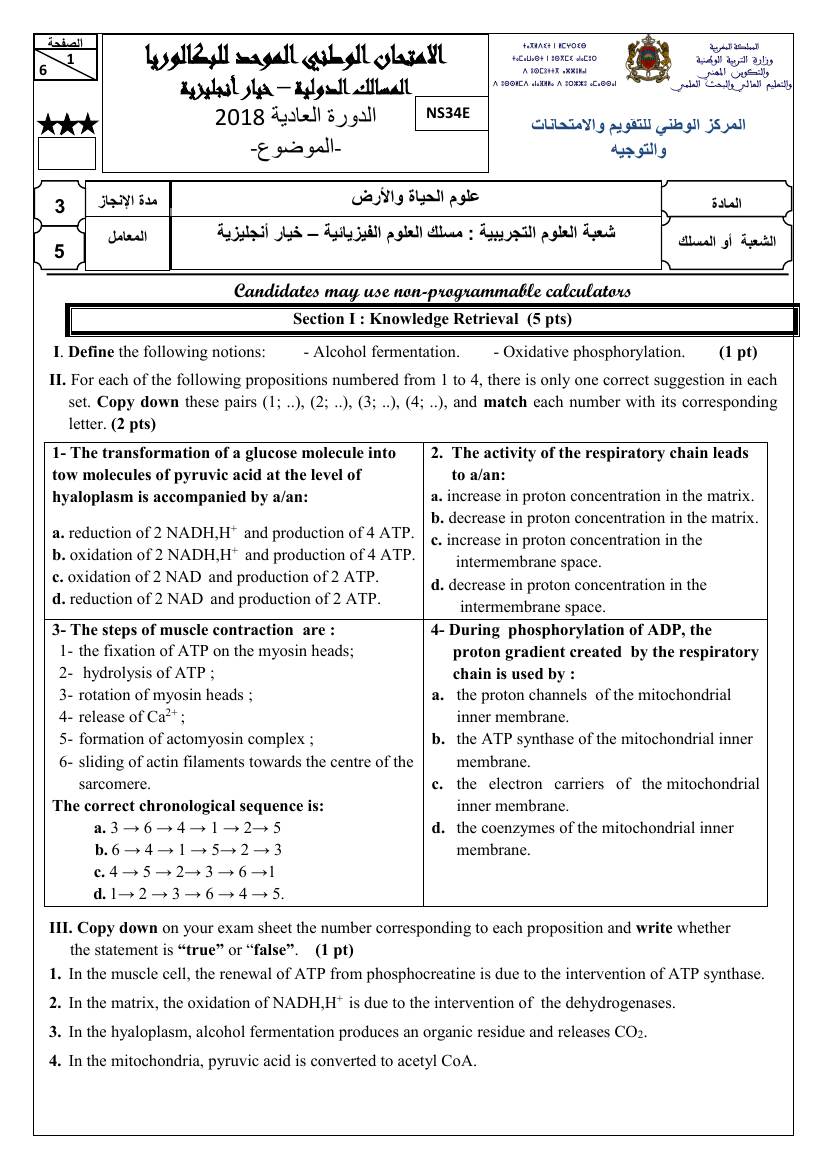
Section I : Knowledge Retrieval (5 pts)

I.Define the following notions: - Alcohol fermentation. - Oxidative phosphorylation.1 pt

II.For each of the following propositions numbered from 1 to 4, there is only one correct suggestion in each set. Copy down these pairs (1; ..), (2; ..), (3; ..), (4; ..), and match each number with its corresponding letter.2 pts

1- The transformation of a glucose molecule into tow molecules of pyruvic acid at the level of hyaloplasm is accompanied by a/an:

a. reduction of 2 NADH,H+\mathrm{NADH,H^+} and production of 4 ATP.

b. oxidation of 2 NADH,H+\mathrm{NADH,H^+} and production of 4 ATP.

c. oxidation of 2 NAD and production of 2 ATP.

d. reduction of 2 NAD and production of 2 ATP.

2. The activity of the respiratory chain leads to a/an:

a. increase in proton concentration in the matrix.

b. decrease in proton concentration in the matrix.

c. increase in proton concentration in the intermembrane space.

d. decrease in proton concentration in the intermembrane space.

3- The steps of muscle contraction are :

1- the fixation of ATP on the myosin heads;

2- hydrolysis of ATP ;

3- rotation of myosin heads ;

4- release of Ca2+\mathrm{Ca^{2+}} ;

5- formation of actomyosin complex ;

6- sliding of actin filaments towards the centre of the sarcomere.

The correct chronological sequence is:

a. 3→6→4→1→2→53 \rightarrow 6 \rightarrow 4 \rightarrow 1 \rightarrow 2 \rightarrow 5

b. 6→4→1→5→2→36 \rightarrow 4 \rightarrow 1 \rightarrow 5 \rightarrow 2 \rightarrow 3

c. 4→5→2→3→6→14 \rightarrow 5 \rightarrow 2 \rightarrow 3 \rightarrow 6 \rightarrow 1

d. 1→2→3→6→4→51 \rightarrow 2 \rightarrow 3 \rightarrow 6 \rightarrow 4 \rightarrow 5.

4- During phosphorylation of ADP, the proton gradient created by the respiratory chain is used by :

a. the proton channels of the mitochondrial inner membrane.

b. the ATP synthase of the mitochondrial inner membrane.

c. the electron carriers of the mitochondrial inner membrane.

d. the coenzymes of the mitochondrial inner membrane.

III.Copy down on your exam sheet the number corresponding to each proposition and write whether the statement is “true” or “false”.1 pt

1. In the muscle cell, the renewal of ATP from phosphocreatine is due to the intervention of ATP synthase.

2. In the matrix, the oxidation of NADH,H+\mathrm{NADH,H^+} is due to the intervention of the dehydrogenases.

3. In the hyaloplasm, alcohol fermentation produces an organic residue and releases CO2\mathrm{CO_2}.

4. In the mitochondria, pyruvic acid is converted to acetyl CoA.

IV.Match each recorded myogram (Group 1) to the corresponding state of stimulations applied on the muscles (Group 2). Copy down these pairs (1; ..), (2; ..), (3; ..), (4; ..), and match each number to its corresponding letter.1 pt

Group 1: Recorded myogram.Group 2 : Application of 2 effective stimulations on the muscle.
1- Complete fusion of two muscle twitches.a- The second stimulation is applied after completion of the first muscle twitch.
2- Incomplete fusion of two muscle twitches.b- The second stimulation is applied during the latent period of the first muscle twitch.
3- Two isolated muscle twitches.c- The second stimulation is applied during the contraction period of the first muscle twitch.
4- One isolated muscle twitch.d- The second stimulation is applied during the relaxation period of the first muscle twitch.

Revoir le cours : Consommation de la matière organique et flux d’énergie · Le muscle strié squelettique

Partie II – Exercice 12,5 pts

Section II : Scientific reasoning and communication in graphic and written modes (15 pts)

Exercise 1 (2.5 pts)

Mody-2 diabetes (Maturity Onset Diabetes of the Young) affects some people before the age of 20. People with this disease suffer from permanent hyperglycemia.

In order to highlight the genetic origin of this disease, we suggest the following data:

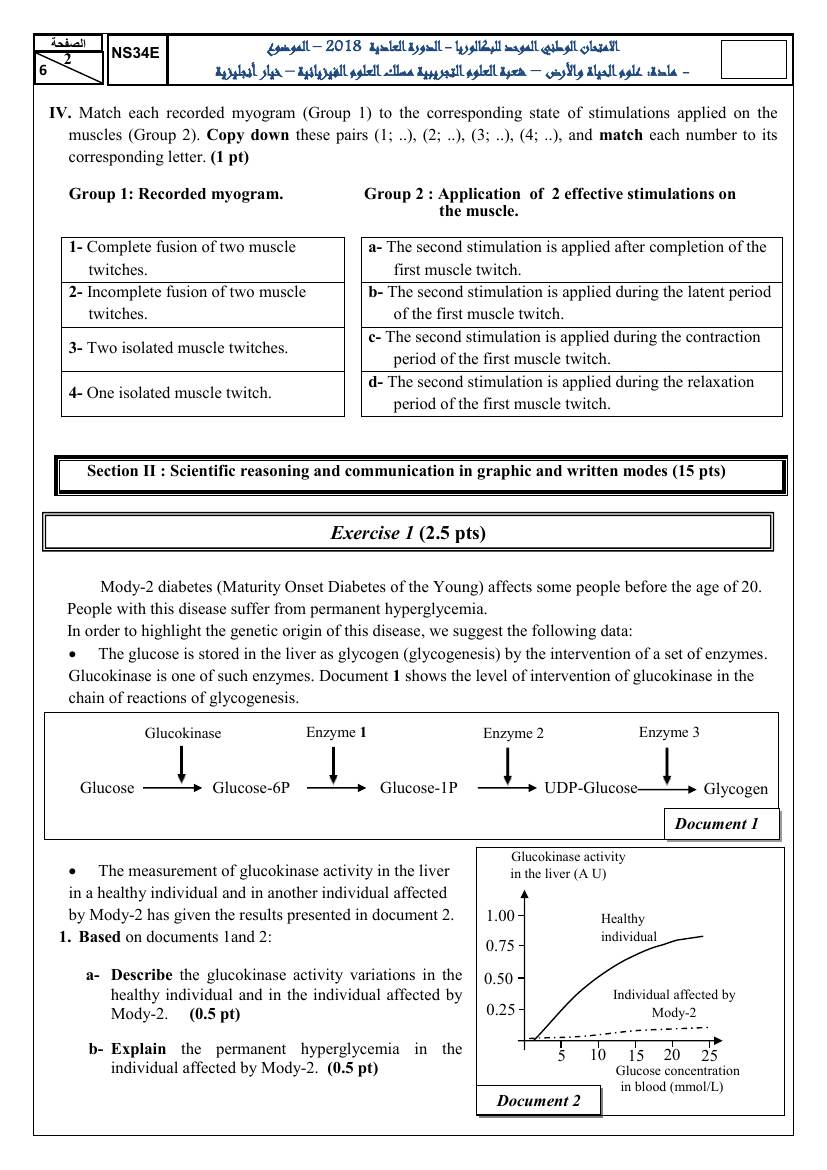
The glucose is stored in the liver as glycogen (glycogenesis) by the intervention of a set of enzymes. Glucokinase is one of such enzymes. Document 1 shows the level of intervention of glucokinase in the chain of reactions of glycogenesis.

Document 1 : voir la page 2 du sujet

The measurement of glucokinase activity in the liver in a healthy individual and in another individual affected by Mody-2 has given the results presented in document 2.

Document 2 : voir la page 2 du sujet

1.Based on documents 1 and 2:

1.a.Describe the glucokinase activity variations in the healthy individual and in the individual affected by Mody-2.0,5 pt

1.b.Explain the permanent hyperglycemia in the individual affected by Mody-2.0,5 pt

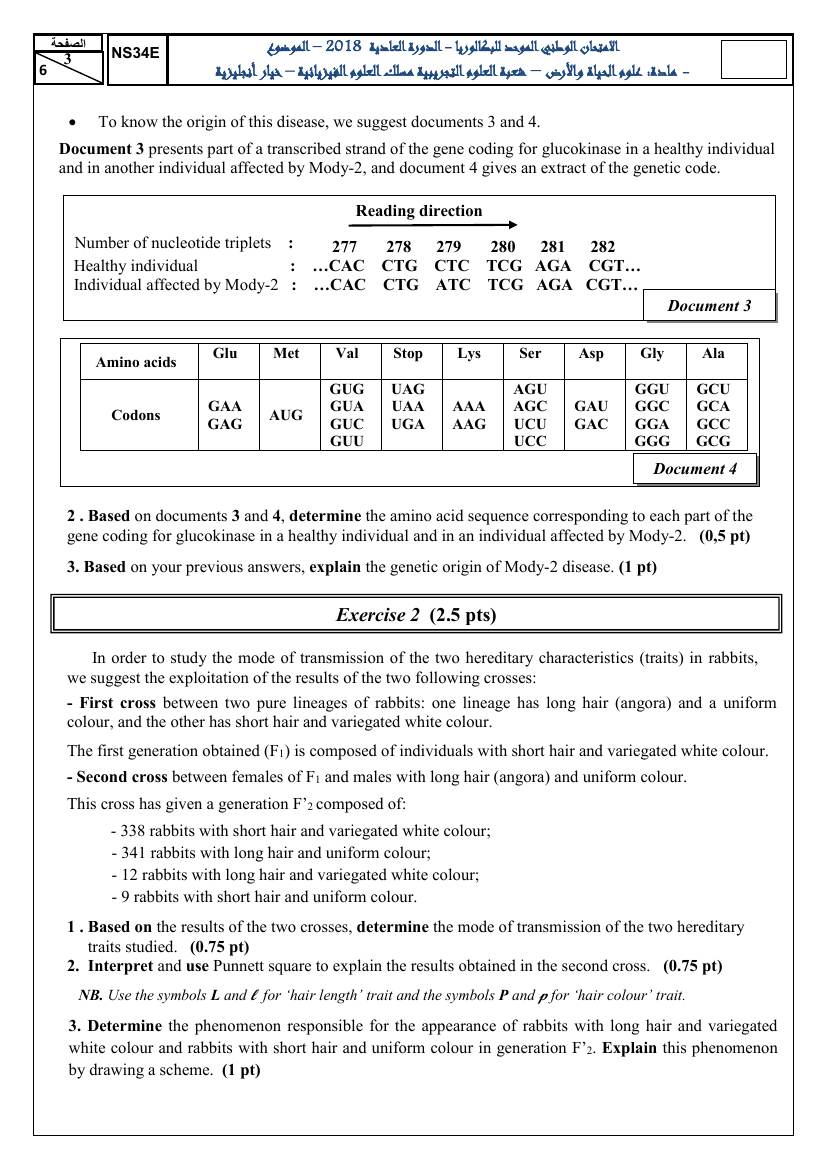
To know the origin of this disease, we suggest documents 3 and 4.

Document 3 presents part of a transcribed strand of the gene coding for glucokinase in a healthy individual and in another individual affected by Mody-2, and document 4 gives an extract of the genetic code.

Number of nucleotide triplets277278279280281282
Healthy individual…CACCTGCTCTCGAGACGT…
Individual affected by Mody-2…CACCTGATCTCGAGACGT…

Document 3 : voir la page 3 du sujet

Amino acidsGluMetValStopLysSerAspGlyAla
CodonsGAA, GAGAUGGUG, GUA, GUC, GUUUAG, UAA, UGAAAA, AAGAGU, AGC, UCU, UCCGAU, GACGGU, GGC, GGA, GGGGCU, GCA, GCC, GCG

Document 4 : voir la page 3 du sujet

2.Based on documents 3 and 4, determine the amino acid sequence corresponding to each part of the gene coding for glucokinase in a healthy individual and in an individual affected by Mody-2.0,5 pt

3.Based on your previous answers, explain the genetic origin of Mody-2 disease.1 pt

Partie II – Exercice 22,5 pts

Exercise 2 (2.5 pts)

In order to study the mode of transmission of the two hereditary characteristics (traits) in rabbits, we suggest the exploitation of the results of the two following crosses:

- First cross between two pure lineages of rabbits: one lineage has long hair (angora) and a uniform colour, and the other has short hair and variegated white colour.

The first generation obtained (F1\mathrm{F_1}) is composed of individuals with short hair and variegated white colour.

- Second cross between females of F1\mathrm{F_1} and males with long hair (angora) and uniform colour.

This cross has given a generation F2′\mathrm{F'_2} composed of:

- 338 rabbits with short hair and variegated white colour;

- 341 rabbits with long hair and uniform colour;

- 12 rabbits with long hair and variegated white colour;

- 9 rabbits with short hair and uniform colour.

1.Based on the results of the two crosses, determine the mode of transmission of the two hereditary traits studied.0,75 pt

2.Interpret and use Punnett square to explain the results obtained in the second cross.0,75 pt

NB. Use the symbols L and l for ‘hair length’ trait and the symbols P and p for ‘hair colour’ trait.

3.Determine the phenomenon responsible for the appearance of rabbits with long hair and variegated white colour and rabbits with short hair and uniform colour in generation F2′\mathrm{F'_2}. Explain this phenomenon by drawing a scheme.1 pt

Partie II – Exercice 35 pts

Exercise 3 (5 pts)

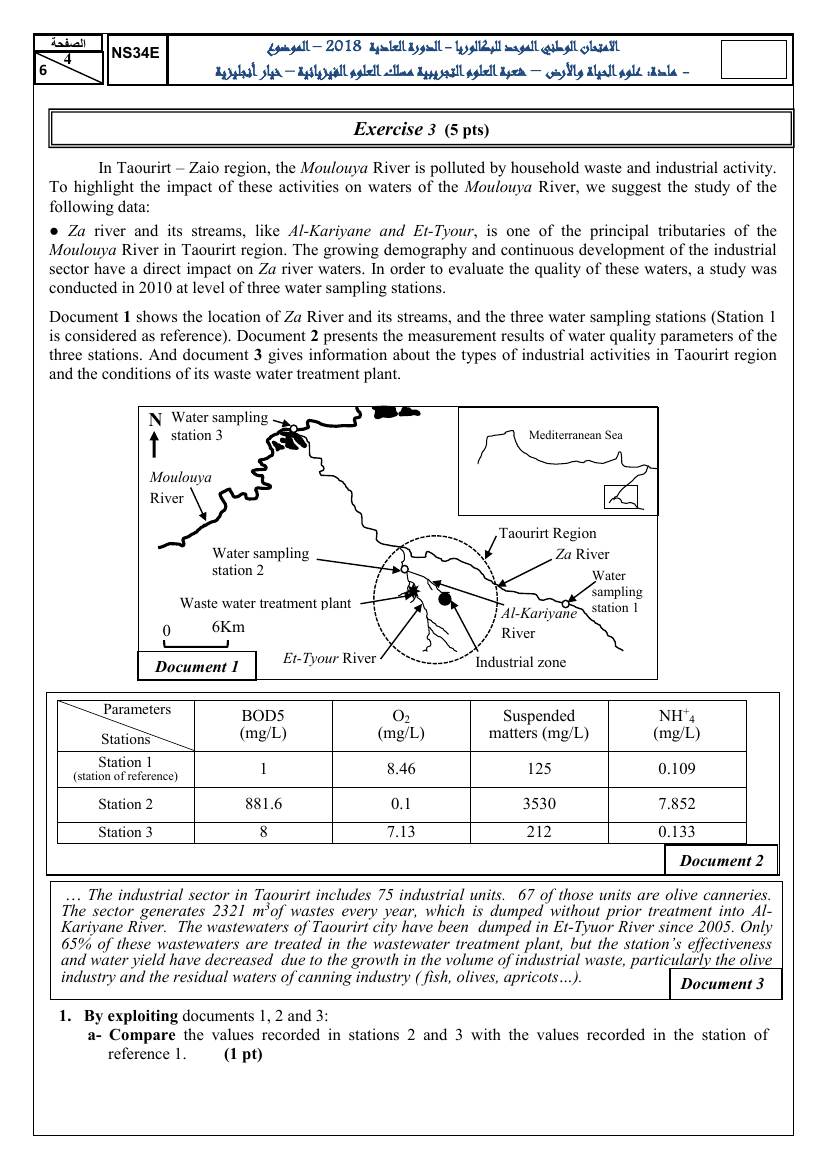
In Taourirt – Zaio region, the Moulouya River is polluted by household waste and industrial activity. To highlight the impact of these activities on waters of the Moulouya River, we suggest the study of the following data:

● Za river and its streams, like Al-Kariyane and Et-Tyour, is one of the principal tributaries of the Moulouya River in Taourirt region. The growing demography and continuous development of the industrial sector have a direct impact on Za river waters. In order to evaluate the quality of these waters, a study was conducted in 2010 at level of three water sampling stations.

Document 1 shows the location of Za River and its streams, and the three water sampling stations (Station 1 is considered as reference). Document 2 presents the measurement results of water quality parameters of the three stations. And document 3 gives information about the types of industrial activities in Taourirt region and the conditions of its waste water treatment plant.

Document 1 : voir la page 4 du sujet

Parameters / StationsBOD5 (mg/L)O2\mathrm{O_2} (mg/L)Suspended matters (mg/L)NH4+\mathrm{NH_4^+} (mg/L)
Station 1 (station of reference)18.461250.109
Station 2881.60.135307.852
Station 387.132120.133

Document 2 : voir la page 4 du sujet

… The industrial sector in Taourirt includes 75 industrial units. 67 of those units are olive canneries. The sector generates 2321 m3\mathrm{m^3} of wastes every year, which is dumped without prior treatment into Al-Kariyane River. The wastewaters of Taourirt city have been dumped in Et-Tyuor River since 2005. Only 65% of these wastewaters are treated in the wastewater treatment plant, but the station’s effectiveness and water yield have decreased due to the growth in the volume of industrial waste, particularly the olive industry and the residual waters of canning industry ( fish, olives, apricots…). (Document 3)

1.By exploiting documents 1, 2 and 3:

1.a.Compare the values recorded in stations 2 and 3 with the values recorded in the station of reference 1.1 pt

1.b.Explain the results recorded in station 2 by specifying its impact on the water of Moulouya River.1,5 pts

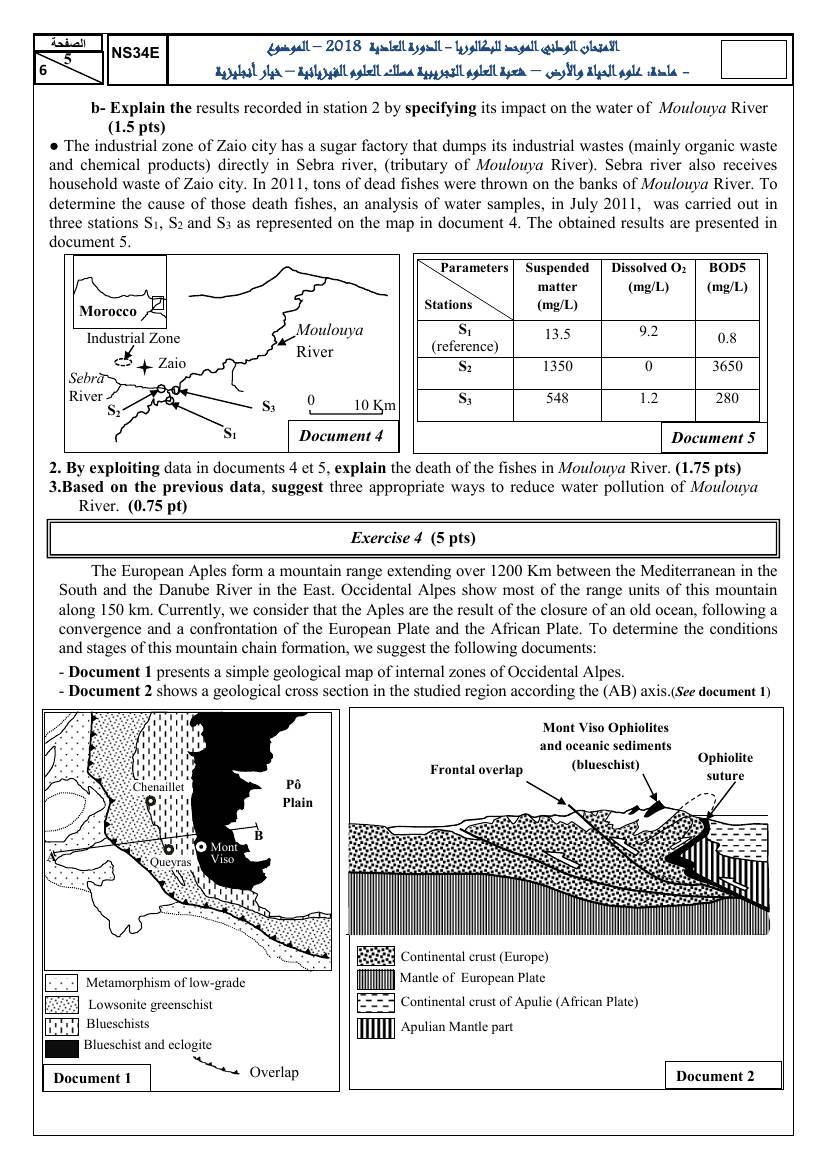
● The industrial zone of Zaio city has a sugar factory that dumps its industrial wastes (mainly organic waste and chemical products) directly in Sebra river, (tributary of Moulouya River). Sebra river also receives household waste of Zaio city. In 2011, tons of dead fishes were thrown on the banks of Moulouya River. To determine the cause of those death fishes, an analysis of water samples, in July 2011, was carried out in three stations S1\mathrm{S_1}, S2\mathrm{S_2} and S3\mathrm{S_3} as represented on the map in document 4. The obtained results are presented in document 5.

Document 4 : voir la page 5 du sujet

Parameters / StationsSuspended matter (mg/L)Dissolved O2\mathrm{O_2} (mg/L)BOD5 (mg/L)
S1\mathrm{S_1} (reference)13.59.20.8
S2\mathrm{S_2}135003650
S3\mathrm{S_3}5481.2280

Document 5 : voir la page 5 du sujet

2.By exploiting data in documents 4 et 5, explain the death of the fishes in Moulouya River.1,75 pts

3.Based on the previous data, suggest three appropriate ways to reduce water pollution of Moulouya River.0,75 pt

Partie II – Exercice 45 pts

Exercise 4 (5 pts)

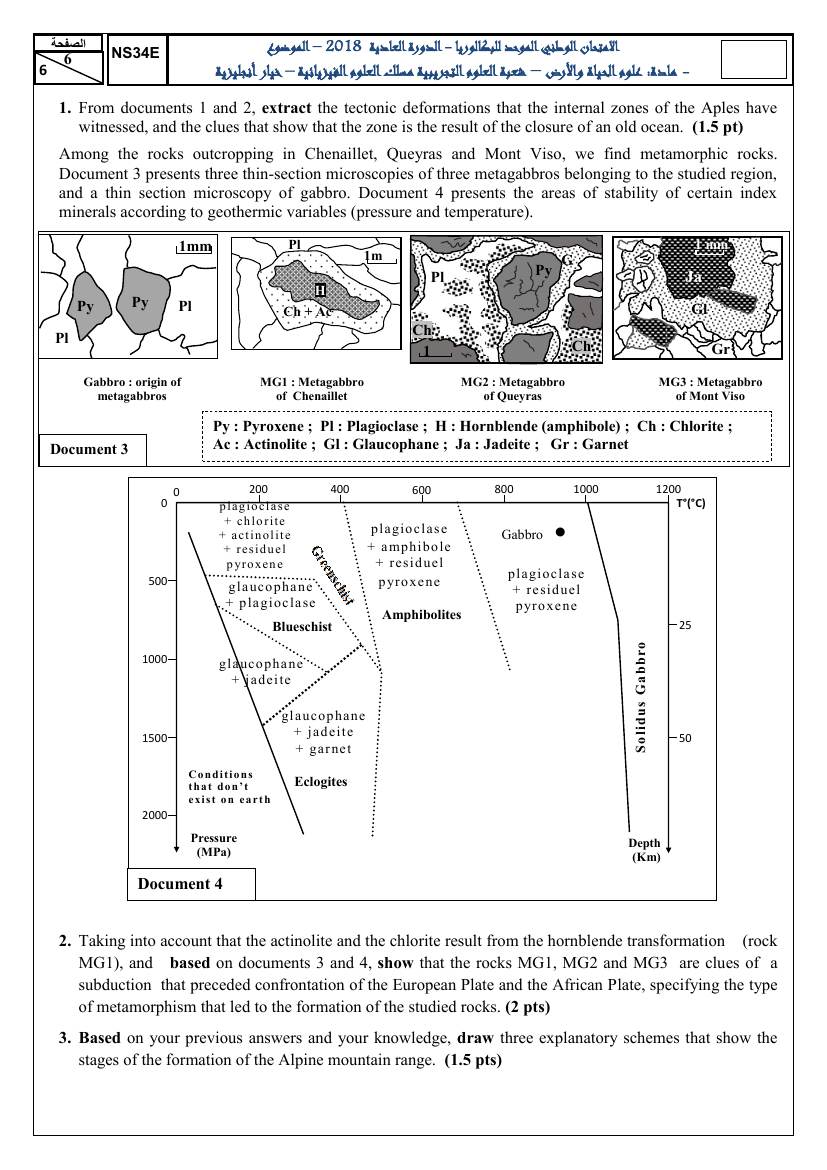
The European Aples form a mountain range extending over 1200 Km between the Mediterranean in the South and the Danube River in the East. Occidental Alpes show most of the range units of this mountain along 150 km. Currently, we consider that the Aples are the result of the closure of an old ocean, following a convergence and a confrontation of the European Plate and the African Plate. To determine the conditions and stages of this mountain chain formation, we suggest the following documents:

- Document 1 presents a simple geological map of internal zones of Occidental Alpes.

- Document 2 shows a geological cross section in the studied region according the (AB) axis.(See document 1)

Document 1 : voir la page 5 du sujet

Document 2 : voir la page 5 du sujet

1.From documents 1 and 2, extract the tectonic deformations that the internal zones of the Aples have witnessed, and the clues that show that the zone is the result of the closure of an old ocean.1,5 pts

Among the rocks outcropping in Chenaillet, Queyras and Mont Viso, we find metamorphic rocks. Document 3 presents three thin-section microscopies of three metagabbros belonging to the studied region, and a thin section microscopy of gabbro. Document 4 presents the areas of stability of certain index minerals according to geothermic variables (pressure and temperature).

Document 3 : voir la page 6 du sujet

Py : Pyroxene ; Pl : Plagioclase ; H : Hornblende (amphibole) ; Ch : Chlorite ; Ac : Actinolite ; Gl : Glaucophane ; Ja : Jadeite ; Gr : Garnet

Document 4 : voir la page 6 du sujet

2.Taking into account that the actinolite and the chlorite result from the hornblende transformation (rock MG1), and based on documents 3 and 4, show that the rocks MG1, MG2 and MG3 are clues of a subduction that preceded confrontation of the European Plate and the African Plate, specifying the type of metamorphism that led to the formation of the studied rocks.2 pts

3.Based on your previous answers and your knowledge, draw three explanatory schemes that show the stages of the formation of the Alpine mountain range.1,5 pts

Entraîne-toi sur ces chapitres avec Kresco, gratuitement

Yallah, wa7d l-khtwa.

Le sujet, tu l’as. Maintenant, prépare-le.

Crée ton compte gratuit : une leçon offerte dans chaque chapitre, les quiz et ton suivi, matière par matière, jusqu’au national.