Jerreb rassek f l-national.

Examen national SVT 2Bac PC (option anglaise) 2017, session normale

SVT · Sciences Physiques · 6 pages

Le sujet en bref

  1. Partie I5 pts

    Consommation de la matière organique et flux d’énergie · Le muscle strié squelettique

  2. Partie II – Exercice 15 pts

    Lois statistiques de la transmission des caractères · Nature et expression de l’information génétique

    Le plumage, la couleur des œufs et le diabète insipide chez la caille japonaise

  3. Partie II – Exercice 25 pts

    Utilisation des matières organiques et inorganiques

    La pollution par les nitrates des puits de la région de Mnasra près de Kénitra

  4. Partie II – Exercice 35 pts

    Formation des chaînes de montagnes

    La chaîne du Karakorum

Total : 20 points

Le sujet, page par page

  1. Examen national SVT 2Bac PC (option anglaise) 2017, session normale, page 1 sur 6
  2. Examen national SVT 2Bac PC (option anglaise) 2017, session normale, page 2 sur 6
  3. Examen national SVT 2Bac PC (option anglaise) 2017, session normale, page 3 sur 6
  4. Examen national SVT 2Bac PC (option anglaise) 2017, session normale, page 4 sur 6
  5. Examen national SVT 2Bac PC (option anglaise) 2017, session normale, page 5 sur 6
  6. Examen national SVT 2Bac PC (option anglaise) 2017, session normale, page 6 sur 6

Sujet officiel de l’examen national unifié du baccalauréat, tel que publié par le Centre national de l’évaluation et des examens (Ministère de l’Éducation nationale).

L’énoncé en texte

Transcription du sujet officiel, pour le lire et le rechercher sur téléphone. Les figures restent sur les pages du sujet ; en cas de différence, le PDF officiel fait foi.

Partie I5 pts

Section I : Knowledge Retrieval (5 pts)

I.Define the following notions: - Muscle twitch – Mitochondrion.1 pt

II.For each of the propositions numbered from 1 to 4, there is only one correct suggestion in each set. Copy down these pairs (1 ; ..), (2 ; ..), (3 ; ..), (4 ; ..), and match each number with its corresponding letter.2 pts

1. Complete tetanus is the result of the fusion of many muscle twitches due to a succession of excitations, so that the next excitation occurs:

a- during the contraction phase of the previous muscle twitch.

b- during the relaxation phase of the previous muscle twitch.

c- after the previous muscle twitch.

d- during the latent phase of the previous muscle twitch.

2. During muscle contraction there is a decrease in the length of the:

a- dark band and the H-band.

b- clear band and the H-band.

c- dark band and clear band, while the H-band retains its length.

d- dark, clear and the H bands.

3. Lactic acid fermentation:

a- releases 4 molecules of ATP from a glucose molecule.

b- has a common stage with respiration called glycolysis.

c- produces organic waste in the form of CO2\mathrm{CO_2}.

d- produces 2 molecules of ATP due to the appearance of the H+\mathrm{H^+} gradient on either side of the inner membrane of mitochondrion.

4. The reactions of the Krebs cycle:

a- do not produce energy.

b- release carbon dioxide (CO2\mathrm{CO_2}).

c- take place in the inner membrane of the mitochondrion.

d- are common between respiration and fermentation.

III.Give the global reaction of glycolysis.0,5 pt

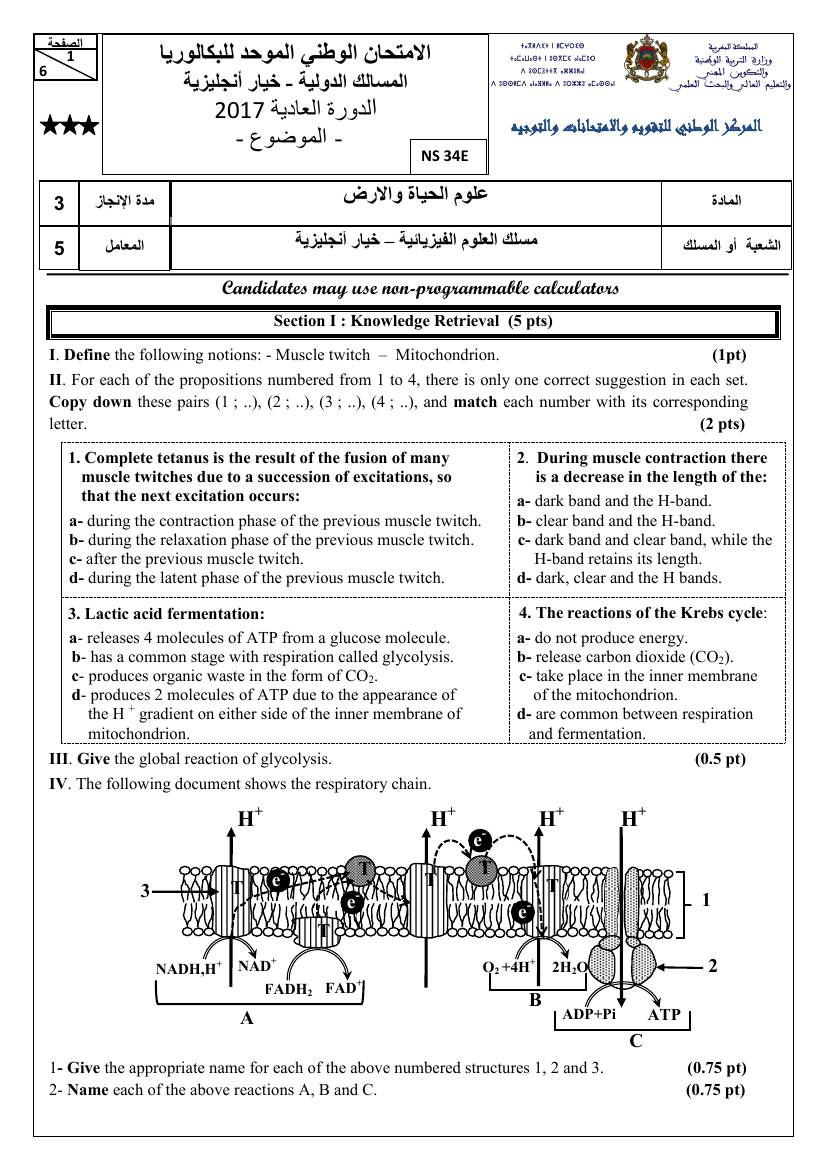
IV. The following document shows the respiratory chain.

Figure : voir la page 1 du sujet

IV.1.Give the appropriate name for each of the above numbered structures 1, 2 and 3.0,75 pt

IV.2.Name each of the above reactions A, B and C.0,75 pt

Revoir le cours : Consommation de la matière organique et flux d’énergie · Le muscle strié squelettique

Partie II – Exercice 15 pts

Section II : Scientific reasoning and communication in graphic and written modes (15pts)

Exercise 1 (5 pts)

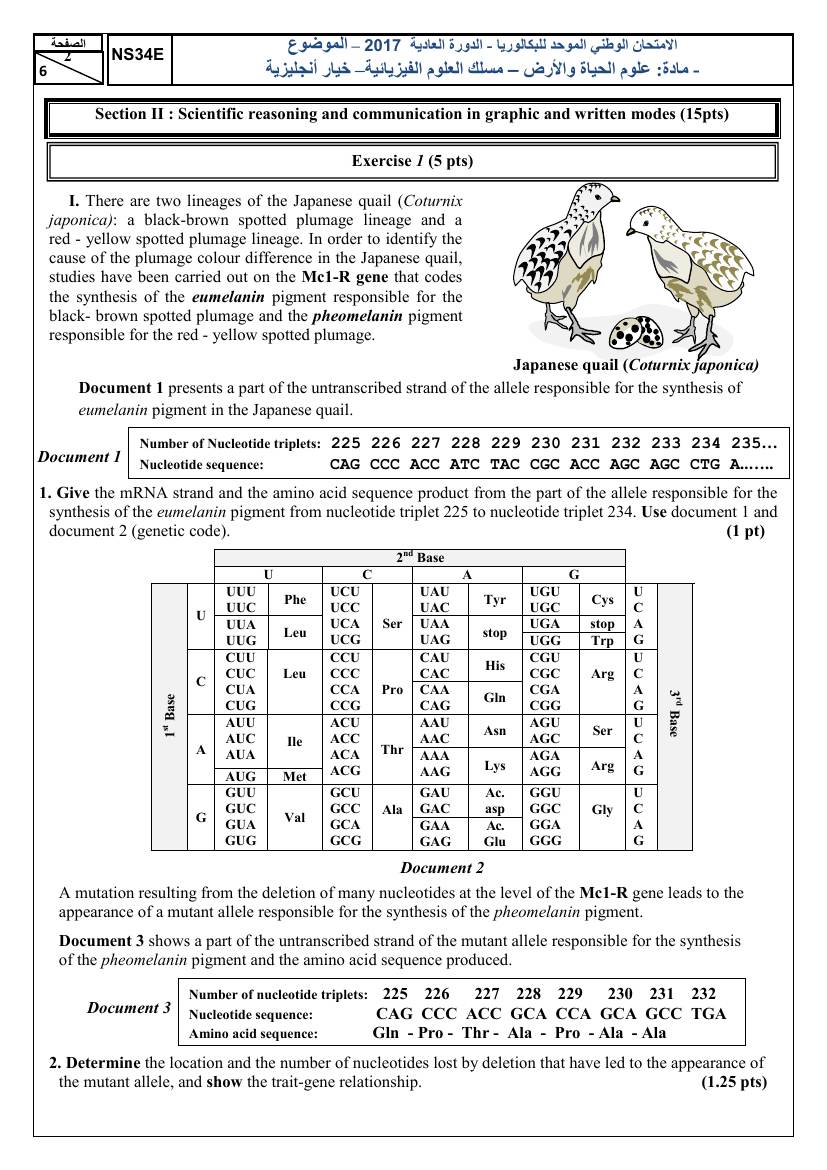
I. There are two lineages of the Japanese quail (Coturnix japonica): a black-brown spotted plumage lineage and a red - yellow spotted plumage lineage. In order to identify the cause of the plumage colour difference in the Japanese quail, studies have been carried out on the Mc1-R gene that codes the synthesis of the eumelanin pigment responsible for the black- brown spotted plumage and the pheomelanin pigment responsible for the red - yellow spotted plumage.

Japanese quail (Coturnix japonica) : voir la page 2 du sujet

Document 1 presents a part of the untranscribed strand of the allele responsible for the synthesis of eumelanin pigment in the Japanese quail.

Number of Nucleotide triplets:225226227228229230231232233234235…
Nucleotide sequence:CAGCCCACCATCTACCGCACCAGCAGCCTGA……

1.Give the mRNA strand and the amino acid sequence product from the part of the allele responsible for the synthesis of the eumelanin pigment from nucleotide triplet 225 to nucleotide triplet 234. Use document 1 and document 2 (genetic code).1 pt

Document 2 : voir la page 2 du sujet

A mutation resulting from the deletion of many nucleotides at the level of the Mc1-R gene leads to the appearance of a mutant allele responsible for the synthesis of the pheomelanin pigment.

Document 3 shows a part of the untranscribed strand of the mutant allele responsible for the synthesis of the pheomelanin pigment and the amino acid sequence produced.

Number of nucleotide triplets:225226227228229230231232
Nucleotide sequence:CAGCCCACCGCACCAGCAGCCTGA
Amino acid sequence:GlnProThrAlaProAlaAla

2.Determine the location and the number of nucleotides lost by deletion that have led to the appearance of the mutant allele, and show the trait-gene relationship.1,25 pts

II- In addition to the colour difference in eggs, Japanese quail can be affected by diabetes insipidus, which is an inherited disease characterised by excessive thirst and excretion of abnormal quantities of very diluted urine.

In order to study the mode of transmission of the two hereditary characteristics (traits), the colour of the eggs and the disease of diabetes insipidus in two lineages of the Japanese quail - one that gives blue eggs and is affected by diabetes insipidus and the other that gives green eggs and is not affected by diabetes insipidus, we suggest the exploitation of the results of the two following crosses:

- First cross between two lineages: a lineage that gives blue eggs and is affected by diabetes insipidus and a lineage that gives green eggs and is not affected by diabetes insipidus. The first generation obtained (F1\mathrm{F_1}) is composed of individuals who give blue eggs and are not affected by diabetes insipidus.

- Second cross between F1\mathrm{F_1} individuals:

The second generation obtained (F2\mathrm{F_2}) is composed of:

- 10 individuals that give green eggs and are affected by diabetes insipidus.

- 33 individuals that give green eggs and are not affected by diabetes insipidus.

- 33 individuals that give blue eggs and are affected by diabetes insipidus.

- 82 individuals that give blue eggs and are not affected by diabetes insipidus.

3.Analyse the results of the two crosses and show the mode of transmission of the two hereditary traits studied.1,5 pts

4.Interpret and use Punnett square to explain the results obtained in the first and the second crosses.1,25 pts

Use the symbols B and b for the character " colour of the eggs " and the symbols D and d for the character " diabetes insipidus ".

Partie II – Exercice 25 pts

Exercise 2 : (5 pts)

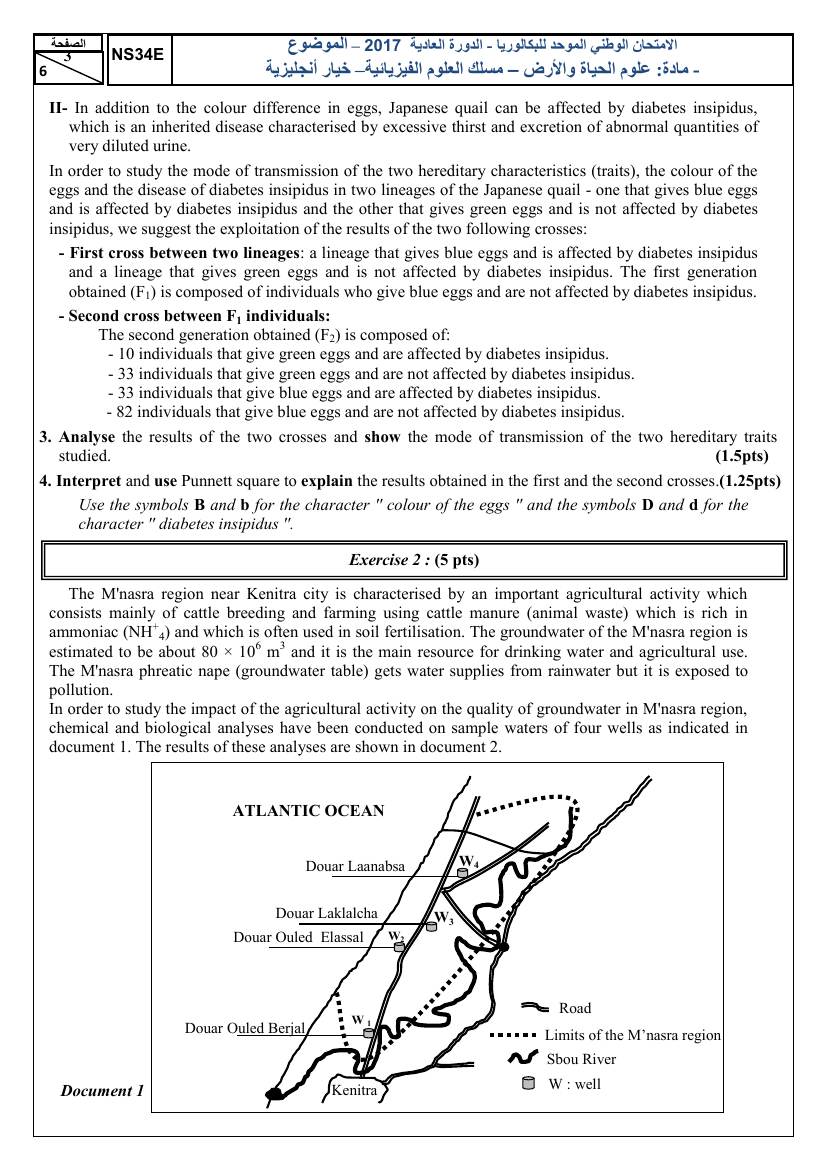
The M'nasra region near Kenitra city is characterised by an important agricultural activity which consists mainly of cattle breeding and farming using cattle manure (animal waste) which is rich in ammoniac (NH4+\mathrm{NH_4^+}) and which is often used in soil fertilisation. The groundwater of the M'nasra region is estimated to be about 80×106 m380 \times 10^{6}\ \mathrm{m^3} and it is the main resource for drinking water and agricultural use. The M'nasra phreatic nape (groundwater table) gets water supplies from rainwater but it is exposed to pollution.

In order to study the impact of the agricultural activity on the quality of groundwater in M'nasra region, chemical and biological analyses have been conducted on sample waters of four wells as indicated in document 1. The results of these analyses are shown in document 2.

Document 1 : voir la page 3 du sujet

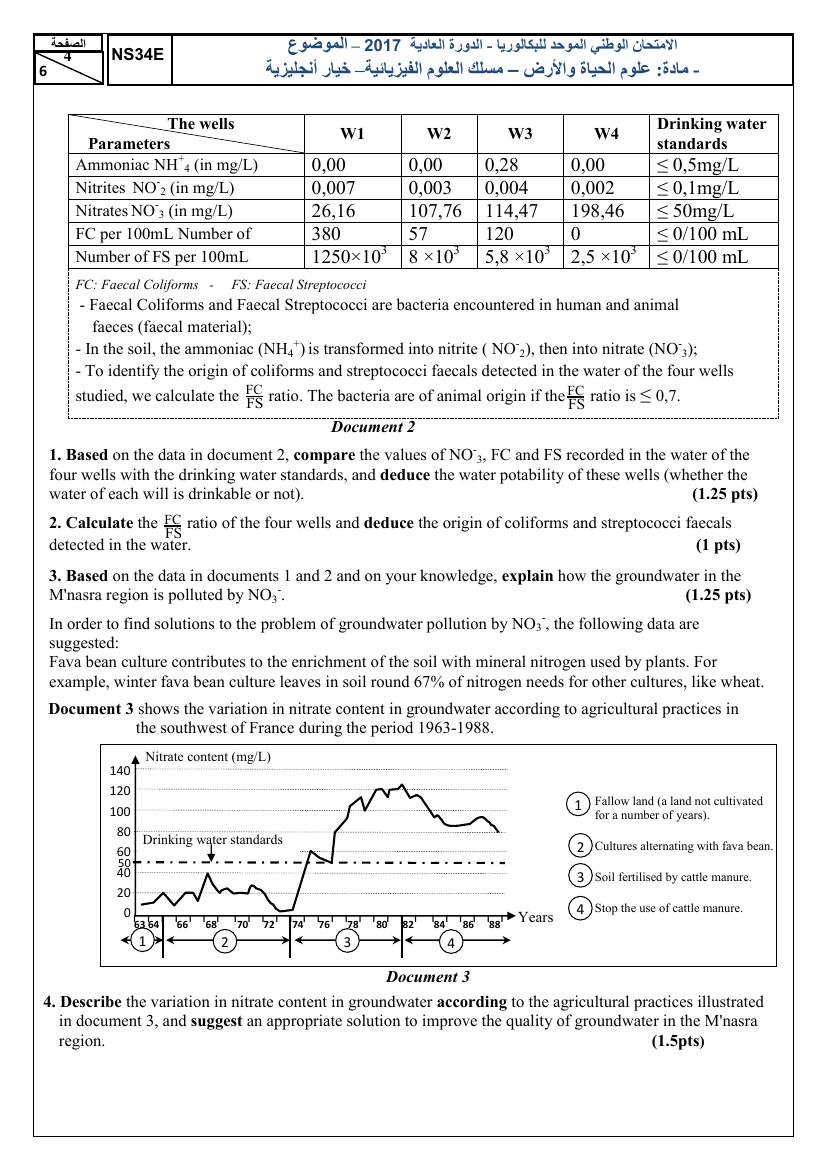
Parameters \ The wellsW1W2W3W4Drinking water standards
Ammoniac NH4+\mathrm{NH_4^+} (in mg/L)0,000,000,280,00≤ 0,5mg/L
Nitrites NO2−\mathrm{NO_2^-} (in mg/L)0,0070,0030,0040,002≤ 0,1mg/L
Nitrates NO3−\mathrm{NO_3^-} (in mg/L)26,16107,76114,47198,46≤ 50mg/L
FC per 100mL Number of380571200≤ 0/100 mL
Number of FS per 100mL1250×1031250\times 10^{3}8×1038\times 10^{3}5,8×1035{,}8\times 10^{3}2,5×1032{,}5\times 10^{3}≤ 0/100 mL

FC: Faecal Coliforms - FS: Faecal Streptococci

- Faecal Coliforms and Faecal Streptococci are bacteria encountered in human and animal faeces (faecal material);

- In the soil, the ammoniac (NH4+\mathrm{NH_4^+}) is transformed into nitrite (NO2−\mathrm{NO_2^-}), then into nitrate (NO3−\mathrm{NO_3^-});

- To identify the origin of coliforms and streptococci faecals detected in the water of the four wells studied, we calculate the FCFS\frac{FC}{FS} ratio. The bacteria are of animal origin if the FCFS\frac{FC}{FS} ratio is ≤ 0,7.

1.Based on the data in document 2, compare the values of NO3−\mathrm{NO_3^-}, FC and FS recorded in the water of the four wells with the drinking water standards, and deduce the water potability of these wells (whether the water of each will is drinkable or not).1,25 pts

2.Calculate the FCFS\frac{FC}{FS} ratio of the four wells and deduce the origin of coliforms and streptococci faecals detected in the water.1 pt

3.Based on the data in documents 1 and 2 and on your knowledge, explain how the groundwater in the M'nasra region is polluted by NO3−\mathrm{NO_3^-}.1,25 pts

In order to find solutions to the problem of groundwater pollution by NO3−\mathrm{NO_3^-}, the following data are suggested:

Fava bean culture contributes to the enrichment of the soil with mineral nitrogen used by plants. For example, winter fava bean culture leaves in soil round 67% of nitrogen needs for other cultures, like wheat.

Document 3 shows the variation in nitrate content in groundwater according to agricultural practices in the southwest of France during the period 1963-1988.

Document 3 : voir la page 4 du sujet

1 Fallow land (a land not cultivated for a number of years). 2 Cultures alternating with fava bean. 3 Soil fertilised by cattle manure. 4 Stop the use of cattle manure.

4.Describe the variation in nitrate content in groundwater according to the agricultural practices illustrated in document 3, and suggest an appropriate solution to improve the quality of groundwater in the M'nasra region.1,5 pts

Partie II – Exercice 35 pts

Exercise 3 : (5 pts)

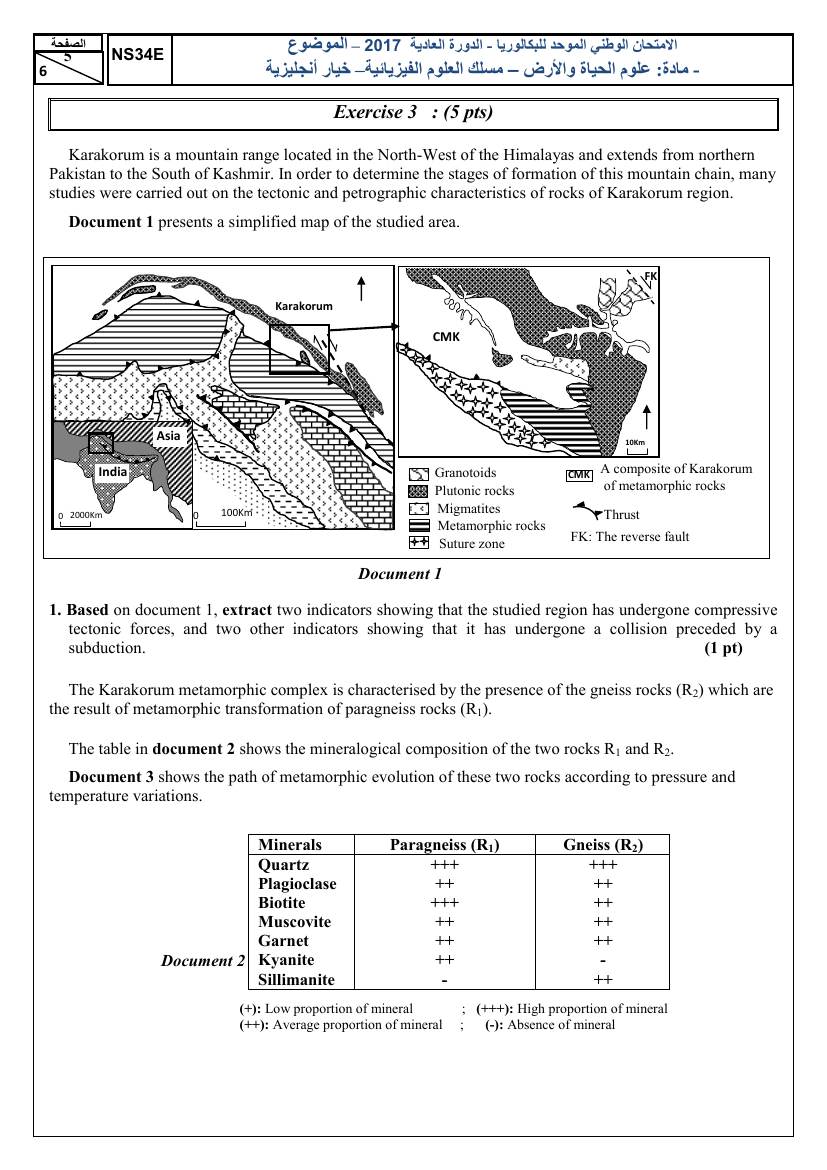
Karakorum is a mountain range located in the North-West of the Himalayas and extends from northern Pakistan to the South of Kashmir. In order to determine the stages of formation of this mountain chain, many studies were carried out on the tectonic and petrographic characteristics of rocks of Karakorum region.

Document 1 presents a simplified map of the studied area.

Document 1 : voir la page 5 du sujet

1.Based on document 1, extract two indicators showing that the studied region has undergone compressive tectonic forces, and two other indicators showing that it has undergone a collision preceded by a subduction.1 pt

The Karakorum metamorphic complex is characterised by the presence of the gneiss rocks (R2\mathrm{R_2}) which are the result of metamorphic transformation of paragneiss rocks (R1\mathrm{R_1}).

The table in document 2 shows the mineralogical composition of the two rocks R1\mathrm{R_1} and R2\mathrm{R_2}.

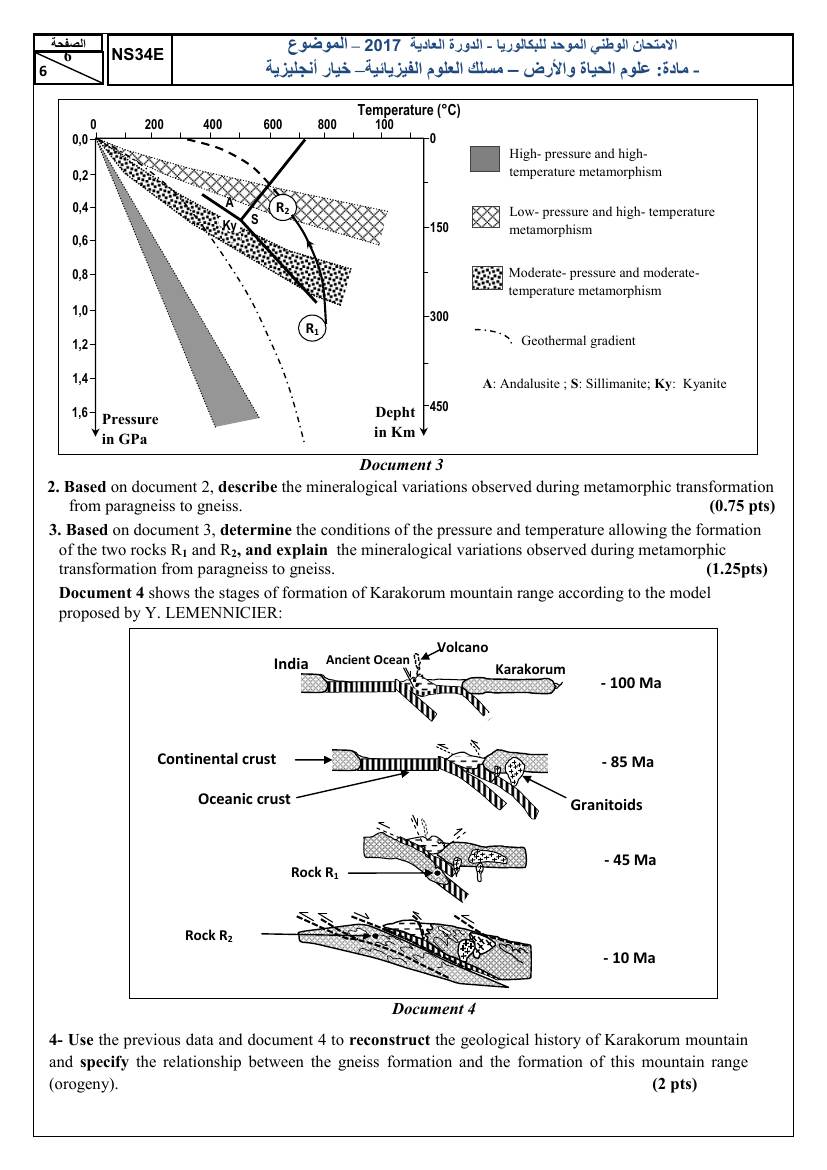
Document 3 shows the path of metamorphic evolution of these two rocks according to pressure and temperature variations.

MineralsParagneiss (R1\mathrm{R_1})Gneiss (R2\mathrm{R_2})
Quartz++++++
Plagioclase++++
Biotite+++++
Muscovite++++
Garnet++++
Kyanite++-
Sillimanite-++

Document 2

(+): Low proportion of mineral ; (+++): High proportion of mineral

(++): Average proportion of mineral ; (-): Absence of mineral

Document 3 : voir la page 6 du sujet

A: Andalusite ; S: Sillimanite; Ky: Kyanite

2.Based on document 2, describe the mineralogical variations observed during metamorphic transformation from paragneiss to gneiss.0,75 pt

3.Based on document 3, determine the conditions of the pressure and temperature allowing the formation of the two rocks R1\mathrm{R_1} and R2\mathrm{R_2}, and explain the mineralogical variations observed during metamorphic transformation from paragneiss to gneiss.1,25 pts

Document 4 shows the stages of formation of Karakorum mountain range according to the model proposed by Y. LEMENNICIER:

Document 4 : voir la page 6 du sujet

4.Use the previous data and document 4 to reconstruct the geological history of Karakorum mountain and specify the relationship between the gneiss formation and the formation of this mountain range (orogeny).2 pts

Entraîne-toi sur ces chapitres avec Kresco, gratuitement

Yallah, wa7d l-khtwa.

Le sujet, tu l’as. Maintenant, prépare-le.

Crée ton compte gratuit : une leçon offerte dans chaque chapitre, les quiz et ton suivi, matière par matière, jusqu’au national.