Jerreb rassek f l-national.

Examen national Physique-Chimie 2Bac SVT (option anglaise) 2020, session normale

Physique-Chimie · Sciences de la Vie et de la Terre · 6 pages

Le sujet en bref

  1. Chimie7 pts

    Suivi temporel d’une transformation chimique · Transformations non totales et état d’équilibre · Dosage acido-basique

    L’oxydation des ions iodure par les ions peroxodisulfate et un comprimé de vitamine C

  2. Physique – Exercice 14 pts

    Ondes mécaniques progressives périodiques · Ondes mécaniques progressives

    Des ondes à la surface de l’eau et des ondes sonores dans l’air

  3. Physique – Exercice 22,5 pts

    Décroissance radioactive · Noyaux, masse et énergie

    Le bismuth 212 de la famille radioactive de l’uranium

  4. Physique – Exercice 36,5 pts

    Dipôle RC · Oscillations libres d’un circuit RLC série

Total : 20 points

Le sujet, page par page

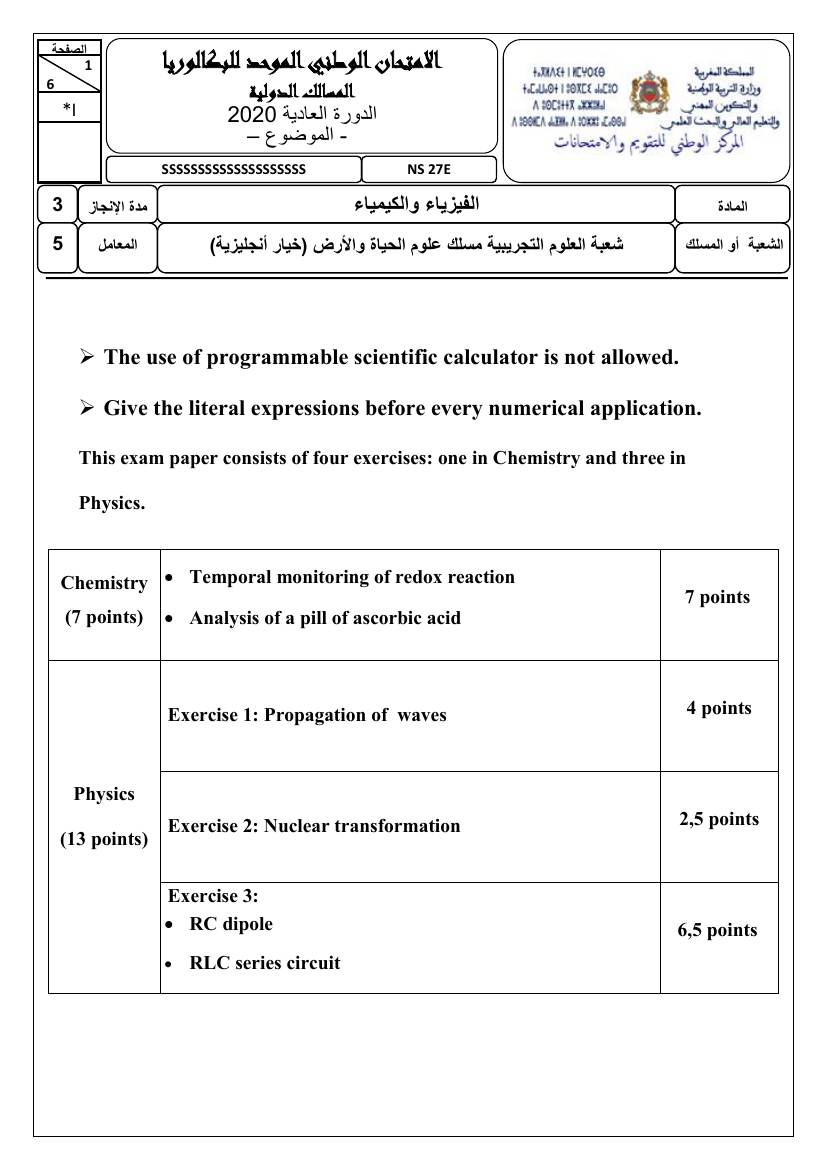
  1. Examen national Physique-Chimie 2Bac SVT (option anglaise) 2020, session normale, page 1 sur 6
  2. Examen national Physique-Chimie 2Bac SVT (option anglaise) 2020, session normale, page 2 sur 6
  3. Examen national Physique-Chimie 2Bac SVT (option anglaise) 2020, session normale, page 3 sur 6
  4. Examen national Physique-Chimie 2Bac SVT (option anglaise) 2020, session normale, page 4 sur 6
  5. Examen national Physique-Chimie 2Bac SVT (option anglaise) 2020, session normale, page 5 sur 6
  6. Examen national Physique-Chimie 2Bac SVT (option anglaise) 2020, session normale, page 6 sur 6

Sujet officiel de l’examen national unifié du baccalauréat, tel que publié par le Centre national de l’évaluation et des examens (Ministère de l’Éducation nationale).

L’énoncé en texte

Transcription du sujet officiel, pour le lire et le rechercher sur téléphone. Les figures restent sur les pages du sujet ; en cas de différence, le PDF officiel fait foi.

Chimie7 pts

Chemistry (7 points): Temporal monitoring of redox reaction – Analysis of a pill of ascorbic acid

Part 1 and part 2 are independent

Redox and acid-base reactions are two types of chemical transformations of paramount importance in chemistry.

These transformations can be studied by different methods, which allows temporal monitoring of a chemical system, determination of some characteristics and quantities, etc

This exercise aims at:

• The temporal monitoring of redox reaction;

• Analysis of a pill of ascorbic acid.

Part 1: The temporal monitoring of redox reaction

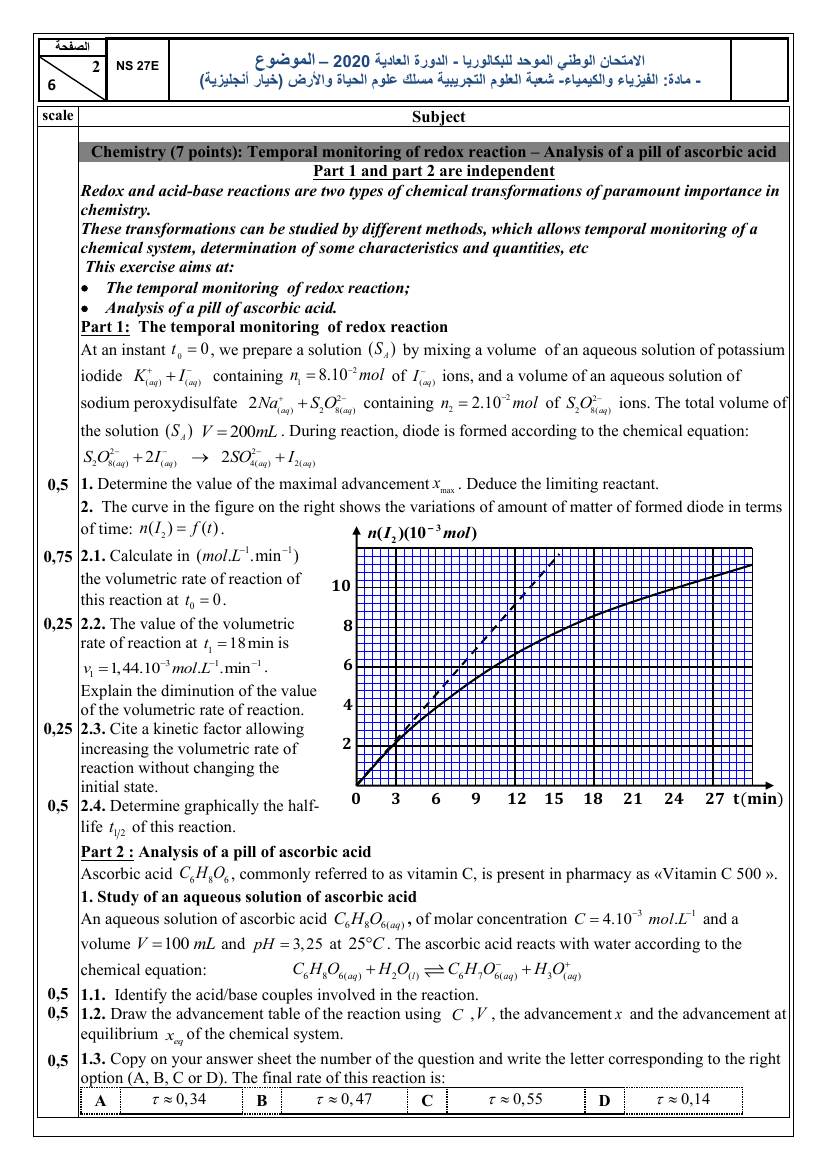
At an instant t0=0t_0 = 0, we prepare a solution (SA)(S_A) by mixing a volume of an aqueous solution of potassium iodide K(aq)++I(aq)−\mathrm{K^+_{(aq)} + I^-_{(aq)}} containing n1=8.10−2 moln_1 = 8.10^{-2}\ \mathrm{mol} of I(aq)−\mathrm{I^-_{(aq)}} ions, and a volume of an aqueous solution of sodium peroxydisulfate 2Na(aq)++S2O82−(aq)\mathrm{2Na^+_{(aq)} + S_2O_8^{2-}{}_{(aq)}} containing n2=2.10−2 moln_2 = 2.10^{-2}\ \mathrm{mol} of S2O82−(aq)\mathrm{S_2O_8^{2-}{}_{(aq)}} ions. The total volume of the solution (SA)(S_A) is V=200 mLV = 200\ \mathrm{mL}. During reaction, diode is formed according to the chemical equation:

S2O82−(aq)+2I(aq)−→2SO42−(aq)+I2(aq)\mathrm{S_2O_8^{2-}{}_{(aq)} + 2I^-_{(aq)} \rightarrow 2SO_4^{2-}{}_{(aq)} + I_{2(aq)}}

1.Determine the value of the maximal advancement xmaxx_{max}. Deduce the limiting reactant.0,5 pt

2. The curve in the figure on the right shows the variations of amount of matter of formed diode in terms of time: n(I2)=f(t)n(\mathrm{I_2}) = f(t).

Figure : voir la page 2 du sujet

2.1.Calculate in (mol.L−1.min−1)(\mathrm{mol.L^{-1}.min^{-1}}) the volumetric rate of reaction of this reaction at t0=0t_0 = 0.0,75 pt

2.2.The value of the volumetric rate of reaction at t1=18 mint_1 = 18\ \mathrm{min} is v1=1,44.10−3 mol.L−1.min−1v_1 = 1{,}44.10^{-3}\ \mathrm{mol.L^{-1}.min^{-1}}. Explain the diminution of the value of the volumetric rate of reaction.0,25 pt

2.3.Cite a kinetic factor allowing increasing the volumetric rate of reaction without changing the initial state.0,25 pt

2.4.Determine graphically the half-life t1/2t_{1/2} of this reaction.0,5 pt

Part 2 : Analysis of a pill of ascorbic acid

Ascorbic acid C6H8O6\mathrm{C_6H_8O_6}, commonly referred to as vitamin C, is present in pharmacy as «Vitamin C 500 ».

1. Study of an aqueous solution of ascorbic acid

An aqueous solution of ascorbic acid C6H8O6(aq)\mathrm{C_6H_8O_{6(aq)}}, of molar concentration C=4.10−3 mol.L−1C = 4.10^{-3}\ \mathrm{mol.L^{-1}} and a volume V=100 mLV = 100\ \mathrm{mL} and pH=3,25pH = 3{,}25 at 25∘C25^\circ C. The ascorbic acid reacts with water according to the chemical equation:

C6H8O6(aq)+H2O(l)⇄C6H7O6(aq)−+H3O(aq)+\mathrm{C_6H_8O_{6(aq)} + H_2O_{(l)} \rightleftarrows C_6H_7O_{6(aq)}^- + H_3O^+_{(aq)}}

1.1.Identify the acid/base couples involved in the reaction.0,5 pt

1.2.Draw the advancement table of the reaction using CC, VV, the advancement xx and the advancement at equilibrium xeqx_{eq} of the chemical system.0,5 pt

1.3.Copy on your answer sheet the number of the question and write the letter corresponding to the right option (A, B, C or D). The final rate of this reaction is:0,5 pt

Aτ≈0,34\tau \approx 0{,}34Bτ≈0,47\tau \approx 0{,}47Cτ≈0,55\tau \approx 0{,}55Dτ≈0,14\tau \approx 0{,}14

1.4.Copy on your answer sheet the number of the question and write the letter corresponding to the right option (A, B, C or D). The final rate of reaction depends on0,5 pt

Athe equilibrium constant KK associated to the equation of reaction and the initial composition of the chemical system
Bthe initial composition of the chemical system only
Cthe equilibrium constant KK associated to the equation of reaction
Dthe temperature of the chemical system

1.5.Show that the expression of the equilibrium constant KK associated with the equation of reaction is: K=C.τ21−τK = \dfrac{C.\tau^2}{1-\tau}. Calculate the acidity constant KAK_A of the couple (C6H8O6(aq)/C6H7O6(aq)−)(\mathrm{C_6H_8O_{6(aq)} / C_6H_7O^-_{6(aq)}}).1 pt

2. Verification of the value of the masse of the ascorbic acid contained in a pill

We crash a pill of «Vitamin C 500», and we dissolve it in a volume V0=200 mLV_0 = 200\ \mathrm{mL} of water. After homogenisation, we obtain a solution (SA)(S_A) of concentration CAC_A.

We take a sample of volume VA=20 mLV_A = 20\ \mathrm{mL} from the solution (SA)(S_A) which we titrate with an aqueous solution of sodium hydroxide Na(aq)++HO(aq)−\mathrm{Na^+_{(aq)} + HO^-_{(aq)}} of molar concentration CB=2,0.10−2 mol.L−1C_B = 2{,}0.10^{-2}\ \mathrm{mol.L^{-1}}.

We obtain the equivalence for a volume VB,E=14,2 mLV_{B,E} = 14{,}2\ \mathrm{mL}.

2.1.Write the chemical equation of the reaction of titration.0,5 pt

2.2.Calculate the molar concentration CAC_A.0,5 pt

2.3.Deduce the value of the ascorbic acid mass contained in the pill, and explain the indication «Vitamin C 500». We give: M(C6H8O6)=176 g.mol−1M(\mathrm{C_6H_8O_6}) = 176\ \mathrm{g.mol^{-1}}.0,75 pt

Revoir le cours : Suivi temporel d’une transformation chimique

Physique – Exercice 14 pts

Exercise 1 (4 points): Propagation of waves

The propagation of a waves is a natural phenomenon which can be produced in some mediums. In different conditions, the study of a propagation can lead to informations about the nature of waves, their characteristics and about the propagation medium.

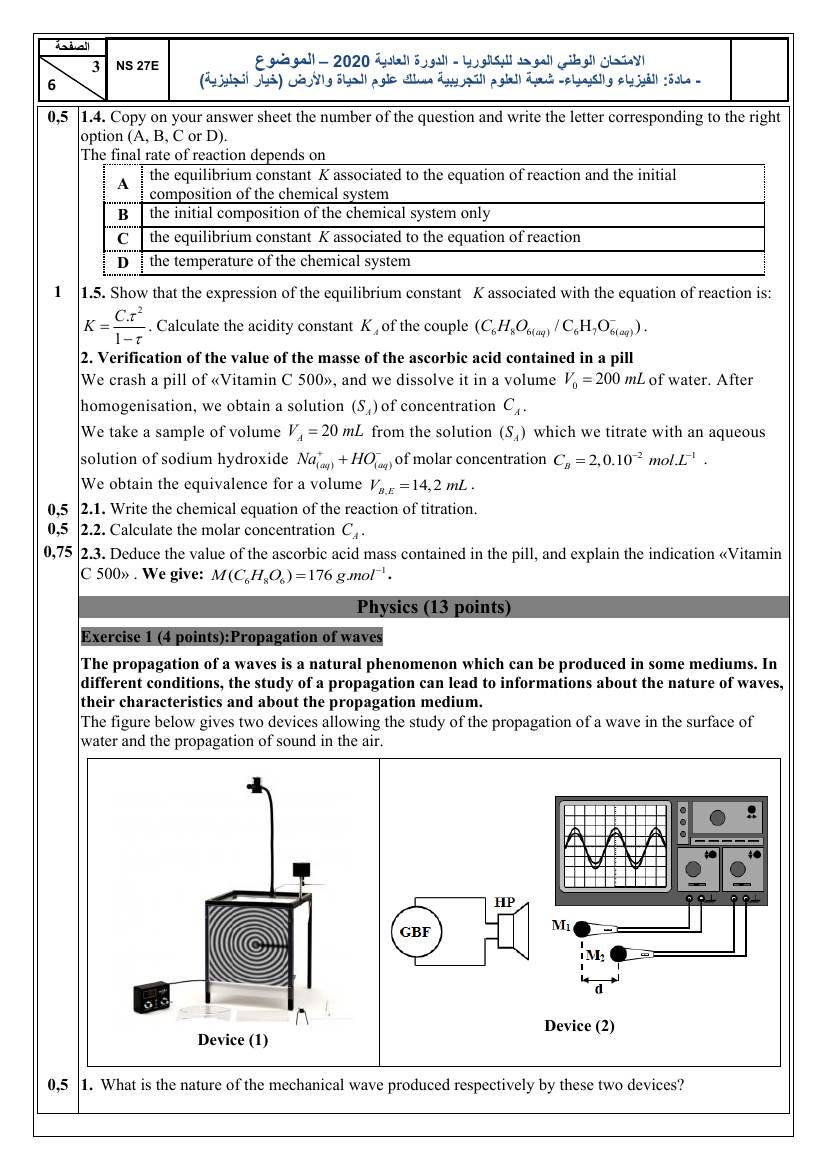
The figure below gives two devices allowing the study of the propagation of a wave in the surface of water and the propagation of sound in the air.

Device (1) : voir la page 3 du sujet

Device (2) : voir la page 3 du sujet

1.What is the nature of the mechanical wave produced respectively by these two devices?0,5 pt

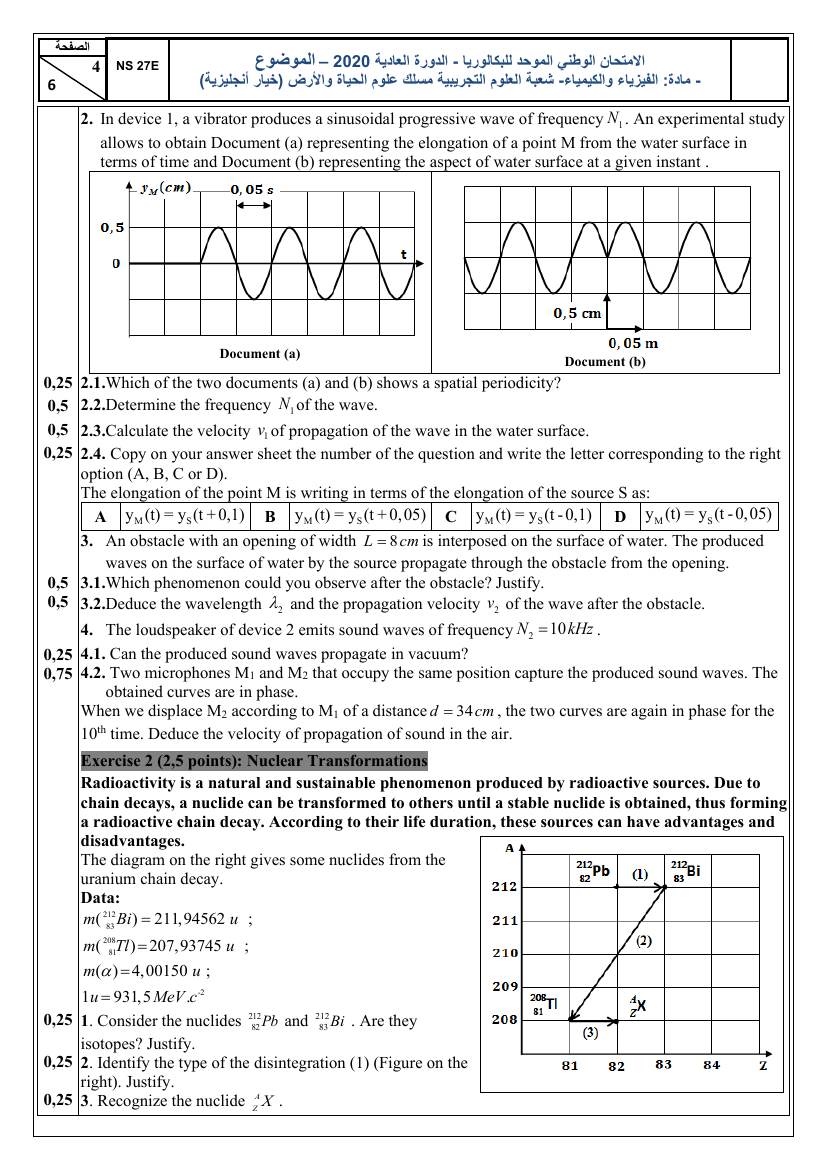
2. In device 1, a vibrator produces a sinusoidal progressive wave of frequency N1N_1. An experimental study allows to obtain Document (a) representing the elongation of a point M from the water surface in terms of time and Document (b) representing the aspect of water surface at a given instant.

Document (a) : voir la page 4 du sujet

Document (b) : voir la page 4 du sujet

2.1.Which of the two documents (a) and (b) shows a spatial periodicity?0,25 pt

2.2.Determine the frequency N1N_1 of the wave.0,5 pt

2.3.Calculate the velocity v1v_1 of propagation of the wave in the water surface.0,5 pt

2.4.Copy on your answer sheet the number of the question and write the letter corresponding to the right option (A, B, C or D). The elongation of the point M is writing in terms of the elongation of the source S as:0,25 pt

AyM(t)=yS(t+0,1)y_M(t) = y_S(t+0{,}1)ByM(t)=yS(t+0,05)y_M(t) = y_S(t+0{,}05)CyM(t)=yS(t−0,1)y_M(t) = y_S(t-0{,}1)DyM(t)=yS(t−0,05)y_M(t) = y_S(t-0{,}05)

3. An obstacle with an opening of width L=8 cmL = 8\ \mathrm{cm} is interposed on the surface of water. The produced waves on the surface of water by the source propagate through the obstacle from the opening.

3.1.Which phenomenon could you observe after the obstacle? Justify.0,5 pt

3.2.Deduce the wavelength λ2\lambda_2 and the propagation velocity v2v_2 of the wave after the obstacle.0,5 pt

4. The loudspeaker of device 2 emits sound waves of frequency N2=10 kHzN_2 = 10\ \mathrm{kHz}.

4.1.Can the produced sound waves propagate in vacuum?0,25 pt

4.2.Two microphones M1M_1 and M2M_2 that occupy the same position capture the produced sound waves. The obtained curves are in phase. When we displace M2M_2 according to M1M_1 of a distance d=34 cmd = 34\ \mathrm{cm}, the two curves are again in phase for the 10th10^{th} time. Deduce the velocity of propagation of sound in the air.0,75 pt

Revoir le cours : Ondes mécaniques progressives périodiques · Ondes mécaniques progressives

Physique – Exercice 22,5 pts

Exercise 2 (2,5 points): Nuclear Transformations

Radioactivity is a natural and sustainable phenomenon produced by radioactive sources. Due to chain decays, a nuclide can be transformed to others until a stable nuclide is obtained, thus forming a radioactive chain decay. According to their life duration, these sources can have advantages and disadvantages.

The diagram on the right gives some nuclides from the uranium chain decay.

Figure : voir la page 4 du sujet

Data:

m(83212Bi)=211,94562 um(\mathrm{^{212}_{83}Bi}) = 211{,}94562\ \mathrm{u} ;

m(81208Tl)=207,93745 um(\mathrm{^{208}_{81}Tl}) = 207{,}93745\ \mathrm{u} ;

m(α)=4,00150 um(\alpha) = 4{,}00150\ \mathrm{u} ;

1u=931,5 MeV.c−21\mathrm{u} = 931{,}5\ \mathrm{MeV.c^{-2}}

1.Consider the nuclides 82212Pb\mathrm{^{212}_{82}Pb} and 83212Bi\mathrm{^{212}_{83}Bi}. Are they isotopes? Justify.0,25 pt

2.Identify the type of the disintegration (1) (Figure on the right). Justify.0,25 pt

3.Recognize the nuclide ZAX\mathrm{^{A}_{Z}X}.0,25 pt

4.Determine, in unit (MeV)(\mathrm{MeV}), the value of the released energy Ereleased=∣ΔE∣E_{released} = |\Delta E| by the disintegration of the nucleus of bismuth 83212Bi\mathrm{^{212}_{83}Bi} to thallium 81208Tl\mathrm{^{208}_{81}Tl}.0,5 pt

5. Consider a radioactive source that contains at an instant (t0=0)(t_0 = 0), a number N0=28,4.1019N_0 = 28{,}4.10^{19} of radioactive bismuth 83212Bi\mathrm{^{212}_{83}Bi}. During 15min, a counter records 4,484.10194{,}484.10^{19} disintegration.

5.1.What is the number of the nucleus of 83212Bi\mathrm{^{212}_{83}Bi} present in the source at t1=15 mint_1 = 15\ \mathrm{min}.0,25 pt

5.2.Determine the radioactive period (Half-life) t1/2t_{1/2} of bismuth 83212Bi\mathrm{^{212}_{83}Bi}.0,5 pt

5.3.Can bismuth 83212Bi\mathrm{^{212}_{83}Bi} nuclide be used for radioactive dating ? Justify.0,5 pt

Revoir le cours : Décroissance radioactive · Noyaux, masse et énergie

Physique – Exercice 36,5 pts

Exercise 3 (6,5 points): RC dipole – RLC series circuit

Capacitors are electronic components that we find everywhere in electric and electronic circuits. They differ by their forms and technologies. They allow energy storage when they are in circuits. This energy is more important for capacitors of large capacities, which will be transferred during different utilisations.

The circuit of Figure 1 is made of:

- An ideal voltage generator of electromotive force EE ;

- A capacitor of an adjustable capacity C;

- An ohmic conductor of resistance RR ;

- A coil of inductance LL and resistance rr ;

- A switch KK.

Figure 1 : voir la page 5 du sujet

Data: R=100 ΩR = 100\ \Omega ; r=20 Ωr = 20\ \Omega

Part 1: Study of charge of a capacitor

At an instant t0=0t_0 = 0 we place the switch KK in position 1.

1.Specify the interest of the circuit in Figure 1.(the switch KK is on position (1)).0,5 pt

2.Establish the differential equation verified by the voltage uC(t)u_C(t) in the terminals of the capacitor.0,5 pt

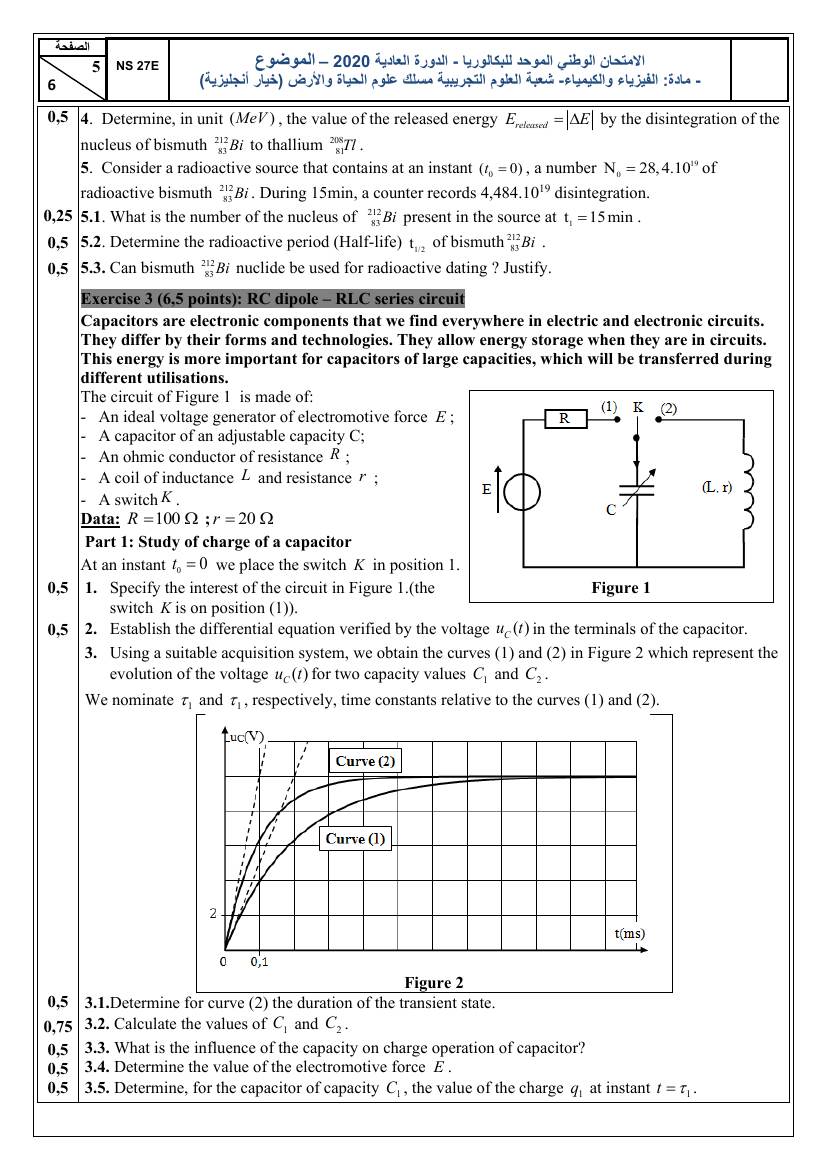
3. Using a suitable acquisition system, we obtain the curves (1) and (2) in Figure 2 which represent the evolution of the voltage uC(t)u_C(t) for two capacity values C1C_1 and C2C_2.

We nominate τ1\tau_1 and τ1\tau_1, respectively, time constants relative to the curves (1) and (2).

Figure 2 : voir la page 5 du sujet

3.1.Determine for curve (2) the duration of the transient state.0,5 pt

3.2.Calculate the values of C1C_1 and C2C_2.0,75 pt

3.3.What is the influence of the capacity on charge operation of capacitor?0,5 pt

3.4.Determine the value of the electromotive force EE.0,5 pt

3.5.Determine, for the capacitor of capacity C1C_1, the value of the charge q1q_1 at instant t=τ1t = \tau_1.0,5 pt

3.6.Using the same generator of electromotive force EE, specify in which case (C1C_1 or C2C_2), the capacitor will store the greatest energy at the end of discharge? Justify.0,5 pt

Part 2: study of RLC series circuit

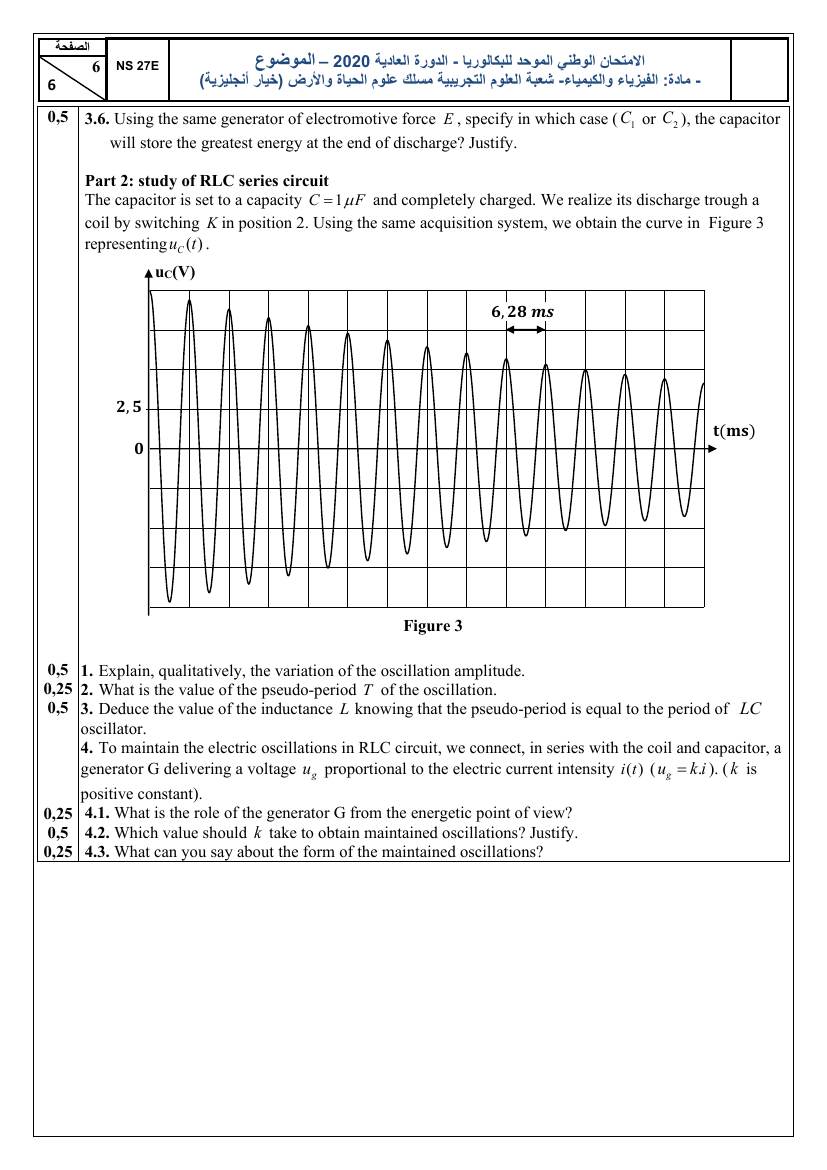
The capacitor is set to a capacity C=1 μFC = 1\ \mu\mathrm{F} and completely charged. We realize its discharge trough a coil by switching KK in position 2. Using the same acquisition system, we obtain the curve in Figure 3 representing uC(t)u_C(t).

Figure 3 : voir la page 6 du sujet

1.Explain, qualitatively, the variation of the oscillation amplitude.0,5 pt

2.What is the value of the pseudo-period TT of the oscillation.0,25 pt

3.Deduce the value of the inductance LL knowing that the pseudo-period is equal to the period of LCLC oscillator.0,5 pt

4. To maintain the electric oscillations in RLC circuit, we connect, in series with the coil and capacitor, a generator G delivering a voltage ugu_g proportional to the electric current intensity i(t)i(t) (ug=k.iu_g = k.i). (kk is positive constant).

4.1.What is the role of the generator G from the energetic point of view?0,25 pt

4.2.Which value should kk take to obtain maintained oscillations? Justify.0,5 pt

4.3.What can you say about the form of the maintained oscillations?0,25 pt

Entraîne-toi sur ces chapitres avec Kresco, gratuitement

Yallah, wa7d l-khtwa.

Le sujet, tu l’as. Maintenant, prépare-le.

Crée ton compte gratuit : une leçon offerte dans chaque chapitre, les quiz et ton suivi, matière par matière, jusqu’au national.