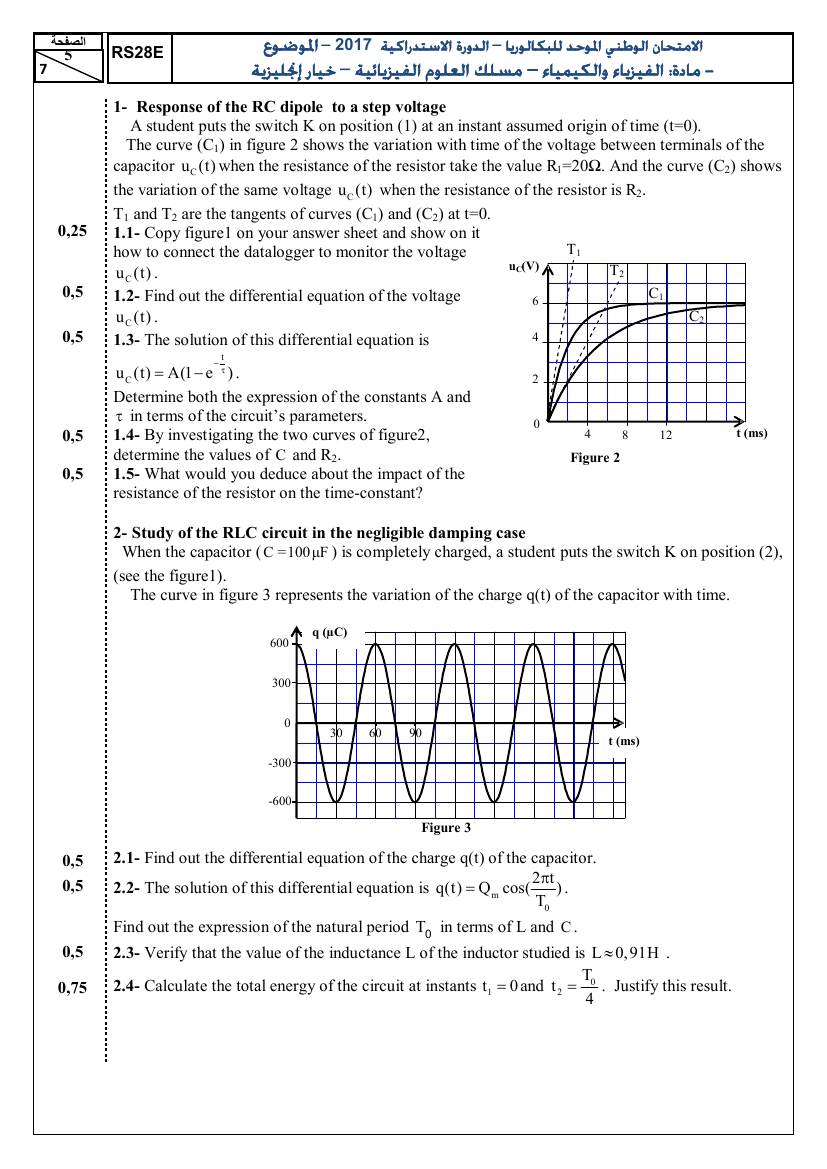
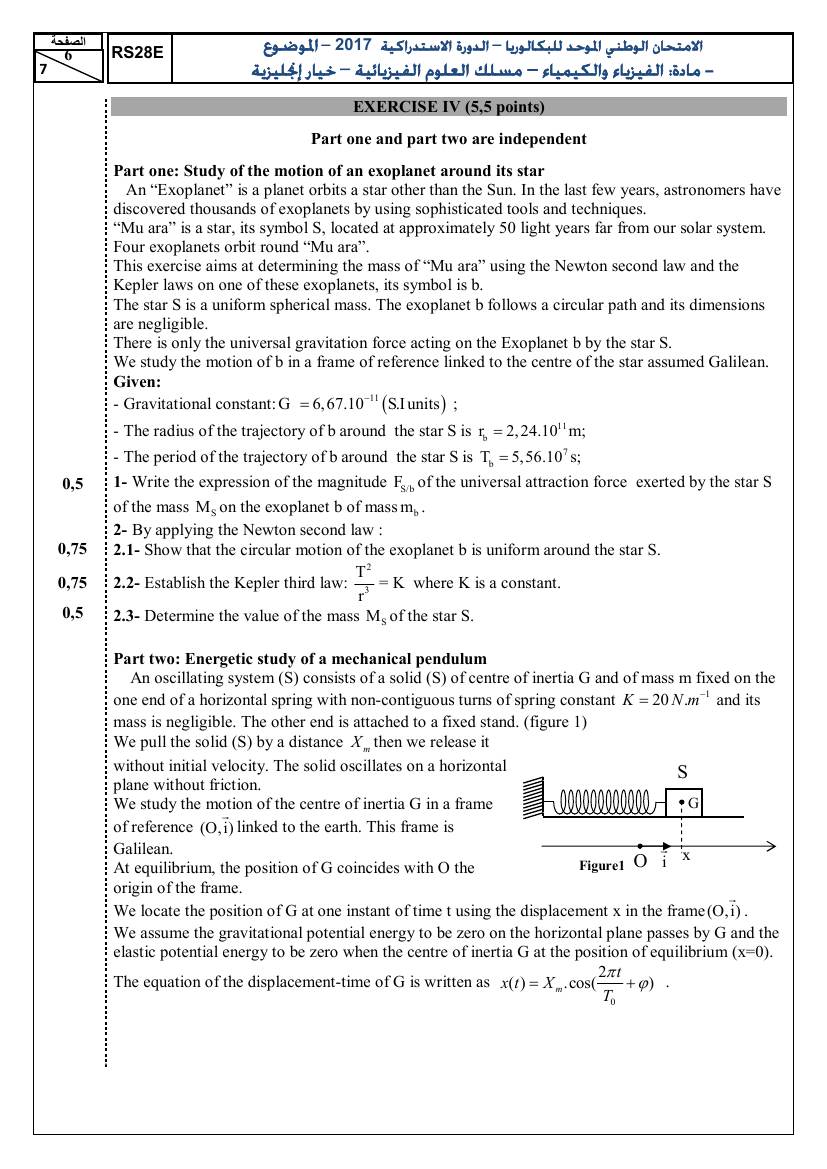
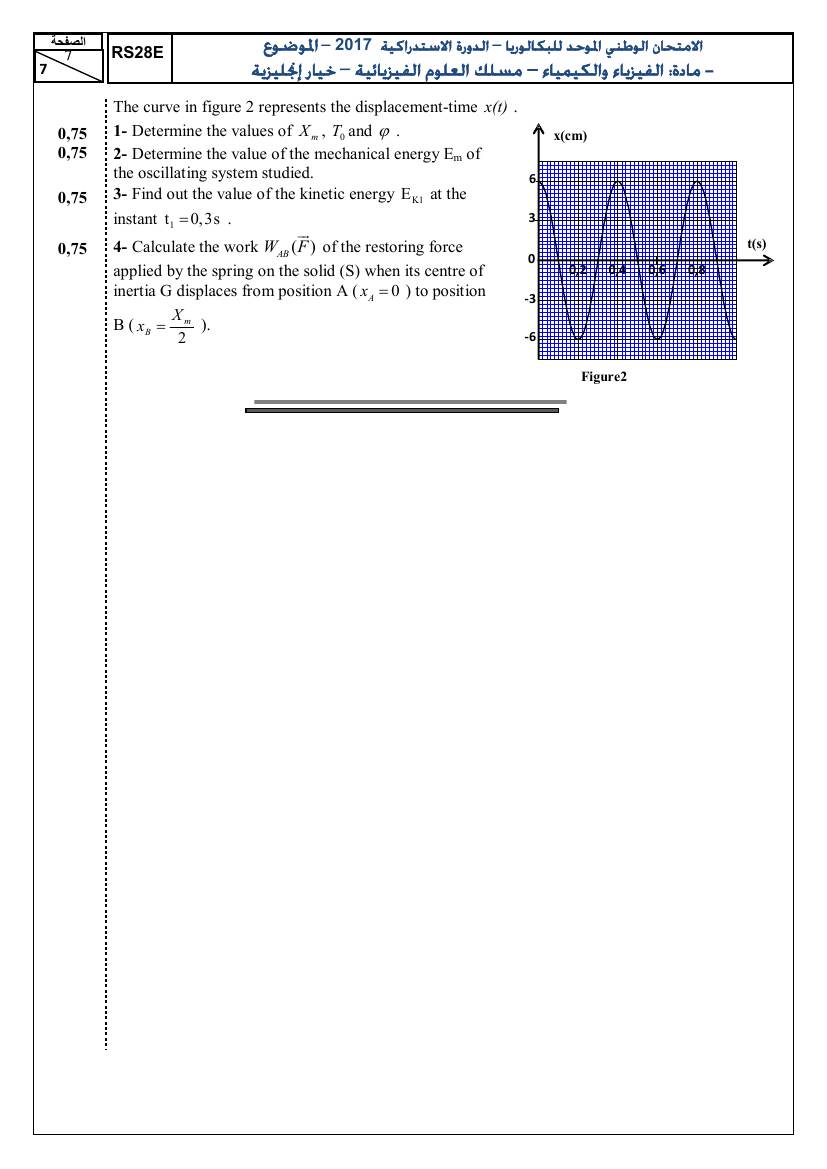
Exercice 17 pts
Part one and part two are independent
Part one: Silver-electroplating by electrolysis
Electrolysis has many industrial uses; for example electroplating some metals with a thin layer of another metal to protect it against the corrosion or to brighten it.
This part of the exercise aims at studying of electrolysis the silver-electroplating process of a plate of copper.
Given:
-Redox pairs involved are and ;
- ;
- Molar mass of silver: .
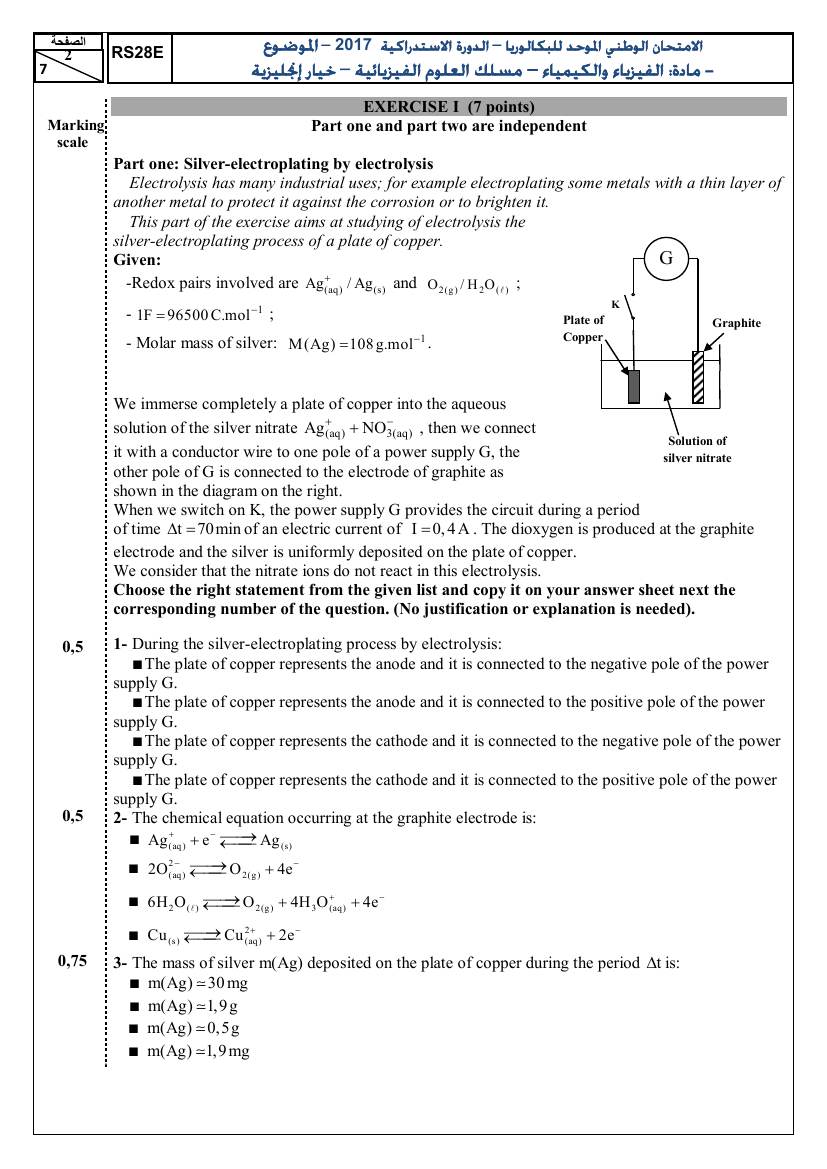
Figure : voir la page 2 du sujet
We immerse completely a plate of copper into the aqueous solution of the silver nitrate , then we connect it with a conductor wire to one pole of a power supply G, the other pole of G is connected to the electrode of graphite as shown in the diagram on the right.
When we switch on K, the power supply G provides the circuit during a period of time of an electric current of . The dioxygen is produced at the graphite electrode and the silver is uniformly deposited on the plate of copper.
We consider that the nitrate ions do not react in this electrolysis.
Choose the right statement from the given list and copy it on your answer sheet next the corresponding number of the question. (No justification or explanation is needed).
1.During the silver-electroplating process by electrolysis:0,5 pt
■ The plate of copper represents the anode and it is connected to the negative pole of the power supply G.
■ The plate of copper represents the anode and it is connected to the positive pole of the power supply G.
■ The plate of copper represents the cathode and it is connected to the negative pole of the power supply G.
■ The plate of copper represents the cathode and it is connected to the positive pole of the power supply G.
2.The chemical equation occurring at the graphite electrode is:0,5 pt
■
■
■
■
3.The mass of silver deposited on the plate of copper during the period is:0,75 pt
■
■
■
■
Part two: Esterification reaction
To manufacture the ethyl ethanoate, a lab assistant prepared a number of graduated tubes. In each one, he mixed the volume of pure ethanol with of ethanoic acid. Hermetically, he put them into a water-bath of a constant temperature of 100°C. To monitor the time-evolution of the chemical system, the lab assistant took out at an instant t of time a tube from the water-bath and immersed it in iced water. He titrated the amount of acid remaining in this tube at this instant using a solution of the sodium hydroxide of a known molar concentration.
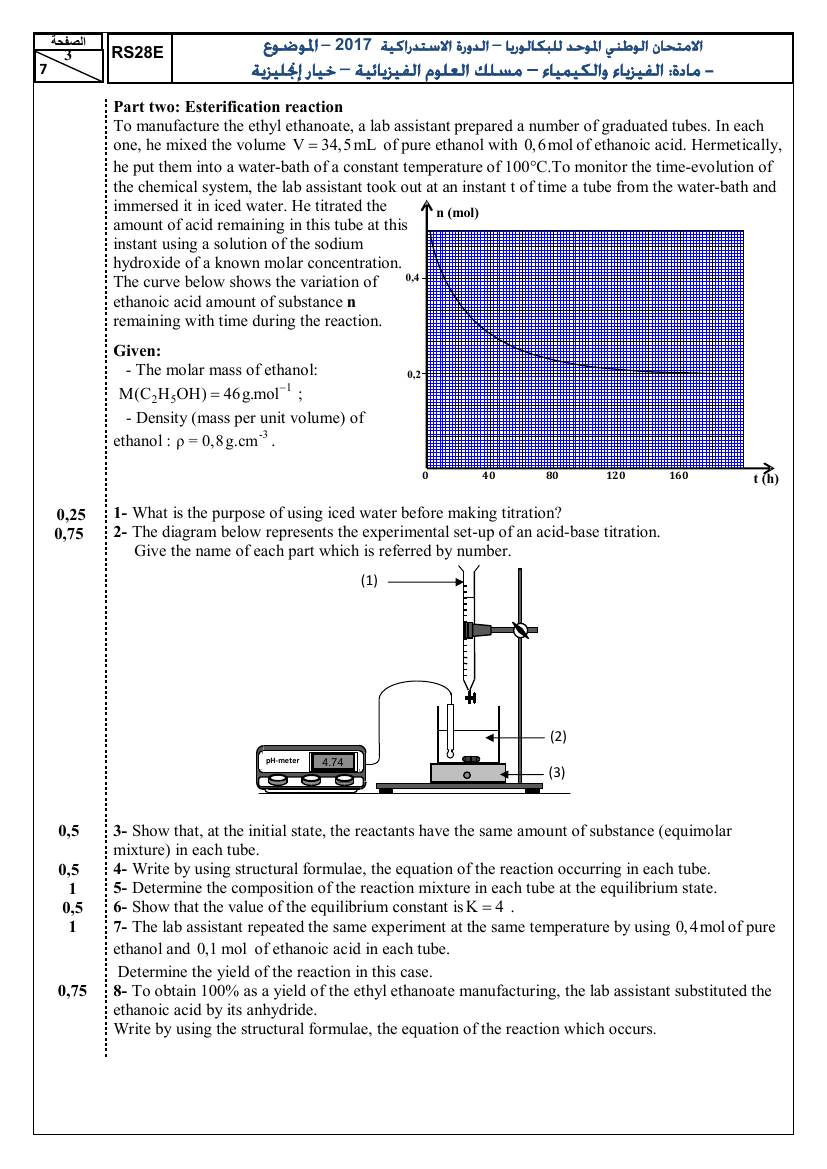
The curve below shows the variation of ethanoic acid amount of substance n remaining with time during the reaction.
Figure : voir la page 3 du sujet
Given:
- The molar mass of ethanol: ;
- Density (mass per unit volume) of ethanol : .
1.What is the purpose of using iced water before making titration?0,25 pt
2.The diagram below represents the experimental set-up of an acid-base titration. Give the name of each part which is referred by number.0,75 pt
Figure : voir la page 3 du sujet
3.Show that, at the initial state, the reactants have the same amount of substance (equimolar mixture) in each tube.0,5 pt
4.Write by using structural formulae, the equation of the reaction occurring in each tube.0,5 pt
5.Determine the composition of the reaction mixture in each tube at the equilibrium state.1 pt
6.Show that the value of the equilibrium constant is .0,5 pt
7.The lab assistant repeated the same experiment at the same temperature by using of pure ethanol and of ethanoic acid in each tube. Determine the yield of the reaction in this case.1 pt
8.To obtain 100% as a yield of the ethyl ethanoate manufacturing, the lab assistant substituted the ethanoic acid by its anhydride. Write by using the structural formulae, the equation of the reaction which occurs.0,75 pt