Jerreb rassek f l-national.

Examen national Maths 2Bac SM (option anglaise) 2020, session de rattrapage

Mathématiques · Sciences Mathématiques A, Sciences Mathématiques B · 5 pages

Le sujet en bref

  1. Exercice 13,5 pts

    Arithmétique

  2. Exercice 23,5 pts

    Structures algébriques

    Au choix avec la partie précédente.

  3. Exercice 33,5 pts

    Nombres complexes

  4. Exercice 413 pts

    Fonctions logarithmes · Suites numériques · Calcul intégral

Total : 20 points

Le sujet, page par page

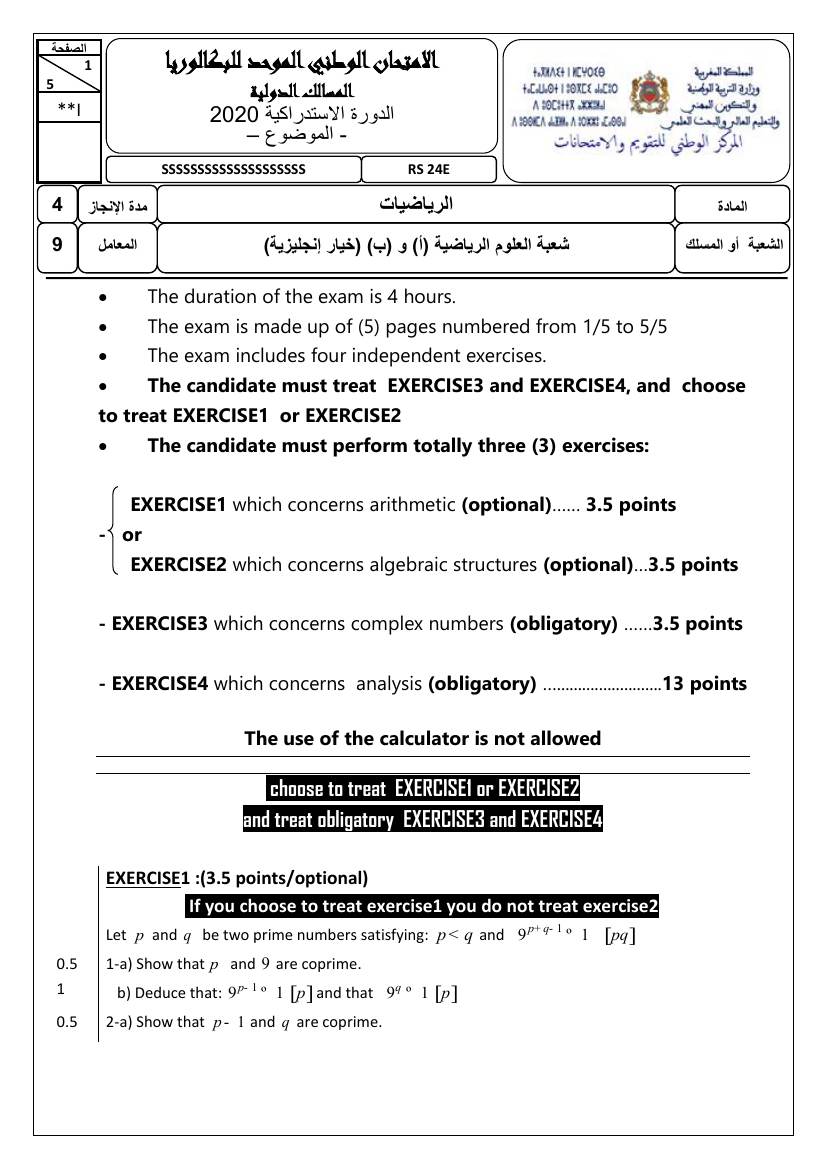
  1. Examen national Maths 2Bac SM (option anglaise) 2020, session de rattrapage, page 1 sur 5
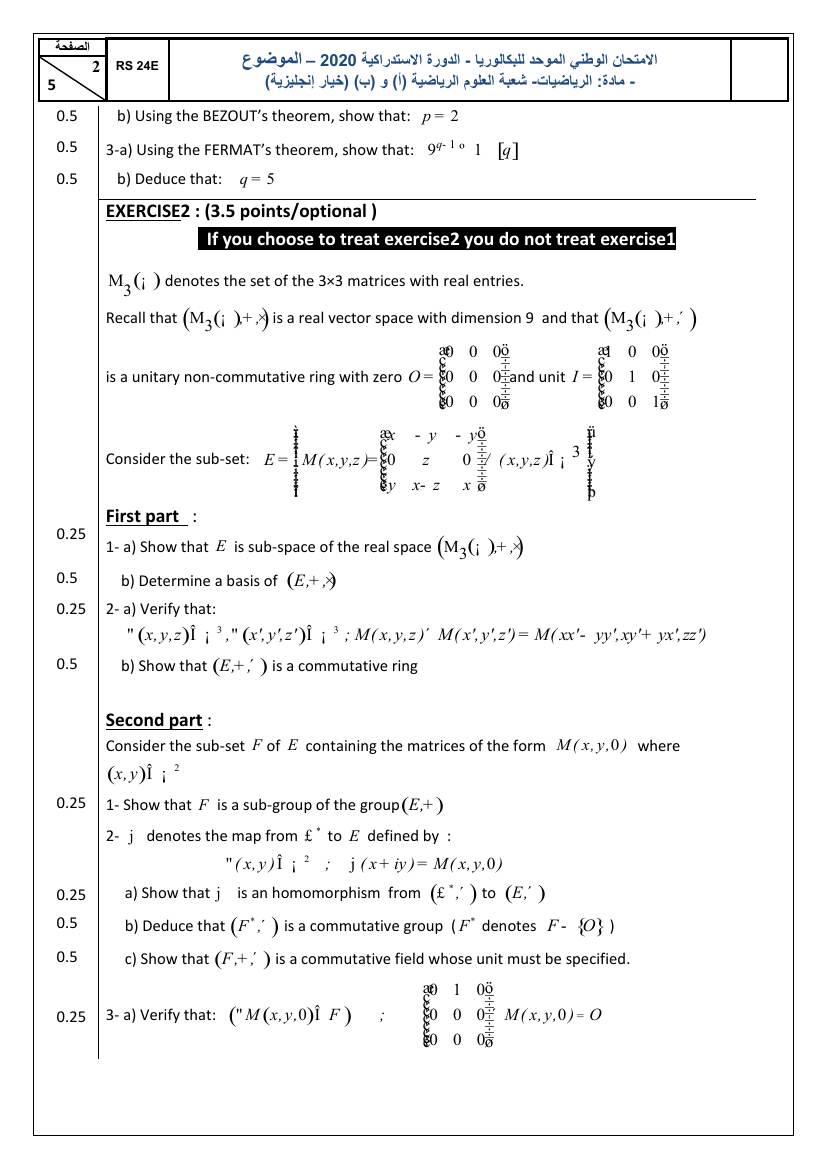
  2. Examen national Maths 2Bac SM (option anglaise) 2020, session de rattrapage, page 2 sur 5
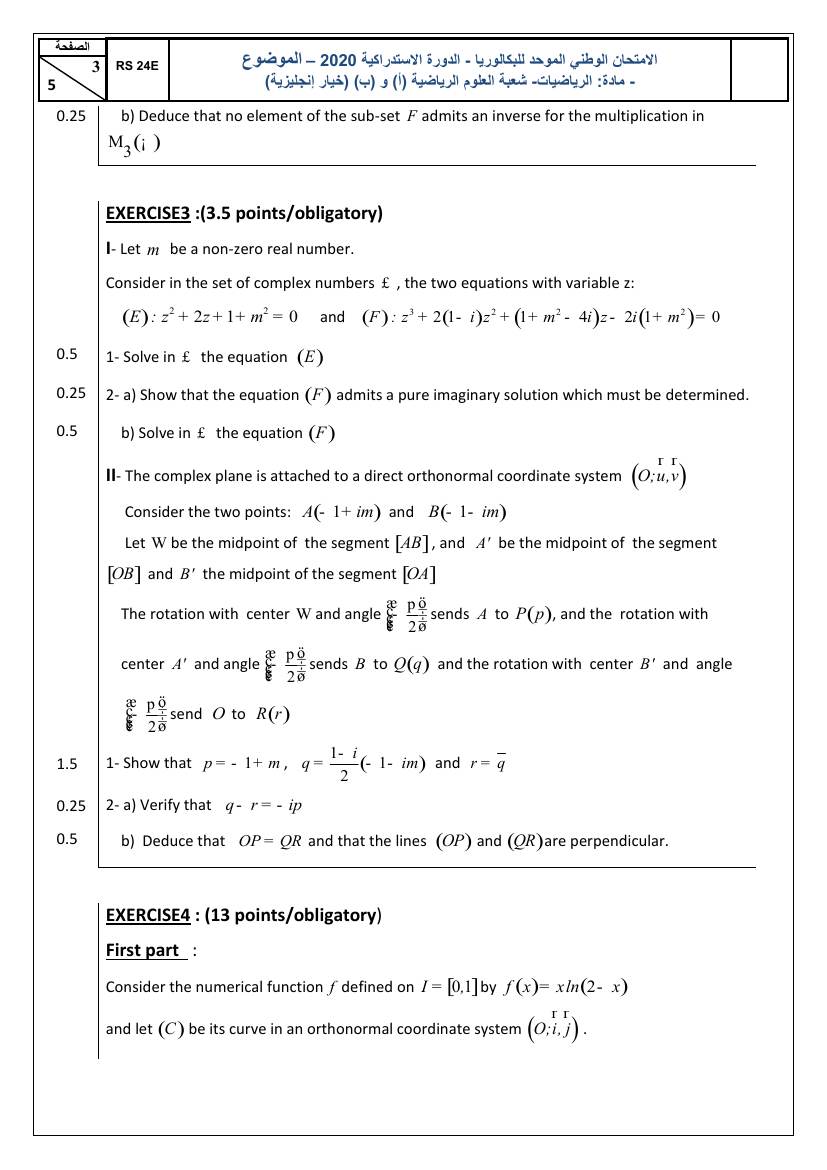
  3. Examen national Maths 2Bac SM (option anglaise) 2020, session de rattrapage, page 3 sur 5
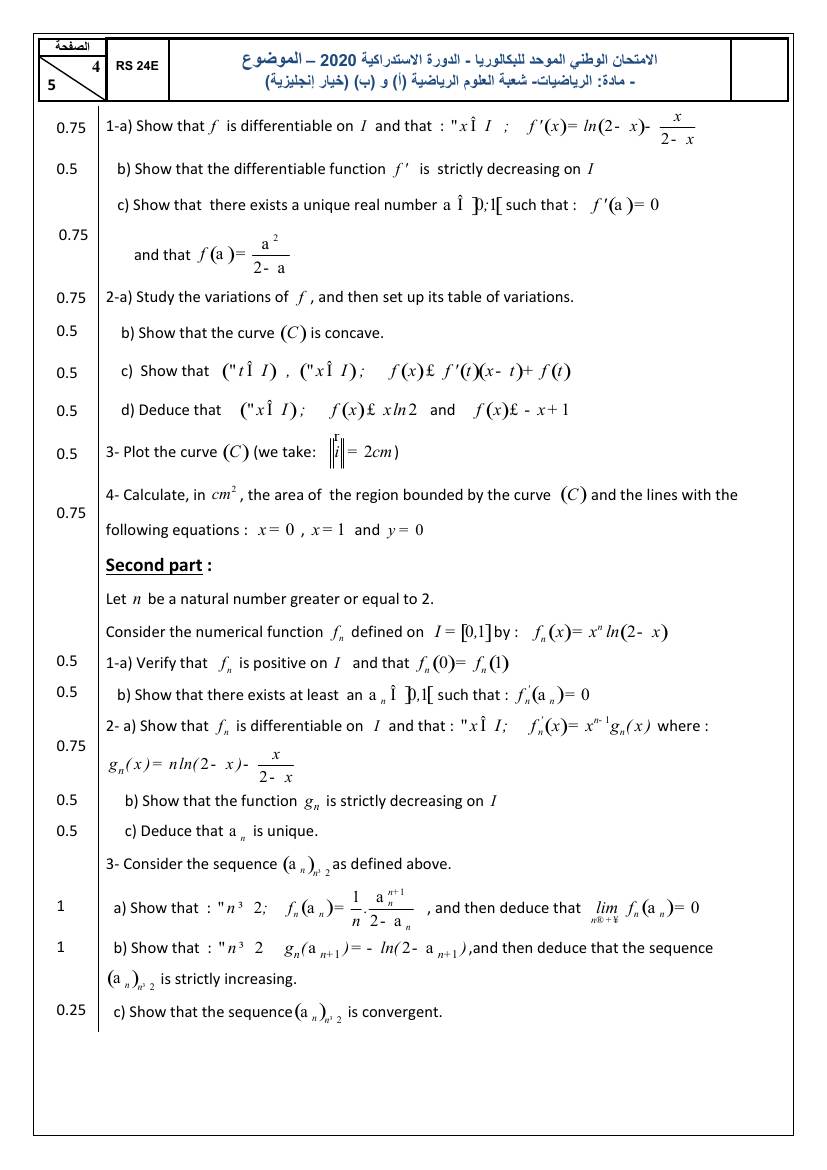
  4. Examen national Maths 2Bac SM (option anglaise) 2020, session de rattrapage, page 4 sur 5
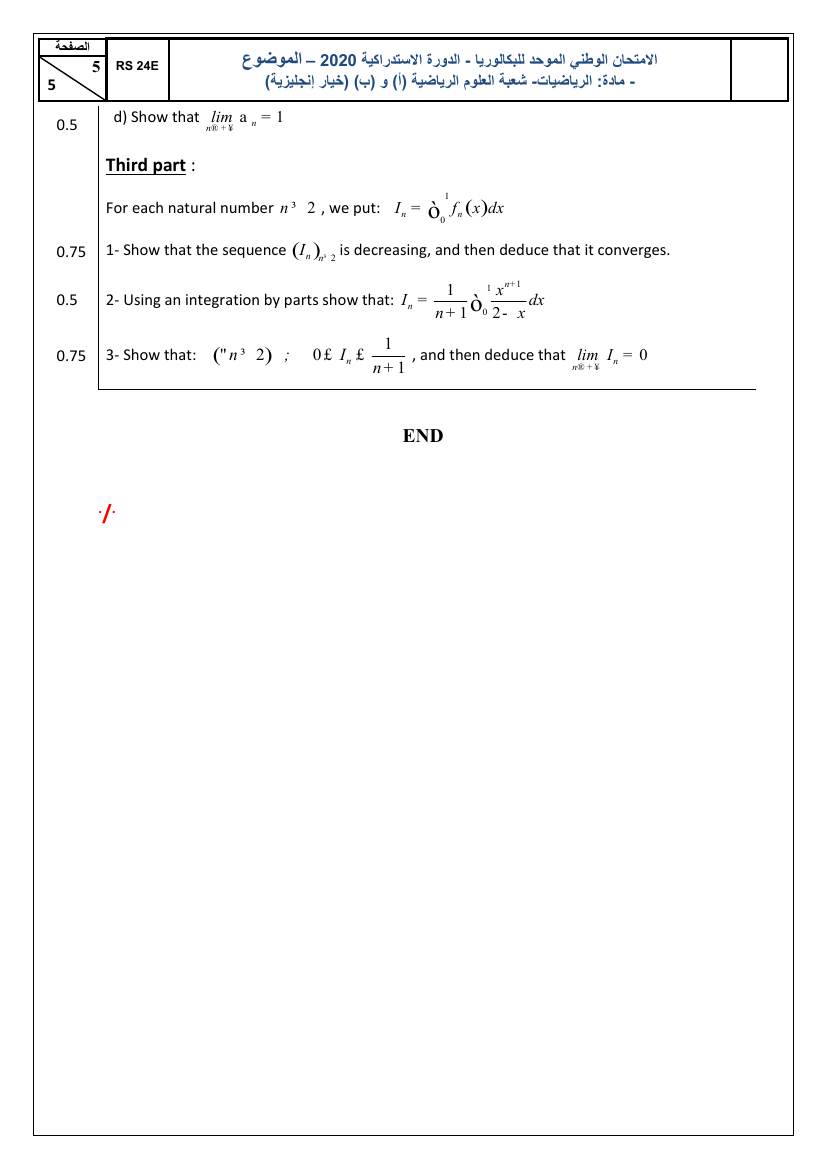
  5. Examen national Maths 2Bac SM (option anglaise) 2020, session de rattrapage, page 5 sur 5

Sujet officiel de l’examen national unifié du baccalauréat, tel que publié par le Centre national de l’évaluation et des examens (Ministère de l’Éducation nationale).

L’énoncé en texte

Transcription du sujet officiel, pour le lire et le rechercher sur téléphone. Les figures restent sur les pages du sujet ; en cas de différence, le PDF officiel fait foi.

Exercice 13,5 pts

EXERCISE1 : (3.5 points/optional)

If you choose to treat exercise1 you do not treat exercise2

Let pp and qq be two prime numbers satisfying: p<qp < q and 9p+q−1≡1 [pq]9^{p+q-1} \equiv 1\ [pq]

1.a.Show that pp and 99 are coprime.0,5 pt

1.b.Deduce that: 9p−1≡1 [p]9^{p-1} \equiv 1\ [p] and that 9q≡1 [p]9^{q} \equiv 1\ [p]1 pt

2.a.Show that p−1p-1 and qq are coprime.0,5 pt

2.b.Using the BEZOUT’s theorem, show that: p=2p = 20,5 pt

3.a.Using the FERMAT’s theorem, show that: 9q−1≡1 [q]9^{q-1} \equiv 1\ [q]0,5 pt

3.b.Deduce that: q=5q = 50,5 pt

Exercice 23,5 pts

EXERCISE2 : (3.5 points/optional)

If you choose to treat exercise2 you do not treat exercise1

M3(R)\mathrm{M}_3(\mathbb{R}) denotes the set of the 3×33\times 3 matrices with real entries.

Recall that (M3(R),+,⋅)(\mathrm{M}_3(\mathbb{R}),+,\cdot) is a real vector space with dimension 9 and that (M3(R),+,×)(\mathrm{M}_3(\mathbb{R}),+,\times) is a unitary non-commutative ring with zero O=(000000000)O = \begin{pmatrix}0&0&0\\0&0&0\\0&0&0\end{pmatrix} and unit I=(100010001)I = \begin{pmatrix}1&0&0\\0&1&0\\0&0&1\end{pmatrix}

Consider the sub-set: E={M(x,y,z)=(x−y−y0z0yx−zx) / (x,y,z)∈R3}E = \left\{ M(x,y,z)=\begin{pmatrix}x&-y&-y\\0&z&0\\y&x-z&x\end{pmatrix} \ /\ (x,y,z)\in\mathbb{R}^3 \right\}

First part :

1.a.Show that EE is sub-space of the real space (M3(R),+,⋅)(\mathrm{M}_3(\mathbb{R}),+,\cdot)0,25 pt

1.b.Determine a basis of (E,+,⋅)(E,+,\cdot)0,5 pt

2.a.Verify that: ∀(x,y,z)∈R3, ∀(x′,y′,z′)∈R3 ; M(x,y,z)×M(x′,y′,z′)=M(xx′−yy′, xy′+yx′, zz′)\forall (x,y,z)\in\mathbb{R}^3,\ \forall (x',y',z')\in\mathbb{R}^3\ ;\ M(x,y,z)\times M(x',y',z') = M(xx'-yy',\,xy'+yx',\,zz')0,25 pt

2.b.Show that (E,+,×)(E,+,\times) is a commutative ring0,5 pt

Second part :

Consider the sub-set FF of EE containing the matrices of the form M(x,y,0)M(x,y,0) where (x,y)∈R2(x,y)\in\mathbb{R}^2

1.Show that FF is a sub-group of the group (E,+)(E,+)0,25 pt

2- φ\varphi denotes the map from C∗\mathbb{C}^* to EE defined by : ∀(x,y)∈R2 ; φ(x+iy)=M(x,y,0)\forall (x,y)\in\mathbb{R}^2\ ;\ \varphi(x+iy)=M(x,y,0)

2.a.Show that φ\varphi is an homomorphism from (C∗,×)(\mathbb{C}^*,\times) to (E,×)(E,\times)0,25 pt

2.b.Deduce that (F∗,×)(F^*,\times) is a commutative group (F∗F^* denotes F−{O}F-\{O\})0,5 pt

2.c.Show that (F,+,×)(F,+,\times) is a commutative field whose unit must be specified.0,5 pt

3.a.Verify that: (∀M(x,y,0)∈F) ; (010000000)×M(x,y,0)=O(\forall M(x,y,0)\in F)\ ;\ \begin{pmatrix}0&1&0\\0&0&0\\0&0&0\end{pmatrix}\times M(x,y,0)=O0,25 pt

3.b.Deduce that no element of the sub-set FF admits an inverse for the multiplication in M3(R)\mathrm{M}_3(\mathbb{R})0,25 pt

Exercice 33,5 pts

EXERCISE3 : (3.5 points/obligatory)

I- Let mm be a non-zero real number.

Consider in the set of complex numbers C\mathbb{C}, the two equations with variable zz:

(E): z2+2z+1+m2=0(E):\ z^2+2z+1+m^2=0 and (F): z3+2(1−i)z2+(1+m2−4i)z−2i(1+m2)=0(F):\ z^3+2(1-i)z^2+(1+m^2-4i)z-2i(1+m^2)=0

1.Solve in C\mathbb{C} the equation (E)(E)0,5 pt

2.a.Show that the equation (F)(F) admits a pure imaginary solution which must be determined.0,25 pt

2.b.Solve in C\mathbb{C} the equation (F)(F)0,5 pt

II- The complex plane is attached to a direct orthonormal coordinate system (O;u⃗,v⃗)(O;\vec{u},\vec{v})

Consider the two points: A(−1+im)A(-1+im) and B(−1−im)B(-1-im)

Let WW be the midpoint of the segment [AB][AB], and A′A' be the midpoint of the segment [OB][OB] and B′B' the midpoint of the segment [OA][OA]

The rotation with center WW and angle (−π2)\left(-\dfrac{\pi}{2}\right) sends AA to P(p)P(p), and the rotation with center A′A' and angle (−π2)\left(-\dfrac{\pi}{2}\right) sends BB to Q(q)Q(q) and the rotation with center B′B' and angle (−π2)\left(-\dfrac{\pi}{2}\right) send OO to R(r)R(r)

1.Show that p=−1+mp=-1+m, q=1−i2(−1−im)q=\dfrac{1-i}{2}(-1-im) and r=q‾r=\overline{q}1,5 pts

2.a.Verify that q−r=−ipq-r=-ip0,25 pt

2.b.Deduce that OP=QROP=QR and that the lines (OP)(OP) and (QR)(QR) are perpendicular.0,5 pt

Exercice 413 pts

EXERCISE4 : (13 points/obligatory)

First part :

Consider the numerical function ff defined on I=[0,1]I=[0,1] by f(x)=xln⁡(2−x)f(x)=x\ln(2-x) and let (C)(C) be its curve in an orthonormal coordinate system (O;i⃗,j⃗)(O;\vec{i},\vec{j}).

1.a.Show that ff is differentiable on II and that : ∀x∈I ; f′(x)=ln⁡(2−x)−x2−x\forall x\in I\ ;\ f'(x)=\ln(2-x)-\dfrac{x}{2-x}0,75 pt

1.b.Show that the differentiable function f′f' is strictly decreasing on II0,5 pt

1.c.Show that there exists a unique real number a∈]0;1[a\in]0;1[ such that : f′(a)=0f'(a)=0 and that f(a)=a22−af(a)=\dfrac{a^2}{2-a}0,75 pt

2.a.Study the variations of ff, and then set up its table of variations.0,75 pt

2.b.Show that the curve (C)(C) is concave.0,5 pt

2.c.Show that (∀t∈I), (∀x∈I) ; f(x)≤f′(t)(x−t)+f(t)(\forall t\in I),\ (\forall x\in I)\ ;\ f(x)\leq f'(t)(x-t)+f(t)0,5 pt

2.d.Deduce that (∀x∈I) ; f(x)≤xln⁡2(\forall x\in I)\ ;\ f(x)\leq x\ln 2 and f(x)≤−x+1f(x)\leq -x+10,5 pt

3.Plot the curve (C)(C) (we take: ∥i⃗∥=2 cm\|\vec{i}\|=2\,\mathrm{cm})0,5 pt

4.Calculate, in cm2\mathrm{cm}^2, the area of the region bounded by the curve (C)(C) and the lines with the following equations : x=0x=0, x=1x=1 and y=0y=00,75 pt

Second part :

Let nn be a natural number greater or equal to 2.

Consider the numerical function fnf_n defined on I=[0,1]I=[0,1] by : fn(x)=xnln⁡(2−x)f_n(x)=x^n\ln(2-x)

1.a.Verify that fnf_n is positive on II and that fn(0)=fn(1)f_n(0)=f_n(1)0,5 pt

1.b.Show that there exists at least an an∈]0,1[a_n\in]0,1[ such that : fn′(an)=0f_n'(a_n)=00,5 pt

2.a.Show that fnf_n is differentiable on II and that : ∀x∈I; fn′(x)=xn−1gn(x)\forall x\in I;\ f_n'(x)=x^{n-1}g_n(x) where : gn(x)=nln⁡(2−x)−x2−xg_n(x)=n\ln(2-x)-\dfrac{x}{2-x}0,75 pt

2.b.Show that the function gng_n is strictly decreasing on II0,5 pt

2.c.Deduce that ana_n is unique.0,5 pt

3- Consider the sequence (an)n≥2(a_n)_{n\geq 2} as defined above.

3.a.Show that : ∀n≥2; fn(an)=1n⋅an n+12−an\forall n\geq 2;\ f_n(a_n)=\dfrac{1}{n}\cdot\dfrac{a_n^{\,n+1}}{2-a_n}, and then deduce that lim⁡n→+∞fn(an)=0\lim_{n\to+\infty} f_n(a_n)=01 pt

3.b.Show that : ∀n≥2  gn(an+1)=−ln⁡(2−an+1)\forall n\geq 2\ \ g_n(a_{n+1})=-\ln(2-a_{n+1}), and then deduce that the sequence (an)n≥2(a_n)_{n\geq 2} is strictly increasing.1 pt

3.c.Show that the sequence (an)n≥2(a_n)_{n\geq 2} is convergent.0,25 pt

3.d.Show that lim⁡n→+∞an=1\lim_{n\to+\infty} a_n=10,5 pt

Third part :

For each natural number n≥2n\geq 2, we put: In=∫01fn(x) dxI_n=\int_0^1 f_n(x)\,dx

1.Show that the sequence (In)n≥2(I_n)_{n\geq 2} is decreasing, and then deduce that it converges.0,75 pt

2.Using an integration by parts show that: In=1n+1∫01xn+12−x dxI_n=\dfrac{1}{n+1}\int_0^1\dfrac{x^{n+1}}{2-x}\,dx0,5 pt

3.Show that: (∀n≥2) ; 0≤In≤1n+1(\forall n\geq 2)\ ;\ 0\leq I_n\leq\dfrac{1}{n+1}, and then deduce that lim⁡n→+∞In=0\lim_{n\to+\infty} I_n=00,75 pt

Revoir le cours : Suites numériques

Entraîne-toi sur ces chapitres avec Kresco, gratuitement

Yallah, wa7d l-khtwa.

Le sujet, tu l’as. Maintenant, prépare-le.

Crée ton compte gratuit : une leçon offerte dans chaque chapitre, les quiz et ton suivi, matière par matière, jusqu’au national.