Jerreb rassek f l-national.

Examen national Maths 2Bac SM (option anglaise) 2020, session normale

Mathématiques · Sciences Mathématiques A, Sciences Mathématiques B · 5 pages

Le sujet en bref

  1. Exercice 13,5 pts

    Arithmétique

  2. Exercice 23,5 pts

    Structures algébriques

    Au choix avec la partie précédente.

  3. Exercice 33,5 pts

    Nombres complexes

  4. Exercice 413 pts

    Fonctions logarithmes · Calcul intégral · Suites numériques

Total : 20 points

Le sujet, page par page

  1. Examen national Maths 2Bac SM (option anglaise) 2020, session normale, page 1 sur 5
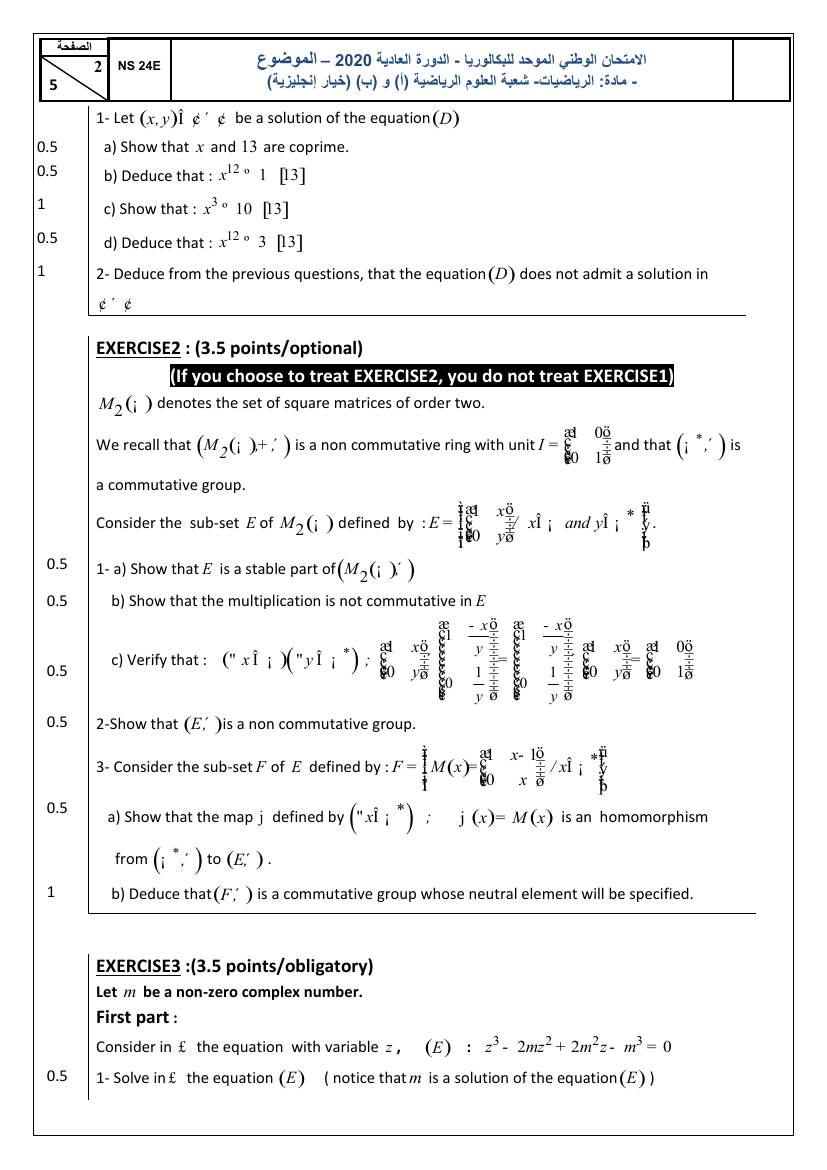
  2. Examen national Maths 2Bac SM (option anglaise) 2020, session normale, page 2 sur 5
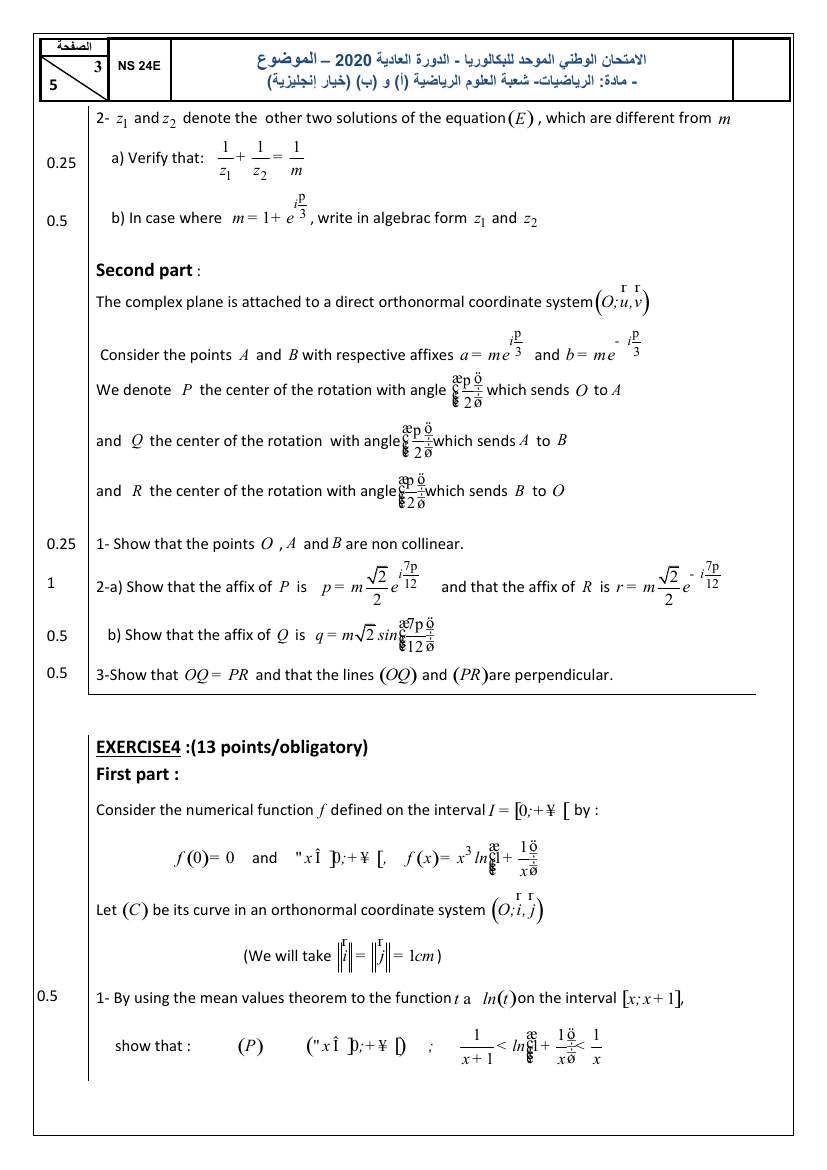
  3. Examen national Maths 2Bac SM (option anglaise) 2020, session normale, page 3 sur 5
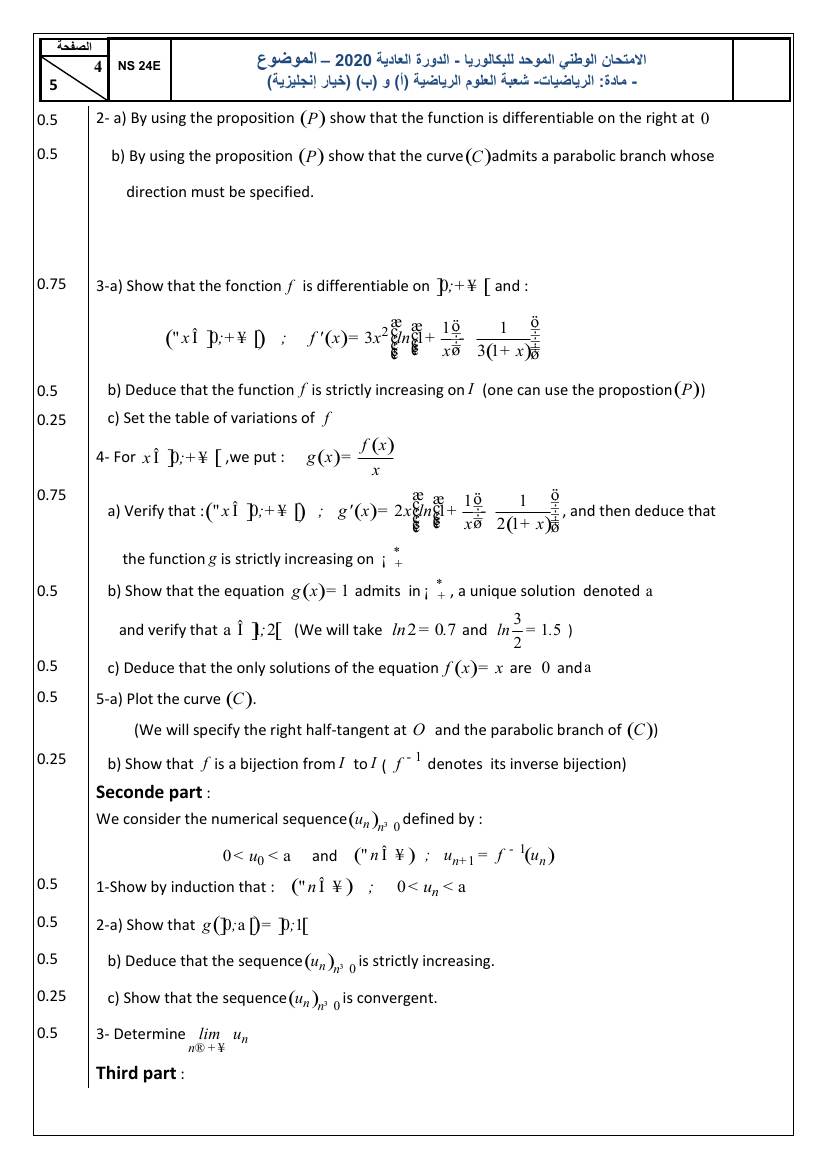
  4. Examen national Maths 2Bac SM (option anglaise) 2020, session normale, page 4 sur 5
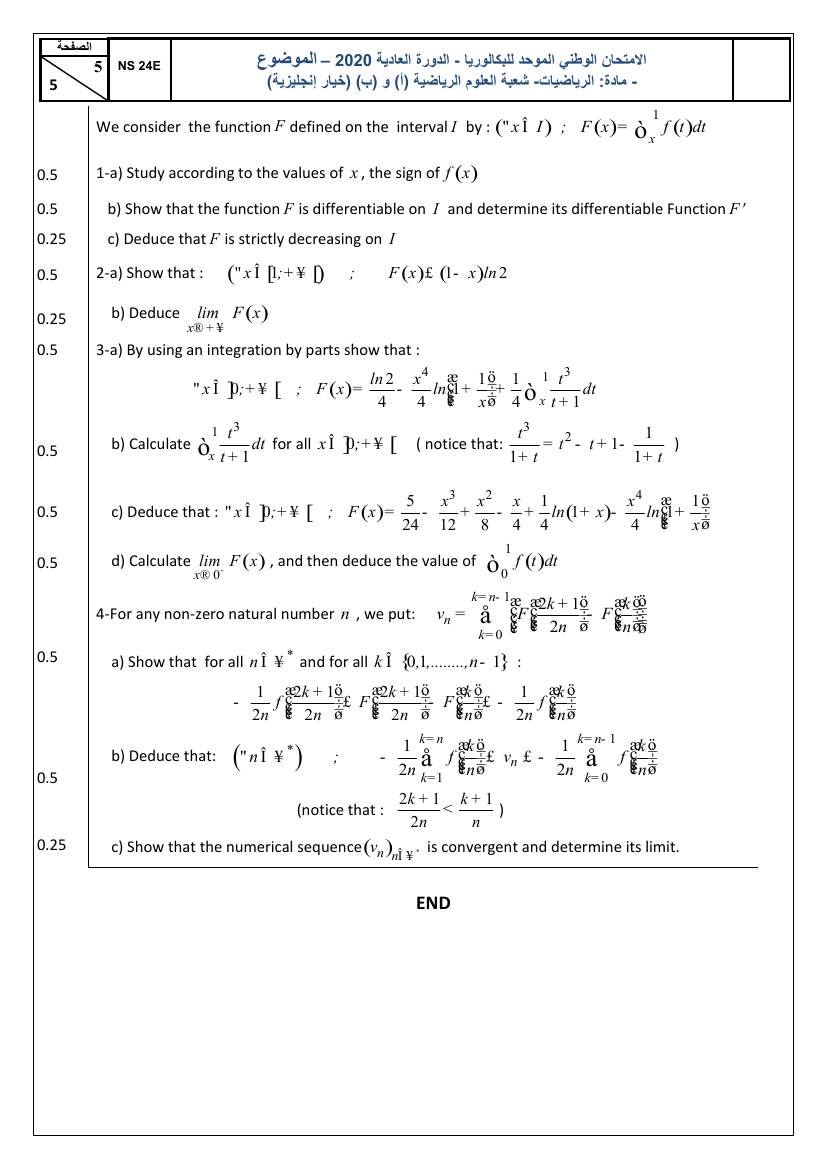
  5. Examen national Maths 2Bac SM (option anglaise) 2020, session normale, page 5 sur 5

Sujet officiel de l’examen national unifié du baccalauréat, tel que publié par le Centre national de l’évaluation et des examens (Ministère de l’Éducation nationale).

L’énoncé en texte

Transcription du sujet officiel, pour le lire et le rechercher sur téléphone. Les figures restent sur les pages du sujet ; en cas de différence, le PDF officiel fait foi.

Exercice 13,5 pts

Consider in Z×Z\mathbb{Z}\times\mathbb{Z} the equation (D)(D) : 7x3−13y=57x^3 - 13y = 5

1.Let (x,y)∈Z×Z(x,y)\in\mathbb{Z}\times\mathbb{Z} be a solution of the equation (D)(D)

1.a.Show that xx and 1313 are coprime.0,5 pt

1.b.Deduce that : x12≡1 [13]x^{12}\equiv 1\ [13]0,5 pt

1.c.Show that : x3≡10 [13]x^3\equiv 10\ [13]1 pt

1.d.Deduce that : x12≡3 [13]x^{12}\equiv 3\ [13]0,5 pt

2.Deduce from the previous questions, that the equation (D)(D) does not admit a solution in Z×Z\mathbb{Z}\times\mathbb{Z}1 pt

Exercice 23,5 pts

M2(R)M_2(\mathbb{R}) denotes the set of square matrices of order two.

We recall that (M2(R),+,×)(M_2(\mathbb{R}),+,\times) is a non commutative ring with unit I=(1001)I=\begin{pmatrix}1&0\\0&1\end{pmatrix} and that (R∗,×)(\mathbb{R}^*,\times) is a commutative group.

Consider the sub-set EE of M2(R)M_2(\mathbb{R}) defined by : E={(1x0y)/ x∈R and y∈R∗}E=\left\{\begin{pmatrix}1&x\\0&y\end{pmatrix}/\ x\in\mathbb{R}\ \text{and}\ y\in\mathbb{R}^*\right\}.

1.a.Show that EE is a stable part of (M2(R),×)(M_2(\mathbb{R}),\times)0,5 pt

1.b.Show that the multiplication is not commutative in EE0,5 pt

1.c.Verify that : (∀x∈R)(∀y∈R∗)(\forall x\in\mathbb{R})(\forall y\in\mathbb{R}^*) ; (1x0y)×(1−xy01y)=(1−xy01y)×(1x0y)=(1001)\begin{pmatrix}1&x\\0&y\end{pmatrix}\times\begin{pmatrix}1&-\dfrac{x}{y}\\0&\dfrac{1}{y}\end{pmatrix}=\begin{pmatrix}1&-\dfrac{x}{y}\\0&\dfrac{1}{y}\end{pmatrix}\times\begin{pmatrix}1&x\\0&y\end{pmatrix}=\begin{pmatrix}1&0\\0&1\end{pmatrix}0,5 pt

2.Show that (E,×)(E,\times) is a non commutative group.0,5 pt

3- Consider the sub-set FF of EE defined by : F={M(x)=(1x−1x0x)/ x∈R∗}F=\left\{M(x)=\begin{pmatrix}1&x-\dfrac{1}{x}\\0&x\end{pmatrix}/\ x\in\mathbb{R}^*\right\}

3.a.Show that the map φ\varphi defined by (∀x∈R∗)(\forall x\in\mathbb{R}^*) ; φ(x)=M(x)\varphi(x)=M(x) is an homomorphism from (R∗,×)(\mathbb{R}^*,\times) to (E,×)(E,\times).0,5 pt

3.b.Deduce that (F,×)(F,\times) is a commutative group whose neutral element will be specified.1 pt

Exercice 33,5 pts

Let mm be a non-zero complex number.

First part :

Consider in C\mathbb{C} the equation with variable zz, (E)(E) : z3−2mz2+2m2z−m3=0z^3-2mz^2+2m^2z-m^3=0

1.Solve in C\mathbb{C} the equation (E)(E) ( notice that mm is a solution of the equation (E)(E) )0,5 pt

2.z1z_1 and z2z_2 denote the other two solutions of the equation (E)(E), which are different from mm

2.a.Verify that: 1z1+1z2=1m\dfrac{1}{z_1}+\dfrac{1}{z_2}=\dfrac{1}{m}0,25 pt

2.b.In case where m=1+eiπ3m=1+e^{i\frac{\pi}{3}}, write in algebrac form z1z_1 and z2z_20,5 pt

Second part :

The complex plane is attached to a direct orthonormal coordinate system (O;u⃗,v⃗)(O;\vec{u},\vec{v})

Consider the points AA and BB with respective affixes a=meiπ3a=me^{i\frac{\pi}{3}} and b=me−iπ3b=me^{-i\frac{\pi}{3}}

We denote PP the center of the rotation with angle (π2)\left(\dfrac{\pi}{2}\right) which sends OO to AA

and QQ the center of the rotation with angle (π2)\left(\dfrac{\pi}{2}\right) which sends AA to BB

and RR the center of the rotation with angle (π2)\left(\dfrac{\pi}{2}\right) which sends BB to OO

1.Show that the points OO, AA and BB are non collinear.0,25 pt

2.a.Show that the affix of PP is p=m22ei7π12p=m\dfrac{\sqrt{2}}{2}e^{i\frac{7\pi}{12}} and that the affix of RR is r=m22e−i7π12r=m\dfrac{\sqrt{2}}{2}e^{-i\frac{7\pi}{12}}1 pt

2.b.Show that the affix of QQ is q=m2 sin⁡(7π12)q=m\sqrt{2}\,\sin\left(\dfrac{7\pi}{12}\right)0,5 pt

3.Show that OQ=PROQ=PR and that the lines (OQ)(OQ) and (PR)(PR) are perpendicular.0,5 pt

Exercice 413 pts

First part :

Consider the numerical function ff defined on the interval I=[0;+∞[I=[0;+\infty[ by :

f(0)=0and(∀x∈]0;+∞[), f(x)=x3ln⁡(1+1x)f(0)=0\quad\text{and}\quad(\forall x\in]0;+\infty[),\ f(x)=x^3\ln\left(1+\dfrac{1}{x}\right)

Let (C)(C) be its curve in an orthonormal coordinate system (O;i⃗,j⃗)(O;\vec{i},\vec{j})

(We will take ∥i⃗∥=∥j⃗∥=1 cm\|\vec{i}\|=\|\vec{j}\|=1\,\mathrm{cm})

1.By using the mean values theorem to the function t↦ln⁡(t)t\mapsto\ln(t) on the interval [x;x+1][x;x+1], show that : (P)(P) (∀x∈]0;+∞[)(\forall x\in]0;+\infty[) ; 1x+1<ln⁡(1+1x)<1x\dfrac{1}{x+1}<\ln\left(1+\dfrac{1}{x}\right)<\dfrac{1}{x}0,5 pt

2.a.By using the proposition (P)(P) show that the function is differentiable on the right at 000,5 pt

2.b.By using the proposition (P)(P) show that the curve (C)(C) admits a parabolic branch whose direction must be specified.0,5 pt

3.a.Show that the fonction ff is differentiable on ]0;+∞[]0;+\infty[ and : (∀x∈]0;+∞[)(\forall x\in]0;+\infty[) ; f′(x)=3x2(ln⁡(1+1x)−13(1+x))f'(x)=3x^2\left(\ln\left(1+\dfrac{1}{x}\right)-\dfrac{1}{3(1+x)}\right)0,75 pt

3.b.Deduce that the function ff is strictly increasing on II (one can use the propostion (P)(P))0,5 pt

3.c.Set the table of variations of ff0,25 pt

4- For x∈]0;+∞[x\in]0;+\infty[, we put : g(x)=f(x)xg(x)=\dfrac{f(x)}{x}

4.a.Verify that : (∀x∈]0;+∞[)(\forall x\in]0;+\infty[) ; g′(x)=2x(ln⁡(1+1x)−12(1+x))g'(x)=2x\left(\ln\left(1+\dfrac{1}{x}\right)-\dfrac{1}{2(1+x)}\right), and then deduce that the function gg is strictly increasing on R+∗\mathbb{R}_+^*0,75 pt

4.b.Show that the equation g(x)=1g(x)=1 admits in R+∗\mathbb{R}_+^*, a unique solution denoted aa and verify that a∈]1;2[a\in]1;2[ (We will take ln⁡2=0.7\ln 2=0.7 and ln⁡32=1.5\ln\dfrac{3}{2}=1.5 )0,5 pt

4.c.Deduce that the only solutions of the equation f(x)=xf(x)=x are 00 and aa0,5 pt

5.a.Plot the curve (C)(C). (We will specify the right half-tangent at OO and the parabolic branch of (C)(C))0,5 pt

5.b.Show that ff is a bijection from II to II ( f−1f^{-1} denotes its inverse bijection)0,25 pt

Seconde part :

We consider the numerical sequence (un)n≥0(u_n)_{n\geq 0} defined by :

0<u0<aand(∀n∈N); un+1=f−1(un)0<u_0<a\quad\text{and}\quad(\forall n\in\mathbb{N});\ u_{n+1}=f^{-1}(u_n)

1.Show by induction that : (∀n∈N)(\forall n\in\mathbb{N}) ; 0<un<a0<u_n<a0,5 pt

2.a.Show that g(]0;a[)=]0;1[g(]0;a[)=]0;1[0,5 pt

2.b.Deduce that the sequence (un)n≥0(u_n)_{n\geq 0} is strictly increasing.0,5 pt

2.c.Show that the sequence (un)n≥0(u_n)_{n\geq 0} is convergent.0,25 pt

3.Determine lim⁡n→+∞un\lim_{n\to+\infty}u_n0,5 pt

Third part :

We consider the function FF defined on the interval II by : (∀x∈I)(\forall x\in I) ; F(x)=∫x1f(t) dtF(x)=\displaystyle\int_x^1 f(t)\,dt

1.a.Study according to the values of xx, the sign of f(x)f(x)0,5 pt

1.b.Show that the function FF is differentiable on II and determine its differentiable Function F′F'0,5 pt

1.c.Deduce that FF is strictly decreasing on II0,25 pt

2.a.Show that : (∀x∈[1;+∞[)(\forall x\in[1;+\infty[) ; F(x)≤(1−x)ln⁡2F(x)\leq(1-x)\ln 20,5 pt

2.b.Deduce lim⁡x→+∞F(x)\lim_{x\to+\infty}F(x)0,25 pt

3.a.By using an integration by parts show that : ∀x∈]0;+∞[\forall x\in]0;+\infty[ ; F(x)=ln⁡24−x44ln⁡(1+1x)+14∫x1t3t+1 dtF(x)=\dfrac{\ln 2}{4}-\dfrac{x^4}{4}\ln\left(1+\dfrac{1}{x}\right)+\dfrac{1}{4}\displaystyle\int_x^1\dfrac{t^3}{t+1}\,dt0,5 pt

3.b.Calculate ∫x1t3t+1 dt\displaystyle\int_x^1\dfrac{t^3}{t+1}\,dt for all x∈]0;+∞[x\in]0;+\infty[ ( notice that: t31+t=t2−t+1−11+t\dfrac{t^3}{1+t}=t^2-t+1-\dfrac{1}{1+t} )0,5 pt

3.c.Deduce that : ∀x∈]0;+∞[\forall x\in]0;+\infty[ ; F(x)=524−x312+x28−x4+14ln⁡(1+x)−x44ln⁡(1+1x)F(x)=\dfrac{5}{24}-\dfrac{x^3}{12}+\dfrac{x^2}{8}-\dfrac{x}{4}+\dfrac{1}{4}\ln(1+x)-\dfrac{x^4}{4}\ln\left(1+\dfrac{1}{x}\right)0,5 pt

3.d.Calculate lim⁡x→0+F(x)\lim_{x\to 0^+}F(x), and then deduce the value of ∫01f(t) dt\displaystyle\int_0^1 f(t)\,dt0,5 pt

4- For any non-zero natural number nn, we put: vn=∑k=0k=n−1(F(2k+12n)−F(kn))v_n=\displaystyle\sum_{k=0}^{k=n-1}\left(F\left(\dfrac{2k+1}{2n}\right)-F\left(\dfrac{k}{n}\right)\right)

4.a.Show that for all n∈N∗n\in\mathbb{N}^* and for all k∈{0,1,…,n−1}k\in\{0,1,\ldots,n-1\} : −12nf(2k+12n)≤F(2k+12n)−F(kn)≤−12nf(kn)-\dfrac{1}{2n}f\left(\dfrac{2k+1}{2n}\right)\leq F\left(\dfrac{2k+1}{2n}\right)-F\left(\dfrac{k}{n}\right)\leq-\dfrac{1}{2n}f\left(\dfrac{k}{n}\right)0,5 pt

4.b.Deduce that: (∀n∈N∗)(\forall n\in\mathbb{N}^*) ; −12n∑k=1k=nf(kn)≤vn≤−12n∑k=0k=n−1f(kn)-\dfrac{1}{2n}\displaystyle\sum_{k=1}^{k=n}f\left(\dfrac{k}{n}\right)\leq v_n\leq-\dfrac{1}{2n}\sum_{k=0}^{k=n-1}f\left(\dfrac{k}{n}\right) (notice that : 2k+12n<k+1n\dfrac{2k+1}{2n}<\dfrac{k+1}{n} )0,5 pt

4.c.Show that the numerical sequence (vn)n∈N∗(v_n)_{n\in\mathbb{N}^*} is convergent and determine its limit.0,25 pt

Revoir le cours : Suites numériques

Entraîne-toi sur ces chapitres avec Kresco, gratuitement

Yallah, wa7d l-khtwa.

Le sujet, tu l’as. Maintenant, prépare-le.

Crée ton compte gratuit : une leçon offerte dans chaque chapitre, les quiz et ton suivi, matière par matière, jusqu’au national.