Jerreb rassek f l-national.

Examen national Maths 2Bac PC/SVT (option anglaise) 2022, session de rattrapage

Mathématiques · Sciences Physiques, Sciences de la Vie et de la Terre · 4 pages

Le sujet en bref

  1. Exercice 12,5 pts

    Suites numériques

  2. Exercice 23 pts

    Géométrie dans l’espace

  3. Exercice 33 pts

    Nombres complexes

  4. Exercice 43 pts

    Calcul des probabilités

    Le tirage simultané de trois boules d’une urne

  5. Problème8,5 pts

    Fonctions logarithmes · Dérivation et étude de fonctions · Calcul intégral

Total : 20 points

Le sujet, page par page

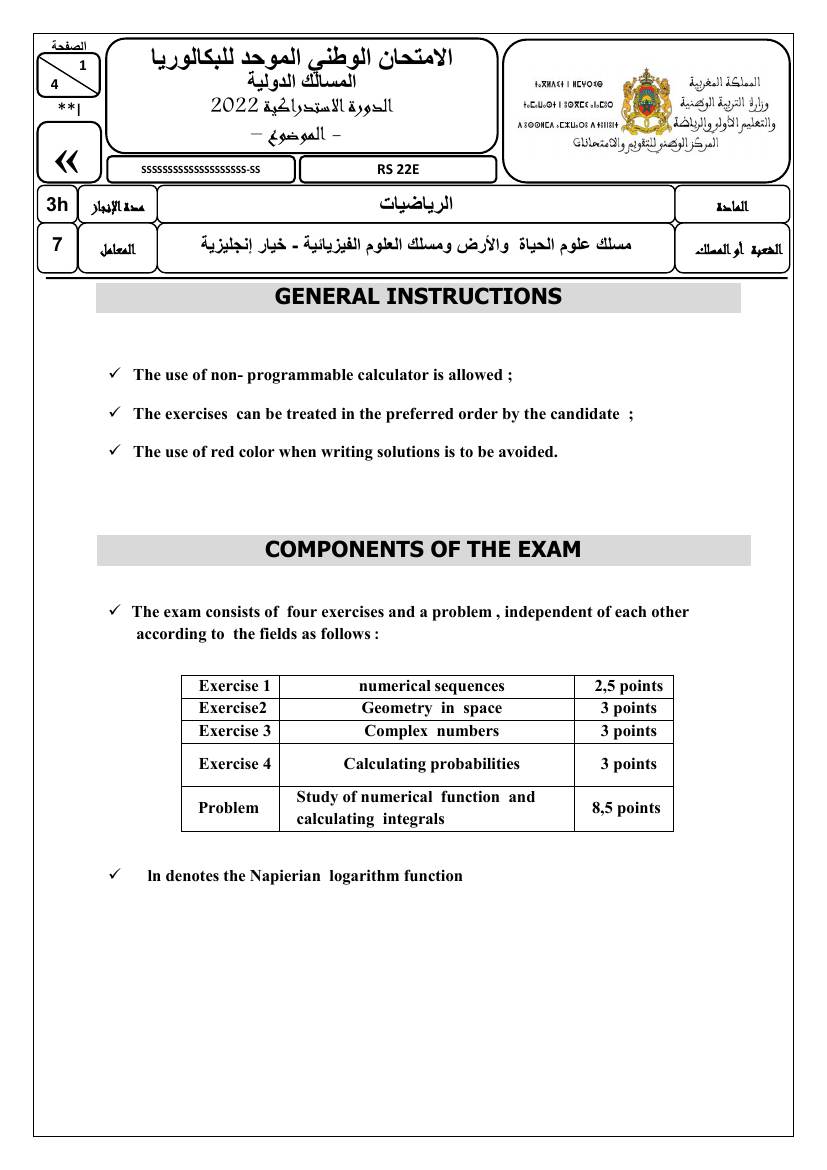
  1. Examen national Maths 2Bac PC/SVT (option anglaise) 2022, session de rattrapage, page 1 sur 4
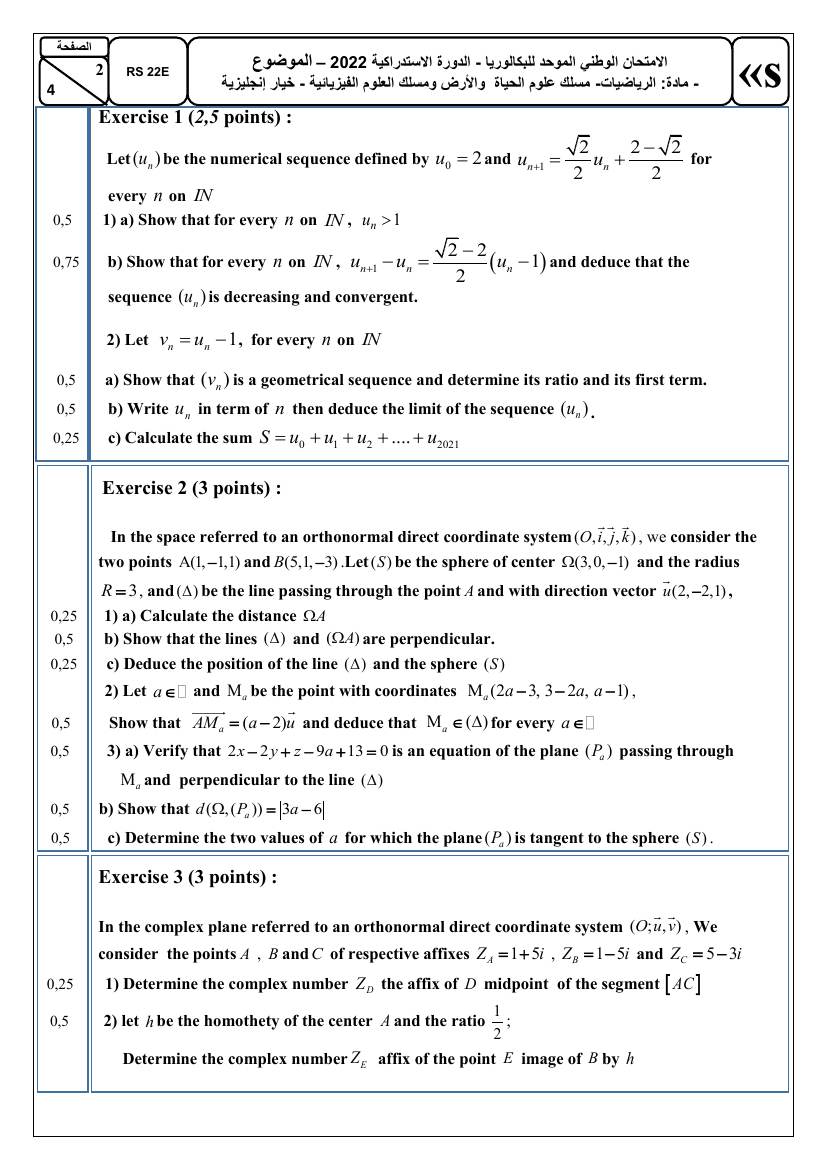
  2. Examen national Maths 2Bac PC/SVT (option anglaise) 2022, session de rattrapage, page 2 sur 4
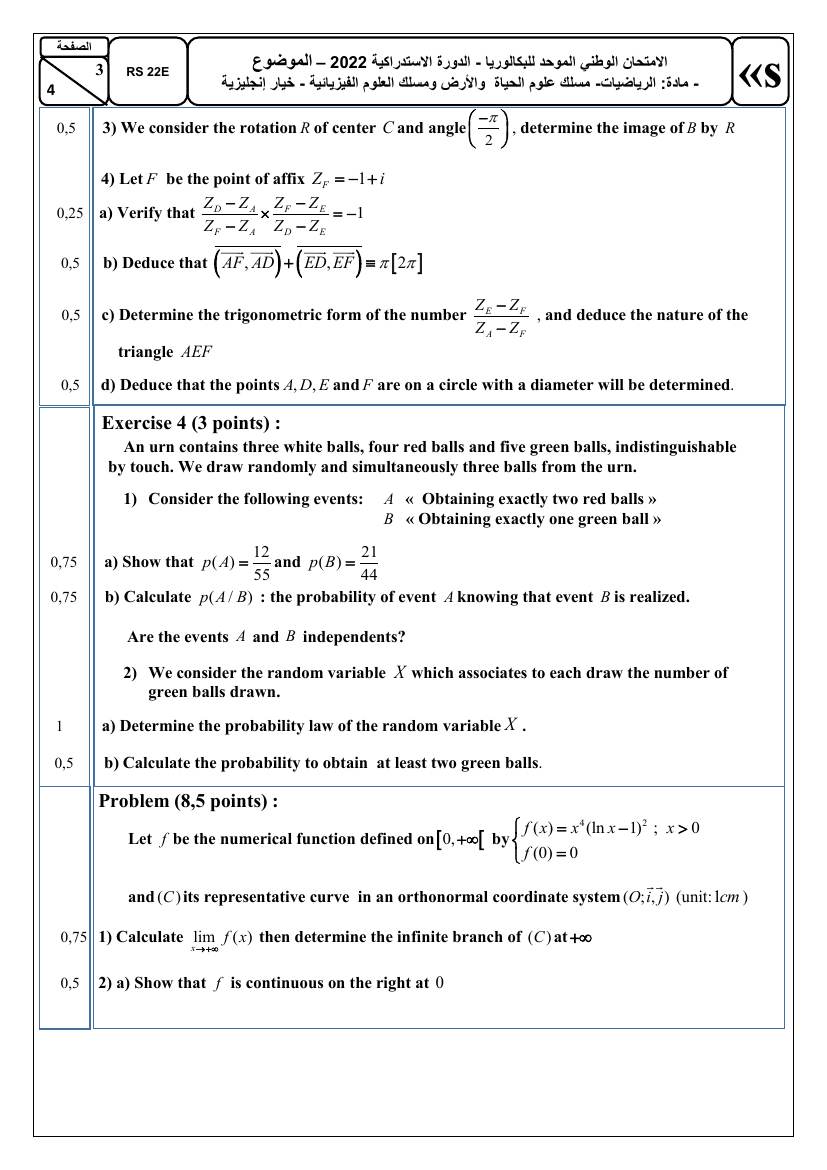
  3. Examen national Maths 2Bac PC/SVT (option anglaise) 2022, session de rattrapage, page 3 sur 4
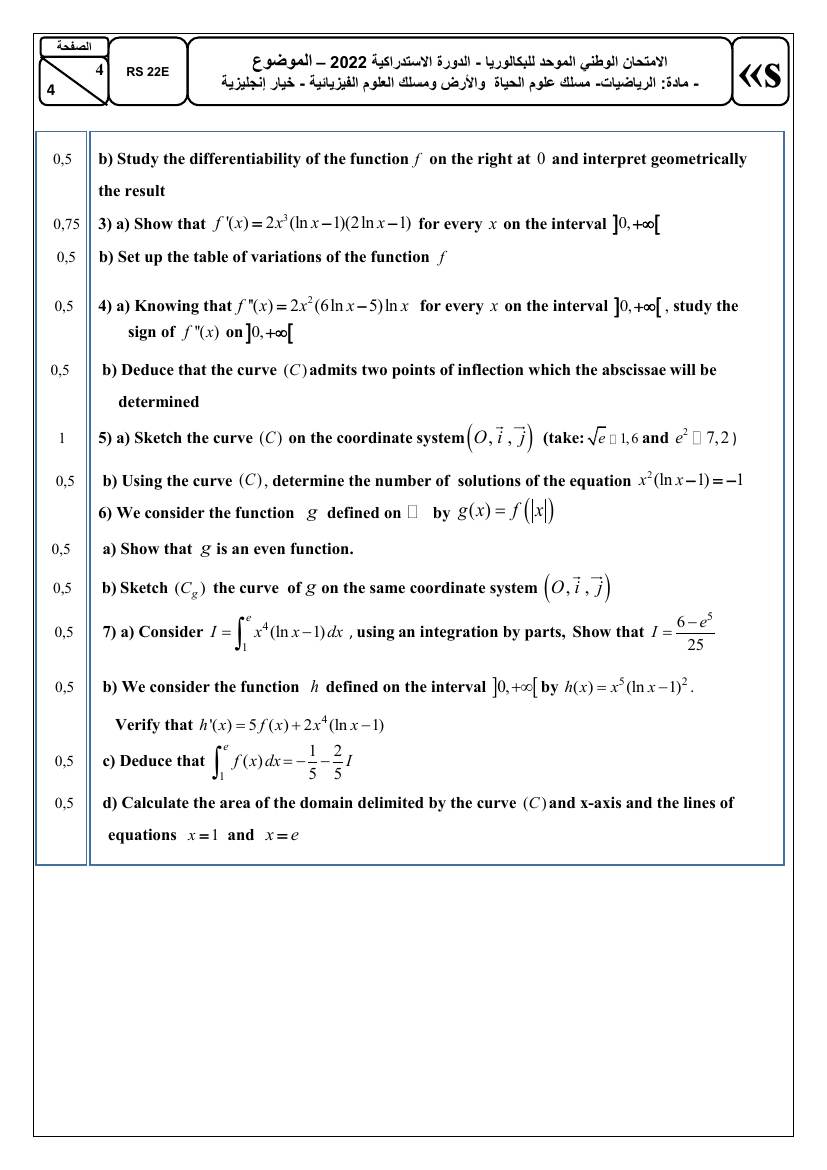
  4. Examen national Maths 2Bac PC/SVT (option anglaise) 2022, session de rattrapage, page 4 sur 4

Sujet officiel de l’examen national unifié du baccalauréat, tel que publié par le Centre national de l’évaluation et des examens (Ministère de l’Éducation nationale).

L’énoncé en texte

Transcription du sujet officiel, pour le lire et le rechercher sur téléphone. Les figures restent sur les pages du sujet ; en cas de différence, le PDF officiel fait foi.

Exercice 12,5 pts

Let (un)(u_n) be the numerical sequence defined by u0=2u_0 = 2 and un+1=22un+2−22u_{n+1} = \dfrac{\sqrt{2}}{2}u_n + \dfrac{2-\sqrt{2}}{2} for every nn on N\mathbb{N}

1.a.Show that for every nn on N\mathbb{N}, un>1u_n > 10,5 pt

1.b.Show that for every nn on N\mathbb{N}, un+1−un=2−22(un−1)u_{n+1} - u_n = \dfrac{\sqrt{2}-2}{2}(u_n - 1) and deduce that the sequence (un)(u_n) is decreasing and convergent.0,75 pt

2) Let vn=un−1v_n = u_n - 1, for every nn on N\mathbb{N}

2.a.Show that (vn)(v_n) is a geometrical sequence and determine its ratio and its first term.0,5 pt

2.b.Write unu_n in term of nn then deduce the limit of the sequence (un)(u_n).0,5 pt

2.c.Calculate the sum S=u0+u1+u2+⋯+u2021S = u_0 + u_1 + u_2 + \dots + u_{2021}0,25 pt

Revoir le cours : Suites numériques

Exercice 23 pts

In the space referred to an orthonormal direct coordinate system (O,i⃗,j⃗,k⃗)(O, \vec{i}, \vec{j}, \vec{k}), we consider the two points A(1,−1,1)A(1,-1,1) and B(5,1,−3)B(5,1,-3). Let (S)(S) be the sphere of center Ω(3,0,−1)\Omega(3,0,-1) and the radius R=3R = 3, and (Δ)(\Delta) be the line passing through the point AA and with direction vector u⃗(2,−2,1)\vec{u}(2,-2,1),

1.a.Calculate the distance ΩA\Omega A0,25 pt

1.b.Show that the lines (Δ)(\Delta) and (ΩA)(\Omega A) are perpendicular.0,5 pt

1.c.Deduce the position of the line (Δ)(\Delta) and the sphere (S)(S)0,25 pt

2) Let a∈Ra \in \mathbb{R} and MaM_a be the point with coordinates Ma(2a−3, 3−2a, a−1)M_a(2a-3,\ 3-2a,\ a-1),

2.Show that AMa→=(a−2)u⃗\overrightarrow{AM_a} = (a-2)\vec{u} and deduce that Ma∈(Δ)M_a \in (\Delta) for every a∈Ra \in \mathbb{R}0,5 pt

3.a.Verify that 2x−2y+z−9a+13=02x - 2y + z - 9a + 13 = 0 is an equation of the plane (Pa)(P_a) passing through MaM_a and perpendicular to the line (Δ)(\Delta)0,5 pt

3.b.Show that d(Ω,(Pa))=∣3a−6∣d(\Omega, (P_a)) = |3a - 6|0,5 pt

3.c.Determine the two values of aa for which the plane (Pa)(P_a) is tangent to the sphere (S)(S).0,5 pt

Exercice 33 pts

In the complex plane referred to an orthonormal direct coordinate system (O;u⃗,v⃗)(O; \vec{u}, \vec{v}), We consider the points AA, BB and CC of respective affixes zA=1+5iz_A = 1+5i, zB=1−5iz_B = 1-5i and zC=5−3iz_C = 5-3i

1.Determine the complex number zDz_D the affix of DD midpoint of the segment [AC][AC]0,25 pt

2.let hh be the homothety of the center AA and the ratio 12\dfrac{1}{2} ; Determine the complex number zEz_E affix of the point EE image of BB by hh0,5 pt

3.We consider the rotation RR of center CC and angle (−π2)\left(\dfrac{-\pi}{2}\right), determine the image of BB by RR0,5 pt

4) Let FF be the point of affix zF=−1+iz_F = -1+i

4.a.Verify that zD−zAzF−zA×zF−zEzD−zE=−1\dfrac{z_D - z_A}{z_F - z_A} \times \dfrac{z_F - z_E}{z_D - z_E} = -10,25 pt

4.b.Deduce that (AF→,AD→‾)+(ED→,EF→‾)≡π [2π]\left(\overline{\overrightarrow{AF}, \overrightarrow{AD}}\right) + \left(\overline{\overrightarrow{ED}, \overrightarrow{EF}}\right) \equiv \pi\ [2\pi]0,5 pt

4.c.Determine the trigonometric form of the number zE−zFzA−zF\dfrac{z_E - z_F}{z_A - z_F}, and deduce the nature of the triangle AEFAEF0,5 pt

4.d.Deduce that the points AA, DD, EE and FF are on a circle with a diameter will be determined.0,5 pt

Exercice 43 pts

An urn contains three white balls, four red balls and five green balls, indistinguishable by touch. We draw randomly and simultaneously three balls from the urn.

1) Consider the following events: AA « Obtaining exactly two red balls » ; BB « Obtaining exactly one green ball »

1.a.Show that p(A)=1255p(A) = \dfrac{12}{55} and p(B)=2144p(B) = \dfrac{21}{44}0,75 pt

1.b.Calculate p(A/B)p(A/B) : the probability of event AA knowing that event BB is realized. Are the events AA and BB independents?0,75 pt

2) We consider the random variable XX which associates to each draw the number of green balls drawn.

2.a.Determine the probability law of the random variable XX.1 pt

2.b.Calculate the probability to obtain at least two green balls.0,5 pt

Problème8,5 pts

Let ff be the numerical function defined on [0,+∞[[0,+\infty[ by f(x)=x4(ln⁡x−1)2f(x) = x^4(\ln x - 1)^2 ; x>0x > 0 and f(0)=0f(0) = 0

and (C)(C) its representative curve in an orthonormal coordinate system (O;i⃗,j⃗)(O; \vec{i}, \vec{j}) (unit: 1 cm1\ \mathrm{cm})

1.Calculate lim⁡x→+∞f(x)\lim_{x \to +\infty} f(x) then determine the infinite branch of (C)(C) at +∞+\infty0,75 pt

2.a.Show that ff is continuous on the right at 000,5 pt

2.b.Study the differentiability of the function ff on the right at 00 and interpret geometrically the result0,5 pt

3.a.Show that f′(x)=2x3(ln⁡x−1)(2ln⁡x−1)f'(x) = 2x^3(\ln x - 1)(2\ln x - 1) for every xx on the interval ]0,+∞[]0,+\infty[0,75 pt

3.b.Set up the table of variations of the function ff0,5 pt

4.a.Knowing that f′′(x)=2x2(6ln⁡x−5)ln⁡xf''(x) = 2x^2(6\ln x - 5)\ln x for every xx on the interval ]0,+∞[]0,+\infty[, study the sign of f′′(x)f''(x) on ]0,+∞[]0,+\infty[0,5 pt

4.b.Deduce that the curve (C)(C) admits two points of inflection which the abscissae will be determined0,5 pt

5.a.Sketch the curve (C)(C) on the coordinate system (O,i⃗,j⃗)(O, \vec{i}, \vec{j}) (take: e≈1,6\sqrt{e} \approx 1{,}6 and e2≈7,2e^2 \approx 7{,}2)1 pt

5.b.Using the curve (C)(C), determine the number of solutions of the equation x2(ln⁡x−1)=−1x^2(\ln x - 1) = -10,5 pt

6) We consider the function gg defined on R\mathbb{R} by g(x)=f(∣x∣)g(x) = f(|x|)

6.a.Show that gg is an even function.0,5 pt

6.b.Sketch (Cg)(C_g) the curve of gg on the same coordinate system (O,i⃗,j⃗)(O, \vec{i}, \vec{j})0,5 pt

7.a.Consider I=∫1ex4(ln⁡x−1) dxI = \int_1^e x^4(\ln x - 1)\,dx, using an integration by parts, Show that I=6−e525I = \dfrac{6 - e^5}{25}0,5 pt

7.b.We consider the function hh defined on the interval ]0,+∞[]0,+\infty[ by h(x)=x5(ln⁡x−1)2h(x) = x^5(\ln x - 1)^2. Verify that h′(x)=5f(x)+2x4(ln⁡x−1)h'(x) = 5f(x) + 2x^4(\ln x - 1)0,5 pt

7.c.Deduce that ∫1ef(x) dx=−15−25I\int_1^e f(x)\,dx = -\dfrac{1}{5} - \dfrac{2}{5}I0,5 pt

7.d.Calculate the area of the domain delimited by the curve (C)(C) and x-axis and the lines of equations x=1x = 1 and x=ex = e0,5 pt

Revoir le cours : Dérivation et étude de fonctions

Entraîne-toi sur ces chapitres avec Kresco, gratuitement

Yallah, wa7d l-khtwa.

Le sujet, tu l’as. Maintenant, prépare-le.

Crée ton compte gratuit : une leçon offerte dans chaque chapitre, les quiz et ton suivi, matière par matière, jusqu’au national.