Jerreb rassek f l-national.

Examen national Maths 2Bac PC/SVT (option anglaise) 2020, session de rattrapage

Mathématiques · Sciences Physiques, Sciences de la Vie et de la Terre · 4 pages

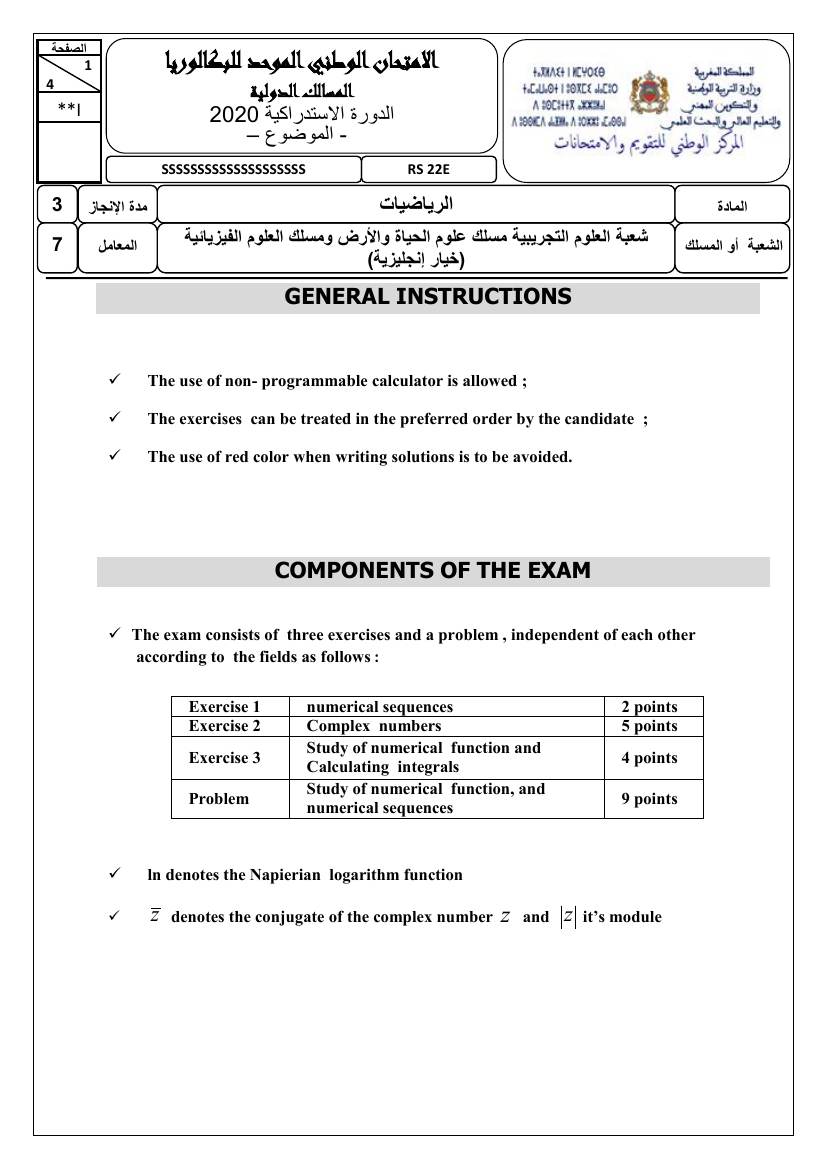
Le sujet en bref

  1. Exercice 12 pts

    Suites numériques

  2. Exercice 25 pts

    Nombres complexes

  3. Exercice 34 pts

    Fonctions exponentielles · Calcul intégral · Dérivation et étude de fonctions

  4. Problème9 pts

    Dérivation et étude de fonctions · Suites numériques · Fonctions exponentielles

Total : 20 points

Le sujet, page par page

  1. Examen national Maths 2Bac PC/SVT (option anglaise) 2020, session de rattrapage, page 1 sur 4
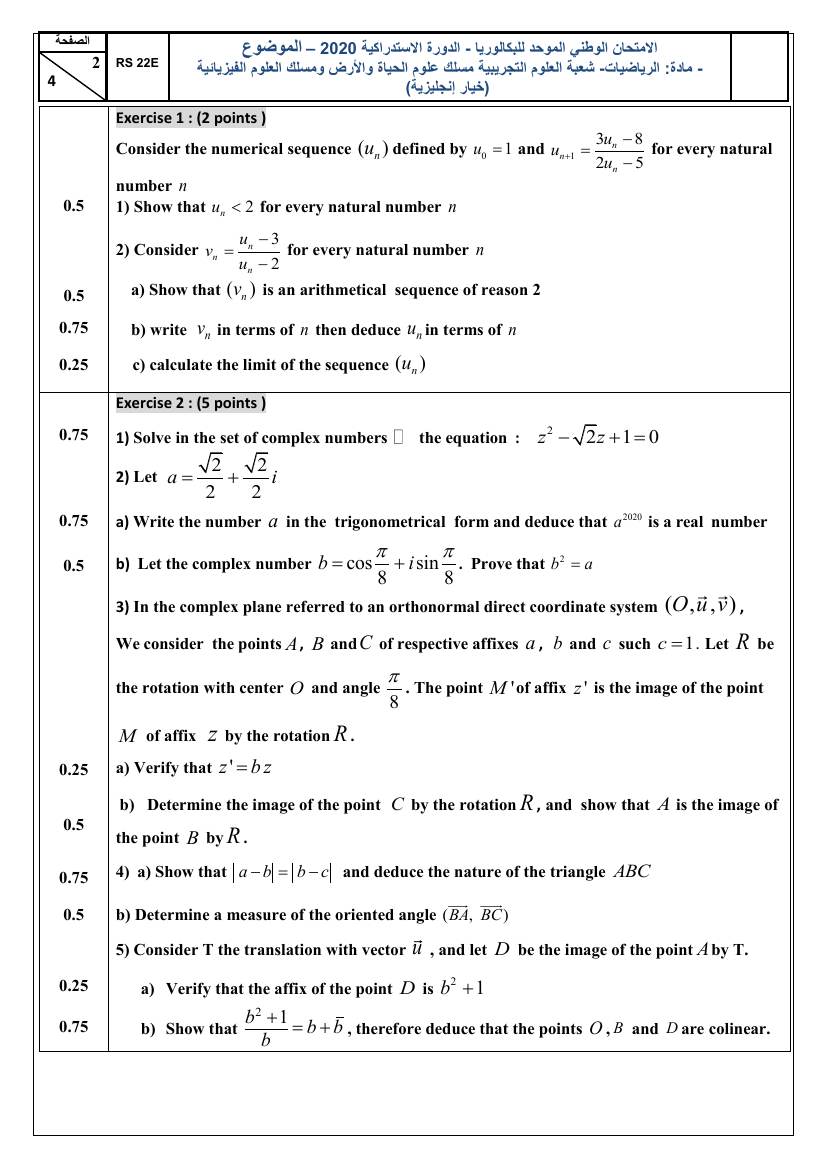
  2. Examen national Maths 2Bac PC/SVT (option anglaise) 2020, session de rattrapage, page 2 sur 4
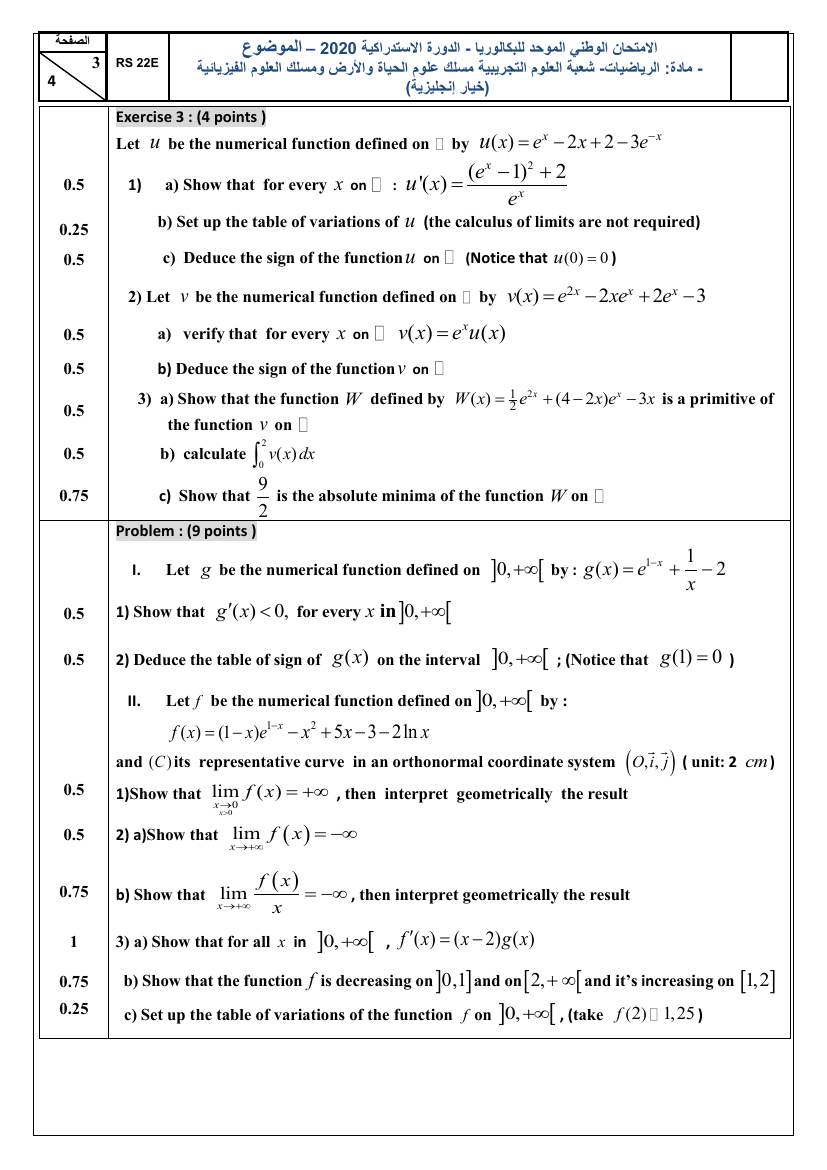
  3. Examen national Maths 2Bac PC/SVT (option anglaise) 2020, session de rattrapage, page 3 sur 4
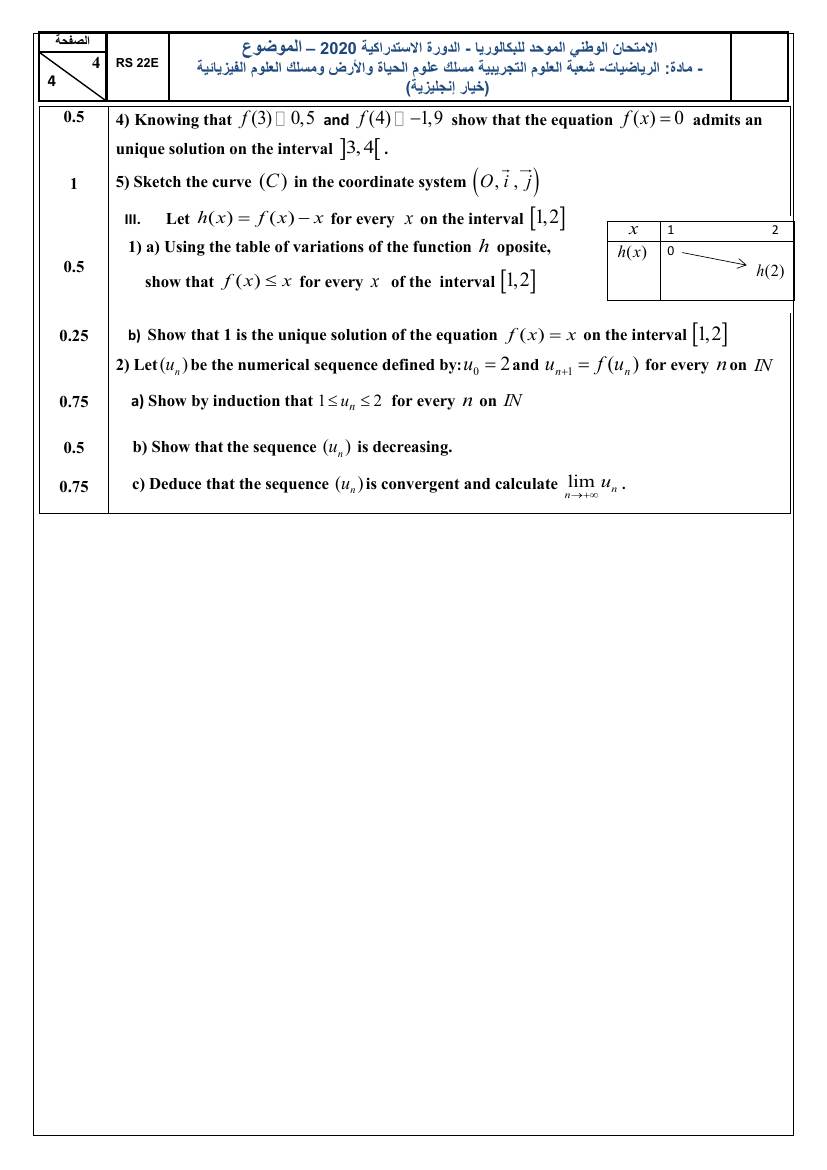
  4. Examen national Maths 2Bac PC/SVT (option anglaise) 2020, session de rattrapage, page 4 sur 4

Sujet officiel de l’examen national unifié du baccalauréat, tel que publié par le Centre national de l’évaluation et des examens (Ministère de l’Éducation nationale).

L’énoncé en texte

Transcription du sujet officiel, pour le lire et le rechercher sur téléphone. Les figures restent sur les pages du sujet ; en cas de différence, le PDF officiel fait foi.

Exercice 12 pts

Consider the numerical sequence (un)(u_n) defined by u0=1u_0 = 1 and un+1=3un−82un−5u_{n+1} = \dfrac{3u_n - 8}{2u_n - 5} for every natural number nn

1.Show that un<2u_n < 2 for every natural number nn0,5 pt

2) Consider vn=un−3un−2v_n = \dfrac{u_n - 3}{u_n - 2} for every natural number nn

2.a.Show that (vn)(v_n) is an arithmetical sequence of reason 20,5 pt

2.b.write vnv_n in terms of nn then deduce unu_n in terms of nn0,75 pt

2.c.calculate the limit of the sequence (un)(u_n)0,25 pt

Revoir le cours : Suites numériques

Exercice 25 pts

1.Solve in the set of complex numbers C\mathbb{C} the equation : z2−2z+1=0z^2 - \sqrt{2}z + 1 = 00,75 pt

2) Let a=22+22ia = \dfrac{\sqrt{2}}{2} + \dfrac{\sqrt{2}}{2}i

2.a.Write the number aa in the trigonometrical form and deduce that a2020a^{2020} is a real number0,75 pt

2.b.Let the complex number b=cos⁡π8+isin⁡π8b = \cos\dfrac{\pi}{8} + i\sin\dfrac{\pi}{8}. Prove that b2=ab^2 = a0,5 pt

3) In the complex plane referred to an orthonormal direct coordinate system (O,u⃗,v⃗)(O,\vec{u},\vec{v}), We consider the points AA, BB and CC of respective affixes aa, bb and cc such c=1c = 1. Let RR be the rotation with center OO and angle π8\dfrac{\pi}{8}. The point M′M' of affix z′z' is the image of the point MM of affix zz by the rotation RR.

3.a.Verify that z′=bzz' = bz0,25 pt

3.b.Determine the image of the point CC by the rotation RR, and show that AA is the image of the point BB by RR.0,5 pt

4.a.Show that ∣a−b∣=∣b−c∣|a-b| = |b-c| and deduce the nature of the triangle ABCABC0,75 pt

4.b.Determine a measure of the oriented angle (BA→,BC→)(\overrightarrow{BA}, \overrightarrow{BC})0,5 pt

5) Consider T the translation with vector u⃗\vec{u}, and let DD be the image of the point AA by T.

5.a.Verify that the affix of the point DD is b2+1b^2 + 10,25 pt

5.b.Show that b2+1b=b+b‾\dfrac{b^2+1}{b} = b + \overline{b}, therefore deduce that the points OO, BB and DD are colinear.0,75 pt

Exercice 34 pts

Let uu be the numerical function defined on R\mathbb{R} by u(x)=ex−2x+2−3e−xu(x) = e^{x} - 2x + 2 - 3e^{-x}

1.a.Show that for every xx on R\mathbb{R} : u′(x)=(ex−1)2+2exu'(x) = \dfrac{(e^{x}-1)^2 + 2}{e^{x}}0,5 pt

1.b.Set up the table of variations of uu (the calculus of limits are not required)0,25 pt

1.c.Deduce the sign of the function uu on R\mathbb{R} (Notice that u(0)=0u(0) = 0)0,5 pt

2) Let vv be the numerical function defined on R\mathbb{R} by v(x)=e2x−2xex+2ex−3v(x) = e^{2x} - 2xe^{x} + 2e^{x} - 3

2.a.verify that for every xx on R\mathbb{R} v(x)=exu(x)v(x) = e^{x}u(x)0,5 pt

2.b.Deduce the sign of the function vv on R\mathbb{R}0,5 pt

3.a.Show that the function WW defined by W(x)=12e2x+(4−2x)ex−3xW(x) = \dfrac{1}{2}e^{2x} + (4-2x)e^{x} - 3x is a primitive of the function vv on R\mathbb{R}0,5 pt

3.b.calculate ∫02v(x) dx\displaystyle\int_0^2 v(x)\,dx0,5 pt

3.c.Show that 92\dfrac{9}{2} is the absolute minima of the function WW on R\mathbb{R}0,75 pt

Revoir le cours : Dérivation et étude de fonctions

Problème9 pts

I.

Let gg be the numerical function defined on ]0,+∞[]0,+\infty[ by : g(x)=e1−x+1x−2g(x) = e^{1-x} + \dfrac{1}{x} - 2

I.1.Show that g′(x)<0g'(x) < 0, for every xx in ]0,+∞[]0,+\infty[0,5 pt

I.2.Deduce the table of sign of g(x)g(x) on the interval ]0,+∞[]0,+\infty[ ; (Notice that g(1)=0g(1) = 0)0,5 pt

II.

Let ff be the numerical function defined on ]0,+∞[]0,+\infty[ by :

f(x)=(1−x)e1−x−x2+5x−3−2ln⁡xf(x) = (1-x)e^{1-x} - x^2 + 5x - 3 - 2\ln x

and (C)(C) its representative curve in an orthonormal coordinate system (O,i⃗,j⃗)(O,\vec{i},\vec{j}) ( unit: 2 cm2\ \mathrm{cm})

II.1.Show that lim⁡x→0x>0f(x)=+∞\displaystyle\lim_{\substack{x \to 0 \\ x>0}} f(x) = +\infty, then interpret geometrically the result0,5 pt

II.2.a.Show that lim⁡x→+∞f(x)=−∞\displaystyle\lim_{x \to +\infty} f(x) = -\infty0,5 pt

II.2.b.Show that lim⁡x→+∞f(x)x=−∞\displaystyle\lim_{x \to +\infty} \dfrac{f(x)}{x} = -\infty, then interpret geometrically the result0,75 pt

II.3.a.Show that for all xx in ]0,+∞[]0,+\infty[, f′(x)=(x−2)g(x)f'(x) = (x-2)g(x)1 pt

II.3.b.Show that the function ff is decreasing on ]0,1]]0,1] and on [2,+∞[[2,+\infty[ and it's increasing on [1,2][1,2]0,75 pt

II.3.c.Set up the table of variations of the function ff on ]0,+∞[]0,+\infty[, (take f(2)≈1,25f(2) \approx 1{,}25)0,25 pt

II.4.Knowing that f(3)≈0,5f(3) \approx 0{,}5 and f(4)≈−1,9f(4) \approx -1{,}9 show that the equation f(x)=0f(x) = 0 admits an unique solution on the interval ]3,4[]3,4[.0,5 pt

II.5.Sketch the curve (C)(C) in the coordinate system (O,i⃗,j⃗)(O,\vec{i},\vec{j})1 pt

III.

Let h(x)=f(x)−xh(x) = f(x) - x for every xx on the interval [1,2][1,2]

xx12
h(x)h(x)0 (decreasing)h(2)h(2)

III.1.a.Using the table of variations of the function hh oposite, show that f(x)≤xf(x) \le x for every xx of the interval [1,2][1,2]0,5 pt

III.1.b.Show that 1 is the unique solution of the equation f(x)=xf(x) = x on the interval [1,2][1,2]0,25 pt

2) Let (un)(u_n) be the numerical sequence defined by: u0=2u_0 = 2 and un+1=f(un)u_{n+1} = f(u_n) for every nn on N\mathbb{N}

III.2.a.Show by induction that 1≤un≤21 \le u_n \le 2 for every nn on N\mathbb{N}0,75 pt

III.2.b.Show that the sequence (un)(u_n) is decreasing.0,5 pt

III.2.c.Deduce that the sequence (un)(u_n) is convergent and calculate lim⁡n→+∞un\displaystyle\lim_{n \to +\infty} u_n.0,75 pt

Revoir le cours : Dérivation et étude de fonctions · Suites numériques

Entraîne-toi sur ces chapitres avec Kresco, gratuitement

Yallah, wa7d l-khtwa.

Le sujet, tu l’as. Maintenant, prépare-le.

Crée ton compte gratuit : une leçon offerte dans chaque chapitre, les quiz et ton suivi, matière par matière, jusqu’au national.