Jerreb rassek f l-national.

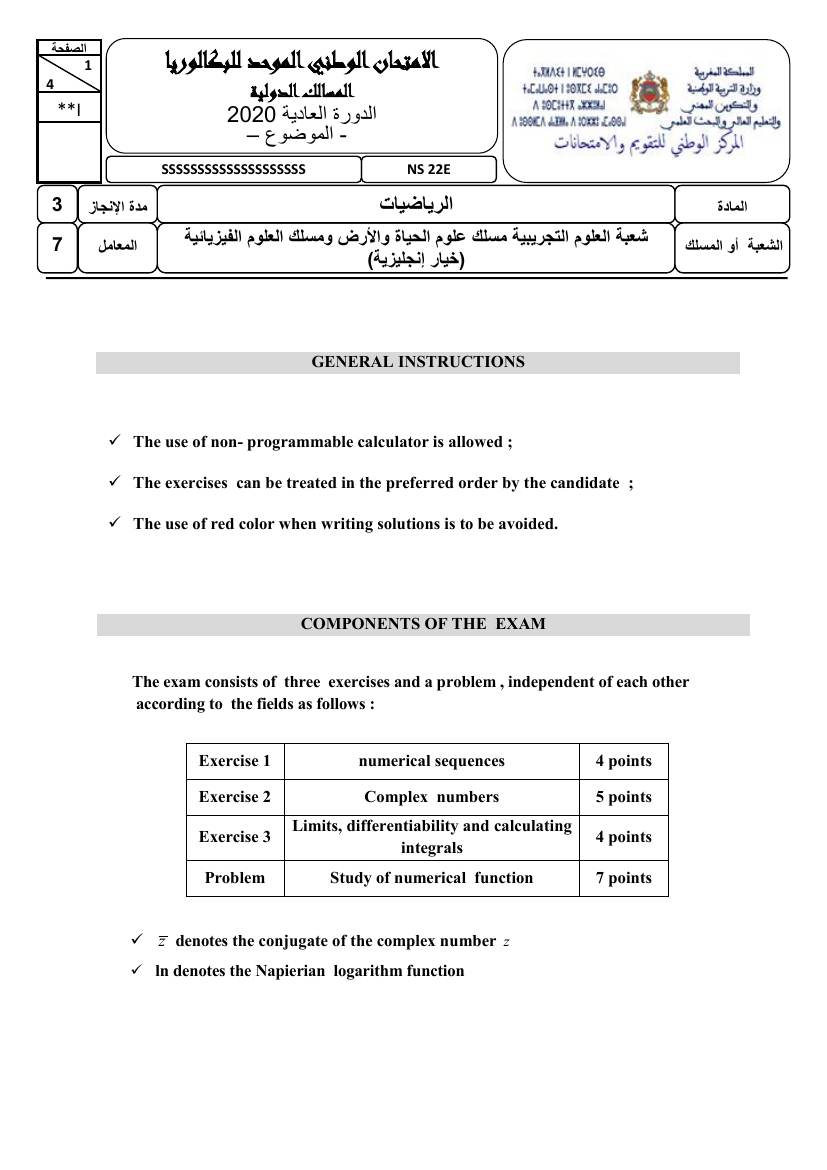
Examen national Maths 2Bac PC/SVT (option anglaise) 2020, session normale

Mathématiques · Sciences Physiques, Sciences de la Vie et de la Terre · 4 pages

Le sujet en bref

  1. Exercice 14 pts

    Suites numériques

  2. Exercice 25 pts

    Nombres complexes

  3. Exercice 34 pts

    Fonctions logarithmes · Calcul intégral · Dérivation et étude de fonctions

  4. Problème7 pts

    Fonctions exponentielles · Dérivation et étude de fonctions · Limites et continuité

Total : 20 points

Le sujet, page par page

  1. Examen national Maths 2Bac PC/SVT (option anglaise) 2020, session normale, page 1 sur 4
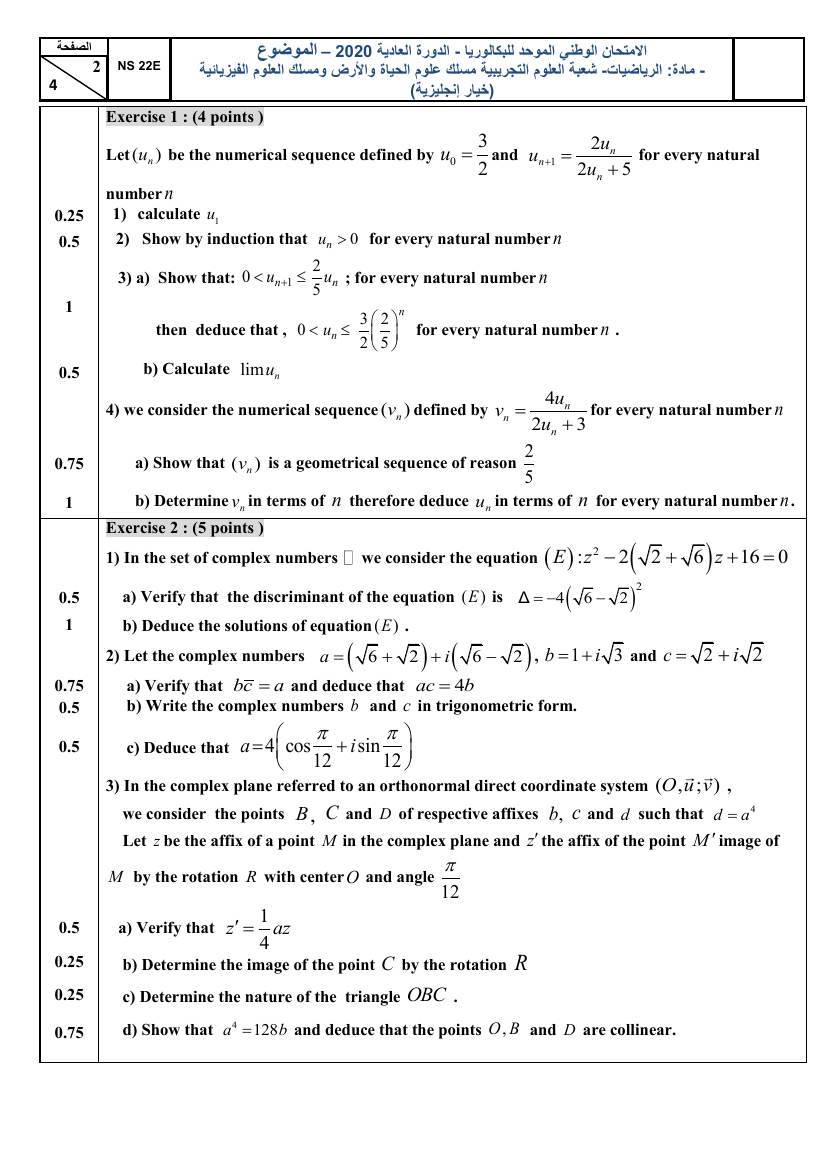
  2. Examen national Maths 2Bac PC/SVT (option anglaise) 2020, session normale, page 2 sur 4
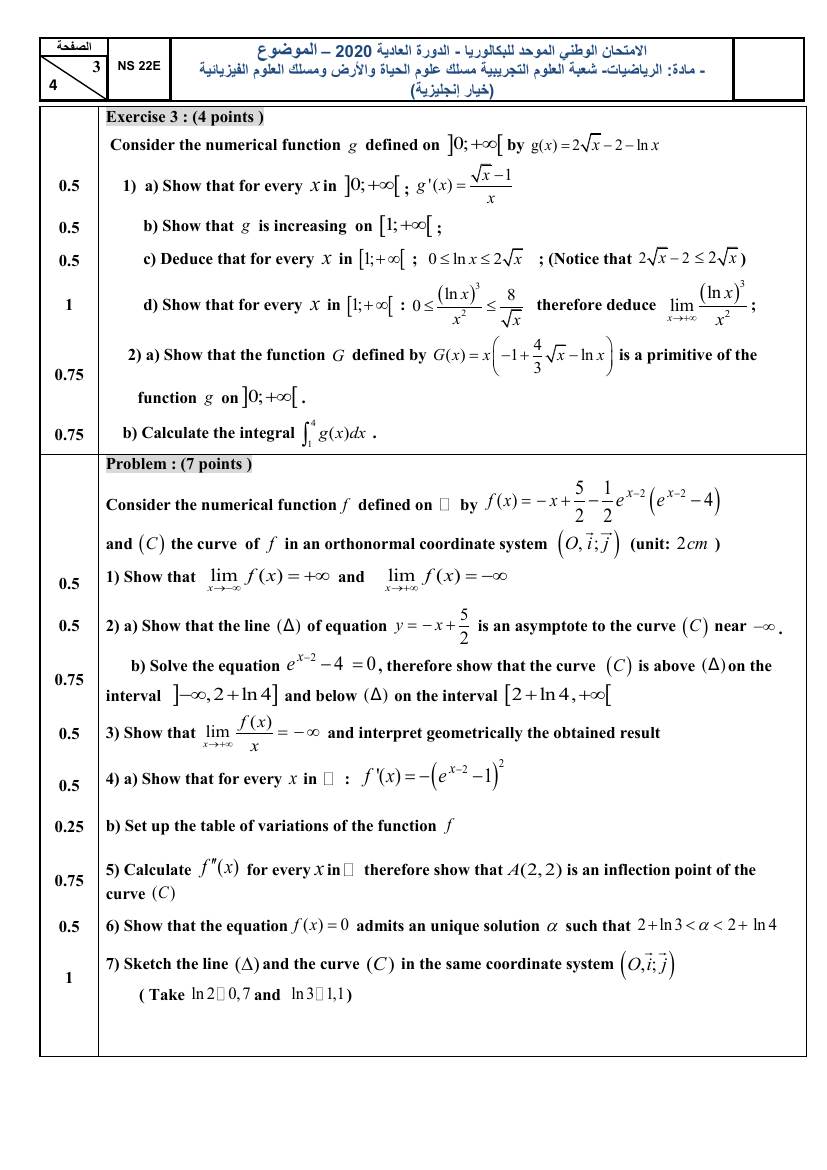
  3. Examen national Maths 2Bac PC/SVT (option anglaise) 2020, session normale, page 3 sur 4
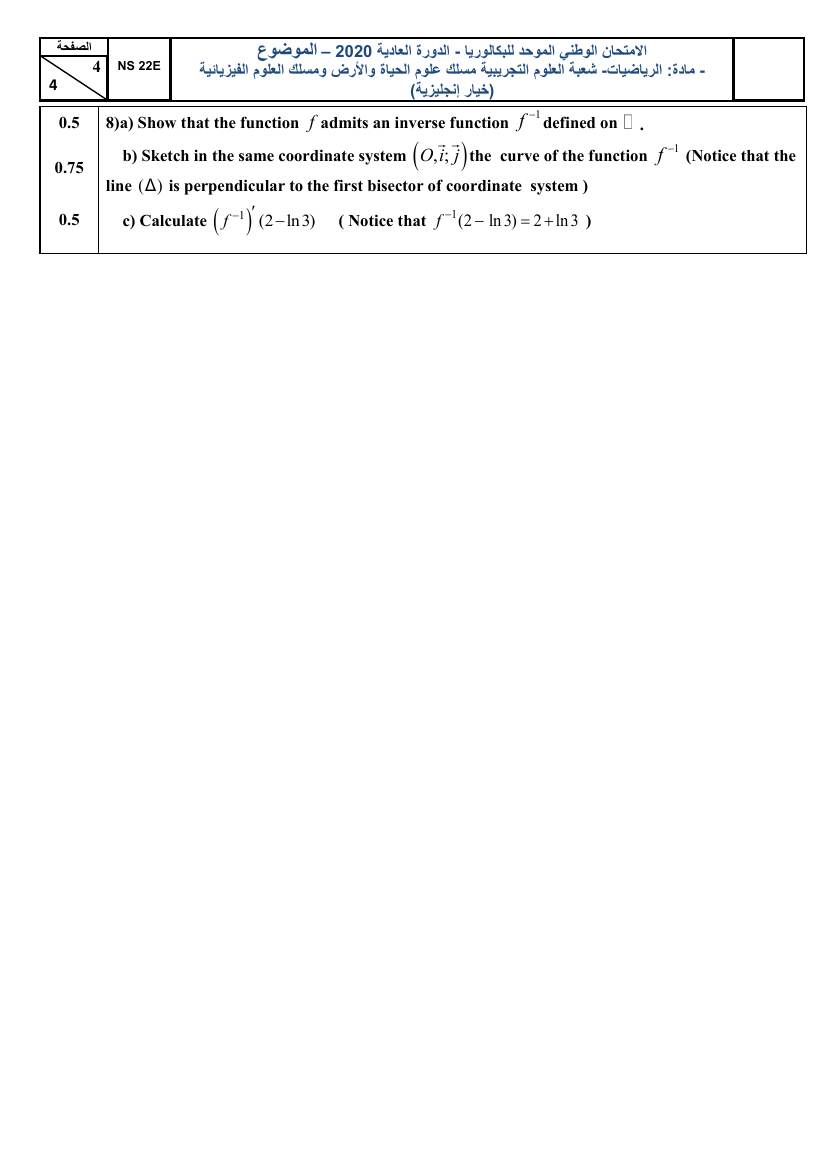
  4. Examen national Maths 2Bac PC/SVT (option anglaise) 2020, session normale, page 4 sur 4

Sujet officiel de l’examen national unifié du baccalauréat, tel que publié par le Centre national de l’évaluation et des examens (Ministère de l’Éducation nationale).

L’énoncé en texte

Transcription du sujet officiel, pour le lire et le rechercher sur téléphone. Les figures restent sur les pages du sujet ; en cas de différence, le PDF officiel fait foi.

Exercice 14 pts

Let (un)(u_n) be the numerical sequence defined by u0=32u_0 = \dfrac{3}{2} and un+1=2un2un+5u_{n+1} = \dfrac{2u_n}{2u_n + 5} for every natural number nn

1.calculate u1u_10,25 pt

2.Show by induction that un>0u_n > 0 for every natural number nn0,5 pt

3.a.Show that: 0<un+1≤25un0 < u_{n+1} \leq \dfrac{2}{5}u_n ; for every natural number nn then deduce that, 0<un≤32(25)n0 < u_n \leq \dfrac{3}{2}\left(\dfrac{2}{5}\right)^n for every natural number nn.1 pt

3.b.Calculate lim⁡un\lim u_n0,5 pt

4) we consider the numerical sequence (vn)(v_n) defined by vn=4un2un+3v_n = \dfrac{4u_n}{2u_n + 3} for every natural number nn

4.a.Show that (vn)(v_n) is a geometrical sequence of reason 25\dfrac{2}{5}0,75 pt

4.b.Determine vnv_n in terms of nn therefore deduce unu_n in terms of nn for every natural number nn.1 pt

Revoir le cours : Suites numériques

Exercice 25 pts

1) In the set of complex numbers C\mathbb{C} we consider the equation (E):z2−2(2+6)z+16=0(E) : z^2 - 2\left(\sqrt{2} + \sqrt{6}\right)z + 16 = 0

1.a.Verify that the discriminant of the equation (E)(E) is Δ=−4(6−2)2\Delta = -4\left(\sqrt{6} - \sqrt{2}\right)^20,5 pt

1.b.Deduce the solutions of equation (E)(E).1 pt

2) Let the complex numbers a=(6+2)+i(6−2)a = \left(\sqrt{6} + \sqrt{2}\right) + i\left(\sqrt{6} - \sqrt{2}\right), b=1+i3b = 1 + i\sqrt{3} and c=2+i2c = \sqrt{2} + i\sqrt{2}

2.a.Verify that bc‾=ab\overline{c} = a and deduce that ac=4bac = 4b0,75 pt

2.b.Write the complex numbers bb and cc in trigonometric form.0,5 pt

2.c.Deduce that a=4(cos⁡π12+isin⁡π12)a = 4\left(\cos\dfrac{\pi}{12} + i\sin\dfrac{\pi}{12}\right)0,5 pt

3) In the complex plane referred to an orthonormal direct coordinate system (O,u⃗;v⃗)(O, \vec{u}; \vec{v}), we consider the points BB, CC and DD of respective affixes bb, cc and dd such that d=a4d = a^4

Let zz be the affix of a point MM in the complex plane and z′z' the affix of the point M′M' image of MM by the rotation RR with center OO and angle π12\dfrac{\pi}{12}

3.a.Verify that z′=14azz' = \dfrac{1}{4}az0,5 pt

3.b.Determine the image of the point CC by the rotation RR0,25 pt

3.c.Determine the nature of the triangle OBCOBC.0,25 pt

3.d.Show that a4=128ba^4 = 128b and deduce that the points OO, BB and DD are collinear.0,75 pt

Exercice 34 pts

Consider the numerical function gg defined on ]0;+∞[]0;+\infty[ by g(x)=2x−2−ln⁡xg(x) = 2\sqrt{x} - 2 - \ln x

1.a.Show that for every xx in ]0;+∞[]0;+\infty[ ; g′(x)=x−1xg'(x) = \dfrac{\sqrt{x} - 1}{x}0,5 pt

1.b.Show that gg is increasing on [1;+∞[[1;+\infty[ ;0,5 pt

1.c.Deduce that for every xx in [1;+∞[[1;+\infty[ ; 0≤ln⁡x≤2x0 \leq \ln x \leq 2\sqrt{x} ; (Notice that 2x−2≤2x2\sqrt{x} - 2 \leq 2\sqrt{x})0,5 pt

1.d.Show that for every xx in [1;+∞[[1;+\infty[ : 0≤(ln⁡x)3x2≤8x0 \leq \dfrac{(\ln x)^3}{x^2} \leq \dfrac{8}{\sqrt{x}} therefore deduce lim⁡x→+∞(ln⁡x)3x2\displaystyle\lim_{x \to +\infty} \dfrac{(\ln x)^3}{x^2} ;1 pt

2.a.Show that the function GG defined by G(x)=x(−1+43x−ln⁡x)G(x) = x\left(-1 + \dfrac{4}{3}\sqrt{x} - \ln x\right) is a primitive of the function gg on ]0;+∞[]0;+\infty[.0,75 pt

2.b.Calculate the integral ∫14g(x) dx\displaystyle\int_1^4 g(x)\,dx.0,75 pt

Revoir le cours : Dérivation et étude de fonctions

Problème7 pts

Consider the numerical function ff defined on R\mathbb{R} by f(x)=−x+52−12ex−2(ex−2−4)f(x) = -x + \dfrac{5}{2} - \dfrac{1}{2}e^{x-2}\left(e^{x-2} - 4\right) and (C)(C) the curve of ff in an orthonormal coordinate system (O,i⃗;j⃗)(O, \vec{i}; \vec{j}) (unit: 2 cm2\ \mathrm{cm})

1.Show that lim⁡x→−∞f(x)=+∞\displaystyle\lim_{x \to -\infty} f(x) = +\infty and lim⁡x→+∞f(x)=−∞\displaystyle\lim_{x \to +\infty} f(x) = -\infty0,5 pt

2.a.Show that the line (Δ)(\Delta) of equation y=−x+52y = -x + \dfrac{5}{2} is an asymptote to the curve (C)(C) near −∞-\infty.0,5 pt

2.b.Solve the equation ex−2−4=0e^{x-2} - 4 = 0, therefore show that the curve (C)(C) is above (Δ)(\Delta) on the interval ]−∞,2+ln⁡4]]-\infty, 2+\ln 4] and below (Δ)(\Delta) on the interval [2+ln⁡4,+∞[[2+\ln 4, +\infty[0,75 pt

3.Show that lim⁡x→+∞f(x)x=−∞\displaystyle\lim_{x \to +\infty} \dfrac{f(x)}{x} = -\infty and interpret geometrically the obtained result0,5 pt

4.a.Show that for every xx in R\mathbb{R} : f′(x)=−(ex−2−1)2f'(x) = -\left(e^{x-2} - 1\right)^20,5 pt

4.b.Set up the table of variations of the function ff0,25 pt

5.Calculate f′′(x)f''(x) for every xx in R\mathbb{R} therefore show that A(2,2)A(2, 2) is an inflection point of the curve (C)(C)0,75 pt

6.Show that the equation f(x)=0f(x) = 0 admits an unique solution α\alpha such that 2+ln⁡3<α<2+ln⁡42 + \ln 3 < \alpha < 2 + \ln 40,5 pt

7.Sketch the line (Δ)(\Delta) and the curve (C)(C) in the same coordinate system (O,i⃗;j⃗)(O, \vec{i}; \vec{j}) ( Take ln⁡2≈0,7\ln 2 \approx 0{,}7 and ln⁡3≈1,1\ln 3 \approx 1{,}1)1 pt

8.a.Show that the function ff admits an inverse function f−1f^{-1} defined on R\mathbb{R}.0,5 pt

8.b.Sketch in the same coordinate system (O,i⃗;j⃗)(O, \vec{i}; \vec{j}) the curve of the function f−1f^{-1} (Notice that the line (Δ)(\Delta) is perpendicular to the first bisector of coordinate system )0,75 pt

8.c.Calculate (f−1)′(2−ln⁡3)\left(f^{-1}\right)'(2 - \ln 3) ( Notice that f−1(2−ln⁡3)=2+ln⁡3f^{-1}(2 - \ln 3) = 2 + \ln 3 )0,5 pt

Revoir le cours : Dérivation et étude de fonctions · Limites et continuité

Entraîne-toi sur ces chapitres avec Kresco, gratuitement

Yallah, wa7d l-khtwa.

Le sujet, tu l’as. Maintenant, prépare-le.

Crée ton compte gratuit : une leçon offerte dans chaque chapitre, les quiz et ton suivi, matière par matière, jusqu’au national.