Partie I5 pts
Section I : Knowledge Retrieval (5 pts)
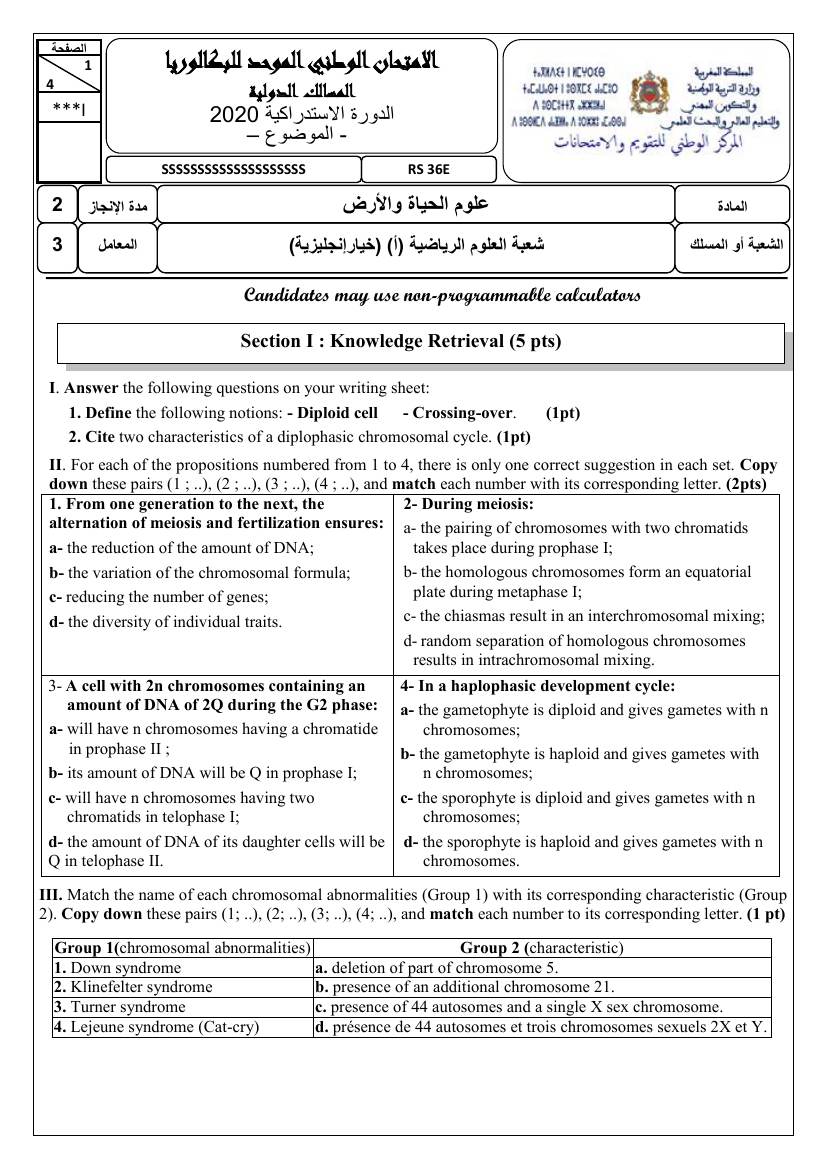
I. Answer the following questions on your writing sheet:
I.1.Define the following notions: - Diploid cell - Crossing-over.1 pt
I.2.Cite two characteristics of a diplophasic chromosomal cycle.1 pt
II.For each of the propositions numbered from 1 to 4, there is only one correct suggestion in each set. Copy down these pairs (1 ; ..), (2 ; ..), (3 ; ..), (4 ; ..), and match each number with its corresponding letter.2 pts
1. From one generation to the next, the alternation of meiosis and fertilization ensures:
a- the reduction of the amount of DNA;
b- the variation of the chromosomal formula;
c- reducing the number of genes;
d- the diversity of individual traits.
2- During meiosis:
a- the pairing of chromosomes with two chromatids takes place during prophase I;
b- the homologous chromosomes form an equatorial plate during metaphase I;
c- the chiasmas result in an interchromosomal mixing;
d- random separation of homologous chromosomes results in intrachromosomal mixing.
3- A cell with chromosomes containing an amount of DNA of during the G2 phase:
a- will have chromosomes having a chromatide in prophase II ;
b- its amount of DNA will be in prophase I;
c- will have chromosomes having two chromatids in telophase I;
d- the amount of DNA of its daughter cells will be in telophase II.
4- In a haplophasic development cycle:
a- the gametophyte is diploid and gives gametes with chromosomes;
b- the gametophyte is haploid and gives gametes with chromosomes;
c- the sporophyte is diploid and gives gametes with chromosomes;
d- the sporophyte is haploid and gives gametes with chromosomes.
III.Match the name of each chromosomal abnormalities (Group 1) with its corresponding characteristic (Group 2). Copy down these pairs (1; ..), (2; ..), (3; ..), (4; ..), and match each number to its corresponding letter.1 pt
| Group 1 (chromosomal abnormalities) | Group 2 (characteristic) |
| 1. Down syndrome | a. deletion of part of chromosome 5. |
| 2. Klinefelter syndrome | b. presence of an additional chromosome 21. |
| 3. Turner syndrome | c. presence of 44 autosomes and a single X sex chromosome. |
| 4. Lejeune syndrome (Cat-cry) | d. présence de 44 autosomes et trois chromosomes sexuels 2X et Y. |
Revoir le cours : Méiose et brassage chromosomique