Jerreb rassek f l-national.

Examen national SVT 2Bac SMA (option anglaise) 2017, session normale

SVT · Sciences Mathématiques A · 5 pages

Le sujet en bref

  1. Partie I5 pts

    Étude quantitative de la variation (biométrie)

  2. Partie II – Exercice 17,5 pts

    Lois statistiques de la transmission des caractères · Méiose et brassage chromosomique

    Le cycle du triton et des croisements chez la drosophile

  3. Partie II – Exercice 22,5 pts

    Génétique humaine

    La transmission de l’épithélioma adénoïde dans une famille

  4. Partie II – Exercice 35 pts

    Génétique des populations

    Les pinsons G. fortis de Daphne Major et les oiseaux Zosterops lateralis

Total : 20 points

Le sujet, page par page

  1. Examen national SVT 2Bac SMA (option anglaise) 2017, session normale, page 1 sur 5
  2. Examen national SVT 2Bac SMA (option anglaise) 2017, session normale, page 2 sur 5
  3. Examen national SVT 2Bac SMA (option anglaise) 2017, session normale, page 3 sur 5
  4. Examen national SVT 2Bac SMA (option anglaise) 2017, session normale, page 4 sur 5
  5. Examen national SVT 2Bac SMA (option anglaise) 2017, session normale, page 5 sur 5

Sujet officiel de l’examen national unifié du baccalauréat, tel que publié par le Centre national de l’évaluation et des examens (Ministère de l’Éducation nationale).

L’énoncé en texte

Transcription du sujet officiel, pour le lire et le rechercher sur téléphone. Les figures restent sur les pages du sujet ; en cas de différence, le PDF officiel fait foi.

Partie I5 pts

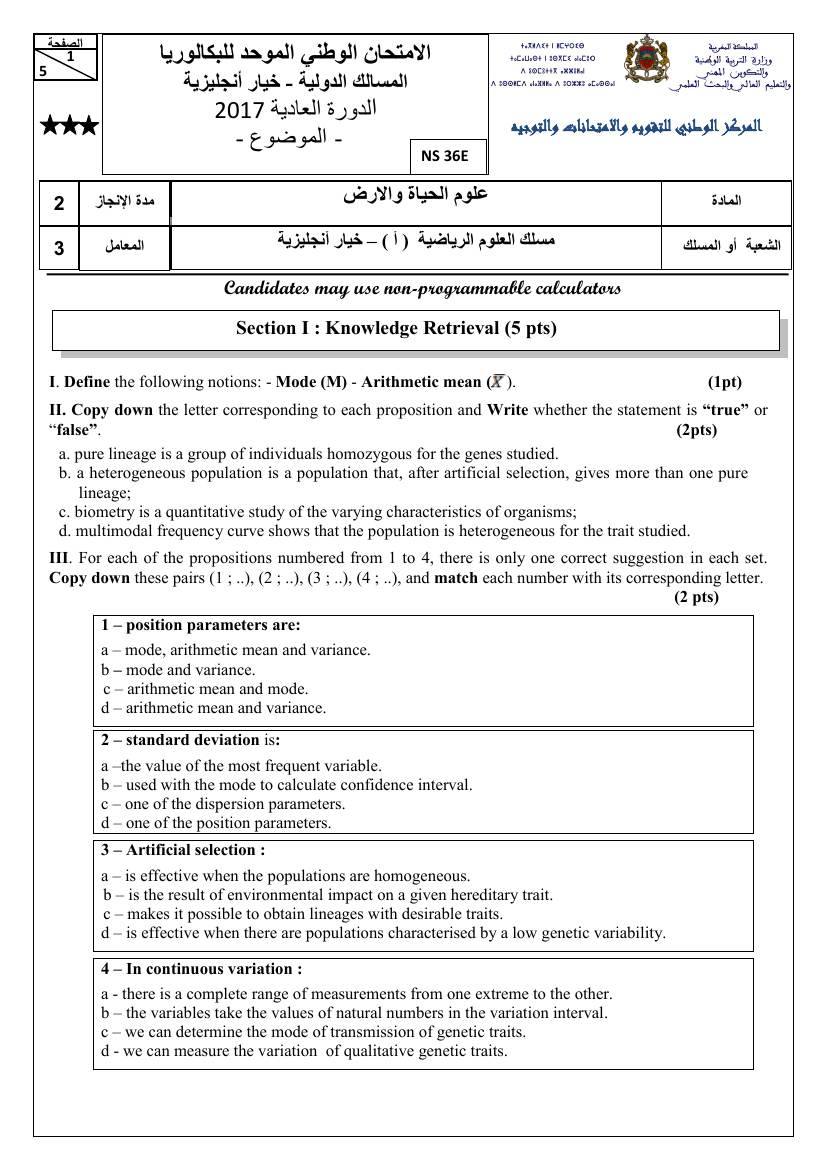
Section I : Knowledge Retrieval (5 pts)

I.Define the following notions: - Mode (M) - Arithmetic mean (X‾\overline{X}).1 pt

II.Copy down the letter corresponding to each proposition and Write whether the statement is “true” or “false”.2 pts

a. pure lineage is a group of individuals homozygous for the genes studied.

b. a heterogeneous population is a population that, after artificial selection, gives more than one pure lineage;

c. biometry is a quantitative study of the varying characteristics of organisms;

d. multimodal frequency curve shows that the population is heterogeneous for the trait studied.

III.For each of the propositions numbered from 1 to 4, there is only one correct suggestion in each set. Copy down these pairs (1 ; ..), (2 ; ..), (3 ; ..), (4 ; ..), and match each number with its corresponding letter.2 pts

1 – position parameters are:

a – mode, arithmetic mean and variance.

b – mode and variance.

c – arithmetic mean and mode.

d – arithmetic mean and variance.

2 – standard deviation is:

a – the value of the most frequent variable.

b – used with the mode to calculate confidence interval.

c – one of the dispersion parameters.

d – one of the position parameters.

3 – Artificial selection :

a – is effective when the populations are homogeneous.

b – is the result of environmental impact on a given hereditary trait.

c – makes it possible to obtain lineages with desirable traits.

d – is effective when there are populations characterised by a low genetic variability.

4 – In continuous variation :

a - there is a complete range of measurements from one extreme to the other.

b – the variables take the values of natural numbers in the variation interval.

c – we can determine the mode of transmission of genetic traits.

d - we can measure the variation of qualitative genetic traits.

Partie II – Exercice 17,5 pts

Section II: Scientific Reasoning and Communication in graphic and written modes (15 pts)

Exercise 1 : (7,5 pts)

To highlight the role of alternation of meiosis and fertilisation in the karyotype stability, and in the diversity of phenotypes through the succession of generations, the following data are proposed:

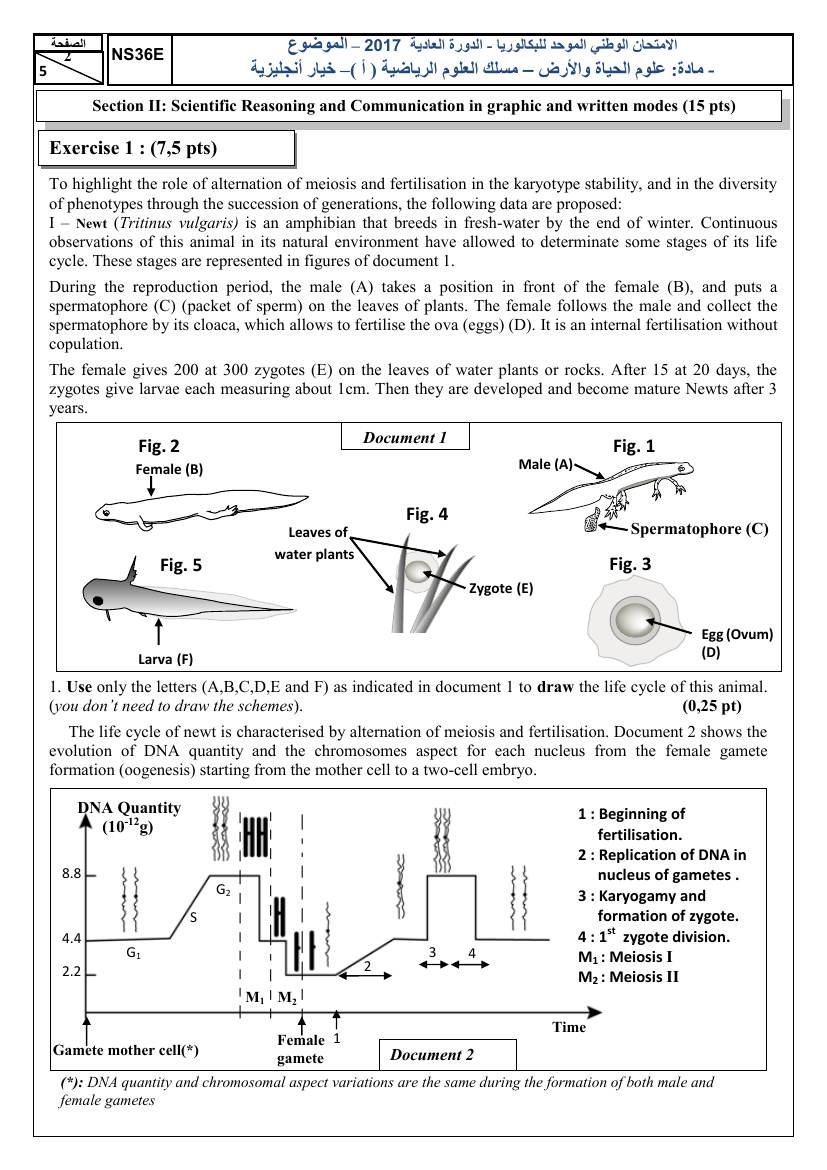
I – Newt (Tritinus vulgaris) is an amphibian that breeds in fresh-water by the end of winter. Continuous observations of this animal in its natural environment have allowed to determinate some stages of its life cycle. These stages are represented in figures of document 1.

During the reproduction period, the male (A) takes a position in front of the female (B), and puts a spermatophore (C) (packet of sperm) on the leaves of plants. The female follows the male and collect the spermatophore by its cloaca, which allows to fertilise the ova (eggs) (D). It is an internal fertilisation without copulation.

The female gives 200 at 300 zygotes (E) on the leaves of water plants or rocks. After 15 at 20 days, the zygotes give larvae each measuring about 1cm. Then they are developed and become mature Newts after 3 years.

Document 1 : voir la page 2 du sujet

1.Use only the letters (A,B,C,D,E and F) as indicated in document 1 to draw the life cycle of this animal. (you don’t need to draw the schemes).0,25 pt

The life cycle of newt is characterised by alternation of meiosis and fertilisation. Document 2 shows the evolution of DNA quantity and the chromosomes aspect for each nucleus from the female gamete formation (oogenesis) starting from the mother cell to a two-cell embryo.

Document 2 : voir la page 2 du sujet

(*): DNA quantity and chromosomal aspect variations are the same during the formation of both male and female gametes

2.Describe the DNA quantity evolution and the chromosomal aspect in the nucleus before, during and after fertilisation, and then deduce the type of chromosomal cycle of this animal (Newt). Justify your answer.1,75 pts

3.Draw a chromosomal cycle diagram of the Newt.0,5 pt

II - To study the mode of transmission of the colour of body and the colour of the eyes in Drosophila, the following crosses are suggested:

First cross between two pure lineages: a male with red eyes and a female with framboesia eyes. This cross gives a first generation (F1\mathrm{F_1}) composed of males with framboesia eyes and females with red eyes.

Second cross between two pure lineages: a male with black body and framboesia eyes and a female with grey body and red eyes. This cross gives a first generation (F1\mathrm{F_1}) composed of individuals with grey body and red eyes.

Third cross: between individuals of the generation F1\mathrm{F_1} (resulting from the second cross). This cross gives a second generation (F2\mathrm{F_2}) composed of:

- 564 individuals of Drosophila with grey body and red eyes;

- 189 individuals of Drosophila with black body and red eyes;

- 185 individuals of Drosophila with grey body and framboesia eyes;

- 62 individuals of Drosophila with black body and framboesia eyes.

4.What can you deduce from the results obtained in the first, the second and the third crosses? Justify your answer.2,75 pts

5.Interpret and use Punnett square to explain the results obtained in the second and the third crosses.2,25 pts

Use the following symbols:

- (G\mathbf{G} and g\mathbf{g}) to represent the colour of the body;

- (R\mathbf{R} and r\mathbf{r}) to represent the colour of the eyes.

Revoir le cours : Lois statistiques de la transmission des caractères · Méiose et brassage chromosomique

Partie II – Exercice 22,5 pts

Exercise 2 : (2.5 points)

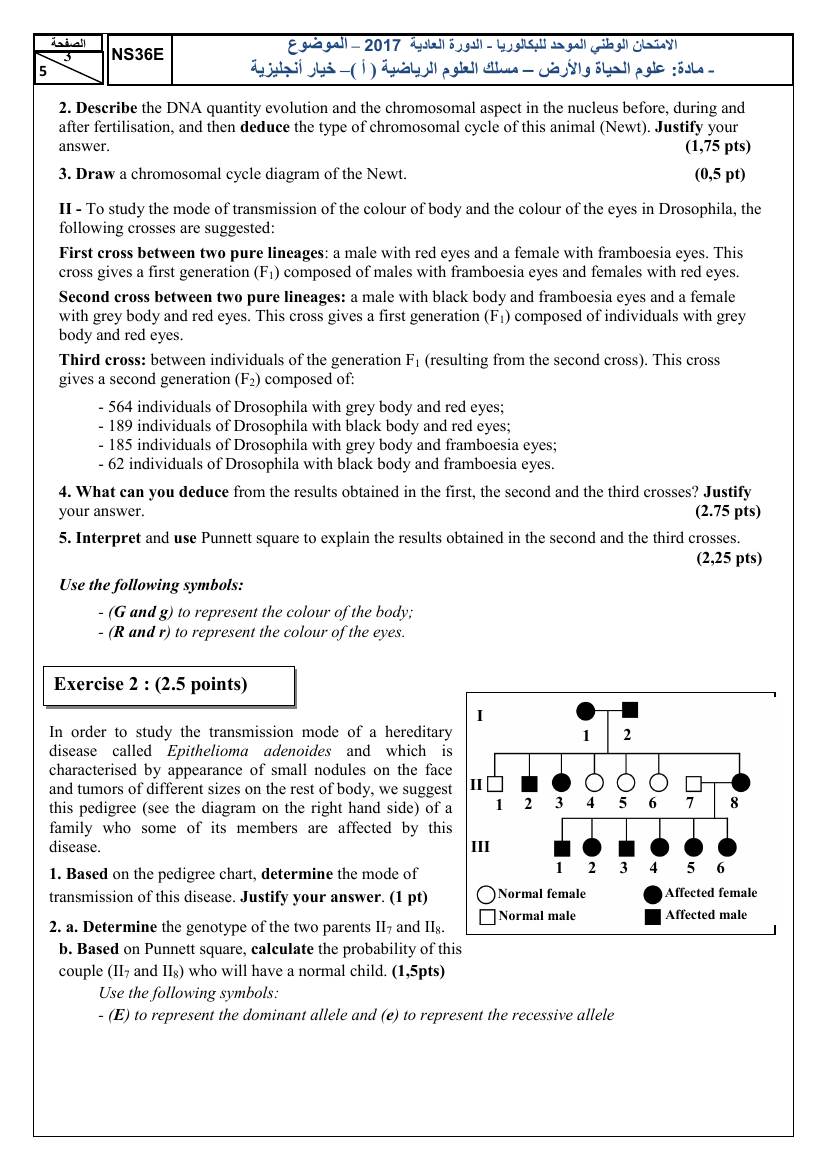
In order to study the transmission mode of a hereditary disease called Epithelioma adenoides and which is characterised by appearance of small nodules on the face and tumors of different sizes on the rest of body, we suggest this pedigree (see the diagram on the right hand side) of a family who some of its members are affected by this disease.

Figure : voir la page 3 du sujet

Normal female; Normal male; Affected female; Affected male

1.Based on the pedigree chart, determine the mode of transmission of this disease. Justify your answer.1 pt

2.a.Determine the genotype of the two parents II7\mathrm{II_7} and II8\mathrm{II_8}.

2.b.Based on Punnett square, calculate the probability of this couple (II7\mathrm{II_7} and II8\mathrm{II_8}) who will have a normal child.1,5 pts

Use the following symbols:

- (E\mathbf{E}) to represent the dominant allele and (e\mathbf{e}) to represent the recessive allele

Partie II – Exercice 35 pts

Exercise 3 : (5 pts)

To highlight the influence of the evolutionary factors on the genetic structure of populations, we suggest the following data:

I. Geospisa fortis are finches (bird species) that live in Daphne Major Island, situated in the center of Galapagos Islands, where the climate is the most important factor impacting the availability of seeds on which these finches feed. These finches have beaks of medium size that they use to eat different seeds, but they prefer to eat easy-to-break seeds.

The year 1977 knew a scarcity of rainfall (no rain for 151 days). This led to a decrease of seeds for G. fortis bird. These finches would be content with the remaining seeds left on the Island after the season preceding the drought. After eating the easy-to-break seeds, there remained only the hard seeds to break.

In order to determine the impact of the drought of the genetic structure of these birds, we have studied the variations in the beak size during one year from 1977 to 1978. The results obtained are shown in the following chart (document 1):

document 1

Number of finchesThe most common beak size (per/mm)
1977Before the drought2168.8
1977After the drought3610.3
1978One generation after the drought1429.8

1.Based on the above chart, extract the variations that the G. fortis population has undergone before and after the drought.0,5 pt

2.Explain the variations you have extracted in question n° 1.0,5 pt

3.Based on your knowledge and the previous data, determine the studied variation factors and show its impact on the genetic structure of the population of G. fortis.1,25 pts

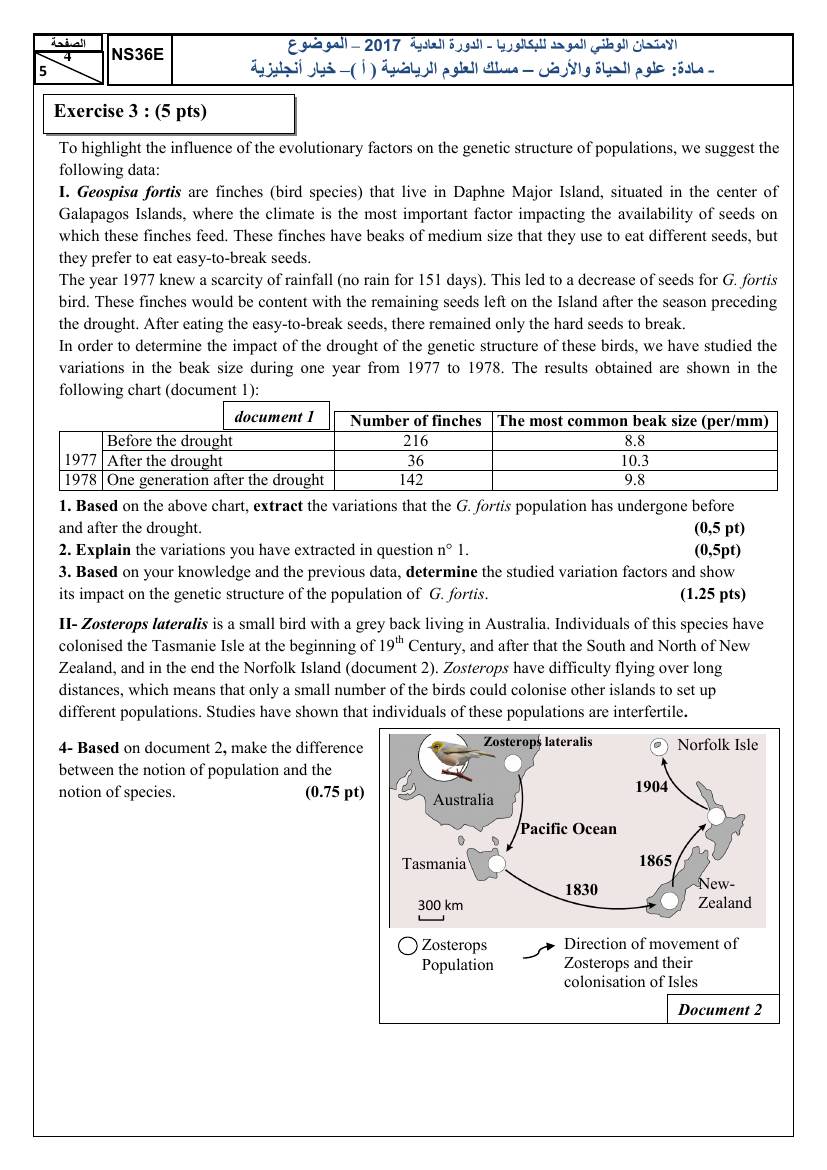
II- Zosterops lateralis is a small bird with a grey back living in Australia. Individuals of this species have colonised the Tasmanie Isle at the beginning of 19th Century, and after that the South and North of New Zealand, and in the end the Norfolk Island (document 2). Zosterops have difficulty flying over long distances, which means that only a small number of the birds could colonise other islands to set up different populations. Studies have shown that individuals of these populations are interfertile.

4.Based on document 2, make the difference between the notion of population and the notion of species.0,75 pt

Document 2 : voir la page 4 du sujet

Zosterops Population; Direction of movement of Zosterops and their colonisation of Isles

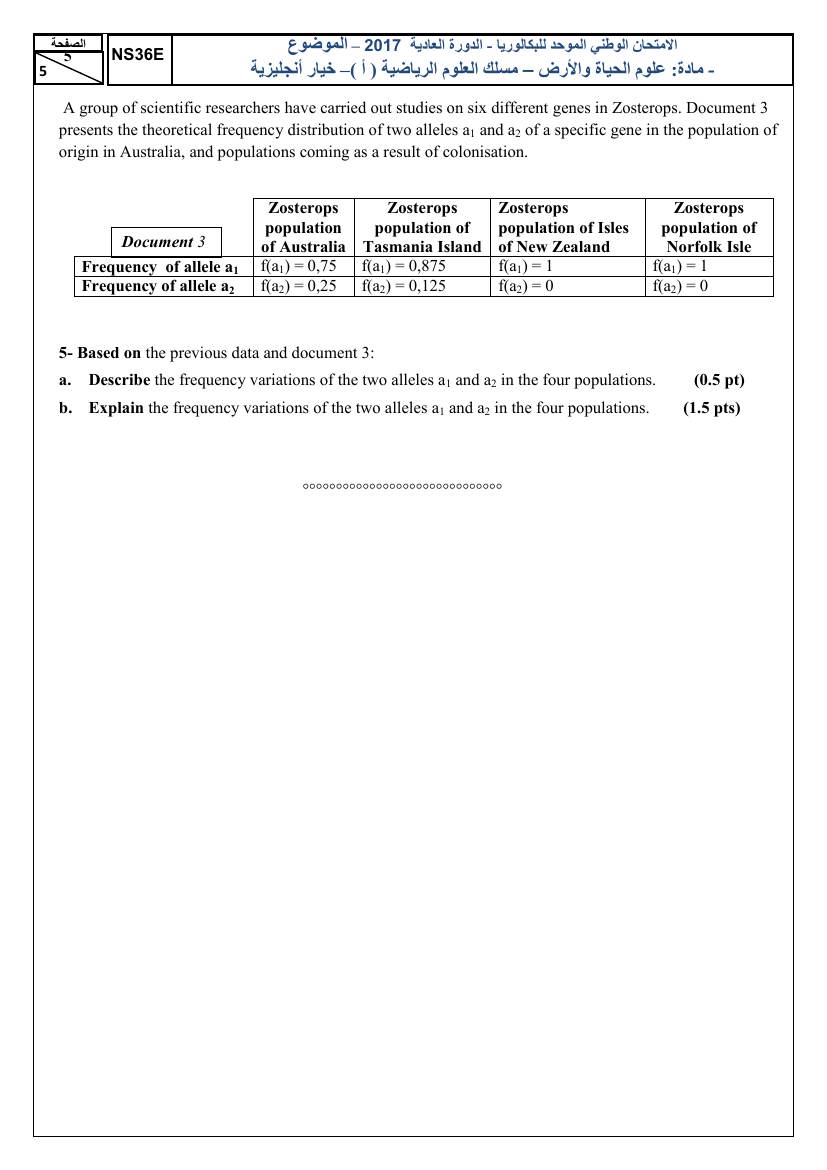
A group of scientific researchers have carried out studies on six different genes in Zosterops. Document 3 presents the theoretical frequency distribution of two alleles a1a_1 and a2a_2 of a specific gene in the population of origin in Australia, and populations coming as a result of colonisation.

Document 3Zosterops population of AustraliaZosterops population of Tasmania IslandZosterops population of Isles of New ZealandZosterops population of Norfolk Isle
Frequency of allele a1a_1f(a1a_1) = 0,75f(a1a_1) = 0,875f(a1a_1) = 1f(a1a_1) = 1
Frequency of allele a2a_2f(a2a_2) = 0,25f(a2a_2) = 0,125f(a2a_2) = 0f(a2a_2) = 0

5- Based on the previous data and document 3:

5.a.Describe the frequency variations of the two alleles a1a_1 and a2a_2 in the four populations.0,5 pt

5.b.Explain the frequency variations of the two alleles a1a_1 and a2a_2 in the four populations.1,5 pts

Entraîne-toi sur ces chapitres avec Kresco, gratuitement

Yallah, wa7d l-khtwa.

Le sujet, tu l’as. Maintenant, prépare-le.

Crée ton compte gratuit : une leçon offerte dans chaque chapitre, les quiz et ton suivi, matière par matière, jusqu’au national.