Jerreb rassek f l-national.

Examen national Physique-Chimie 2Bac SVT (option anglaise) 2022, session de rattrapage

Physique-Chimie · Sciences de la Vie et de la Terre · 6 pages

Le sujet en bref

  1. Chimie7 pts

    Transformations non totales et état d’équilibre · Évolution spontanée d’un système chimique · Suivi temporel d’une transformation chimique

    Des systèmes chimiques mettant en jeu l’acide méthanoïque

  2. Physique – Exercice 13,5 pts

    Propagation des ondes lumineuses · Ondes mécaniques progressives périodiques

    Une onde sonore dans l’air et la dispersion de la lumière dans le verre

  3. Physique – Exercice 25,5 pts

    Dipôle RC · Oscillations libres d’un circuit RLC série

  4. Physique – Exercice 34 pts

    Lois de Newton

    Un solide glissant sur un plan incliné, avec puis sans frottement

Total : 20 points

Le sujet, page par page

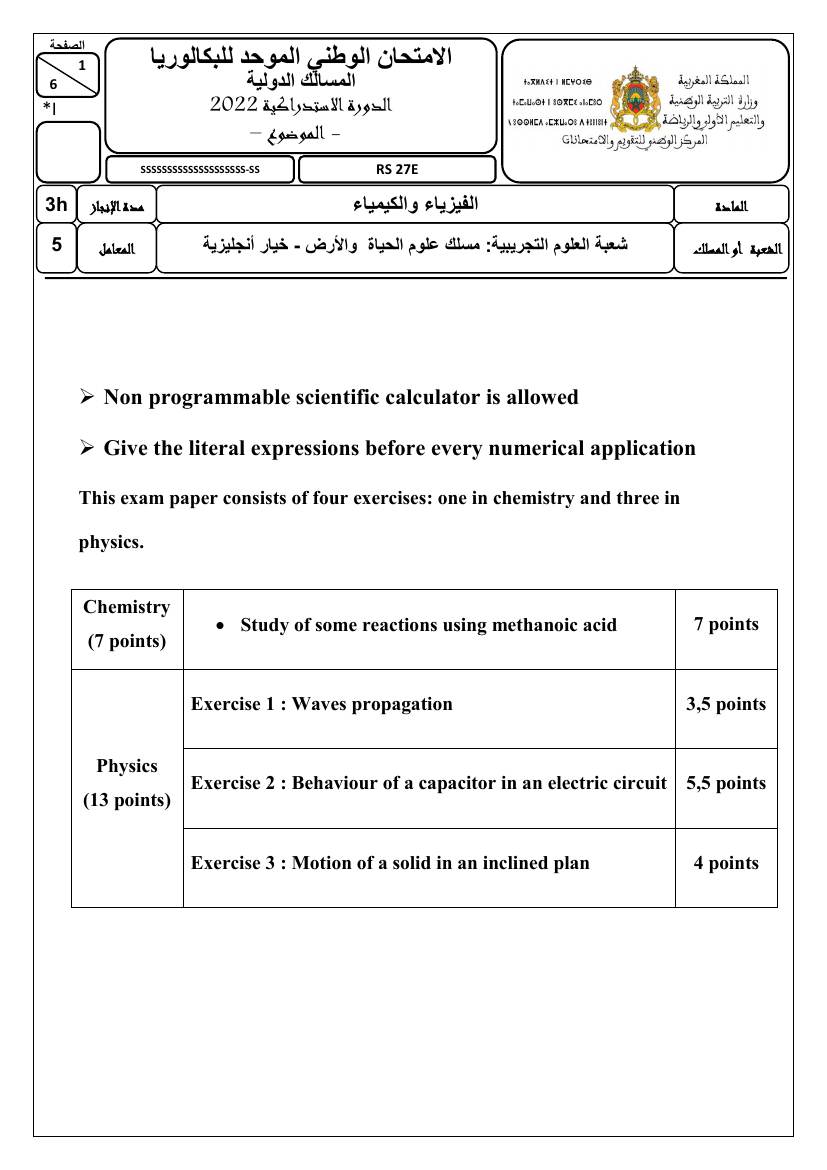
  1. Examen national Physique-Chimie 2Bac SVT (option anglaise) 2022, session de rattrapage, page 1 sur 6
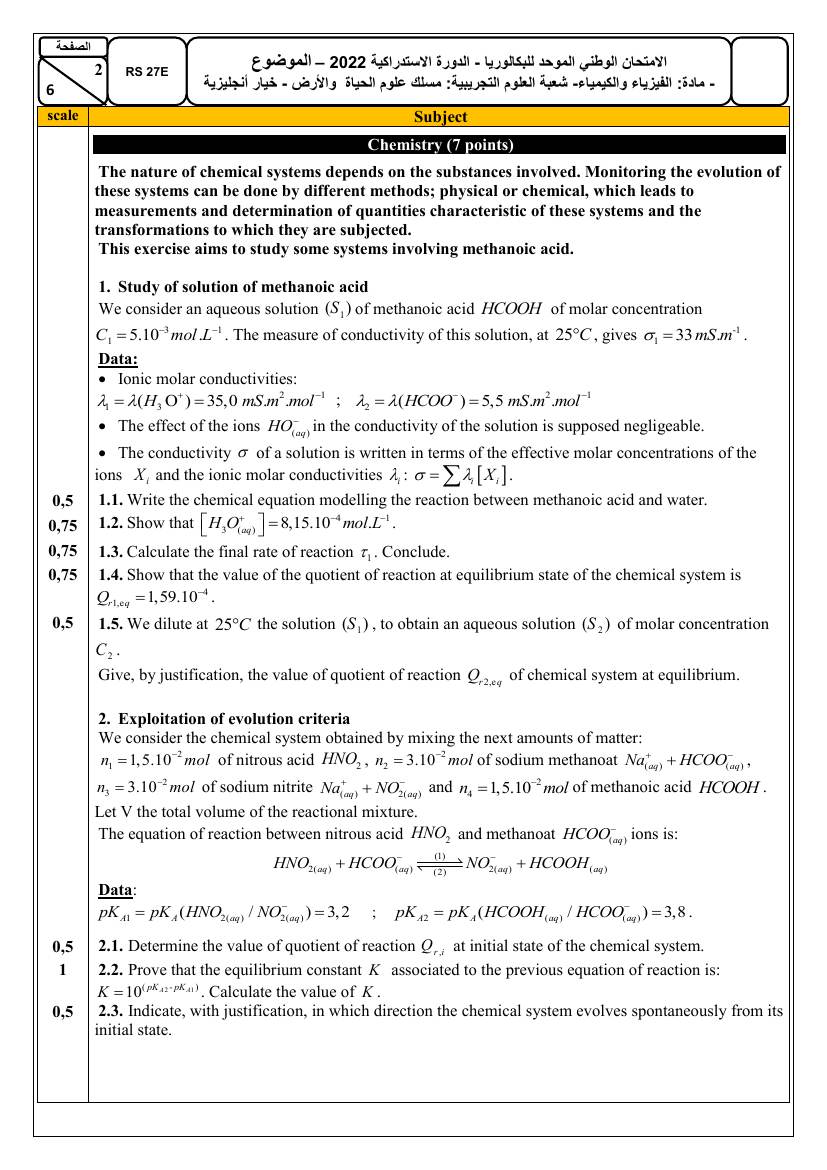
  2. Examen national Physique-Chimie 2Bac SVT (option anglaise) 2022, session de rattrapage, page 2 sur 6
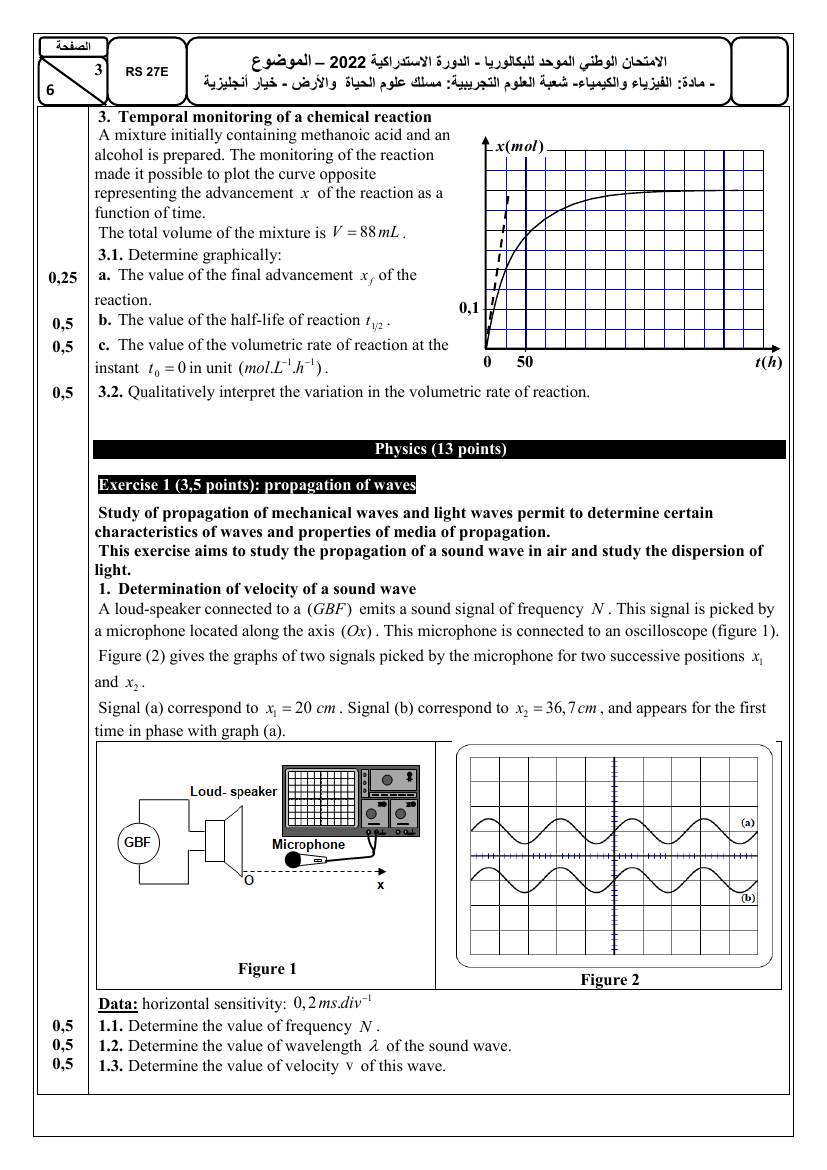
  3. Examen national Physique-Chimie 2Bac SVT (option anglaise) 2022, session de rattrapage, page 3 sur 6
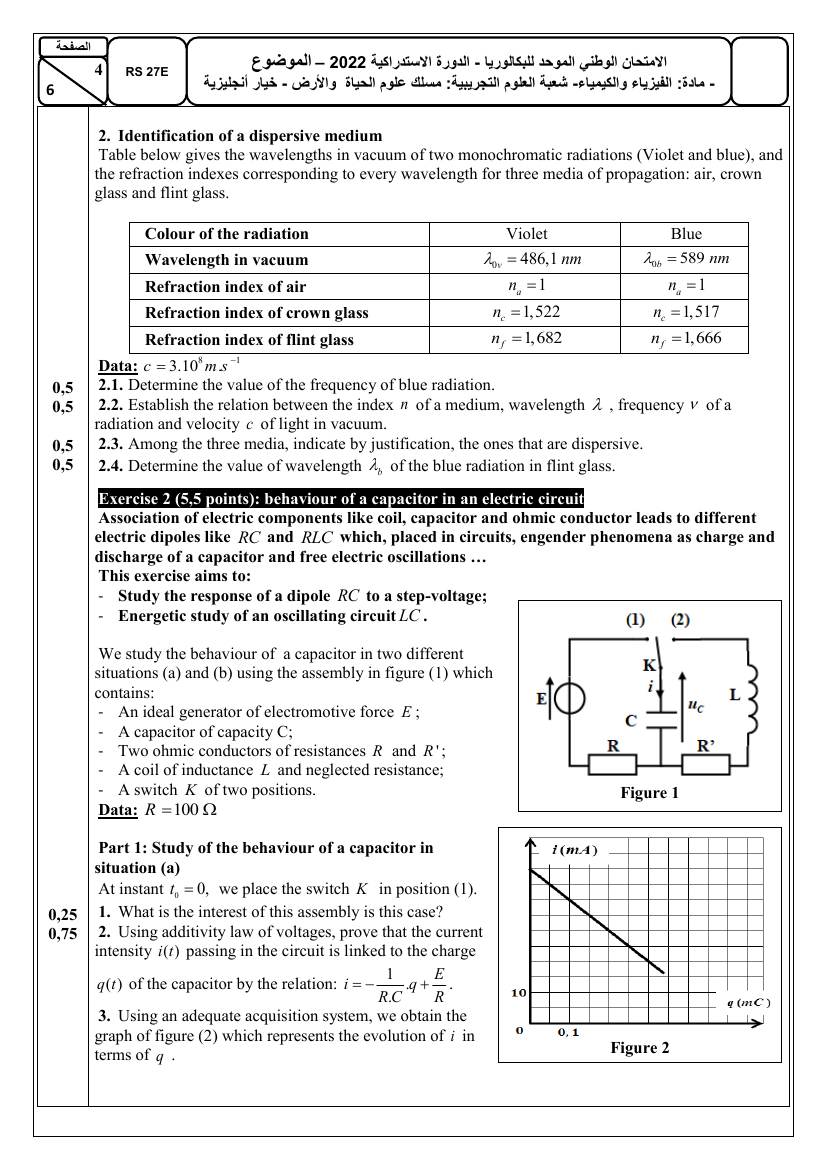
  4. Examen national Physique-Chimie 2Bac SVT (option anglaise) 2022, session de rattrapage, page 4 sur 6
  5. Examen national Physique-Chimie 2Bac SVT (option anglaise) 2022, session de rattrapage, page 5 sur 6
  6. Examen national Physique-Chimie 2Bac SVT (option anglaise) 2022, session de rattrapage, page 6 sur 6

Sujet officiel de l’examen national unifié du baccalauréat, tel que publié par le Centre national de l’évaluation et des examens (Ministère de l’Éducation nationale).

L’énoncé en texte

Transcription du sujet officiel, pour le lire et le rechercher sur téléphone. Les figures restent sur les pages du sujet ; en cas de différence, le PDF officiel fait foi.

Chimie7 pts

The nature of chemical systems depends on the substances involved. Monitoring the evolution of these systems can be done by different methods; physical or chemical, which leads to measurements and determination of quantities characteristic of these systems and the transformations to which they are subjected.

This exercise aims to study some systems involving methanoic acid.

1. Study of solution of methanoic acid

We consider an aqueous solution (S1)(S_1) of methanoic acid HCOOH\mathrm{HCOOH} of molar concentration C1=5⋅10−3 mol⋅L−1C_1 = 5\cdot 10^{-3}\ \mathrm{mol\cdot L^{-1}}. The measure of conductivity of this solution, at 25 °C25\,°\mathrm{C}, gives σ1=33 mS⋅m−1\sigma_1 = 33\ \mathrm{mS\cdot m^{-1}}.

Data:

Ionic molar conductivities:

λ1=λ(H3O+)=35,0 mS⋅m2⋅mol−1\lambda_1 = \lambda(\mathrm{H_3O^+}) = 35{,}0\ \mathrm{mS\cdot m^2\cdot mol^{-1}} ; λ2=λ(HCOO−)=5,5 mS⋅m2⋅mol−1\lambda_2 = \lambda(\mathrm{HCOO^-}) = 5{,}5\ \mathrm{mS\cdot m^2\cdot mol^{-1}}

The effect of the ions HO(aq)−\mathrm{HO^-_{(aq)}} in the conductivity of the solution is supposed negligeable.

The conductivity σ\sigma of a solution is written in terms of the effective molar concentrations of the ions XiX_i and the ionic molar conductivities λi\lambda_i: σ=∑λi[Xi]\sigma = \sum \lambda_i [X_i].

1.1.Write the chemical equation modelling the reaction between methanoic acid and water.0,5 pt

1.2.Show that [H3O(aq)+]=8,15⋅10−4 mol⋅L−1[\mathrm{H_3O^+_{(aq)}}] = 8{,}15\cdot 10^{-4}\ \mathrm{mol\cdot L^{-1}}.0,75 pt

1.3.Calculate the final rate of reaction τ1\tau_1. Conclude.0,75 pt

1.4.Show that the value of the quotient of reaction at equilibrium state of the chemical system is Qr1,eq=1,59⋅10−4Q_{r1,eq} = 1{,}59\cdot 10^{-4}.0,75 pt

1.5.We dilute at 25 °C25\,°\mathrm{C} the solution (S1)(S_1), to obtain an aqueous solution (S2)(S_2) of molar concentration C2C_2. Give, by justification, the value of quotient of reaction Qr2,eqQ_{r2,eq} of chemical system at equilibrium.0,5 pt

2. Exploitation of evolution criteria

We consider the chemical system obtained by mixing the next amounts of matter:

n1=1,5⋅10−2 moln_1 = 1{,}5\cdot 10^{-2}\ \mathrm{mol} of nitrous acid HNO2\mathrm{HNO_2}, n2=3⋅10−2 moln_2 = 3\cdot 10^{-2}\ \mathrm{mol} of sodium methanoat Na(aq)++HCOO(aq)−\mathrm{Na^+_{(aq)} + HCOO^-_{(aq)}}, n3=3⋅10−2 moln_3 = 3\cdot 10^{-2}\ \mathrm{mol} of sodium nitrite Na(aq)++NO2(aq)−\mathrm{Na^+_{(aq)} + NO_{2(aq)}^-} and n4=1,5⋅10−2 moln_4 = 1{,}5\cdot 10^{-2}\ \mathrm{mol} of methanoic acid HCOOH\mathrm{HCOOH}.

Let V the total volume of the reactional mixture.

The equation of reaction between nitrous acid HNO2\mathrm{HNO_2} and methanoat HCOO(aq)−\mathrm{HCOO^-_{(aq)}} ions is:

HNO2(aq)+HCOO(aq)−  ⇄(1)(2)  NO2(aq)−+HCOOH(aq)\mathrm{HNO_{2(aq)} + HCOO^-_{(aq)}} \;\underset{(2)}{\overset{(1)}{\rightleftarrows}}\; \mathrm{NO^-_{2(aq)} + HCOOH_{(aq)}}

Data:

pKA1=pKA(HNO2(aq)/NO2(aq)−)=3,2pK_{A1} = pK_A(\mathrm{HNO_{2(aq)}/NO^-_{2(aq)}}) = 3{,}2 ; pKA2=pKA(HCOOH(aq)/HCOO(aq)−)=3,8pK_{A2} = pK_A(\mathrm{HCOOH_{(aq)}/HCOO^-_{(aq)}}) = 3{,}8.

2.1.Determine the value of quotient of reaction Qr,iQ_{r,i} at initial state of the chemical system.0,5 pt

2.2.Prove that the equilibrium constant KK associated to the previous equation of reaction is: K=10(pKA2−pKA1)K = 10^{(pK_{A2} - pK_{A1})}. Calculate the value of KK.1 pt

2.3.Indicate, with justification, in which direction the chemical system evolves spontaneously from its initial state.0,5 pt

3. Temporal monitoring of a chemical reaction

A mixture initially containing methanoic acid and an alcohol is prepared. The monitoring of the reaction made it possible to plot the curve opposite representing the advancement xx of the reaction as a function of time.

Figure : voir la page 3 du sujet

The total volume of the mixture is V=88 mLV = 88\ \mathrm{mL}.

3.1.Determine graphically:

3.1.a.The value of the final advancement xfx_f of the reaction.0,25 pt

3.1.b.The value of the half-life of reaction t1/2t_{1/2}.0,5 pt

3.1.c.The value of the volumetric rate of reaction at the instant t0=0t_0 = 0 in unit (mol⋅L−1⋅h−1)(\mathrm{mol\cdot L^{-1}\cdot h^{-1}}).0,5 pt

3.2.Qualitatively interpret the variation in the volumetric rate of reaction.0,5 pt

Revoir le cours : Suivi temporel d’une transformation chimique

Physique – Exercice 13,5 pts

Exercise 1 (3,5 points): propagation of waves

Study of propagation of mechanical waves and light waves permit to determine certain characteristics of waves and properties of media of propagation.

This exercise aims to study the propagation of a sound wave in air and study the dispersion of light.

1. Determination of velocity of a sound wave

A loud-speaker connected to a (GBF)(GBF) emits a sound signal of frequency NN. This signal is picked by a microphone located along the axis (Ox)(Ox). This microphone is connected to an oscilloscope (figure 1).

Figure (2) gives the graphs of two signals picked by the microphone for two successive positions x1x_1 and x2x_2.

Signal (a) correspond to x1=20 cmx_1 = 20\ \mathrm{cm}. Signal (b) correspond to x2=36,7 cmx_2 = 36{,}7\ \mathrm{cm}, and appears for the first time in phase with graph (a).

Figure 1 : voir la page 3 du sujet

Figure 2 : voir la page 3 du sujet

Data: horizontal sensitivity: 0,2 ms⋅div−10{,}2\ \mathrm{ms\cdot div^{-1}}

1.1.Determine the value of frequency NN.0,5 pt

1.2.Determine the value of wavelength λ\lambda of the sound wave.0,5 pt

1.3.Determine the value of velocity vv of this wave.0,5 pt

2. Identification of a dispersive medium

Table below gives the wavelengths in vacuum of two monochromatic radiations (Violet and blue), and the refraction indexes corresponding to every wavelength for three media of propagation: air, crown glass and flint glass.

Colour of the radiationVioletBlue
Wavelength in vacuumλ0v=486,1 nm\lambda_{0v} = 486{,}1\ \mathrm{nm}λ0b=589 nm\lambda_{0b} = 589\ \mathrm{nm}
Refraction index of airna=1n_a = 1na=1n_a = 1
Refraction index of crown glassnc=1,522n_c = 1{,}522nc=1,517n_c = 1{,}517
Refraction index of flint glassnf=1,682n_f = 1{,}682nf=1,666n_f = 1{,}666

Data: c=3⋅108 m⋅s−1c = 3\cdot 10^{8}\ \mathrm{m\cdot s^{-1}}

2.1.Determine the value of the frequency of blue radiation.0,5 pt

2.2.Establish the relation between the index nn of a medium, wavelength λ\lambda, frequency ν\nu of a radiation and velocity cc of light in vacuum.0,5 pt

2.3.Among the three media, indicate by justification, the ones that are dispersive.0,5 pt

2.4.Determine the value of wavelength λb\lambda_b of the blue radiation in flint glass.0,5 pt

Revoir le cours : Propagation des ondes lumineuses · Ondes mécaniques progressives périodiques

Physique – Exercice 25,5 pts

Exercise 2 (5,5 points): behaviour of a capacitor in an electric circuit

Association of electric components like coil, capacitor and ohmic conductor leads to different electric dipoles like RCRC and RLCRLC which, placed in circuits, engender phenomena as charge and discharge of a capacitor and free electric oscillations …

This exercise aims to:

- Study the response of a dipole RCRC to a step-voltage;

- Energetic study of an oscillating circuit LCLC.

We study the behaviour of a capacitor in two different situations (a) and (b) using the assembly in figure (1) which contains:

- An ideal generator of electromotive force EE;

- A capacitor of capacity C;

- Two ohmic conductors of resistances RR and R′R';

- A coil of inductance LL and neglected resistance;

- A switch KK of two positions.

Figure 1 : voir la page 4 du sujet

Data: R=100 ΩR = 100\ \Omega

Part 1: Study of the behaviour of a capacitor in situation (a)

At instant t0=0t_0 = 0, we place the switch KK in position (1).

1.What is the interest of this assembly is this case?0,25 pt

2.Using additivity law of voltages, prove that the current intensity i(t)i(t) passing in the circuit is linked to the charge q(t)q(t) of the capacitor by the relation: i=−1R⋅C⋅q+ERi = -\dfrac{1}{R\cdot C}\cdot q + \dfrac{E}{R}.0,75 pt

3.Using an adequate acquisition system, we obtain the graph of figure (2) which represents the evolution of ii in terms of qq. By exploiting the graph, determine the values of:

Figure 2 : voir la page 4 du sujet

3.a.Maximal intensity of electric current I0I_0;0,5 pt

3.b.Electromotive force EE;0,5 pt

3.c.Time constant of the circuit τ\tau;0,5 pt

3.d.The maximal charge QmaxQ_{max} of the capacitor at the end of its charge.0,5 pt

Part 2: Study of the behaviour of the capacitor in situation (b)

Once the capacitor is totally charged under the voltage uC0=Eu_{C0} = E in the situation (a), we switch KK to the position (2) at an instant t0=0t_0 = 0.

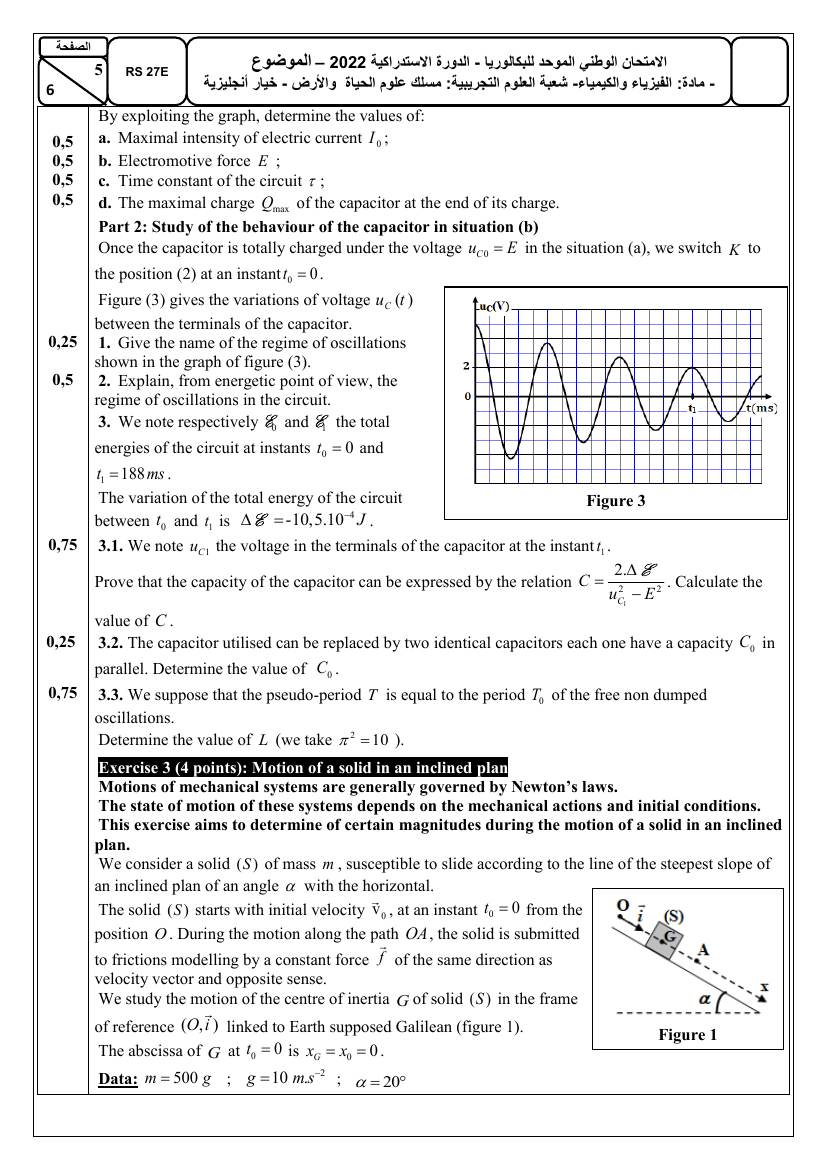
Figure (3) gives the variations of voltage uC(t)u_C(t) between the terminals of the capacitor.

Figure 3 : voir la page 5 du sujet

1.Give the name of the regime of oscillations shown in the graph of figure (3).0,25 pt

2.Explain, from energetic point of view, the regime of oscillations in the circuit.0,5 pt

3.We note respectively E0\mathscr{E}_0 and E1\mathscr{E}_1 the total energies of the circuit at instants t0=0t_0 = 0 and t1=188 mst_1 = 188\ \mathrm{ms}. The variation of the total energy of the circuit between t0t_0 and t1t_1 is ΔE=−10,5⋅10−4 J\Delta\mathscr{E} = -10{,}5\cdot 10^{-4}\ \mathrm{J}.

3.1.We note uC1u_{C1} the voltage in the terminals of the capacitor at the instant t1t_1. Prove that the capacity of the capacitor can be expressed by the relation C=2⋅ΔEuC12−E2C = \dfrac{2\cdot\Delta\mathscr{E}}{u_{C_1}^2 - E^2}. Calculate the value of CC.0,75 pt

3.2.The capacitor utilised can be replaced by two identical capacitors each one have a capacity C0C_0 in parallel. Determine the value of C0C_0.0,25 pt

3.3.We suppose that the pseudo-period TT is equal to the period T0T_0 of the free non dumped oscillations. Determine the value of LL (we take π2=10\pi^2 = 10).0,75 pt

Physique – Exercice 34 pts

Exercise 3 (4 points): Motion of a solid in an inclined plan

Motions of mechanical systems are generally governed by Newton’s laws.

The state of motion of these systems depends on the mechanical actions and initial conditions.

This exercise aims to determine of certain magnitudes during the motion of a solid in an inclined plan.

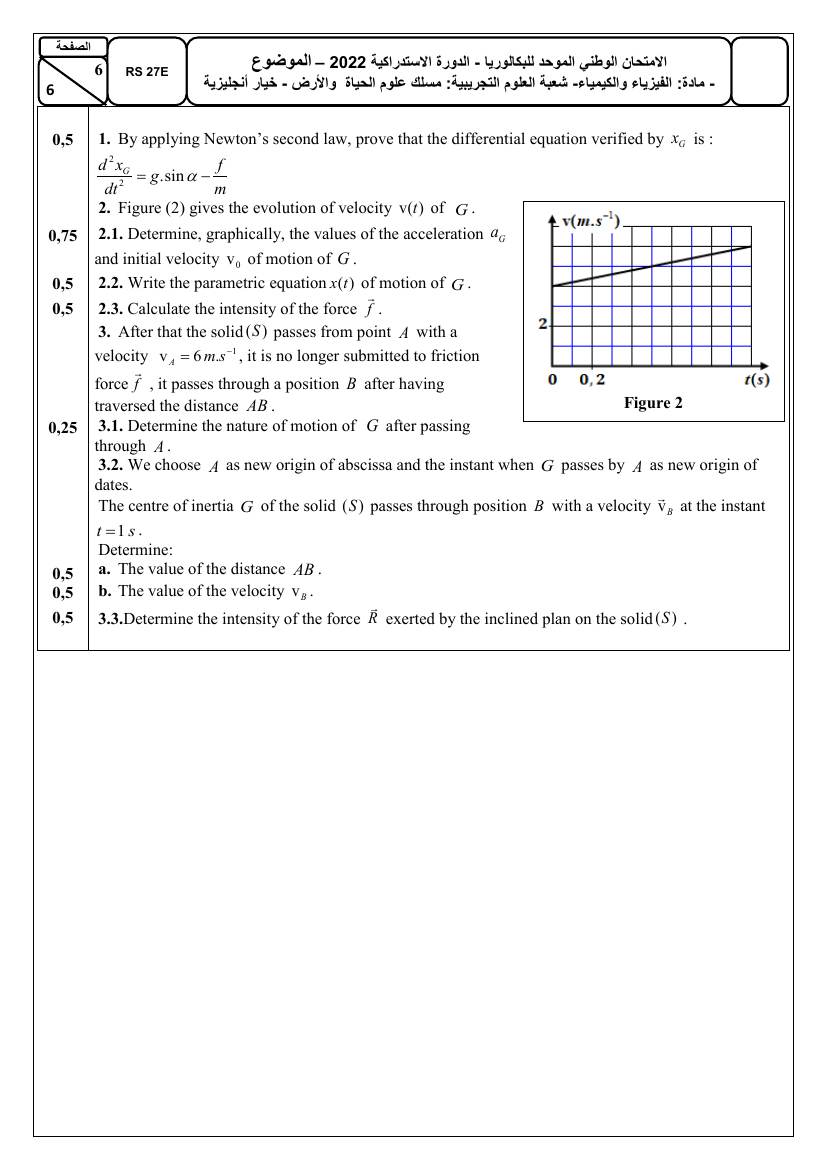
We consider a solid (S)(S) of mass mm, susceptible to slide according to the line of the steepest slope of an inclined plan of an angle α\alpha with the horizontal.

The solid (S)(S) starts with initial velocity v⃗0\vec{v}_0, at an instant t0=0t_0 = 0 from the position OO. During the motion along the path OAOA, the solid is submitted to frictions modelling by a constant force f⃗\vec{f} of the same direction as velocity vector and opposite sense.

We study the motion of the centre of inertia GG of solid (S)(S) in the frame of reference (O,i⃗)(O,\vec{i}) linked to Earth supposed Galilean (figure 1).

Figure 1 : voir la page 5 du sujet

The abscissa of GG at t0=0t_0 = 0 is xG=x0=0x_G = x_0 = 0.

Data: m=500 gm = 500\ \mathrm{g} ; g=10 m⋅s−2g = 10\ \mathrm{m\cdot s^{-2}} ; α=20°\alpha = 20°

1.By applying Newton’s second law, prove that the differential equation verified by xGx_G is : d2xGdt2=g⋅sin⁡α−fm\dfrac{d^2 x_G}{dt^2} = g\cdot\sin\alpha - \dfrac{f}{m}0,5 pt

2.Figure (2) gives the evolution of velocity v(t)v(t) of GG.

Figure 2 : voir la page 6 du sujet

2.1.Determine, graphically, the values of the acceleration aGa_G and initial velocity v0v_0 of motion of GG.0,75 pt

2.2.Write the parametric equation x(t)x(t) of motion of GG.0,5 pt

2.3.Calculate the intensity of the force f⃗\vec{f}.0,5 pt

3.After that the solid (S)(S) passes from point AA with a velocity vA=6 m⋅s−1v_A = 6\ \mathrm{m\cdot s^{-1}}, it is no longer submitted to friction force f⃗\vec{f}, it passes through a position BB after having traversed the distance ABAB.

3.1.Determine the nature of motion of GG after passing through AA.0,25 pt

3.2.We choose AA as new origin of abscissa and the instant when GG passes by AA as new origin of dates. The centre of inertia GG of the solid (S)(S) passes through position BB with a velocity v⃗B\vec{v}_B at the instant t=1 st = 1\ \mathrm{s}. Determine:

3.2.a.The value of the distance ABAB.0,5 pt

3.2.b.The value of the velocity vBv_B.0,5 pt

3.3.Determine the intensity of the force R⃗\vec{R} exerted by the inclined plan on the solid (S)(S).0,5 pt

Entraîne-toi sur ces chapitres avec Kresco, gratuitement

Yallah, wa7d l-khtwa.

Le sujet, tu l’as. Maintenant, prépare-le.

Crée ton compte gratuit : une leçon offerte dans chaque chapitre, les quiz et ton suivi, matière par matière, jusqu’au national.