Jerreb rassek f l-national.

Examen national Physique-Chimie 2Bac SVT (option anglaise) 2022, session normale

Physique-Chimie · Sciences de la Vie et de la Terre · 6 pages

Le sujet en bref

  1. Chimie7 pts

    Suivi temporel d’une transformation chimique · Dosage acido-basique · Transformations non totales et état d’équilibre

    L’oxydation des ions iodure par l’eau oxygénée et la pureté de l’acide valérique

  2. Physique – Exercice 13,5 pts

    Ondes mécaniques progressives périodiques · Propagation des ondes lumineuses

    Une onde le long d’une corde et la diffraction d’un laser par une fente

  3. Physique – Exercice 25,5 pts

    Dipôle RC · Oscillations libres d’un circuit RLC série

  4. Physique – Exercice 34 pts

    Lois de Newton

    Un solide tiré par une force motrice sur un plan horizontal

Total : 20 points

Le sujet, page par page

  1. Examen national Physique-Chimie 2Bac SVT (option anglaise) 2022, session normale, page 1 sur 6
  2. Examen national Physique-Chimie 2Bac SVT (option anglaise) 2022, session normale, page 2 sur 6
  3. Examen national Physique-Chimie 2Bac SVT (option anglaise) 2022, session normale, page 3 sur 6
  4. Examen national Physique-Chimie 2Bac SVT (option anglaise) 2022, session normale, page 4 sur 6
  5. Examen national Physique-Chimie 2Bac SVT (option anglaise) 2022, session normale, page 5 sur 6
  6. Examen national Physique-Chimie 2Bac SVT (option anglaise) 2022, session normale, page 6 sur 6

Sujet officiel de l’examen national unifié du baccalauréat, tel que publié par le Centre national de l’évaluation et des examens (Ministère de l’Éducation nationale).

L’énoncé en texte

Transcription du sujet officiel, pour le lire et le rechercher sur téléphone. Les figures restent sur les pages du sujet ; en cas de différence, le PDF officiel fait foi.

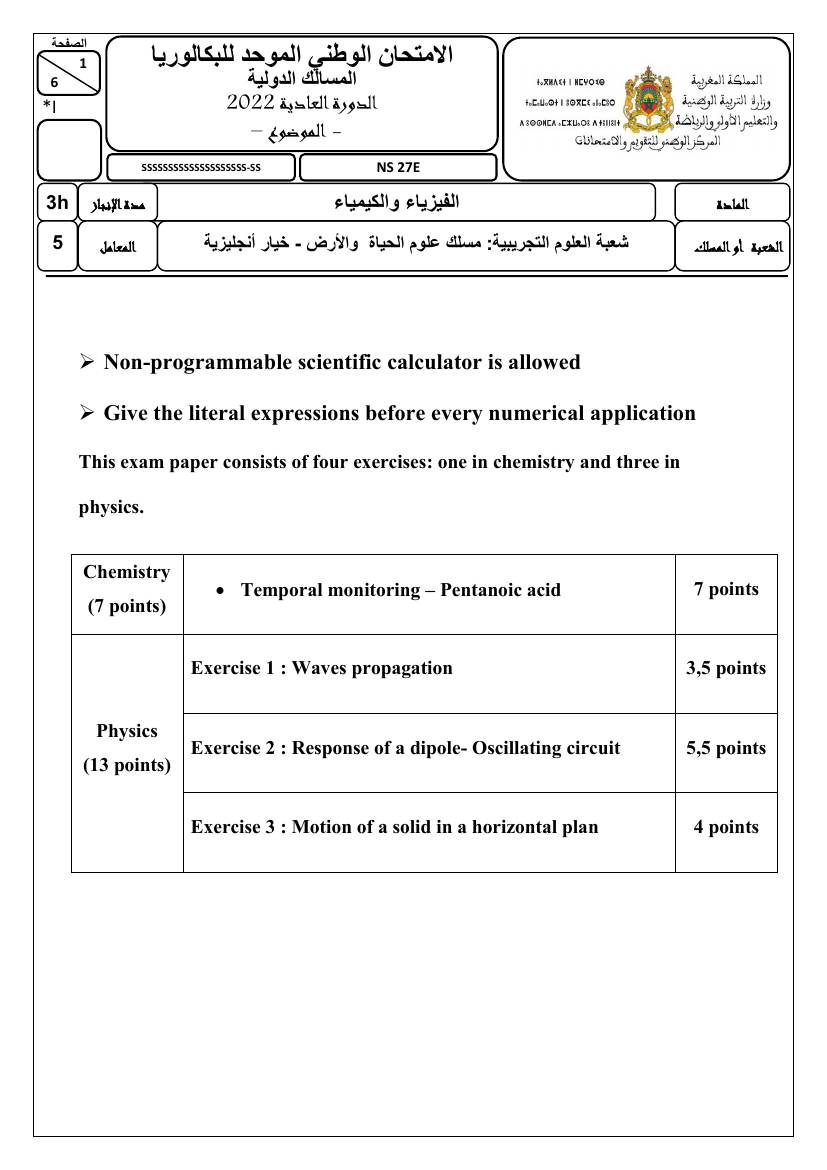
Chimie7 pts

Part 1 and Part 2 are independents

The study of chemical transformations permits the temporal monitoring evolution of chemical systems and determine some caracteristics based on technics or different methods.

This exercise aims to:

- Study the temporal monitoring of a chemical transformation;

- Determine the degree of purity.

Part 1: Study of temporal monitoring of chemical transformation

To monitor the reaction between hydrogen peroxide H2O2(aq)\mathrm{H_2O_{2(aq)}} and iodide ions I(aq)−\mathrm{I^-_{(aq)}}, we realise the oxidation of iodide ions by hydrogen peroxide in acid medium by monitoring the advancement xx of the reaction in different experimental conditions.

Three experiments are carried out in the presence of an excess of H3O(aq)+\mathrm{H_3O^+_{(aq)}} ions. The total volume of the mixture is the same in the three experiments V=100 mLV = 100\ \mathrm{mL}.

The chemical equation modelling the studied chemical transformation is:

H2O2(aq)+2I(aq)−+2H3O(aq)+→I2(aq)+4H2O(l)\mathrm{H_2O_{2(aq)} + 2I^-_{(aq)} + 2H_3O^+_{(aq)} \rightarrow I_{2(aq)} + 4H_2O_{(l)}}

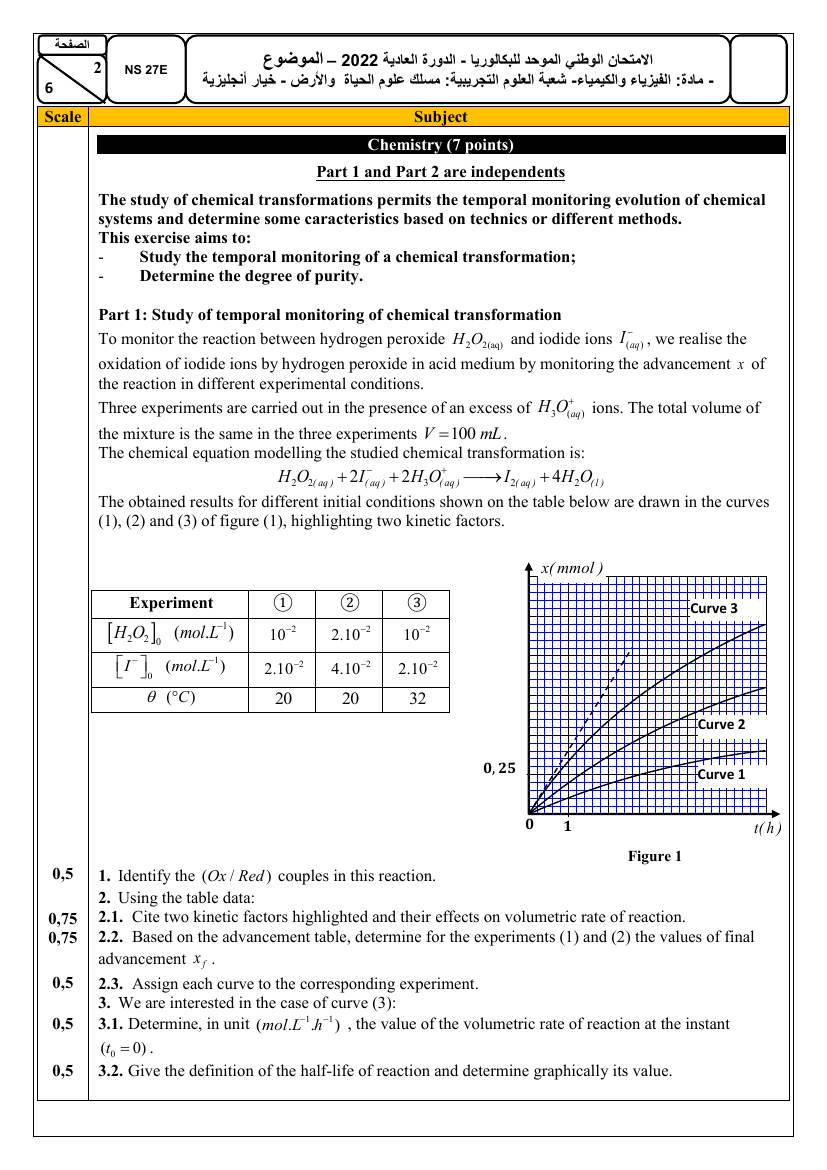
The obtained results for different initial conditions shown on the table below are drawn in the curves (1), (2) and (3) of figure (1), highlighting two kinetic factors.

Experiment①②③
[H2O2]0 (mol⋅L−1)[\mathrm{H_2O_2}]_0\ (\mathrm{mol\cdot L^{-1}})10−210^{-2}2⋅10−22\cdot 10^{-2}10−210^{-2}
[I−]0 (mol⋅L−1)[\mathrm{I^-}]_0\ (\mathrm{mol\cdot L^{-1}})2⋅10−22\cdot 10^{-2}4⋅10−24\cdot 10^{-2}2⋅10−22\cdot 10^{-2}
θ (∘C)\theta\ (^\circ\mathrm{C})202032

Figure 1 : voir la page 2 du sujet

1.Identify the (Ox/Red)(Ox / Red) couples in this reaction.0,5 pt

2. Using the table data:

2.1.Cite two kinetic factors highlighted and their effects on volumetric rate of reaction.0,75 pt

2.2.Based on the advancement table, determine for the experiments (1) and (2) the values of final advancement xfx_f.0,75 pt

2.3.Assign each curve to the corresponding experiment.0,5 pt

3. We are interested in the case of curve (3):

3.1.Determine, in unit (mol⋅L−1⋅h−1)(\mathrm{mol\cdot L^{-1}\cdot h^{-1}}), the value of the volumetric rate of reaction at the instant (t0=0)(t_0 = 0).0,5 pt

3.2.Give the definition of the half-life of reaction and determine graphically its value.0,5 pt

Part 2: Determination of degree of purity of valeric acid

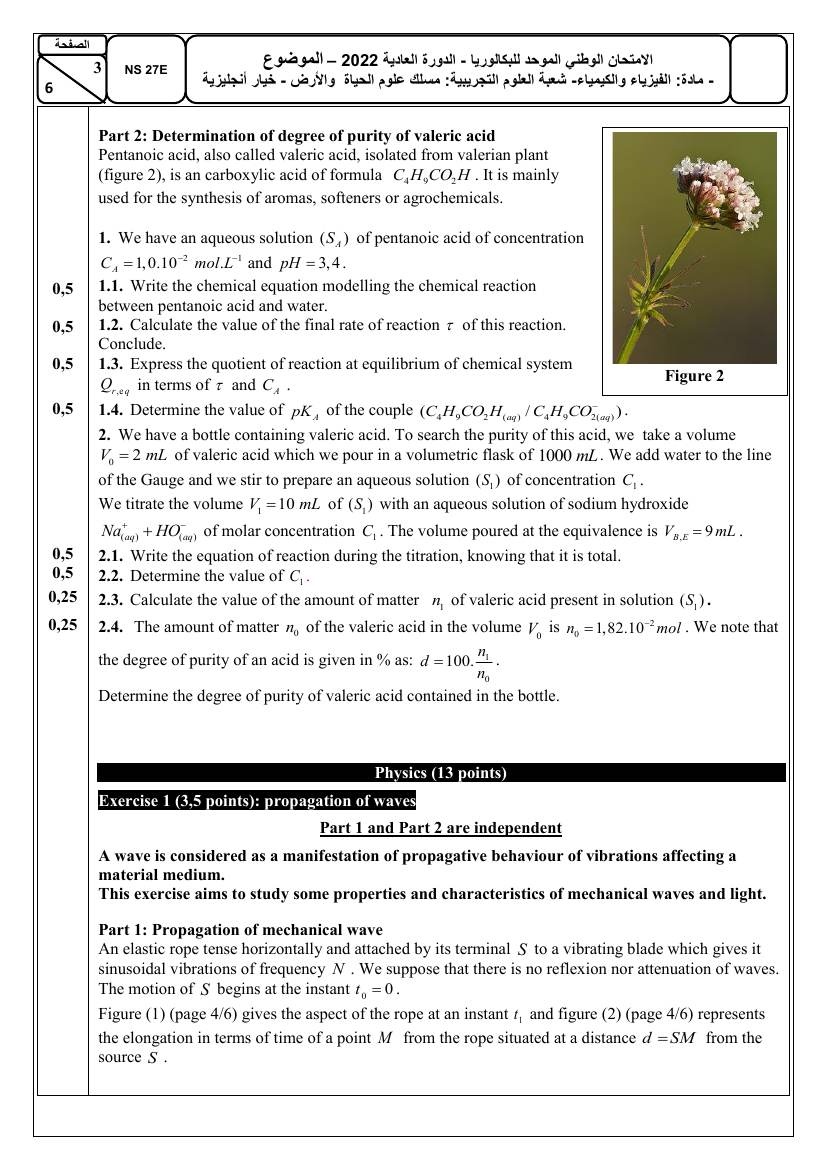
Pentanoic acid, also called valeric acid, isolated from valerian plant (figure 2), is an carboxylic acid of formula C4H9CO2H\mathrm{C_4H_9CO_2H}. It is mainly used for the synthesis of aromas, softeners or agrochemicals.

Figure 2 : voir la page 3 du sujet

1. We have an aqueous solution (SA)(S_A) of pentanoic acid of concentration CA=1,0⋅10−2 mol⋅L−1C_A = 1{,}0\cdot 10^{-2}\ \mathrm{mol\cdot L^{-1}} and pH=3,4pH = 3{,}4.

1.1.Write the chemical equation modelling the chemical reaction between pentanoic acid and water.0,5 pt

1.2.Calculate the value of the final rate of reaction τ\tau of this reaction. Conclude.0,5 pt

1.3.Express the quotient of reaction at equilibrium of chemical system Qr,eqQ_{r,eq} in terms of τ\tau and CAC_A.0,5 pt

1.4.Determine the value of pKApK_A of the couple (C4H9CO2H(aq)/C4H9CO2(aq)−)(\mathrm{C_4H_9CO_2H_{(aq)} / C_4H_9CO_{2(aq)}^-}).0,5 pt

2. We have a bottle containing valeric acid. To search the purity of this acid, we take a volume V0=2 mLV_0 = 2\ \mathrm{mL} of valeric acid which we pour in a volumetric flask of 1000 mL1000\ \mathrm{mL}. We add water to the line of the Gauge and we stir to prepare an aqueous solution (S1)(S_1) of concentration C1C_1.

We titrate the volume V1=10 mLV_1 = 10\ \mathrm{mL} of (S1)(S_1) with an aqueous solution of sodium hydroxide Na(aq)++HO(aq)−\mathrm{Na^+_{(aq)} + HO^-_{(aq)}} of molar concentration C1C_1. The volume poured at the equivalence is VB,E=9 mLV_{B,E} = 9\ \mathrm{mL}.

2.1.Write the equation of reaction during the titration, knowing that it is total.0,5 pt

2.2.Determine the value of C1C_1.0,5 pt

2.3.Calculate the value of the amount of matter n1n_1 of valeric acid present in solution (S1)(S_1).0,25 pt

2.4.The amount of matter n0n_0 of the valeric acid in the volume V0V_0 is n0=1,82⋅10−2 moln_0 = 1{,}82\cdot 10^{-2}\ \mathrm{mol}. We note that the degree of purity of an acid is given in % as: d=100⋅n1n0d = 100\cdot \dfrac{n_1}{n_0}. Determine the degree of purity of valeric acid contained in the bottle.0,25 pt

Revoir le cours : Suivi temporel d’une transformation chimique

Physique – Exercice 13,5 pts

Exercise 1 (3,5 points): propagation of waves

Part 1 and Part 2 are independent

A wave is considered as a manifestation of propagative behaviour of vibrations affecting a material medium.

This exercise aims to study some properties and characteristics of mechanical waves and light.

Part 1: Propagation of mechanical wave

An elastic rope tense horizontally and attached by its terminal SS to a vibrating blade which gives it sinusoidal vibrations of frequency NN. We suppose that there is no reflexion nor attenuation of waves. The motion of SS begins at the instant t0=0t_0 = 0.

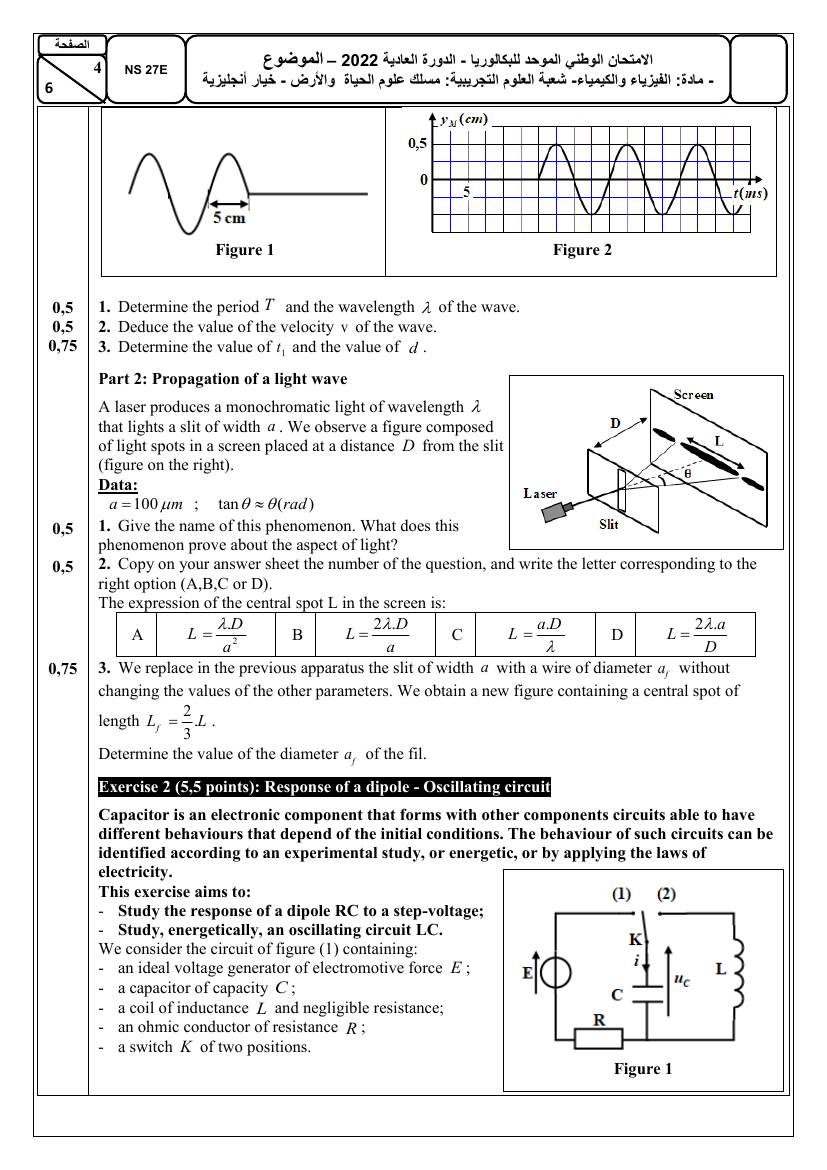
Figure (1) (page 4/6) gives the aspect of the rope at an instant t1t_1 and figure (2) (page 4/6) represents the elongation in terms of time of a point MM from the rope situated at a distance d=SMd = SM from the source SS.

Figure 1 : voir la page 4 du sujet

Figure 2 : voir la page 4 du sujet

1.Determine the period TT and the wavelength λ\lambda of the wave.0,5 pt

2.Deduce the value of the velocity vv of the wave.0,5 pt

3.Determine the value of t1t_1 and the value of dd.0,75 pt

Part 2: Propagation of a light wave

A laser produces a monochromatic light of wavelength λ\lambda that lights a slit of width aa. We observe a figure composed of light spots in a screen placed at a distance DD from the slit (figure on the right).

Figure : voir la page 4 du sujet

Data:

a=100 μma = 100\ \mu\mathrm{m} ; tan⁡θ≈θ (rad)\tan\theta \approx \theta\ (\mathrm{rad})

1.Give the name of this phenomenon. What does this phenomenon prove about the aspect of light?0,5 pt

2.Copy on your answer sheet the number of the question, and write the letter corresponding to the right option (A,B,C or D). The expression of the central spot L in the screen is:0,5 pt

AL=λ⋅Da2L = \dfrac{\lambda\cdot D}{a^2}BL=2λ⋅DaL = \dfrac{2\lambda\cdot D}{a}CL=a⋅DλL = \dfrac{a\cdot D}{\lambda}DL=2λ⋅aDL = \dfrac{2\lambda\cdot a}{D}

3.We replace in the previous apparatus the slit of width aa with a wire of diameter afa_f without changing the values of the other parameters. We obtain a new figure containing a central spot of length Lf=23⋅LL_f = \dfrac{2}{3}\cdot L. Determine the value of the diameter afa_f of the fil.0,75 pt

Revoir le cours : Ondes mécaniques progressives périodiques · Propagation des ondes lumineuses

Physique – Exercice 25,5 pts

Exercise 2 (5,5 points): Response of a dipole - Oscillating circuit

Capacitor is an electronic component that forms with other components circuits able to have different behaviours that depend of the initial conditions. The behaviour of such circuits can be identified according to an experimental study, or energetic, or by applying the laws of electricity.

This exercise aims to:

- Study the response of a dipole RC to a step-voltage;

- Study, energetically, an oscillating circuit LC.

We consider the circuit of figure (1) containing:

- an ideal voltage generator of electromotive force EE;

- a capacitor of capacity CC;

- a coil of inductance LL and negligible resistance;

- an ohmic conductor of resistance RR;

- a switch KK of two positions.

Figure 1 : voir la page 4 du sujet

1. Response of a dipole RC to a step-voltage

At the instant t0=0t_0 = 0 we place the switch KK in position (1).

1.1.Find out the differential equation verified by the voltage uCu_C between the terminals of the capacitor.0,5 pt

1.2.The solution of this differential equation is written as uC(t)=E⋅(1−e−tRC)u_C(t) = E\cdot(1 - e^{-\frac{t}{RC}}). Copy on your answer sheet the number of the question, and write the letter corresponding to the right option (A,B,C or D). The expression of the instantaneous current intensity i(t)i(t) in this circuit is:0,5 pt

Ai(t)=ER⋅(1−e−tRC)i(t) = \dfrac{E}{R}\cdot(1 - e^{-\frac{t}{RC}})Bi(t)=−ER⋅e−tRCi(t) = -\dfrac{E}{R}\cdot e^{-\frac{t}{RC}}Ci(t)=ERC⋅e−tRCi(t) = \dfrac{E}{RC}\cdot e^{-\frac{t}{RC}}Di(t)=ER⋅e−tRCi(t) = \dfrac{E}{R}\cdot e^{-\frac{t}{RC}}

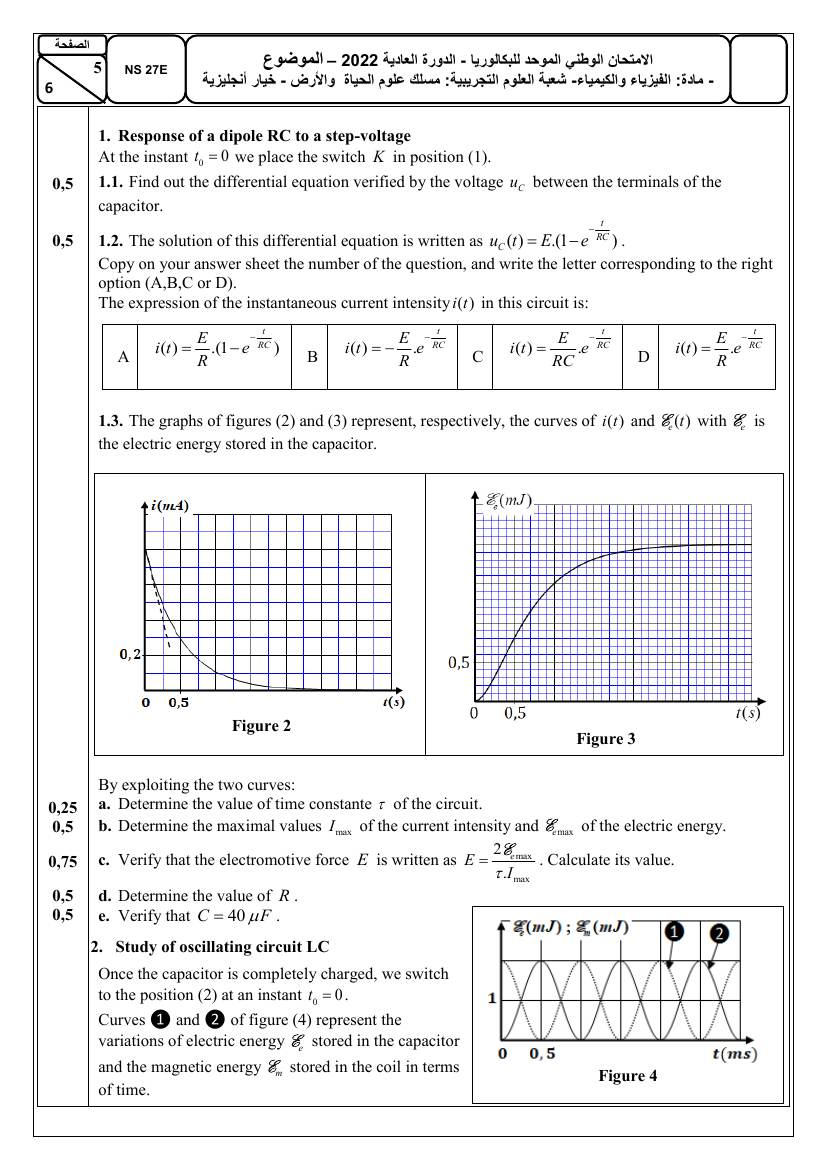
1.3. The graphs of figures (2) and (3) represent, respectively, the curves of i(t)i(t) and Ee(t)\mathcal{E}_e(t) with Ee\mathcal{E}_e is the electric energy stored in the capacitor.

Figure 2 : voir la page 5 du sujet

Figure 3 : voir la page 5 du sujet

By exploiting the two curves:

1.3.a.Determine the value of time constante τ\tau of the circuit.0,25 pt

1.3.b.Determine the maximal values Imax⁡I_{\max} of the current intensity and Eemax⁡\mathcal{E}_{e\max} of the electric energy.0,5 pt

1.3.c.Verify that the electromotive force EE is written as E=2Eemax⁡τ⋅Imax⁡E = \dfrac{2\mathcal{E}_{e\max}}{\tau\cdot I_{\max}}. Calculate its value.0,75 pt

1.3.d.Determine the value of RR.0,5 pt

1.3.e.Verify that C=40 μFC = 40\ \mu\mathrm{F}.0,5 pt

2. Study of oscillating circuit LC

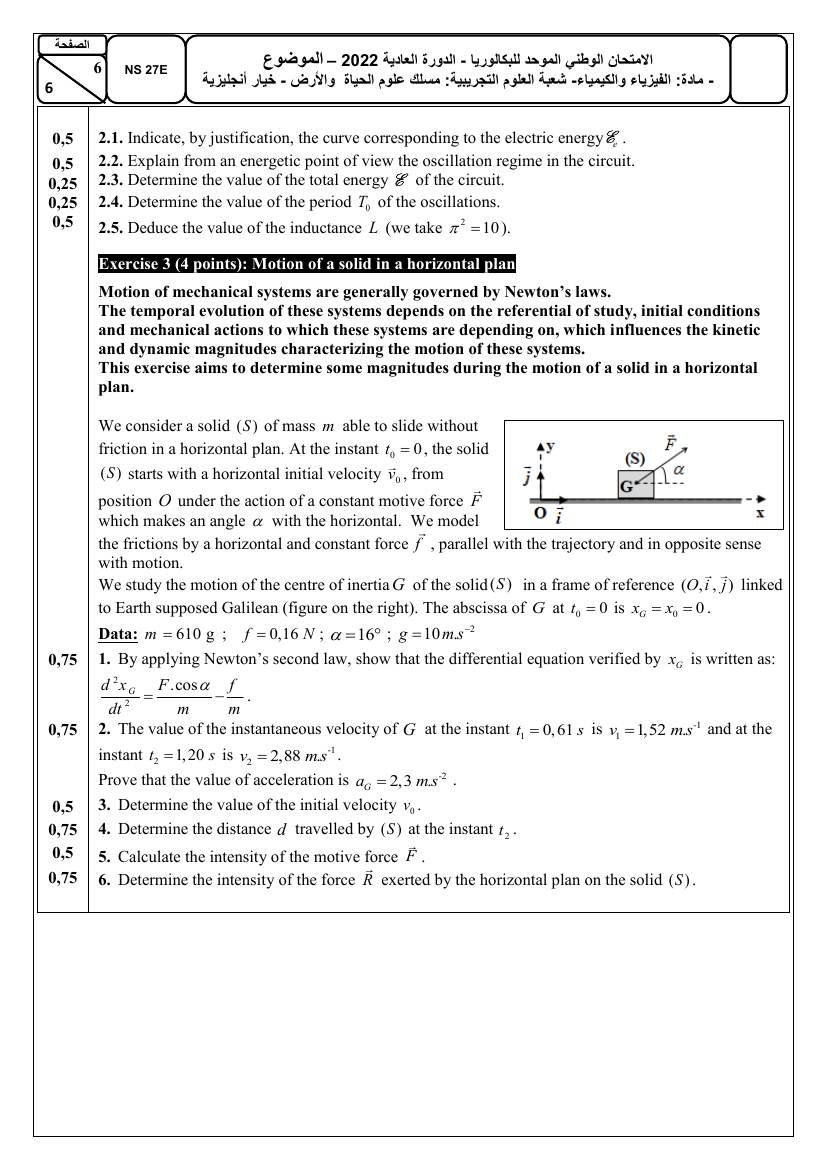
Once the capacitor is completely charged, we switch to the position (2) at an instant t0=0t_0 = 0. Curves ❶ and ❷ of figure (4) represent the variations of electric energy Ee\mathcal{E}_e stored in the capacitor and the magnetic energy Em\mathcal{E}_m stored in the coil in terms of time.

Figure 4 : voir la page 5 du sujet

2.1.Indicate, by justification, the curve corresponding to the electric energy Ee\mathcal{E}_e.0,5 pt

2.2.Explain from an energetic point of view the oscillation regime in the circuit.0,5 pt

2.3.Determine the value of the total energy E\mathcal{E} of the circuit.0,25 pt

2.4.Determine the value of the period T0T_0 of the oscillations.0,25 pt

2.5.Deduce the value of the inductance LL (we take π2=10\pi^2 = 10).0,5 pt

Physique – Exercice 34 pts

Exercise 3 (4 points): Motion of a solid in a horizontal plan

Motion of mechanical systems are generally governed by Newton’s laws. The temporal evolution of these systems depends on the referential of study, initial conditions and mechanical actions to which these systems are depending on, which influences the kinetic and dynamic magnitudes characterizing the motion of these systems.

This exercise aims to determine some magnitudes during the motion of a solid in a horizontal plan.

We consider a solid (S)(S) of mass mm able to slide without friction in a horizontal plan. At the instant t0=0t_0 = 0, the solid (S)(S) starts with a horizontal initial velocity v⃗0\vec{v}_0, from position OO under the action of a constant motive force F⃗\vec{F} which makes an angle α\alpha with the horizontal. We model the frictions by a horizontal and constant force f⃗\vec{f}, parallel with the trajectory and in opposite sense with motion.

Figure : voir la page 6 du sujet

We study the motion of the centre of inertia GG of the solid (S)(S) in a frame of reference (O,i⃗,j⃗)(O,\vec{i},\vec{j}) linked to Earth supposed Galilean (figure on the right). The abscissa of GG at t0=0t_0 = 0 is xG=x0=0x_G = x_0 = 0.

Data: m=610 gm = 610\ \mathrm{g} ; f=0,16 Nf = 0{,}16\ \mathrm{N} ; α=16∘\alpha = 16^\circ ; g=10 m⋅s−2g = 10\ \mathrm{m\cdot s^{-2}}

1.By applying Newton’s second law, show that the differential equation verified by xGx_G is written as: d2xGdt2=F⋅cos⁡αm−fm\dfrac{d^2x_G}{dt^2} = \dfrac{F\cdot\cos\alpha}{m} - \dfrac{f}{m}.0,75 pt

2.The value of the instantaneous velocity of GG at the instant t1=0,61 st_1 = 0{,}61\ \mathrm{s} is v1=1,52 m⋅s−1v_1 = 1{,}52\ \mathrm{m\cdot s^{-1}} and at the instant t2=1,20 st_2 = 1{,}20\ \mathrm{s} is v2=2,88 m⋅s−1v_2 = 2{,}88\ \mathrm{m\cdot s^{-1}}. Prove that the value of acceleration is aG=2,3 m⋅s−2a_G = 2{,}3\ \mathrm{m\cdot s^{-2}}.0,75 pt

3.Determine the value of the initial velocity v0v_0.0,5 pt

4.Determine the distance dd travelled by (S)(S) at the instant t2t_2.0,75 pt

5.Calculate the intensity of the motive force F⃗\vec{F}.0,5 pt

6.Determine the intensity of the force R⃗\vec{R} exerted by the horizontal plan on the solid (S)(S).0,75 pt

Entraîne-toi sur ces chapitres avec Kresco, gratuitement

Yallah, wa7d l-khtwa.

Le sujet, tu l’as. Maintenant, prépare-le.

Crée ton compte gratuit : une leçon offerte dans chaque chapitre, les quiz et ton suivi, matière par matière, jusqu’au national.