Chimie7 pts
Chemistry (7 points) Part I and Part II are independent.
Part I: Volumetric rate of a reaction; acid-base reactions
Chloride bleach is a chemical product of current use. It is a disinfectant and very effective against the bacterial and viral contaminations.
The active principle of the chloride bleach is due to the presence of the hypochlorite ion . This ion is able to act as either an oxidant and a base.
In this part of the exercise we study:
- The kinetics of the decomposition of hypochlorite ions ;
- Acid–base reactions using the pair .
1- Temporal Monitoring of the effective molar concentration of the hypochlorite ion
During the storing of the chloride bleach, hypochlorite ions contained in the bleach decomposes according to the chemical equation of reaction below:
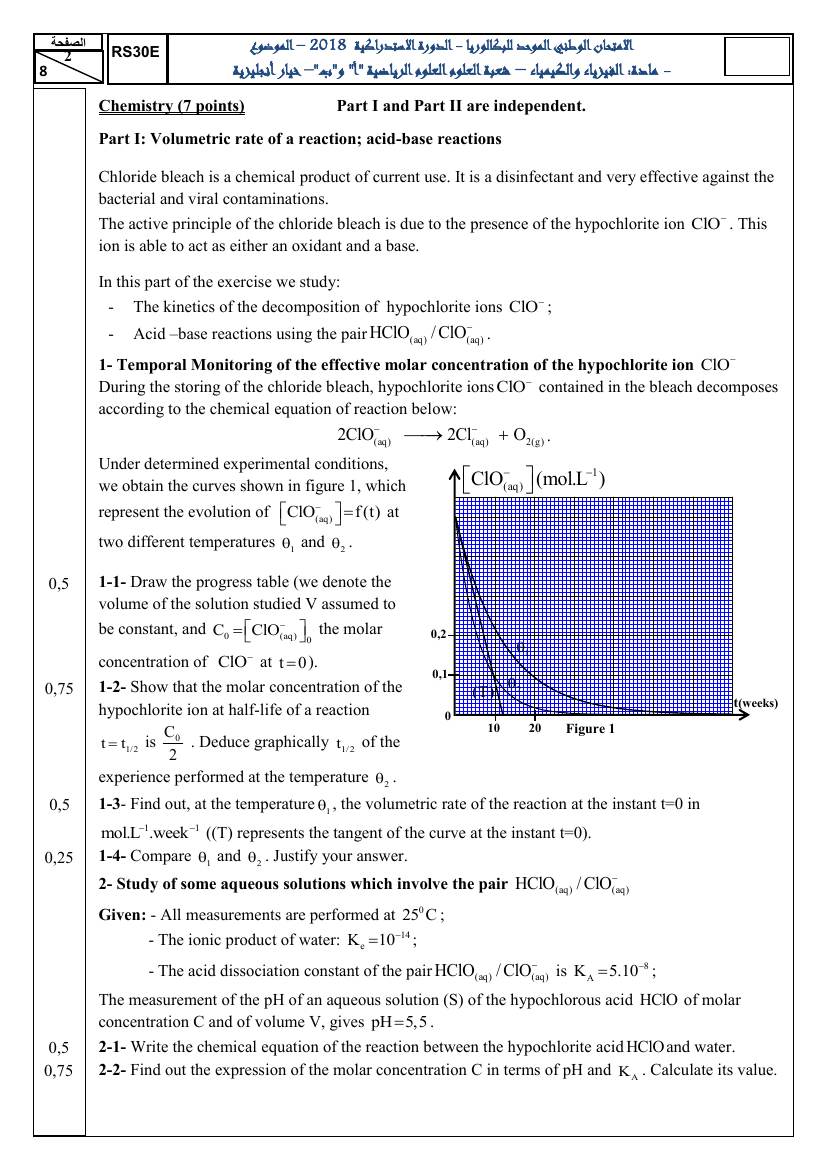
Under determined experimental conditions, we obtain the curves shown in figure 1, which represent the evolution of at two different temperatures and .
Figure 1 : voir la page 2 du sujet
1-1.Draw the progress table (we denote the volume of the solution studied assumed to be constant, and the molar concentration of at ).0,5 pt
1-2.Show that the molar concentration of the hypochlorite ion at half-life of a reaction is . Deduce graphically of the experience performed at the temperature .0,75 pt
1-3.Find out, at the temperature , the volumetric rate of the reaction at the instant in ((T) represents the tangent of the curve at the instant ).0,5 pt
1-4.Compare and . Justify your answer.0,25 pt
2- Study of some aqueous solutions which involve the pair
Given: - All measurements are performed at ;
- The ionic product of water: ;
- The acid dissociation constant of the pair is ;
The measurement of the pH of an aqueous solution (S) of the hypochlorous acid of molar concentration and of volume , gives .
2-1.Write the chemical equation of the reaction between the hypochlorite acid and water.0,5 pt
2-2.Find out the expression of the molar concentration in terms of pH and . Calculate its value.0,75 pt
2-3.We define the ratio of the base specie in a solution by: . Show that .0,5 pt
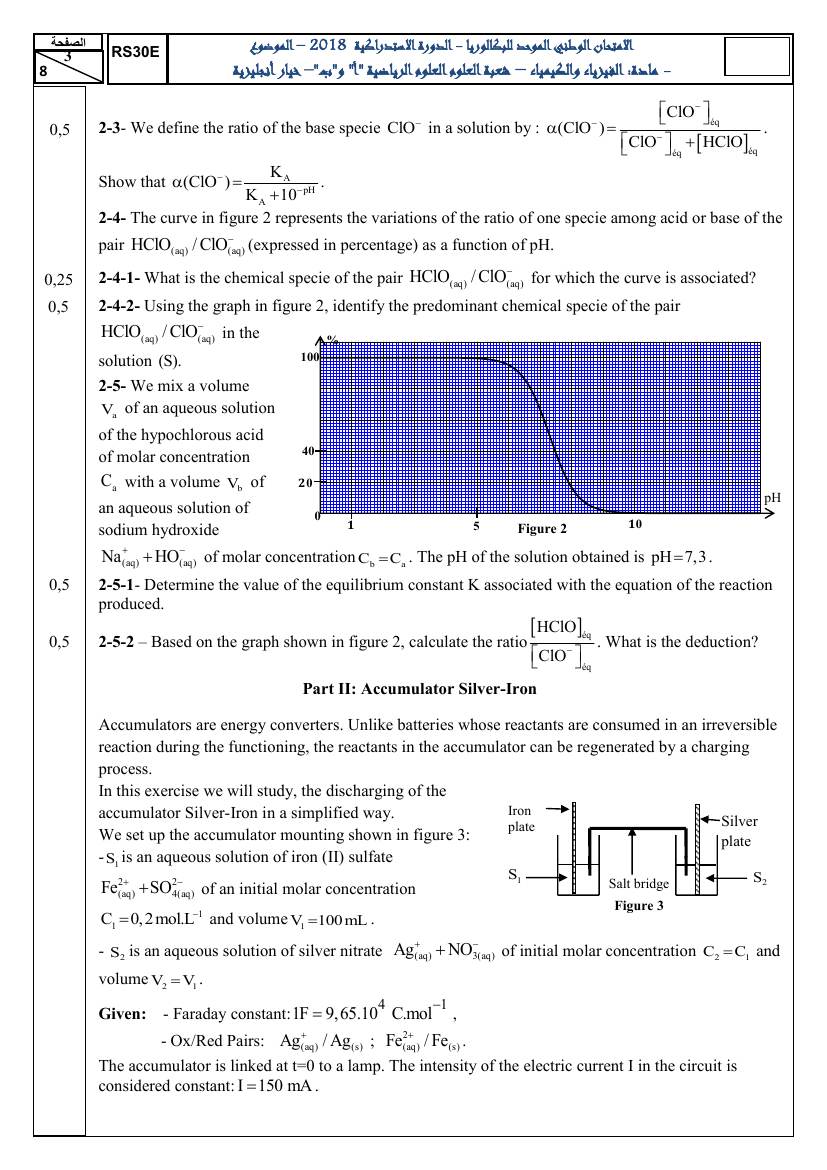
2-4- The curve in figure 2 represents the variations of the ratio of one specie among acid or base of the pair (expressed in percentage) as a function of pH.
Figure 2 : voir la page 3 du sujet
2-4-1.What is the chemical specie of the pair for which the curve is associated?0,25 pt
2-4-2.Using the graph in figure 2, identify the predominant chemical specie of the pair in the solution (S).0,5 pt
2-5- We mix a volume of an aqueous solution of the hypochlorous acid of molar concentration with a volume of an aqueous solution of sodium hydroxide of molar concentration . The pH of the solution obtained is .
2-5-1.Determine the value of the equilibrium constant associated with the equation of the reaction produced.0,5 pt
2-5-2.Based on the graph shown in figure 2, calculate the ratio . What is the deduction?0,5 pt
Part II: Accumulator Silver-Iron
Accumulators are energy converters. Unlike batteries whose reactants are consumed in an irreversible reaction during the functioning, the reactants in the accumulator can be regenerated by a charging process.
In this exercise we will study, the discharging of the accumulator Silver-Iron in a simplified way.
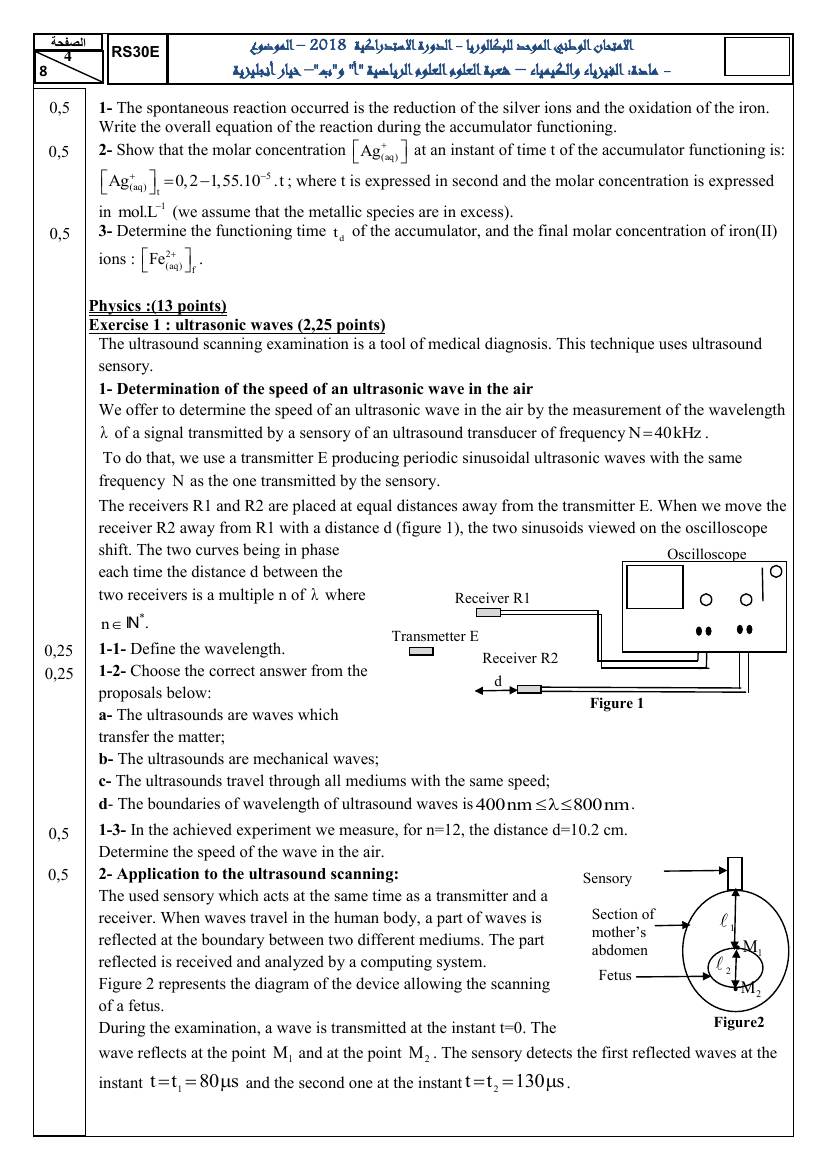
We set up the accumulator mounting shown in figure 3:
Figure 3 : voir la page 3 du sujet
- is an aqueous solution of iron (II) sulfate of an initial molar concentration and volume .
- is an aqueous solution of silver nitrate of initial molar concentration and volume .
Given: - Faraday constant: ,
- Ox/Red Pairs: ; .
The accumulator is linked at t=0 to a lamp. The intensity of the electric current in the circuit is considered constant: .
1.The spontaneous reaction occurred is the reduction of the silver ions and the oxidation of the iron. Write the overall equation of the reaction during the accumulator functioning.0,5 pt
2.Show that the molar concentration at an instant of time of the accumulator functioning is: ; where is expressed in second and the molar concentration is expressed in (we assume that the metallic species are in excess).0,5 pt
3.Determine the functioning time of the accumulator, and the final molar concentration of iron(II) ions: .0,5 pt
Revoir le cours : Suivi temporel d’une transformation chimique