Jerreb rassek f l-national.

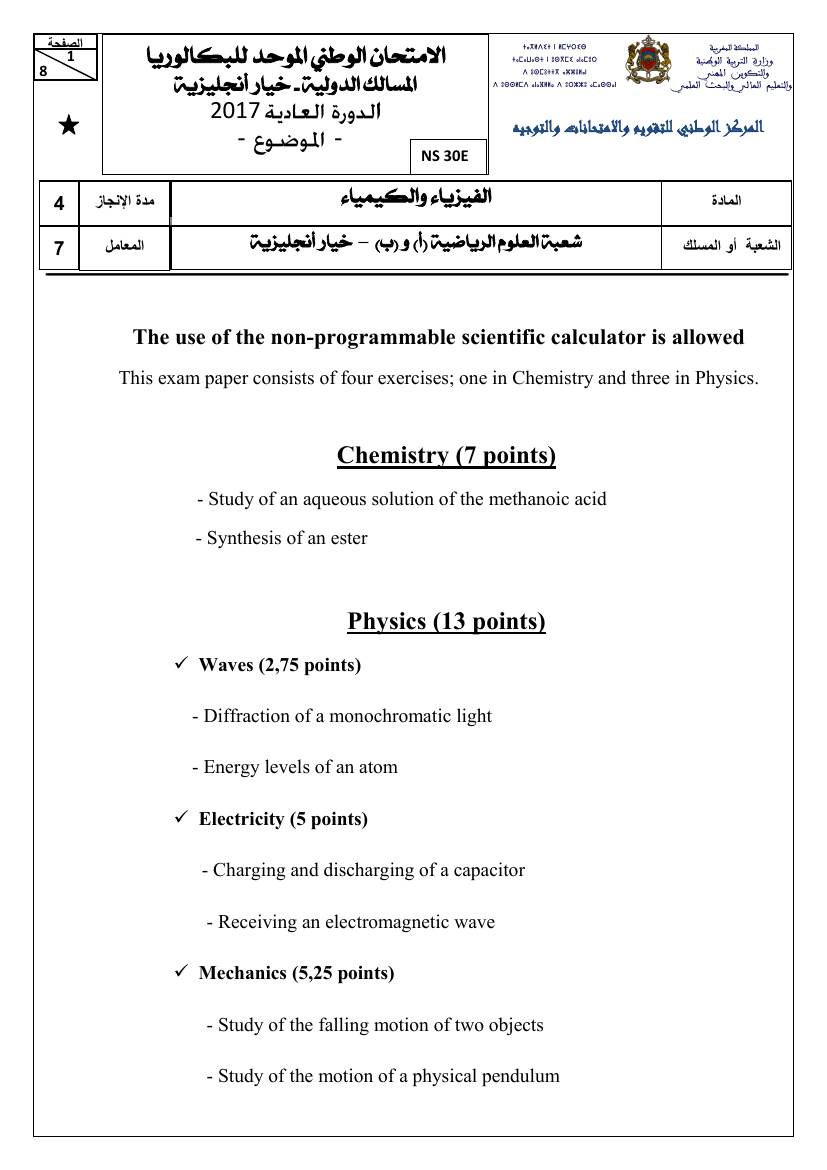
Examen national Physique-Chimie 2Bac SM (option anglaise) 2017, session normale

Physique-Chimie · Sciences Mathématiques A, Sciences Mathématiques B · 8 pages

Le sujet en bref

  1. Chimie7 pts

    Dosage acido-basique · Réactions acide-base · Estérification et hydrolyse

    L’acide méthanoïque et la synthèse d’un ester avec le propan-1-ol

  2. Physique – Exercice 12,75 pts

    Propagation des ondes lumineuses · L’atome et la mécanique de Newton

    La lumière rouge d’un laser hélium-néon et les niveaux d’énergie du néon

  3. Physique – Exercice 25 pts

    Dipôle RC · Oscillations libres d’un circuit RLC série · Ondes électromagnétiques et modulation d’amplitude

    La charge et la décharge d’un condensateur, puis la réception d’une onde modulée

  4. Physique – Exercice 35,25 pts

    Systèmes mécaniques oscillants · Chute verticale d’un solide · Mouvements plans

    La chute d’un objet avec frottement, un projectile, et une tige homogène oscillante

Total : 20 points

Le sujet, page par page

  1. Examen national Physique-Chimie 2Bac SM (option anglaise) 2017, session normale, page 1 sur 8
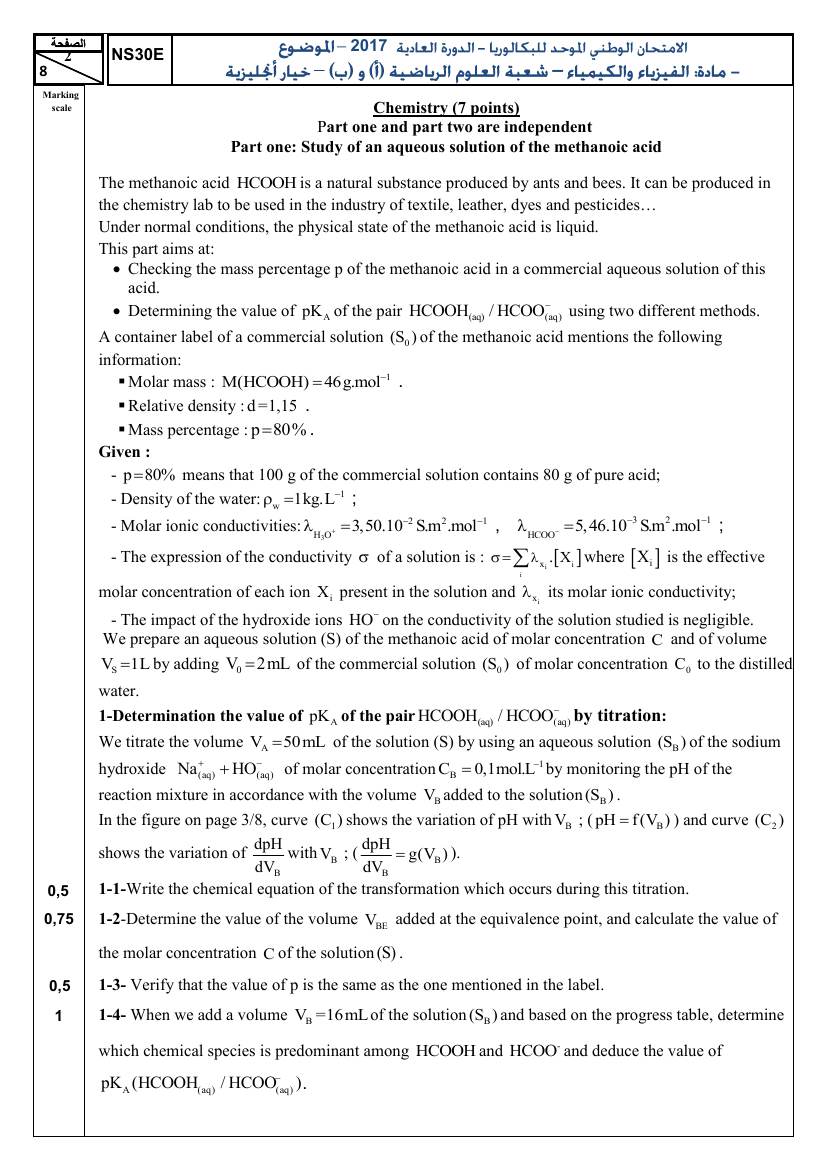
  2. Examen national Physique-Chimie 2Bac SM (option anglaise) 2017, session normale, page 2 sur 8
  3. Examen national Physique-Chimie 2Bac SM (option anglaise) 2017, session normale, page 3 sur 8
  4. Examen national Physique-Chimie 2Bac SM (option anglaise) 2017, session normale, page 4 sur 8
  5. Examen national Physique-Chimie 2Bac SM (option anglaise) 2017, session normale, page 5 sur 8
  6. Examen national Physique-Chimie 2Bac SM (option anglaise) 2017, session normale, page 6 sur 8
  7. Examen national Physique-Chimie 2Bac SM (option anglaise) 2017, session normale, page 7 sur 8
  8. Examen national Physique-Chimie 2Bac SM (option anglaise) 2017, session normale, page 8 sur 8

Sujet officiel de l’examen national unifié du baccalauréat, tel que publié par le Centre national de l’évaluation et des examens (Ministère de l’Éducation nationale).

L’énoncé en texte

Transcription du sujet officiel, pour le lire et le rechercher sur téléphone. Les figures restent sur les pages du sujet ; en cas de différence, le PDF officiel fait foi.

Chimie7 pts

Part one: Study of an aqueous solution of the methanoic acid

The methanoic acid HCOOH\mathrm{HCOOH} is a natural substance produced by ants and bees. It can be produced in the chemistry lab to be used in the industry of textile, leather, dyes and pesticides…

Under normal conditions, the physical state of the methanoic acid is liquid.

This part aims at:

Checking the mass percentage p of the methanoic acid in a commercial aqueous solution of this acid.

Determining the value of pKA\mathrm{pK_A} of the pair HCOOH(aq) / HCOO(aq)−\mathrm{HCOOH_{(aq)}\ /\ HCOO^-_{(aq)}} using two different methods.

A container label of a commercial solution (S0)(\mathrm{S_0}) of the methanoic acid mentions the following information:

Molar mass : M(HCOOH)=46 g⋅mol−1M(\mathrm{HCOOH}) = 46\ \mathrm{g\cdot mol^{-1}}.

Relative density : d=1,15d = 1{,}15.

Mass percentage : p=80 %p = 80\,\%.

Given :

p=80 %p = 80\,\% means that 100 g of the commercial solution contains 80 g of pure acid;

Density of the water: ρw=1 kg⋅L−1\rho_w = 1\ \mathrm{kg\cdot L^{-1}} ;

Molar ionic conductivities: λH3O+=3,50⋅10−2 S⋅m2⋅mol−1\lambda_{\mathrm{H_3O^+}} = 3{,}50\cdot 10^{-2}\ \mathrm{S\cdot m^2\cdot mol^{-1}}, λHCOO−=5,46⋅10−3 S⋅m2⋅mol−1\lambda_{\mathrm{HCOO^-}} = 5{,}46\cdot 10^{-3}\ \mathrm{S\cdot m^2\cdot mol^{-1}} ;

The expression of the conductivity σ\sigma of a solution is : σ=∑iλxi⋅[Xi]\sigma = \sum_i \lambda_{x_i}\cdot[X_i] where [Xi][X_i] is the effective molar concentration of each ion XiX_i present in the solution and λxi\lambda_{x_i} its molar ionic conductivity;

The impact of the hydroxide ions HO−\mathrm{HO^-} on the conductivity of the solution studied is negligible.

We prepare an aqueous solution (S) of the methanoic acid of molar concentration C and of volume VS=1 LV_S = 1\ \mathrm{L} by adding V0=2 mLV_0 = 2\ \mathrm{mL} of the commercial solution (S0)(\mathrm{S_0}) of molar concentration C0C_0 to the distilled water.

1-Determination the value of pK_A of the pair HCOOH(aq) / HCOO−(aq) by titration:

We titrate the volume VA=50 mLV_A = 50\ \mathrm{mL} of the solution (S) by using an aqueous solution (SB)(\mathrm{S_B}) of the sodium hydroxide Na(aq)++HO(aq)−\mathrm{Na^+_{(aq)} + HO^-_{(aq)}} of molar concentration CB=0,1 mol⋅L−1C_B = 0{,}1\ \mathrm{mol\cdot L^{-1}} by monitoring the pH of the reaction mixture in accordance with the volume VBV_B added to the solution (SB)(\mathrm{S_B}).

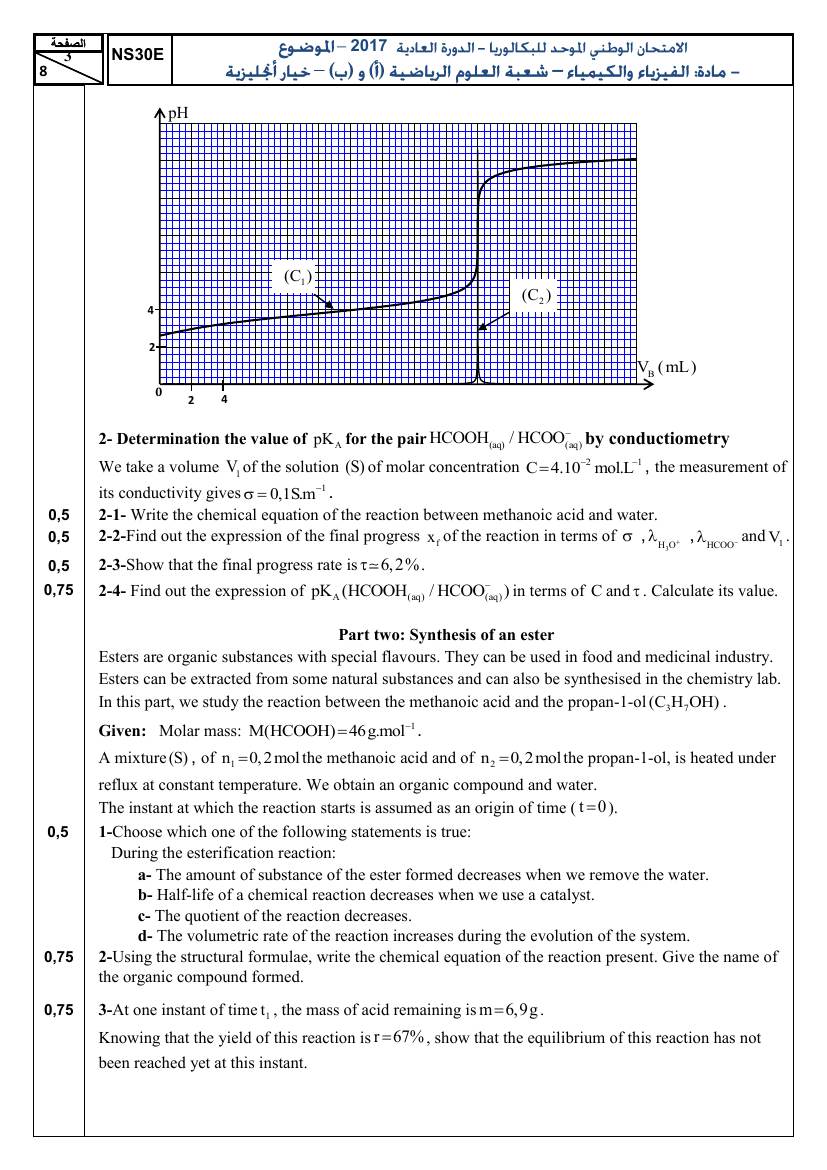
In the figure on page 3/8, curve (C1)(C_1) shows the variation of pH with VBV_B ; (pH=f(VB)\mathrm{pH} = f(V_B)) and curve (C2)(C_2) shows the variation of dpHdVB\dfrac{d\mathrm{pH}}{dV_B} with VBV_B ; (dpHdVB=g(VB)\dfrac{d\mathrm{pH}}{dV_B} = g(V_B)).

Figure : voir la page 3 du sujet

1.1.Write the chemical equation of the transformation which occurs during this titration.0,5 pt

1.2.Determine the value of the volume VBEV_{BE} added at the equivalence point, and calculate the value of the molar concentration C of the solution (S).0,75 pt

1.3.Verify that the value of p is the same as the one mentioned in the label.0,5 pt

1.4.When we add a volume VB=16 mLV_B = 16\ \mathrm{mL} of the solution (SB)(\mathrm{S_B}) and based on the progress table, determine which chemical species is predominant among HCOOH\mathrm{HCOOH} and HCOO−\mathrm{HCOO^-} and deduce the value of pKA(HCOOH(aq)/HCOO(aq)−)\mathrm{pK_A(HCOOH_{(aq)}/HCOO^-_{(aq)})}.1 pt

2- Determination the value of pK_A for the pair HCOOH(aq) / HCOO−(aq) by conductiometry

We take a volume V1V_1 of the solution (S) of molar concentration C=4⋅10−2 mol⋅L−1C = 4\cdot 10^{-2}\ \mathrm{mol\cdot L^{-1}}, the measurement of its conductivity gives σ=0,1 S⋅m−1\sigma = 0{,}1\ \mathrm{S\cdot m^{-1}}.

2.1.Write the chemical equation of the reaction between methanoic acid and water.0,5 pt

2.2.Find out the expression of the final progress xfx_f of the reaction in terms of σ\sigma, λH3O+\lambda_{\mathrm{H_3O^+}}, λHCOO−\lambda_{\mathrm{HCOO^-}} and V1V_1.0,5 pt

2.3.Show that the final progress rate is τ≃6,2 %\tau \simeq 6{,}2\,\%.0,5 pt

2.4.Find out the expression of pKA(HCOOH(aq)/HCOO(aq)−)\mathrm{pK_A(HCOOH_{(aq)}/HCOO^-_{(aq)})} in terms of C and τ\tau. Calculate its value.0,75 pt

Part two: Synthesis of an ester

Esters are organic substances with special flavours. They can be used in food and medicinal industry. Esters can be extracted from some natural substances and can also be synthesised in the chemistry lab.

In this part, we study the reaction between the methanoic acid and the propan-1-ol (C3H7OH)(\mathrm{C_3H_7OH}).

Given: Molar mass: M(HCOOH)=46 g⋅mol−1M(\mathrm{HCOOH}) = 46\ \mathrm{g\cdot mol^{-1}}.

A mixture (S), of n1=0,2 moln_1 = 0{,}2\ \mathrm{mol} the methanoic acid and of n2=0,2 moln_2 = 0{,}2\ \mathrm{mol} the propan-1-ol, is heated under reflux at constant temperature. We obtain an organic compound and water.

The instant at which the reaction starts is assumed as an origin of time (t=0t = 0).

1.Choose which one of the following statements is true: During the esterification reaction:0,5 pt

a.The amount of substance of the ester formed decreases when we remove the water.

b.Half-life of a chemical reaction decreases when we use a catalyst.

c.The quotient of the reaction decreases.

d.The volumetric rate of the reaction increases during the evolution of the system.

2.Using the structural formulae, write the chemical equation of the reaction present. Give the name of the organic compound formed.0,75 pt

3.At one instant of time t1t_1, the mass of acid remaining is m=6,9 gm = 6{,}9\ \mathrm{g}. Knowing that the yield of this reaction is r=67 %r = 67\,\%, show that the equilibrium of this reaction has not been reached yet at this instant.0,75 pt

Physique – Exercice 12,75 pts

Waves (2,75 points) : Diffraction of a monochromatic light – energy levels of an atom.

The purpose of this exercise is to study some properties of the red light emitted by a helium-neon laser (He-Ne). The wavelength of this light in the air is λ=633 nm\lambda = 633\ \mathrm{nm}.

Given : Speed of light in the air : c=3⋅108 m⋅s−1c = 3\cdot 10^{8}\ \mathrm{m\cdot s^{-1}} ;

Planck constant : h=6,63⋅10−34 J⋅sh = 6{,}63\cdot 10^{-34}\ \mathrm{J\cdot s} ;

1 eV=1,6022⋅10−19 J1\ \mathrm{eV} = 1{,}6022\cdot 10^{-19}\ \mathrm{J} ;

For the small angles, we have tan⁡θ≈θ\tan\theta \approx \theta where θ\theta is expressed in radian.

1-Diffraction of a monochromatic light emitted by helium-neon laser (He-Ne)

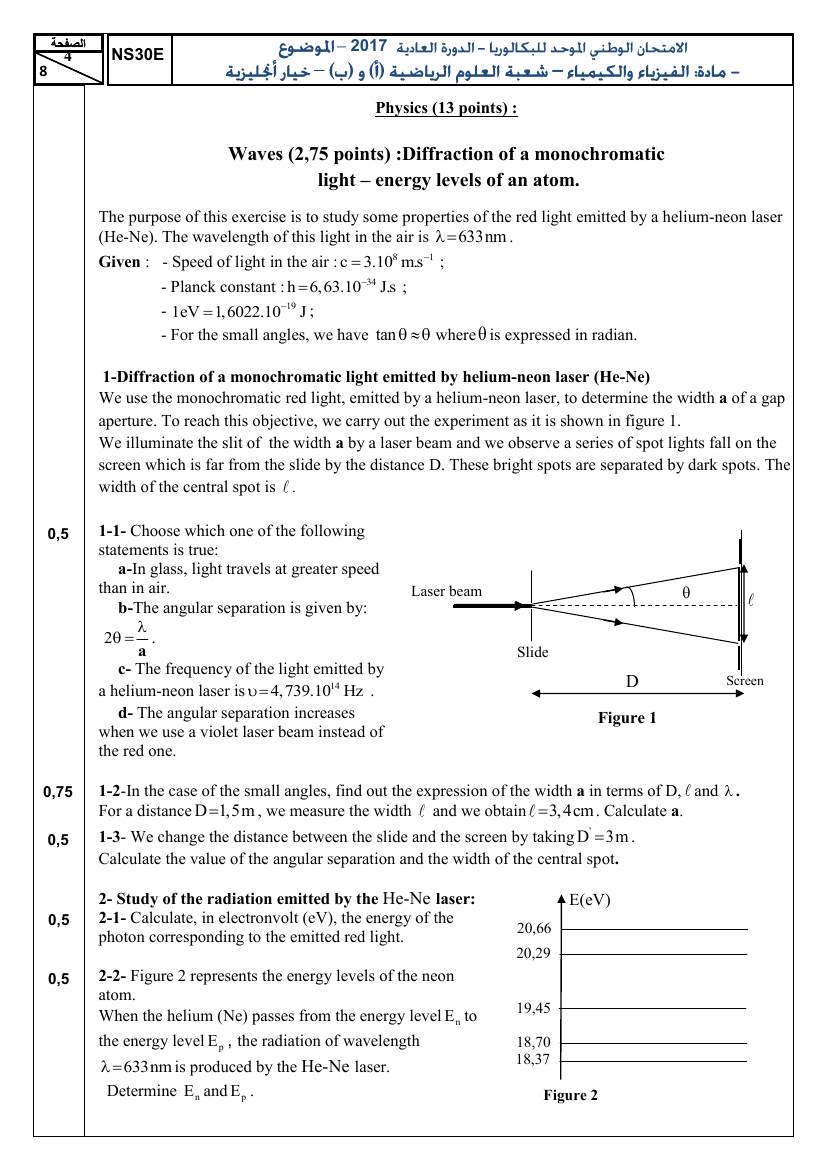
We use the monochromatic red light, emitted by a helium-neon laser, to determine the width a of a gap aperture. To reach this objective, we carry out the experiment as it is shown in figure 1.

We illuminate the slit of the width a by a laser beam and we observe a series of spot lights fall on the screen which is far from the slide by the distance D. These bright spots are separated by dark spots. The width of the central spot is ℓ\ell.

Figure 1 : voir la page 4 du sujet

1.1.Choose which one of the following statements is true:0,5 pt

a.In glass, light travels at greater speed than in air.

b.The angular separation is given by: 2θ=λa2\theta = \dfrac{\lambda}{a}.

c.The frequency of the light emitted by a helium-neon laser is υ=4,739⋅1014 Hz\upsilon = 4{,}739\cdot 10^{14}\ \mathrm{Hz}.

d.The angular separation increases when we use a violet laser beam instead of the red one.

1.2.In the case of the small angles, find out the expression of the width a in terms of D, ℓ\ell and λ\lambda. For a distance D=1,5 mD = 1{,}5\ \mathrm{m}, we measure the width ℓ\ell and we obtain ℓ=3,4 cm\ell = 3{,}4\ \mathrm{cm}. Calculate a.0,75 pt

1.3.We change the distance between the slide and the screen by taking D′=3 mD' = 3\ \mathrm{m}. Calculate the value of the angular separation and the width of the central spot.0,5 pt

2- Study of the radiation emitted by the He-Ne laser:

2.1.Calculate, in electronvolt (eV), the energy of the photon corresponding to the emitted red light.0,5 pt

2.2.Figure 2 represents the energy levels of the neon atom. When the helium (Ne) passes from the energy level EnE_n to the energy level EpE_p, the radiation of wavelength λ=633 nm\lambda = 633\ \mathrm{nm} is produced by the He-Ne laser. Determine EnE_n and EpE_p.0,5 pt

Figure 2 : voir la page 4 du sujet

E (eV)
20,66
20,29
19,45
18,70
18,37

Revoir le cours : Propagation des ondes lumineuses

Physique – Exercice 25 pts

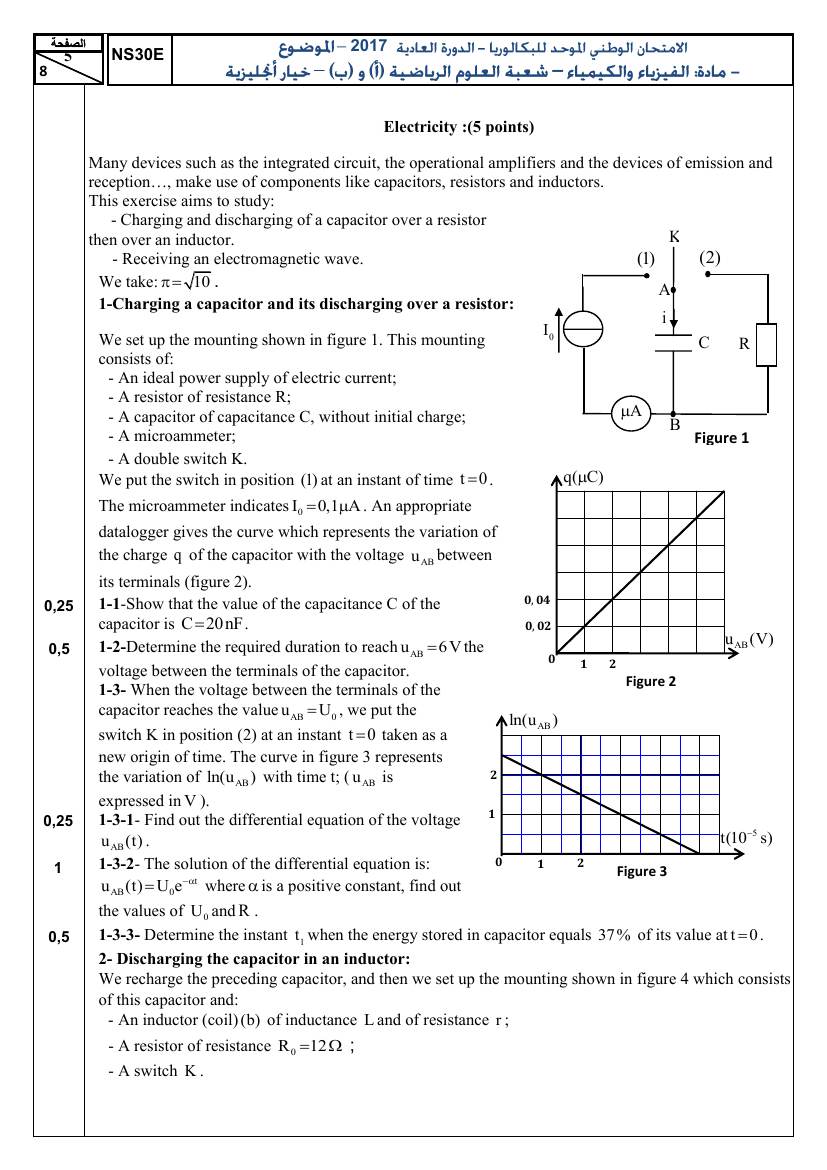
Electricity : (5 points)

Many devices such as the integrated circuit, the operational amplifiers and the devices of emission and reception…, make use of components like capacitors, resistors and inductors.

This exercise aims to study:

Charging and discharging of a capacitor over a resistor then over an inductor.

Receiving an electromagnetic wave.

We take: π=10\pi = \sqrt{10}.

1-Charging a capacitor and its discharging over a resistor:

We set up the mounting shown in figure 1. This mounting consists of:

An ideal power supply of electric current;

A resistor of resistance R;

A capacitor of capacitance C, without initial charge;

A microammeter;

A double switch K.

Figure 1 : voir la page 5 du sujet

We put the switch in position (1) at an instant of time t=0t = 0. The microammeter indicates I0=0,1 μAI_0 = 0{,}1\ \mu\mathrm{A}. An appropriate datalogger gives the curve which represents the variation of the charge q of the capacitor with the voltage uABu_{AB} between its terminals (figure 2).

Figure 2 : voir la page 5 du sujet

1.1.Show that the value of the capacitance C of the capacitor is C=20 nFC = 20\ \mathrm{nF}.0,25 pt

1.2.Determine the required duration to reach uAB=6 Vu_{AB} = 6\ \mathrm{V} the voltage between the terminals of the capacitor.0,5 pt

1-3- When the voltage between the terminals of the capacitor reaches the value uAB=U0u_{AB} = U_0, we put the switch K in position (2) at an instant t=0t = 0 taken as a new origin of time. The curve in figure 3 represents the variation of ln⁡(uAB)\ln(u_{AB}) with time t; (uABu_{AB} is expressed in V).

Figure 3 : voir la page 5 du sujet

1.3.1.Find out the differential equation of the voltage uAB(t)u_{AB}(t).0,25 pt

1.3.2.The solution of the differential equation is: uAB(t)=U0e−αtu_{AB}(t) = U_0 e^{-\alpha t} where α\alpha is a positive constant, find out the values of U0U_0 and R.1 pt

1.3.3.Determine the instant t1t_1 when the energy stored in capacitor equals 37 %37\,\% of its value at t=0t = 0.0,5 pt

2- Discharging the capacitor in an inductor:

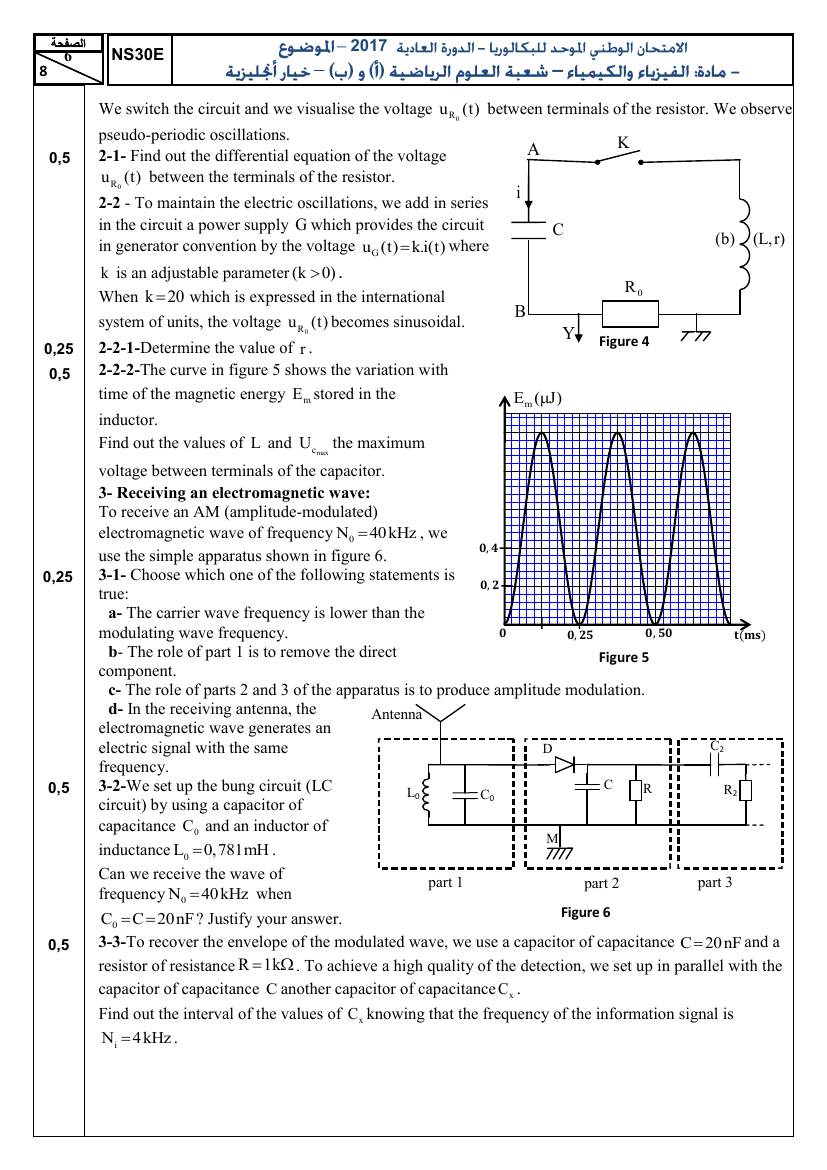
We recharge the preceding capacitor, and then we set up the mounting shown in figure 4 which consists of this capacitor and:

An inductor (coil) (b) of inductance L and of resistance r ;

A resistor of resistance R0=12 ΩR_0 = 12\ \Omega ;

A switch K.

We switch the circuit and we visualise the voltage uR0(t)u_{R_0}(t) between terminals of the resistor. We observe pseudo-periodic oscillations.

Figure 4 : voir la page 6 du sujet

2.1.Find out the differential equation of the voltage uR0(t)u_{R_0}(t) between the terminals of the resistor.0,5 pt

2-2 - To maintain the electric oscillations, we add in series in the circuit a power supply G which provides the circuit in generator convention by the voltage uG(t)=k⋅i(t)u_G(t) = k\cdot i(t) where k is an adjustable parameter (k>0k > 0). When k=20k = 20 which is expressed in the international system of units, the voltage uR0(t)u_{R_0}(t) becomes sinusoidal.

2.2.1.Determine the value of r.0,25 pt

2.2.2.The curve in figure 5 shows the variation with time of the magnetic energy EmE_m stored in the inductor. Find out the values of L and UCmaxU_{C_{max}} the maximum voltage between terminals of the capacitor.0,5 pt

Figure 5 : voir la page 6 du sujet

3- Receiving an electromagnetic wave:

To receive an AM (amplitude-modulated) electromagnetic wave of frequency N0=40 kHzN_0 = 40\ \mathrm{kHz}, we use the simple apparatus shown in figure 6.

Figure 6 : voir la page 6 du sujet

3.1.Choose which one of the following statements is true:0,25 pt

a.The carrier wave frequency is lower than the modulating wave frequency.

b.The role of part 1 is to remove the direct component.

c.The role of parts 2 and 3 of the apparatus is to produce amplitude modulation.

d.In the receiving antenna, the electromagnetic wave generates an electric signal with the same frequency.

3.2.We set up the bung circuit (LC circuit) by using a capacitor of capacitance C0C_0 and an inductor of inductance L0=0,781 mHL_0 = 0{,}781\ \mathrm{mH}. Can we receive the wave of frequency N0=40 kHzN_0 = 40\ \mathrm{kHz} when C0=C=20 nFC_0 = C = 20\ \mathrm{nF} ? Justify your answer.0,5 pt

3.3.To recover the envelope of the modulated wave, we use a capacitor of capacitance C=20 nFC = 20\ \mathrm{nF} and a resistor of resistance R=1 kΩR = 1\ \mathrm{k\Omega}. To achieve a high quality of the detection, we set up in parallel with the capacitor of capacitance C another capacitor of capacitance CxC_x. Find out the interval of the values of CxC_x knowing that the frequency of the information signal is Ni=4 kHzN_i = 4\ \mathrm{kHz}.0,5 pt

Physique – Exercice 35,25 pts

Mechanics : (5,25 marks)

Part one and part two are independent

Part one: Study the falling motion of two objects

In this part, we study the falling motion of two objects (A) and (B) in the frame of reference R(O,i⃗,j⃗)R(O,\vec{i},\vec{j}) linked to the earth assumed Galilean. Point O is located on the ground (Figure 1).

The upthrust force (Archimedes’ force) is negligible about other forces and we take the gravitational field strength g=10 m⋅s−2g = 10\ \mathrm{m\cdot s^{-2}}.

1-Study the falling of an object with friction:

At an instant assumed the origin of time (t=0t = 0), we liberate from the position H (figure 1), without initial velocity, an object (A) with the center of inertia GAG_A and of mass mA=0,5 kgm_A = 0{,}5\ \mathrm{kg}.

In addition to its weight, the object (A) obeys to a frictional fluid force (viscous force) f⃗=−k⋅vA⃗\vec{f} = -k\cdot\vec{v_A} where vA⃗\vec{v_A} is the velocity of GAG_A at one instant t and k is a positive constant.

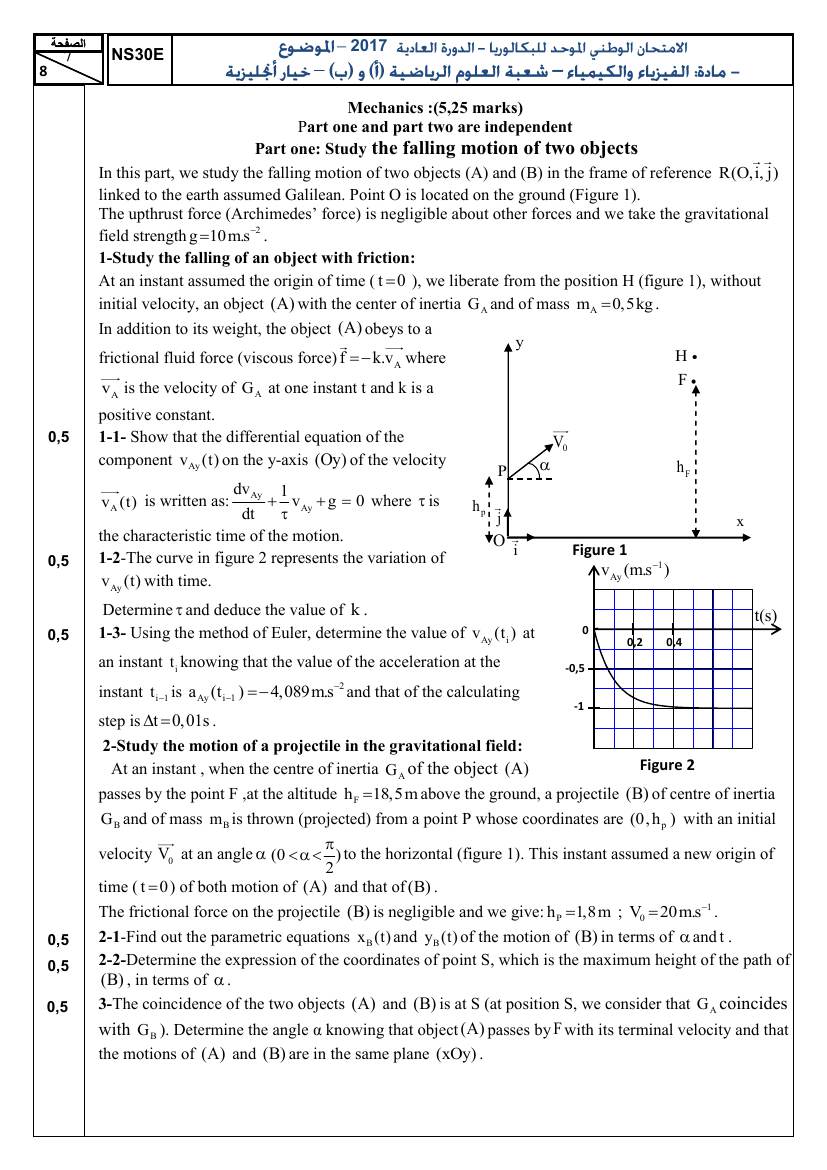
Figure 1 : voir la page 7 du sujet

1.1.Show that the differential equation of the component vAy(t)v_{Ay}(t) on the y-axis (Oy) of the velocity vA⃗(t)\vec{v_A}(t) is written as: dvAydt+1τvAy+g=0\dfrac{dv_{Ay}}{dt} + \dfrac{1}{\tau}v_{Ay} + g = 0 where τ\tau is the characteristic time of the motion.0,5 pt

1.2.The curve in figure 2 represents the variation of vAy(t)v_{Ay}(t) with time. Determine τ\tau and deduce the value of k.0,5 pt

Figure 2 : voir la page 7 du sujet

1.3.Using the method of Euler, determine the value of vAy(ti)v_{Ay}(t_i) at an instant tit_i knowing that the value of the acceleration at the instant ti−1t_{i-1} is aAy(ti−1)=−4,089 m⋅s−2a_{Ay}(t_{i-1}) = -4{,}089\ \mathrm{m\cdot s^{-2}} and that of the calculating step is Δt=0,01 s\Delta t = 0{,}01\ \mathrm{s}.0,5 pt

2-Study the motion of a projectile in the gravitational field:

At an instant , when the centre of inertia GAG_A of the object (A) passes by the point F ,at the altitude hF=18,5 mh_F = 18{,}5\ \mathrm{m} above the ground, a projectile (B) of centre of inertia GBG_B and of mass mBm_B is thrown (projected) from a point P whose coordinates are (0,hP)(0, h_P) with an initial velocity V0⃗\vec{V_0} at an angle α\alpha (0<α<π20 < \alpha < \dfrac{\pi}{2}) to the horizontal (figure 1). This instant assumed a new origin of time (t=0t = 0) of both motion of (A) and that of (B).

The frictional force on the projectile (B) is negligible and we give: hP=1,8 mh_P = 1{,}8\ \mathrm{m} ; V0=20 m⋅s−1V_0 = 20\ \mathrm{m\cdot s^{-1}}.

2.1.Find out the parametric equations xB(t)x_B(t) and yB(t)y_B(t) of the motion of (B) in terms of α\alpha and t.0,5 pt

2.2.Determine the expression of the coordinates of point S, which is the maximum height of the path of (B), in terms of α\alpha.0,5 pt

3.The coincidence of the two objects (A) and (B) is at S (at position S, we consider that GAG_A coincides with GBG_B). Determine the angle α\alpha knowing that object (A) passes by F with its terminal velocity and that the motions of (A) and (B) are in the same plane (xOy).0,5 pt

Part two: Study the motion of a physical pendulum

This part aims at determining of the gravitational field strength on a place and some physical quantities linked to the motion of the physical pendulum motion.

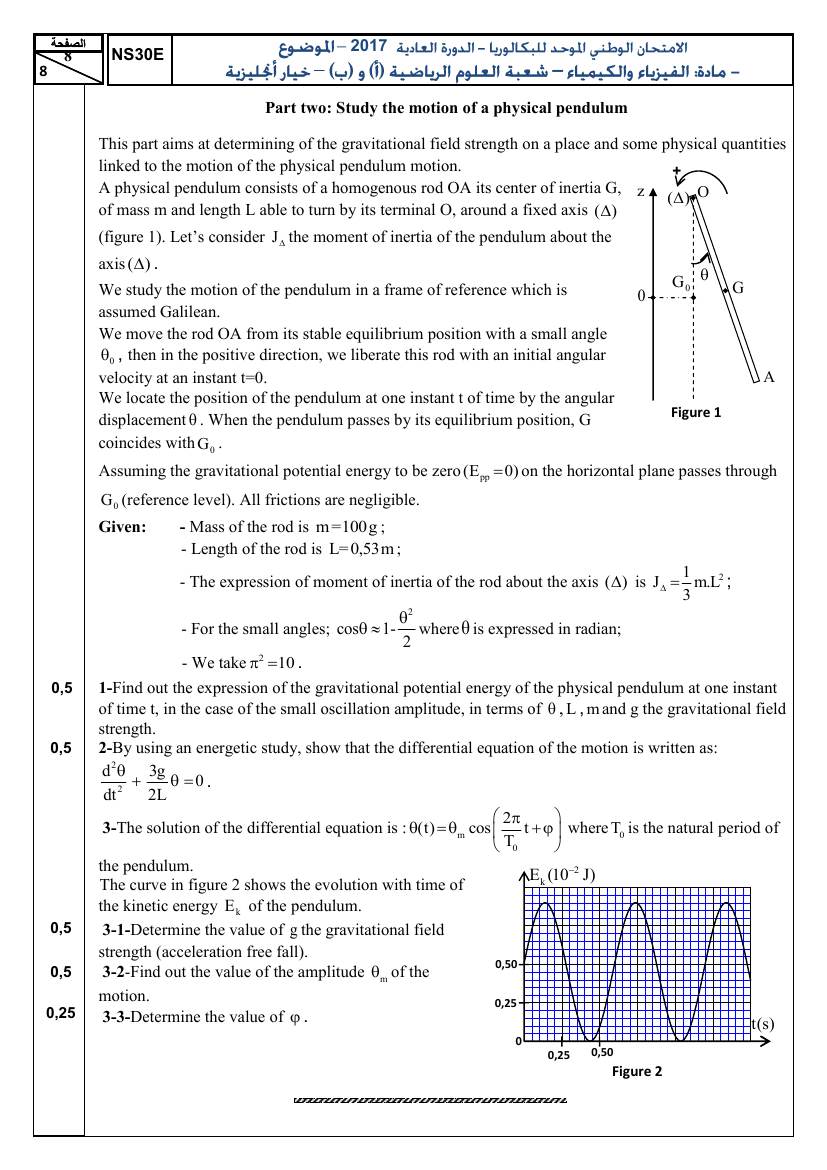
A physical pendulum consists of a homogenous rod OA its center of inertia G, of mass m and length L able to turn by its terminal O, around a fixed axis (Δ)(\Delta) (figure 1). Let’s consider JΔJ_\Delta the moment of inertia of the pendulum about the axis (Δ)(\Delta).

We study the motion of the pendulum in a frame of reference which is assumed Galilean.

We move the rod OA from its stable equilibrium position with a small angle θ0\theta_0, then in the positive direction, we liberate this rod with an initial angular velocity at an instant t=0.

We locate the position of the pendulum at one instant t of time by the angular displacement θ\theta. When the pendulum passes by its equilibrium position, G coincides with G0G_0.

Figure 1 : voir la page 8 du sujet

Assuming the gravitational potential energy to be zero (Epp=0E_{pp} = 0) on the horizontal plane passes through G0G_0 (reference level). All frictions are negligible.

Given: Mass of the rod is m=100 gm = 100\ \mathrm{g} ;

Length of the rod is L=0,53 mL = 0{,}53\ \mathrm{m} ;

The expression of moment of inertia of the rod about the axis (Δ)(\Delta) is JΔ=13m⋅L2J_\Delta = \dfrac{1}{3}m\cdot L^2 ;

For the small angles; cos⁡θ≈1−θ22\cos\theta \approx 1 - \dfrac{\theta^2}{2} where θ\theta is expressed in radian;

We take π2=10\pi^2 = 10.

1.Find out the expression of the gravitational potential energy of the physical pendulum at one instant of time t, in the case of the small oscillation amplitude, in terms of θ\theta, L, m and g the gravitational field strength.0,5 pt

2.By using an energetic study, show that the differential equation of the motion is written as: d2θdt2+3g2Lθ=0\dfrac{d^2\theta}{dt^2} + \dfrac{3g}{2L}\theta = 0.0,5 pt

3-The solution of the differential equation is : θ(t)=θmcos⁡(2πT0t+φ)\theta(t) = \theta_m \cos\left(\dfrac{2\pi}{T_0}t + \varphi\right) where T0T_0 is the natural period of the pendulum.

The curve in figure 2 shows the evolution with time of the kinetic energy EkE_k of the pendulum.

Figure 2 : voir la page 8 du sujet

3.1.Determine the value of g the gravitational field strength (acceleration free fall).0,5 pt

3.2.Find out the value of the amplitude θm\theta_m of the motion.0,5 pt

3.3.Determine the value of φ\varphi.0,25 pt

Entraîne-toi sur ces chapitres avec Kresco, gratuitement

Yallah, wa7d l-khtwa.

Le sujet, tu l’as. Maintenant, prépare-le.

Crée ton compte gratuit : une leçon offerte dans chaque chapitre, les quiz et ton suivi, matière par matière, jusqu’au national.