Jerreb rassek f l-national.

Examen national Physique-Chimie 2Bac SM (option anglaise) 2018, session normale

Physique-Chimie · Sciences Mathématiques A, Sciences Mathématiques B · 8 pages

Le sujet en bref

  1. Chimie7 pts

    Réactions acide-base · Estérification et hydrolyse · Électrolyse (transformations forcées)

    L’acide 2-méthylpropanoïque, l’hydrolyse d’un ester et l’électrolyse de l’eau

  2. Physique – Exercice 13,25 pts

    Décroissance radioactive · Mouvements plans · Noyaux, masse et énergie

    Le radium 226 et une particule alpha dans un champ magnétique uniforme

  3. Physique – Exercice 25 pts

    Dipôle RL · Dipôle RC · Circuit RLC série en régime sinusoïdal forcé

  4. Physique – Exercice 34,75 pts

    Chute verticale d’un solide · Systèmes mécaniques oscillants · Aspects énergétiques des oscillations

    Un plongeur dans l’air puis dans l’eau, et un pendule élastique sur un plan incliné

Total : 20 points

Le sujet, page par page

  1. Examen national Physique-Chimie 2Bac SM (option anglaise) 2018, session normale, page 1 sur 8
  2. Examen national Physique-Chimie 2Bac SM (option anglaise) 2018, session normale, page 2 sur 8
  3. Examen national Physique-Chimie 2Bac SM (option anglaise) 2018, session normale, page 3 sur 8
  4. Examen national Physique-Chimie 2Bac SM (option anglaise) 2018, session normale, page 4 sur 8
  5. Examen national Physique-Chimie 2Bac SM (option anglaise) 2018, session normale, page 5 sur 8
  6. Examen national Physique-Chimie 2Bac SM (option anglaise) 2018, session normale, page 6 sur 8
  7. Examen national Physique-Chimie 2Bac SM (option anglaise) 2018, session normale, page 7 sur 8
  8. Examen national Physique-Chimie 2Bac SM (option anglaise) 2018, session normale, page 8 sur 8

Sujet officiel de l’examen national unifié du baccalauréat, tel que publié par le Centre national de l’évaluation et des examens (Ministère de l’Éducation nationale).

L’énoncé en texte

Transcription du sujet officiel, pour le lire et le rechercher sur téléphone. Les figures restent sur les pages du sujet ; en cas de différence, le PDF officiel fait foi.

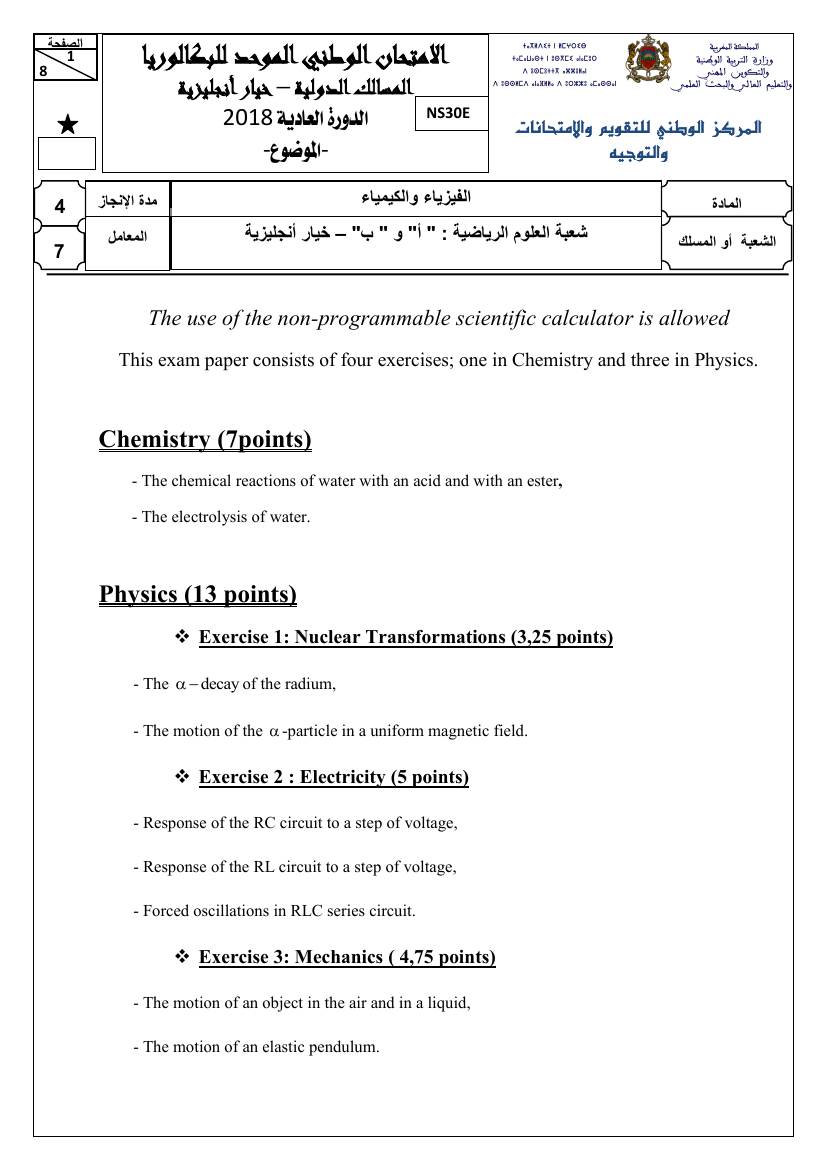
Chimie7 pts

Water is chemical specie which plays an important role in chemistry of aqueous solutions. We will study in this exercise:

- An aqueous solution of an acid;

- Hydrolysis of an ester;

- Electrolysis of water.

1-Study of an aqueous solution of an acid HA:

We prepare an aqueous solution SA\mathrm{S_A} of 2-methylpropanoic acid, denoted HA\mathrm{HA}, of volume VV and molar concentration C=10−2 mol⋅L−1C = 10^{-2}\ \mathrm{mol\cdot L^{-1}}. We denote by A−\mathrm{A^-} the conjugate base of HA\mathrm{HA}.

The measurement of pH of the solution SA\mathrm{S_A} gives the value pH=3.44\mathrm{pH} = 3.44.

1-1.Write the chemical equation of the reaction between the acid HA\mathrm{HA} and water.0,25 pt

1-2.Calculate the final progress rate of the reaction, and deduce which chemical specie is predominant of the pair HA(aq)/A(aq)−\mathrm{HA_{(aq)}/A^-_{(aq)}}.0,75 pt

1-3.Find out the expression of the constant pKA\mathrm{pK_A} of the pair HA(aq)/A(aq)−\mathrm{HA_{(aq)}/A^-_{(aq)}} in terms of CC and pH. Check that pKA≈4.86\mathrm{pK_A} \approx 4.86.0,75 pt

1-4-We take a volume VA=20 mLV_A = 20\ \mathrm{mL} of the aqueous solution SA\mathrm{S_A} to which we add progressively a volume VBV_B of an aqueous solution (SB)(\mathrm{S_B}) of sodium hydroxide Na(aq)++HO(aq)−\mathrm{Na^+_{(aq)} + HO^-_{(aq)}} of molar concentration CB=CC_B = C where VB<20 mLV_B < 20\ \mathrm{mL}.

1-4-1.Write the chemical equation of the occurring reaction (the reaction is considered complete).0,5 pt

1-4-2.Find out the value of the volume VBV_B of the aqueous solution (SB)(\mathrm{S_B}) added at the moment when pH of the reaction mixture is pH=5.50\mathrm{pH} = 5.50.0,5 pt

2- Hydrolysis of an ester:

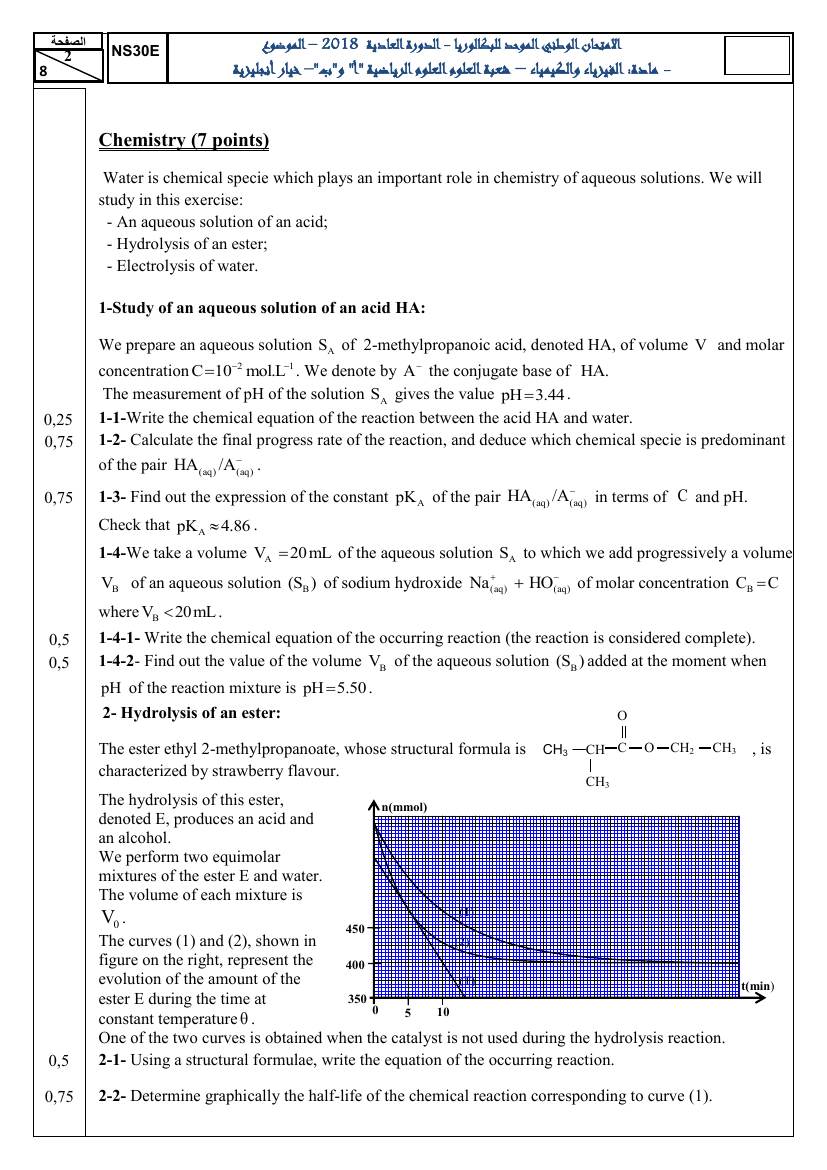
The ester ethyl 2-methylpropanoate, whose structural formula is CH3−CH(CH3)−C(=O)−O−CH2−CH3\mathrm{CH_3-CH(CH_3)-C(=O)-O-CH_2-CH_3}, is characterized by strawberry flavour.

The hydrolysis of this ester, denoted E, produces an acid and an alcohol.

We perform two equimolar mixtures of the ester E and water. The volume of each mixture is V0V_0.

The curves (1) and (2), shown in figure on the right, represent the evolution of the amount of the ester E during the time at constant temperature θ\theta.

Figure : voir la page 2 du sujet

One of the two curves is obtained when the catalyst is not used during the hydrolysis reaction.

2-1.Using a structural formulae, write the equation of the occurring reaction.0,5 pt

2-2.Determine graphically the half-life of the chemical reaction corresponding to curve (1).0,75 pt

2-3.Indicate, justifying your answer, the curve which corresponds to the hydrolysis reaction performed without the use of the catalyst.0,5 pt

2-4.Using the curve (2), determine the volumetric rate of the reaction expressed in mol⋅L−1⋅min−1\mathrm{mol\cdot L^{-1}\cdot min^{-1}}, at the instant of time t1=5 mint_1 = 5\ \mathrm{min} ( (T) represents the tangent of the curve (2) at the instant t1t_1 ). We take the volume of the mixture V0=71 mLV_0 = 71\ \mathrm{mL}.0,75 pt

1- Electrolysis of water:

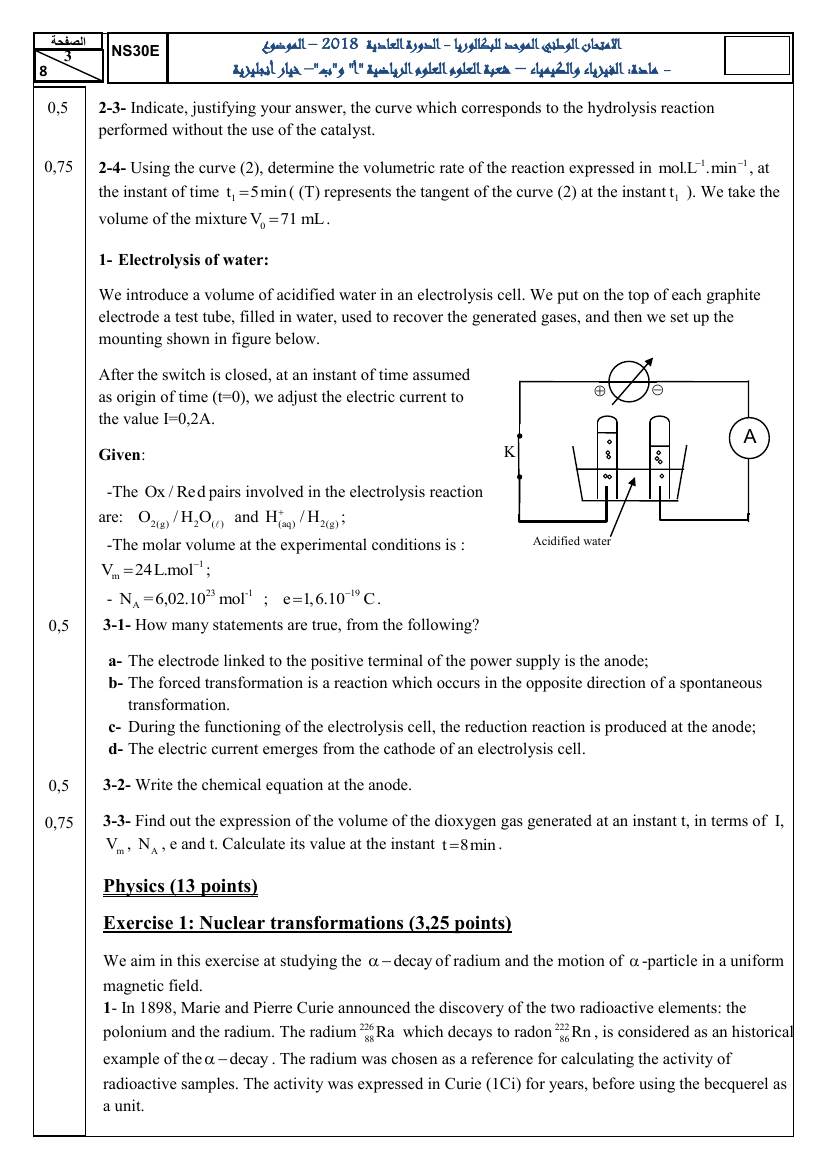
We introduce a volume of acidified water in an electrolysis cell. We put on the top of each graphite electrode a test tube, filled in water, used to recover the generated gases, and then we set up the mounting shown in figure below.

After the switch is closed, at an instant of time assumed as origin of time (t=0), we adjust the electric current to the value I=0,2A.

Figure : voir la page 3 du sujet

Given:

-The Ox/Red pairs involved in the electrolysis reaction are: O2(g)/H2O(ℓ)\mathrm{O_{2(g)}/H_2O_{(\ell)}} and H(aq)+/H2(g)\mathrm{H^+_{(aq)}/H_{2(g)}};

-The molar volume at the experimental conditions is : Vm=24 L⋅mol−1V_m = 24\ \mathrm{L\cdot mol^{-1}};

- NA=6,02⋅1023 mol−1N_A = 6{,}02\cdot 10^{23}\ \mathrm{mol^{-1}} ; e=1,6⋅10−19 Ce = 1{,}6\cdot 10^{-19}\ \mathrm{C}.

3-1.How many statements are true, from the following? a- The electrode linked to the positive terminal of the power supply is the anode; b- The forced transformation is a reaction which occurs in the opposite direction of a spontaneous transformation. c- During the functioning of the electrolysis cell, the reduction reaction is produced at the anode; d- The electric current emerges from the cathode of an electrolysis cell.0,5 pt

3-2.Write the chemical equation at the anode.0,5 pt

3-3.Find out the expression of the volume of the dioxygen gas generated at an instant t, in terms of II, VmV_m, NAN_A, ee and tt. Calculate its value at the instant t=8 mint = 8\ \mathrm{min}.0,75 pt

Physique – Exercice 13,25 pts

Exercise 1: Nuclear transformations (3,25 points)

We aim in this exercise at studying the α\alpha-decay of radium and the motion of α\alpha-particle in a uniform magnetic field.

1- In 1898, Marie and Pierre Curie announced the discovery of the two radioactive elements: the polonium and the radium. The radium 88226Ra\mathrm{^{226}_{88}Ra} which decays to radon 86222Rn\mathrm{^{222}_{86}Rn}, is considered as an historical example of the α\alpha-decay. The radium was chosen as a reference for calculating the activity of radioactive samples. The activity was expressed in Curie (1Ci) for years, before using the becquerel as a unit.

The Curie (1Ci) is the activity of a sample of one gram (1g) of radium 226.

Given: - Molar mass of radium: M=226 g⋅mol−1M = 226\ \mathrm{g\cdot mol^{-1}} ; Avogadro constant : NA=6,02⋅1023 mol−1N_A = 6{,}02\cdot 10^{23}\ \mathrm{mol^{-1}} ;

- The binding energy of the radium nucleus: Eℓ(88226Ra)=1,7311⋅103 MeVE_\ell(\mathrm{^{226}_{88}Ra}) = 1{,}7311\cdot 10^{3}\ \mathrm{MeV} ;

- The binding energy of the radon nucleus : Eℓ(86222Rn)=1,7074⋅103 MeVE_\ell(\mathrm{^{222}_{86}Rn}) = 1{,}7074\cdot 10^{3}\ \mathrm{MeV} ;

- The binding energy of the helium nucleus: Eℓ(24He)=28,4 MeVE_\ell(\mathrm{^{4}_{2}He}) = 28{,}4\ \mathrm{MeV} ;

- Decay constant of the radium: λ=1,4⋅10−11 s−1\lambda = 1{,}4\cdot 10^{-11}\ \mathrm{s^{-1}} ; 1year= 365,25 days;

1-1.Define the binding energy of a nucleus.0,25 pt

1-2.Choose, from the following statements, the one which is true a- The radium and the radon are isotopes; b- The radon nucleus consisting of 88 neutrons and 138 protons. c- In a time equals 3t1/23t_{1/2} ( t1/2t_{1/2} is the half-life of the radium), the number of the radium nuclei equals 12.5% of its value at t=0t = 0. d- The relation between the half-life and the decay constant is : t1/2=λ⋅ln⁡2t_{1/2} = \lambda\cdot\ln 2.0,5 pt

1-3.Show that: 1 Ci≈3,73⋅1010 Bq1\ \mathrm{Ci} \approx 3{,}73\cdot 10^{10}\ \mathrm{Bq}.0,5 pt

1-4.What would be in June 2018 the activity, in Bq unit, of 1g of radium’s sample, knowing that its activity in June 1898 was 1Ci.0,5 pt

1-5.Calculate in MeV, the energy released (produced) by a decay of radium nucleus.0,5 pt

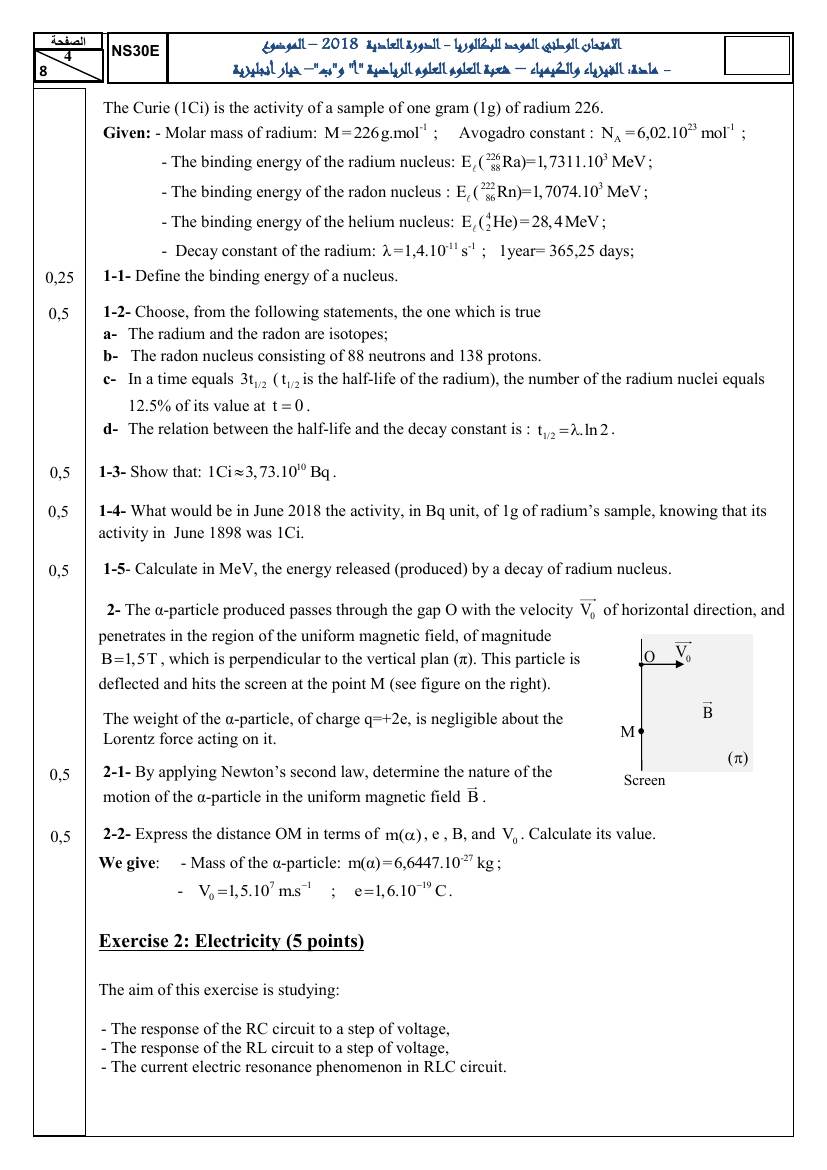
2- The α\alpha-particle produced passes through the gap O with the velocity V0⃗\vec{V_0} of horizontal direction, and penetrates in the region of the uniform magnetic field, of magnitude B=1,5 TB = 1{,}5\ \mathrm{T}, which is perpendicular to the vertical plan (π)(\pi). This particle is deflected and hits the screen at the point M (see figure on the right).

Figure : voir la page 4 du sujet

The weight of the α\alpha-particle, of charge q=+2eq = +2e, is negligible about the Lorentz force acting on it.

2-1.By applying Newton’s second law, determine the nature of the motion of the α\alpha-particle in the uniform magnetic field B⃗\vec{B}.0,5 pt

2-2.Express the distance OM in terms of m(α)m(\alpha), ee, BB, and V0V_0. Calculate its value.0,5 pt

We give: - Mass of the α\alpha-particle: m(α)=6,6447⋅10−27 kgm(\alpha) = 6{,}6447\cdot 10^{-27}\ \mathrm{kg} ;

- V0=1,5⋅107 m⋅s−1V_0 = 1{,}5\cdot 10^{7}\ \mathrm{m\cdot s^{-1}} ; e=1,6⋅10−19 Ce = 1{,}6\cdot 10^{-19}\ \mathrm{C}.

Revoir le cours : Décroissance radioactive · Noyaux, masse et énergie

Physique – Exercice 25 pts

Exercise 2: Electricity (5 points)

The aim of this exercise is studying:

- The response of the RC circuit to a step of voltage,

- The response of the RL circuit to a step of voltage,

- The current electric resonance phenomenon in RLC circuit.

I- Response of the RC circuit to a step of voltage.

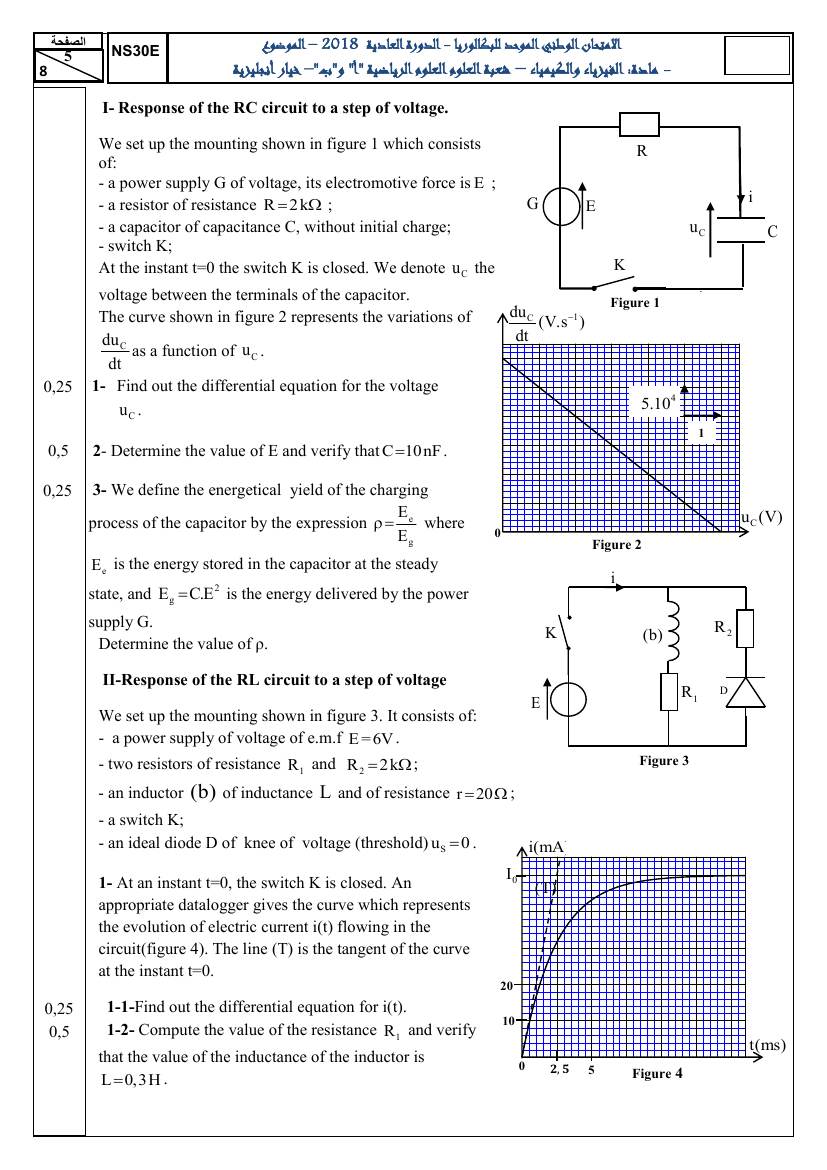
We set up the mounting shown in figure 1 which consists of:

- a power supply G of voltage, its electromotive force is EE ;

- a resistor of resistance R=2 kΩR = 2\ \mathrm{k\Omega} ;

- a capacitor of capacitance CC, without initial charge;

- switch K;

Figure 1 : voir la page 5 du sujet

At the instant t=0 the switch K is closed. We denote uCu_C the voltage between the terminals of the capacitor.

The curve shown in figure 2 represents the variations of duCdt (V⋅s−1)\dfrac{du_C}{dt}\ (\mathrm{V\cdot s^{-1}}) as a function of uCu_C.

Figure 2 : voir la page 5 du sujet

1.Find out the differential equation for the voltage uCu_C.0,25 pt

2.Determine the value of EE and verify that C=10 nFC = 10\ \mathrm{nF}.0,5 pt

3.We define the energetical yield of the charging process of the capacitor by the expression ρ=EeEg\rho = \dfrac{E_e}{E_g} where EeE_e is the energy stored in the capacitor at the steady state, and Eg=C⋅E2E_g = C\cdot E^2 is the energy delivered by the power supply G. Determine the value of ρ\rho.0,25 pt

II-Response of the RL circuit to a step of voltage

We set up the mounting shown in figure 3. It consists of:

- a power supply of voltage of e.m.f E=6 VE = 6\ \mathrm{V}.

- two resistors of resistance R1R_1 and R2=2 kΩR_2 = 2\ \mathrm{k\Omega};

- an inductor (b) of inductance LL and of resistance r=20 Ωr = 20\ \Omega;

- a switch K;

- an ideal diode D of knee of voltage (threshold) uS=0u_S = 0.

Figure 3 : voir la page 5 du sujet

1- At an instant t=0, the switch K is closed. An appropriate datalogger gives the curve which represents the evolution of electric current i(t) flowing in the circuit(figure 4). The line (T) is the tangent of the curve at the instant t=0.

Figure 4 : voir la page 5 du sujet

1-1.Find out the differential equation for i(t).0,25 pt

1-2.Compute the value of the resistance R1R_1 and verify that the value of the inductance of the inductor is L=0,3 HL = 0{,}3\ \mathrm{H}.0,5 pt

1-3.Calculate the voltage between the terminals of the inductor at the steady state.0,5 pt

2-When the steady state reaches, we open the switch K, at an instant t assumed as a new origin of time t=0.

2-1.Just after opening the switch K, what is the value of the electric current intensity? Justify your answer.0,5 pt

2-2.Based on the differential equation of the electric current intensity i(t), determine at the instant t=0 the value of di(t)dt\dfrac{di(t)}{dt} and that of the voltage between terminals of the inductor.0,75 pt

3.At the moment of opening the switch, justify the role of the part of circuit which consists of the diode and the resistor of resistance R2R_2.0,25 pt

III- Forced oscillations in RLC series circuit

We set up the RLC circuit which consists of the following components mounted in series:

- a low frequency generator, which delivers a sinusoidal alternating voltage u(t), of a constant effective voltage and adjustable frequency;

- the resistor of the resistance, R3=1980 ΩR_3 = 1980\ \Omega;

- the previous inductor (b);

- the capacitor of capacitance C1C_1.

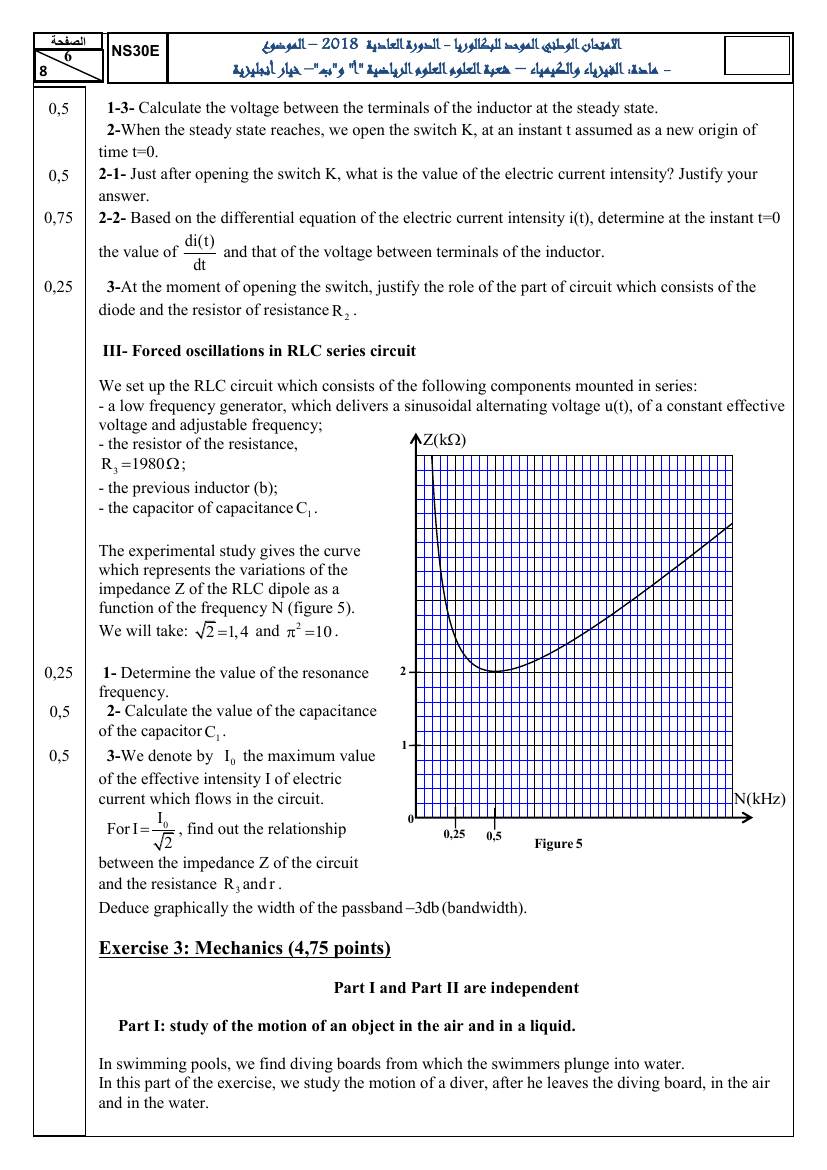
The experimental study gives the curve which represents the variations of the impedance Z of the RLC dipole as a function of the frequency N (figure 5). We will take: 2=1,4\sqrt{2} = 1{,}4 and π2=10\pi^2 = 10.

Figure 5 : voir la page 6 du sujet

1.Determine the value of the resonance frequency.0,25 pt

2.Calculate the value of the capacitance of the capacitor C1C_1.0,5 pt

3.We denote by I0I_0 the maximum value of the effective intensity I of electric current which flows in the circuit. For I=I02I = \dfrac{I_0}{\sqrt{2}}, find out the relationship between the impedance Z of the circuit and the resistance R3R_3 and rr. Deduce graphically the width of the passband −3db-3\mathrm{db} (bandwidth).0,5 pt

Physique – Exercice 34,75 pts

Exercise 3: Mechanics (4,75 points)

Part I and Part II are independent

Part I: study of the motion of an object in the air and in a liquid.

In swimming pools, we find diving boards from which the swimmers plunge into water. In this part of the exercise, we study the motion of a diver, after he leaves the diving board, in the air and in the water.

The diver is modelled by an object (S) with center of inertia G and of mass m. We study the motion of the center of inertia G of the object (S) in a frame of reference R(O,k⃗)R(O,\vec{k}) linked to the earth assumed Galilean (figure 1)

Given: m=80 kgm = 80\ \mathrm{kg} ; the gravitational field strength: g=10 m⋅s−2g = 10\ \mathrm{m\cdot s^{-2}} ; we take 2=1,4\sqrt{2} = 1{,}4.

1- Study of the motion of the center of inertia G in the air

After the diver leaves the diving board without initial velocity, at an instant of time assumed origin of time (t0=0t_0 = 0), and before he hits the water, the motion in the air is assumed as free fall.

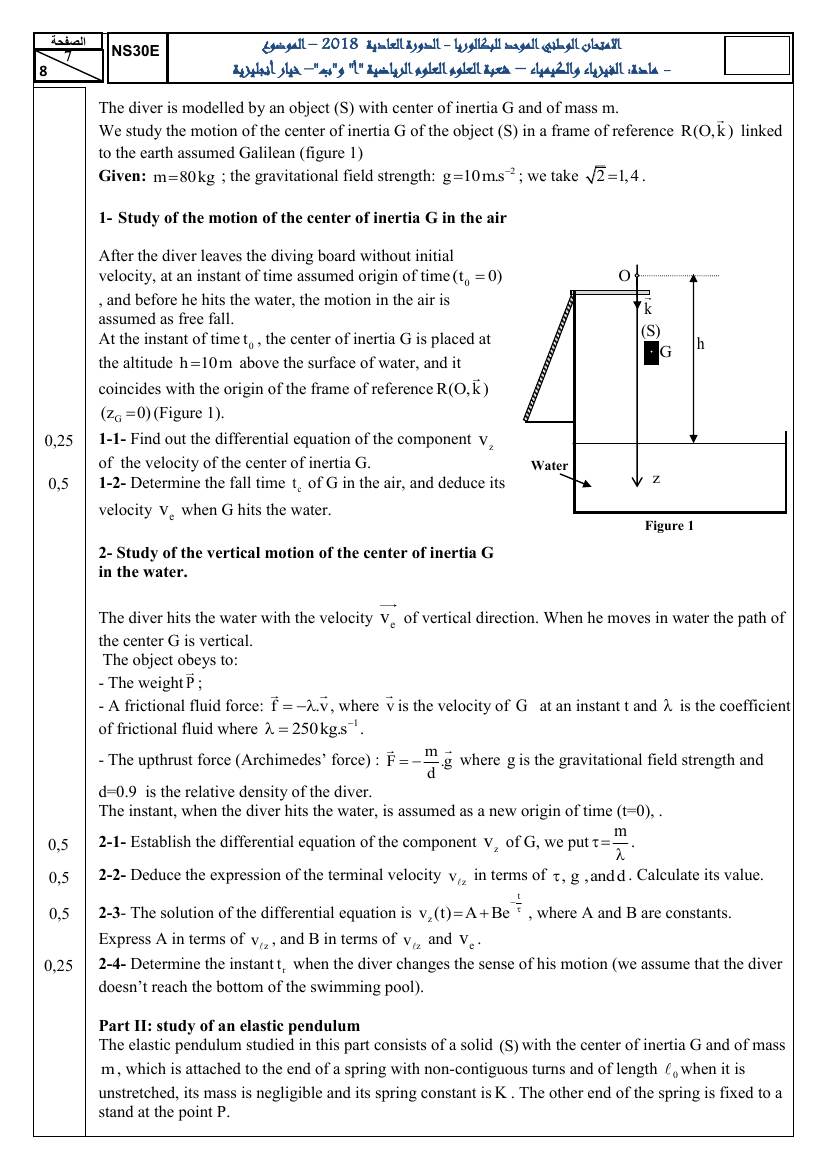
At the instant of time t0t_0, the center of inertia G is placed at the altitude h=10 mh = 10\ \mathrm{m} above the surface of water, and it coincides with the origin of the frame of reference R(O,k⃗)R(O,\vec{k}) (zG=0z_G = 0) (Figure 1).

Figure 1 : voir la page 7 du sujet

1-1.Find out the differential equation of the component vzv_z of the velocity of the center of inertia G.0,25 pt

1-2.Determine the fall time tct_c of G in the air, and deduce its velocity vev_e when G hits the water.0,5 pt

2- Study of the vertical motion of the center of inertia G in the water.

The diver hits the water with the velocity ve⃗\vec{v_e} of vertical direction. When he moves in water the path of the center G is vertical.

The object obeys to:

- The weight P⃗\vec{P} ;

- A frictional fluid force: f⃗=−λ⋅v⃗\vec{f} = -\lambda\cdot\vec{v}, where v⃗\vec{v} is the velocity of G at an instant t and λ\lambda is the coefficient of frictional fluid where λ=250 kg⋅s−1\lambda = 250\ \mathrm{kg\cdot s^{-1}}.

- The upthrust force (Archimedes’ force) : F⃗=−md⋅g⃗\vec{F} = -\dfrac{m}{d}\cdot\vec{g} where gg is the gravitational field strength and d=0.9 is the relative density of the diver.

The instant, when the diver hits the water, is assumed as a new origin of time (t=0), .

2-1.Establish the differential equation of the component vzv_z of G, we put τ=mλ\tau = \dfrac{m}{\lambda}.0,5 pt

2-2.Deduce the expression of the terminal velocity vℓzv_{\ell z} in terms of τ\tau, gg, and dd. Calculate its value.0,5 pt

2-3.The solution of the differential equation is vz(t)=A+B e−tτv_z(t) = A + B\,e^{-\frac{t}{\tau}}, where A and B are constants. Express A in terms of vℓzv_{\ell z}, and B in terms of vℓzv_{\ell z} and vev_e.0,5 pt

2-4.Determine the instant trt_r when the diver changes the sense of his motion (we assume that the diver doesn’t reach the bottom of the swimming pool).0,25 pt

Part II: study of an elastic pendulum

The elastic pendulum studied in this part consists of a solid (S) with the center of inertia G and of mass mm, which is attached to the end of a spring with non-contiguous turns and of length ℓ0\ell_0 when it is unstretched, its mass is negligible and its spring constant is KK. The other end of the spring is fixed to a stand at the point P.

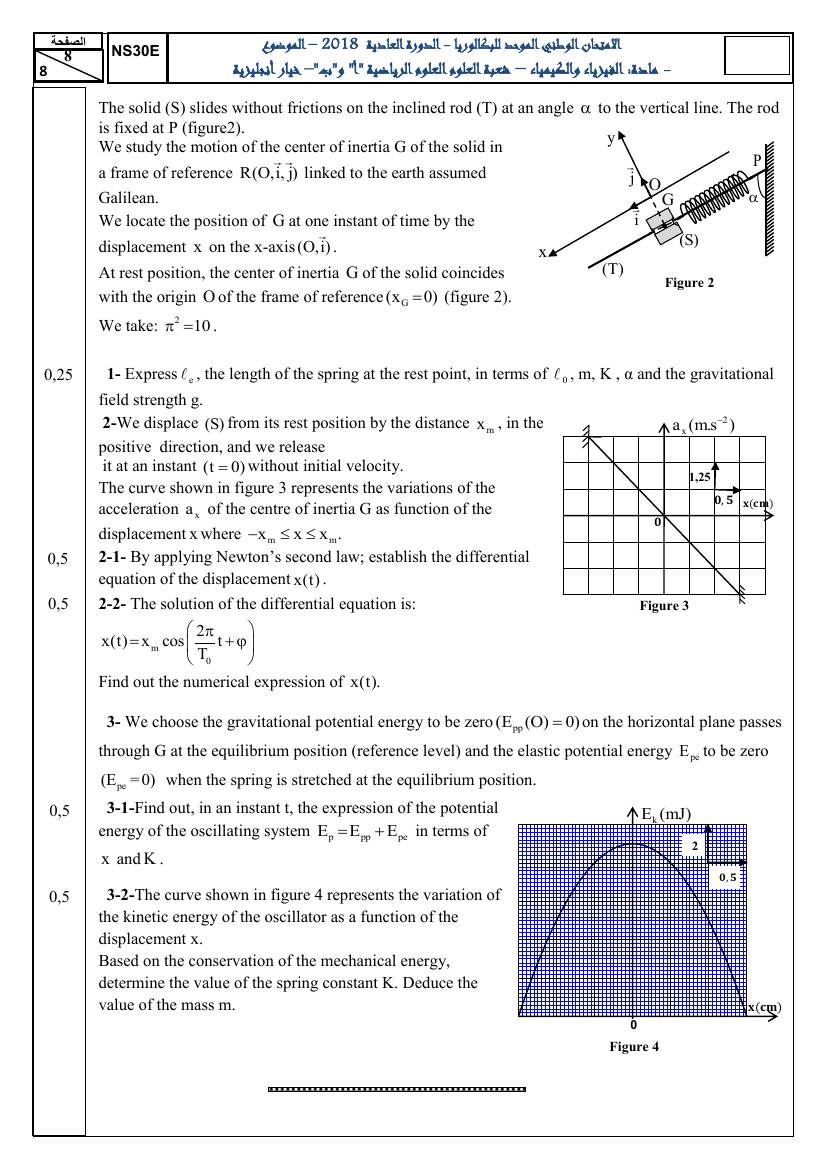
The solid (S) slides without frictions on the inclined rod (T) at an angle α\alpha to the vertical line. The rod is fixed at P (figure2).

We study the motion of the center of inertia G of the solid in a frame of reference R(O,i⃗,j⃗)R(O,\vec{i},\vec{j}) linked to the earth assumed Galilean.

We locate the position of G at one instant of time by the displacement xx on the x-axis (O,i⃗)(O,\vec{i}).

At rest position, the center of inertia G of the solid coincides with the origin O of the frame of reference (xG=0x_G = 0) (figure 2).

Figure 2 : voir la page 8 du sujet

We take: π2=10\pi^2 = 10.

1.Express ℓe\ell_e, the length of the spring at the rest point, in terms of ℓ0\ell_0, mm, KK, α\alpha and the gravitational field strength gg.0,25 pt

2-We displace (S) from its rest position by the distance xmx_m, in the positive direction, and we release it at an instant (t = 0) without initial velocity. The curve shown in figure 3 represents the variations of the acceleration axa_x of the centre of inertia G as function of the displacement xx where −xm≤x≤xm-x_m \le x \le x_m.

Figure 3 : voir la page 8 du sujet

2-1.By applying Newton’s second law; establish the differential equation of the displacement x(t)x(t).0,5 pt

2-2.The solution of the differential equation is: x(t)=xmcos⁡(2πT0t+φ)x(t) = x_m \cos\left(\dfrac{2\pi}{T_0}t + \varphi\right) Find out the numerical expression of x(t)x(t).0,5 pt

3- We choose the gravitational potential energy to be zero (Epp(O)=0E_{pp}(O) = 0) on the horizontal plane passes through G at the equilibrium position (reference level) and the elastic potential energy EpeE_{pe} to be zero (Epe=0E_{pe} = 0) when the spring is stretched at the equilibrium position.

3-1.Find out, in an instant t, the expression of the potential energy of the oscillating system Ep=Epp+EpeE_p = E_{pp} + E_{pe} in terms of xx and KK.0,5 pt

3-2.The curve shown in figure 4 represents the variation of the kinetic energy of the oscillator as a function of the displacement x. Based on the conservation of the mechanical energy, determine the value of the spring constant K. Deduce the value of the mass m.0,5 pt

Figure 4 : voir la page 8 du sujet

Entraîne-toi sur ces chapitres avec Kresco, gratuitement

Yallah, wa7d l-khtwa.

Le sujet, tu l’as. Maintenant, prépare-le.

Crée ton compte gratuit : une leçon offerte dans chaque chapitre, les quiz et ton suivi, matière par matière, jusqu’au national.