Chimie7 pts
Part I and part II are independent
Part I: Study of hydrolysis of an ester and study of an aqueous solution of the propanoic acid
Carboxylic acids are chemical substances existing in natural organic compounds or synthetics. These acids are used in the production of many substances such as esters, which have a special flavour and can be used in medicinal and food industry…
In this part, we are interested in studying the hydrolysis of an ester E and studying an aqueous solution of the propanoic acid ().
Given:
Molar molecular masses: , , .
.
1-Study of hydrolysis of an ester:
1-1-Under certain experimental conditions, of an ester react with of water to produce propanoic acid and ethanol ().
1-1-1.Write the structural formula of the ester E and give its name.0,5 pt
1-1-2.Determine the mass of the carboxylic acid formed at equilibrium, knowing that the equilibrium constant of this transformation is .0,75 pt
1-2- We perform the basic hydrolysis of a mass of the ester E, using in excess an aqueous solution of the sodium hydroxide . We obtain a mass of the alcohol.
1-2-1.Write the equation of the occurring reaction.0,25 pt
1-2-2.Determine the yield of this reaction.0,5 pt
2- Study of an aqueous solution of the propanoic acid
2-1-We have an aqueous solution of the propanoic acid of molar concentration and of volume . The measurement of the pH of this solution gives the value .
2-1-1.Write the equation of the propanoic acid with water.0,25 pt
2-1-2.Write an expression of pH of the solution in terms of of the pair and the molar effective concentration of both chemical species and in the solution.0,25 pt
2-1-3.Show that the final progress rate of the reaction is written as: . Calculate its value.1 pt
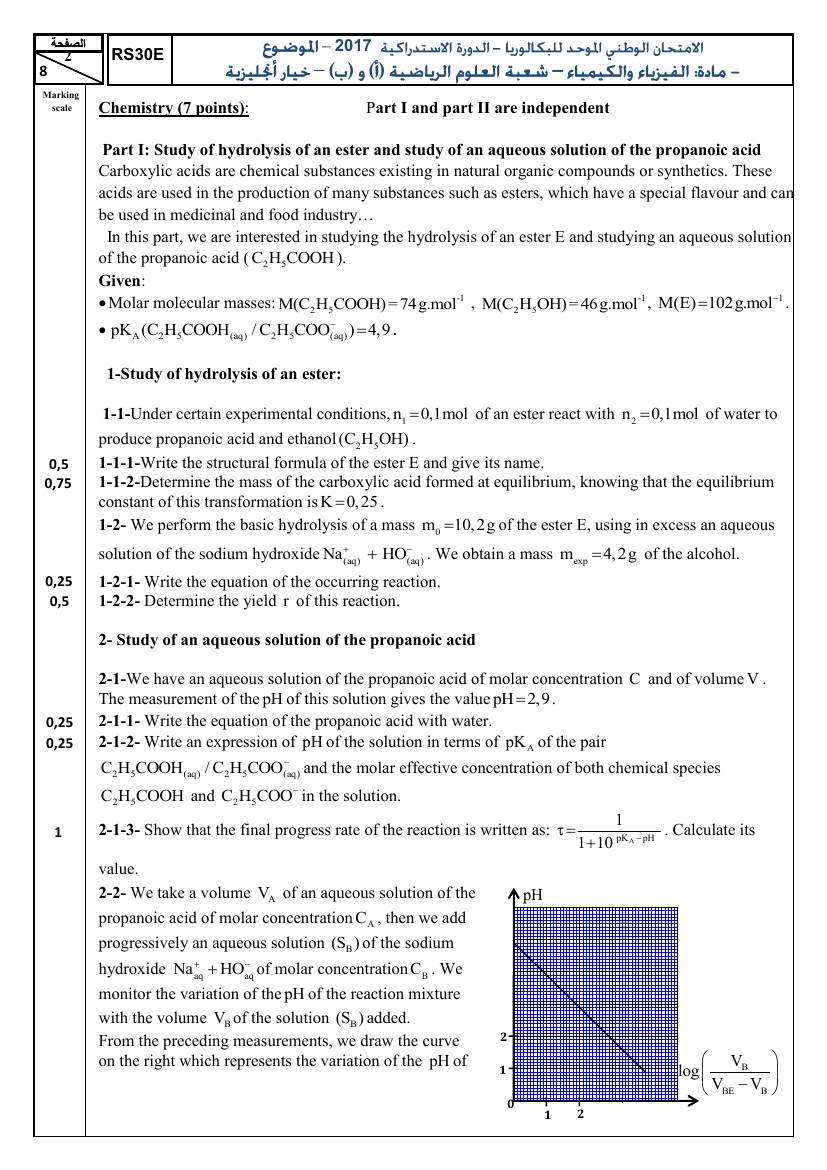
2-2- We take a volume of an aqueous solution of the propanoic acid of molar concentration , then we add progressively an aqueous solution () of the sodium hydroxide of molar concentration . We monitor the variation of the pH of the reaction mixture with the volume of the solution () added.
From the preceding measurements, we draw the curve on the right which represents the variation of the pH of the reaction mixture with so that where is the volume of the sodium hydroxide added at the equivalence point.
Figure : voir la page 2 du sujet
2-2-1.Write the equation of the titration.0,25 pt
2-2-2.Find out, for a volume of the solution () added, the expression of the ratio in terms of and .0,5 pt
2-2-3.Verify the value of the .0,5 pt
Part II : Study of the electrochemical cell: Cadmium – Silver
We study the electrochemical cell Cadmium – Silver which involves the two redox pairs and .
Given :
Faraday : ,
The equilibrium constant associated to this equation: is à ,
Molar mass of Cadmium : ,
The immersed consumable part of the electrode is in excess.
We perform this electrochemical cell by immersing:
- A silver plate in a beaker which contains an aqueous solution of the silver nitrate of volume of initial molar concentration .
- A cadmium plate in another beaker which contains an aqueous solution of the cadmium nitrate of volume of initial molar concentration .
A salt bridge connects the two solutions.
In series, between electrodes of the cell, we set up a resistor, an ammeter and a switch.
1.Choose which one of the following statements is true:0,5 pt
a- The transformations occurring in the electrochemical cells are forced.
b- The positive pole of the electrochemical cell is the electrode of silver.
c- The spontaneous direction of the chemical system of the electrochemical cell is the direction (2) of the equation.
d- The oxidation occurs at the cathode.
2- We switch on the circuit at an instant () taken as an origin of time. A steady electric current of intensity flows through the circuit.
2-1.Write the expression, at one instant of time, of the reaction quotient in terms of the progress of the reaction.0,5 pt
2-2.Calculate at the instant .0,75 pt
2-3.Calculate the change of the mass of the cadmium between and the instant at which the electrochemical cell is consumed.0,5 pt