Jerreb rassek f l-national.

Examen national Physique-Chimie 2Bac PC (option anglaise) 2022, session de rattrapage

Physique-Chimie · Sciences Physiques · 8 pages

Le sujet en bref

  1. Exercice 17 pts

    Dosage acido-basique · Électrolyse (transformations forcées) · Réactions acide-base

    L’électrolyse d’une solution de chlorure d’or (III) et la méthylamine en solution aqueuse

  2. Exercice 23,5 pts

    Ondes mécaniques progressives périodiques · Décroissance radioactive · Noyaux, masse et énergie

    Une onde à la surface de l’eau et la datation au carbone 14

  3. Exercice 34,5 pts

    Dipôle RL · Oscillations libres d’un circuit RLC série · Ondes électromagnétiques et modulation d’amplitude

  4. Exercice 45 pts

    Lois de Newton · Systèmes mécaniques oscillants

    Un solide sur un plan incliné et un oscillateur horizontal solide-ressort

Total : 20 points

Le sujet, page par page

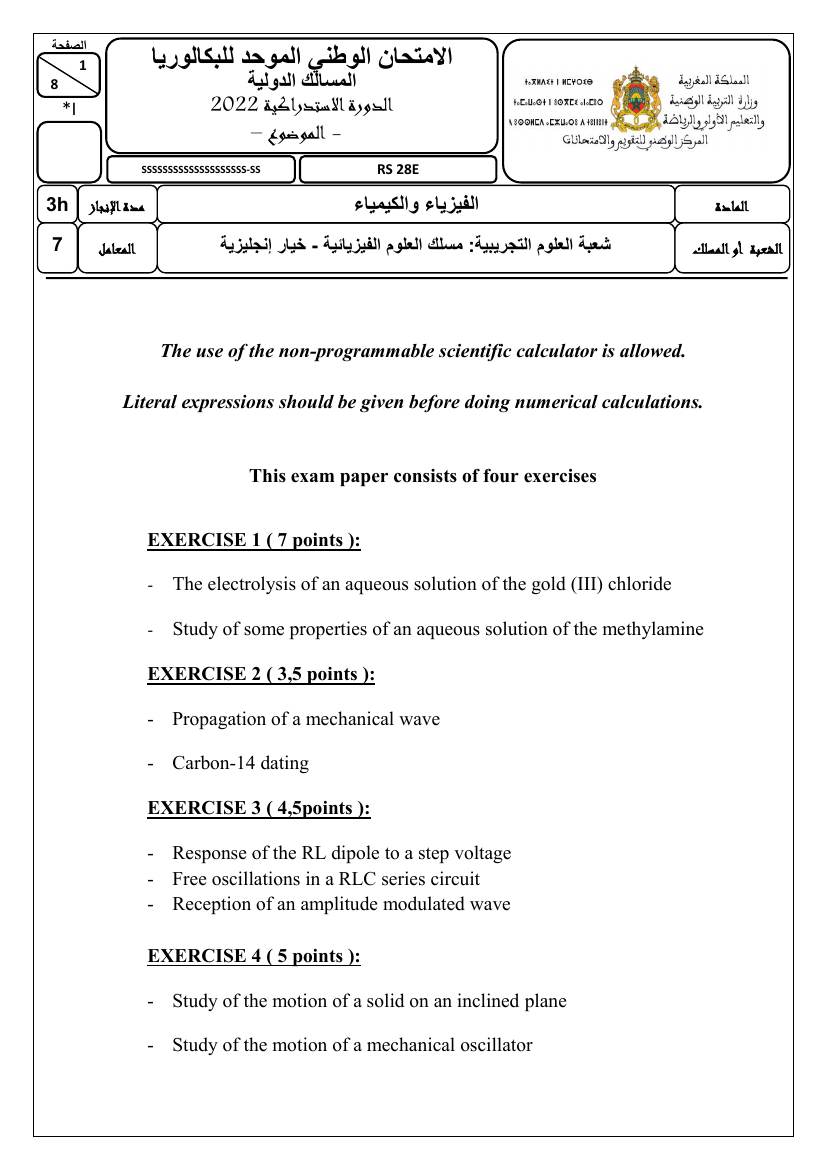
  1. Examen national Physique-Chimie 2Bac PC (option anglaise) 2022, session de rattrapage, page 1 sur 8
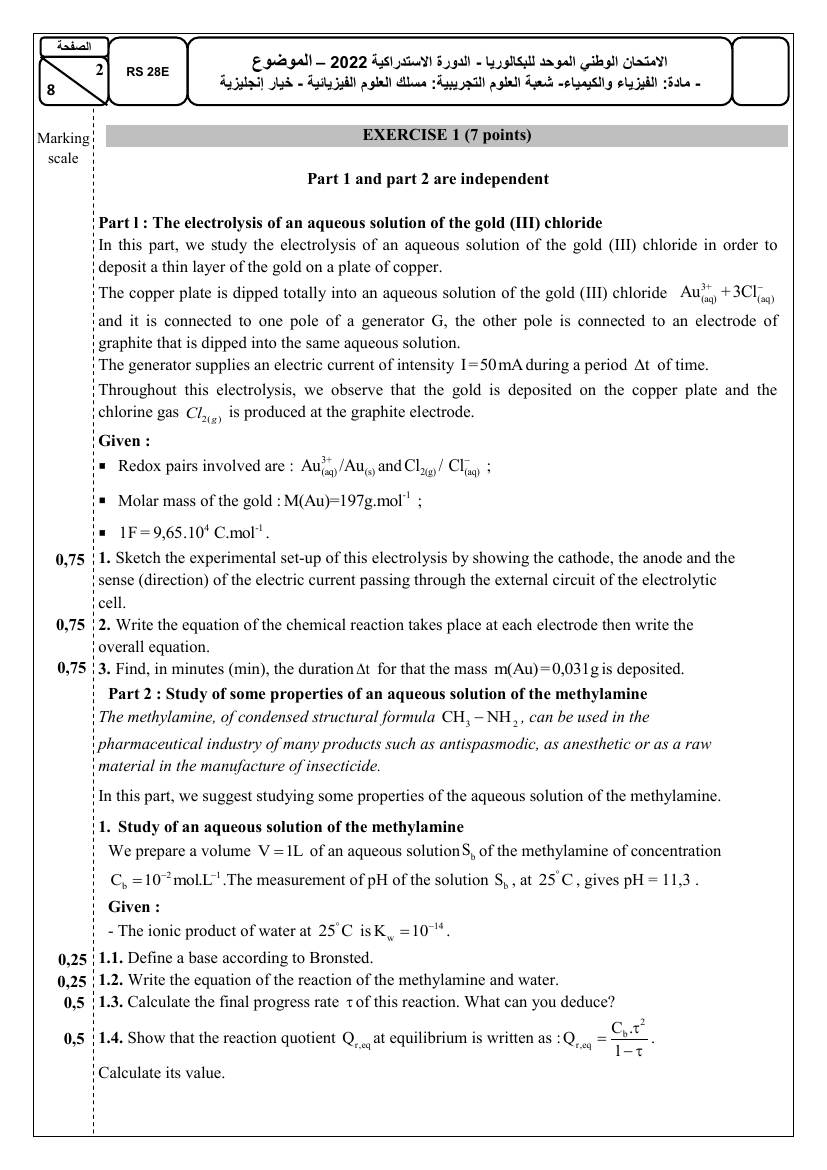
  2. Examen national Physique-Chimie 2Bac PC (option anglaise) 2022, session de rattrapage, page 2 sur 8
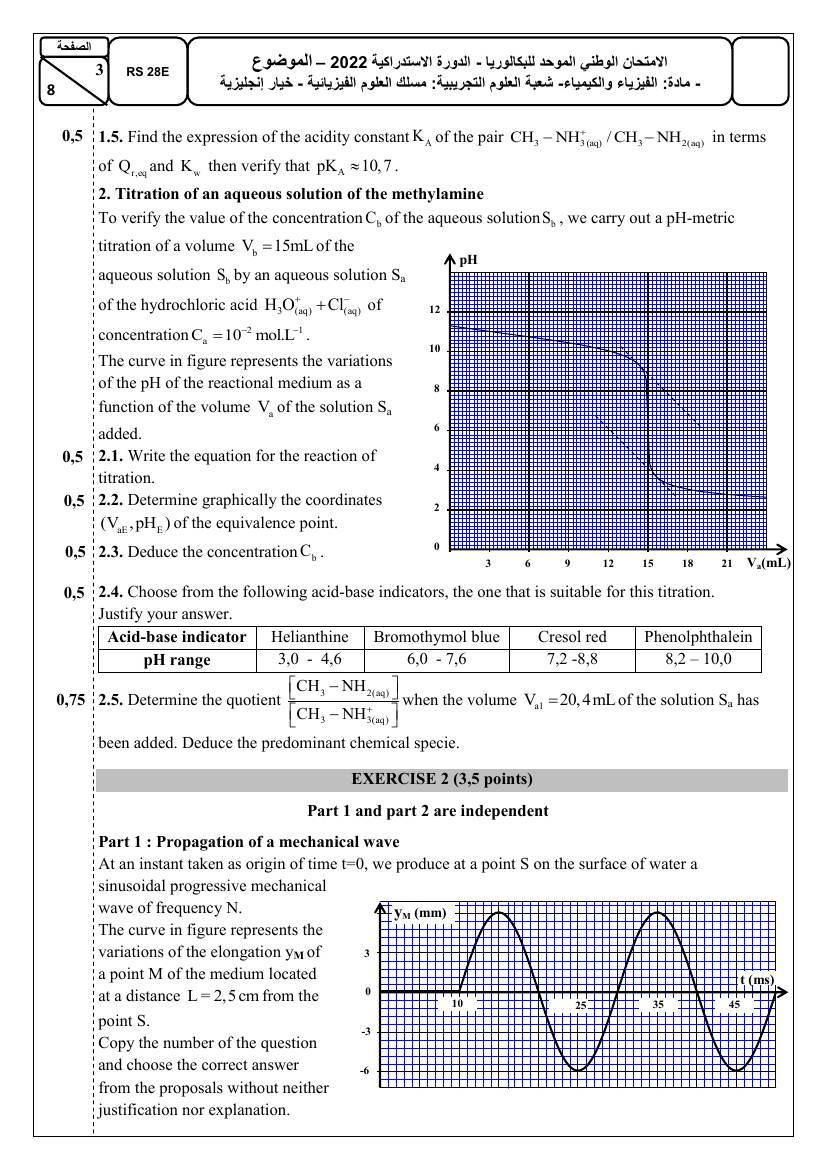
  3. Examen national Physique-Chimie 2Bac PC (option anglaise) 2022, session de rattrapage, page 3 sur 8
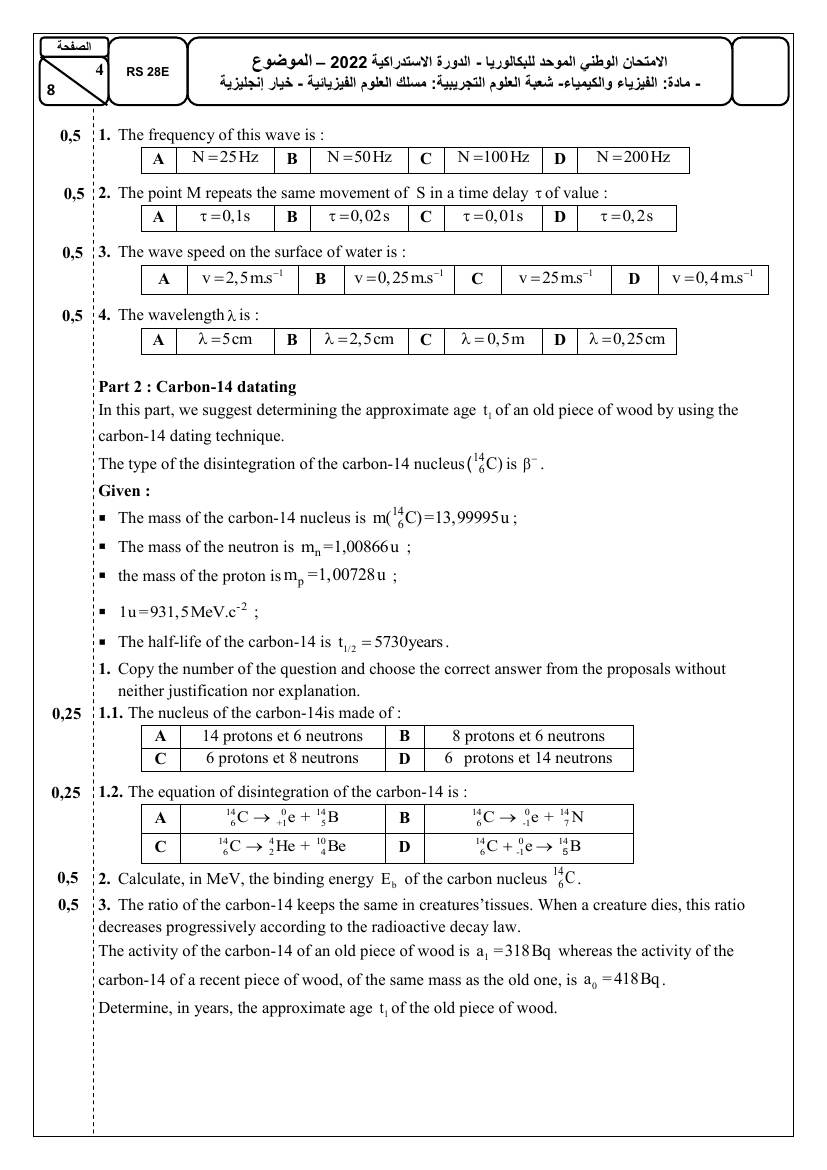
  4. Examen national Physique-Chimie 2Bac PC (option anglaise) 2022, session de rattrapage, page 4 sur 8
  5. Examen national Physique-Chimie 2Bac PC (option anglaise) 2022, session de rattrapage, page 5 sur 8
  6. Examen national Physique-Chimie 2Bac PC (option anglaise) 2022, session de rattrapage, page 6 sur 8
  7. Examen national Physique-Chimie 2Bac PC (option anglaise) 2022, session de rattrapage, page 7 sur 8
  8. Examen national Physique-Chimie 2Bac PC (option anglaise) 2022, session de rattrapage, page 8 sur 8

Sujet officiel de l’examen national unifié du baccalauréat, tel que publié par le Centre national de l’évaluation et des examens (Ministère de l’Éducation nationale).

L’énoncé en texte

Transcription du sujet officiel, pour le lire et le rechercher sur téléphone. Les figures restent sur les pages du sujet ; en cas de différence, le PDF officiel fait foi.

Exercice 17 pts

Part 1 and part 2 are independent

Part 1 : The electrolysis of an aqueous solution of the gold (III) chloride

In this part, we study the electrolysis of an aqueous solution of the gold (III) chloride in order to deposit a thin layer of the gold on a plate of copper.

The copper plate is dipped totally into an aqueous solution of the gold (III) chloride Au(aq)3++3Cl(aq)−\mathrm{Au^{3+}_{(aq)} + 3Cl^-_{(aq)}} and it is connected to one pole of a generator G, the other pole is connected to an electrode of graphite that is dipped into the same aqueous solution.

The generator supplies an electric current of intensity I=50 mAI = 50\ \mathrm{mA} during a period Δt\Delta t of time.

Throughout this electrolysis, we observe that the gold is deposited on the copper plate and the chlorine gas Cl2(g)\mathrm{Cl_{2(g)}} is produced at the graphite electrode.

Given :

Redox pairs involved are : Au(aq)3+/Au(s)\mathrm{Au^{3+}_{(aq)}/Au_{(s)}} and Cl2(g)/Cl(aq)−\mathrm{Cl_{2(g)}/Cl^-_{(aq)}} ;

Molar mass of the gold : M(Au)=197 g⋅mol−1M(\mathrm{Au}) = 197\ \mathrm{g\cdot mol^{-1}} ;

1 F=9,65⋅104 C⋅mol−11\,\mathrm{F} = 9{,}65\cdot 10^{4}\ \mathrm{C\cdot mol^{-1}}.

1.Sketch the experimental set-up of this electrolysis by showing the cathode, the anode and the sense (direction) of the electric current passing through the external circuit of the electrolytic cell.0,75 pt

2.Write the equation of the chemical reaction takes place at each electrode then write the overall equation.0,75 pt

3.Find, in minutes (min), the duration Δt\Delta t for that the mass m(Au)=0,031 gm(\mathrm{Au}) = 0{,}031\ \mathrm{g} is deposited.0,75 pt

Part 2 : Study of some properties of an aqueous solution of the methylamine

The methylamine, of condensed structural formula CH3−NH2\mathrm{CH_3-NH_2}, can be used in the pharmaceutical industry of many products such as antispasmodic, as anesthetic or as a raw material in the manufacture of insecticide.

In this part, we suggest studying some properties of the aqueous solution of the methylamine.

1. Study of an aqueous solution of the methylamine

We prepare a volume V=1 LV = 1\ \mathrm{L} of an aqueous solution SbS_b of the methylamine of concentration Cb=10−2 mol⋅L−1C_b = 10^{-2}\ \mathrm{mol\cdot L^{-1}}. The measurement of pH of the solution SbS_b, at 25∘C25^\circ\mathrm{C}, gives pH = 11,3.

Given :

- The ionic product of water at 25∘C25^\circ\mathrm{C} is Kw=10−14K_w = 10^{-14}.

1.1.Define a base according to Bronsted.0,25 pt

1.2.Write the equation of the reaction of the methylamine and water.0,25 pt

1.3.Calculate the final progress rate τ\tau of this reaction. What can you deduce?0,5 pt

1.4.Show that the reaction quotient Qr,eqQ_{r,eq} at equilibrium is written as : Qr,eq=Cb⋅τ21−τQ_{r,eq} = \dfrac{C_b\cdot\tau^2}{1-\tau}. Calculate its value.0,5 pt

1.5.Find the expression of the acidity constant KAK_A of the pair CH3−NH3(aq)+/CH3−NH2(aq)\mathrm{CH_3-NH^+_{3(aq)}/CH_3-NH_{2(aq)}} in terms of Qr,eqQ_{r,eq} and KwK_w then verify that pKA≈10,7\mathrm{p}K_A \approx 10{,}7.0,5 pt

2. Titration of an aqueous solution of the methylamine

To verify the value of the concentration CbC_b of the aqueous solution SbS_b, we carry out a pH-metric titration of a volume Vb=15 mLV_b = 15\ \mathrm{mL} of the aqueous solution SbS_b by an aqueous solution SaS_a of the hydrochloric acid H3O(aq)++Cl(aq)−\mathrm{H_3O^+_{(aq)} + Cl^-_{(aq)}} of concentration Ca=10−2 mol⋅L−1C_a = 10^{-2}\ \mathrm{mol\cdot L^{-1}}.

The curve in figure represents the variations of the pH of the reactional medium as a function of the volume VaV_a of the solution SaS_a added.

Figure : voir la page 3 du sujet

2.1.Write the equation for the reaction of titration.0,5 pt

2.2.Determine graphically the coordinates (VaE,pHE)(V_{aE}, \mathrm{pH}_E) of the equivalence point.0,5 pt

2.3.Deduce the concentration CbC_b.0,5 pt

2.4.Choose from the following acid-base indicators, the one that is suitable for this titration. Justify your answer.0,5 pt

Acid-base indicatorHelianthineBromothymol blueCresol redPhenolphthalein
pH range3,0 - 4,66,0 - 7,67,2 -8,88,2 – 10,0

2.5.Determine the quotient [CH3−NH2(aq)][CH3−NH3(aq)+]\dfrac{[\mathrm{CH_3-NH_{2(aq)}}]}{[\mathrm{CH_3-NH^+_{3(aq)}}]} when the volume Va1=20,4 mLV_{a1} = 20{,}4\ \mathrm{mL} of the solution SaS_a has been added. Deduce the predominant chemical specie.0,75 pt

Exercice 23,5 pts

Part 1 and part 2 are independent

Part 1 : Propagation of a mechanical wave

At an instant taken as origin of time t=0, we produce at a point S on the surface of water a sinusoidal progressive mechanical wave of frequency NN.

The curve in figure represents the variations of the elongation yMy_M of a point M of the medium located at a distance L=2,5 cmL = 2{,}5\ \mathrm{cm} from the point S.

Figure : voir la page 3 du sujet

Copy the number of the question and choose the correct answer from the proposals without neither justification nor explanation.

1.The frequency of this wave is :0,5 pt

AN=25 HzN = 25\ \mathrm{Hz}BN=50 HzN = 50\ \mathrm{Hz}CN=100 HzN = 100\ \mathrm{Hz}DN=200 HzN = 200\ \mathrm{Hz}

2.The point M repeats the same movement of S in a time delay τ\tau of value :0,5 pt

Aτ=0,1 s\tau = 0{,}1\ \mathrm{s}Bτ=0,02 s\tau = 0{,}02\ \mathrm{s}Cτ=0,01 s\tau = 0{,}01\ \mathrm{s}Dτ=0,2 s\tau = 0{,}2\ \mathrm{s}

3.The wave speed on the surface of water is :0,5 pt

Av=2,5 m⋅s−1v = 2{,}5\ \mathrm{m\cdot s^{-1}}Bv=0,25 m⋅s−1v = 0{,}25\ \mathrm{m\cdot s^{-1}}Cv=25 m⋅s−1v = 25\ \mathrm{m\cdot s^{-1}}Dv=0,4 m⋅s−1v = 0{,}4\ \mathrm{m\cdot s^{-1}}

4.The wavelength λ\lambda is :0,5 pt

Aλ=5 cm\lambda = 5\ \mathrm{cm}Bλ=2,5 cm\lambda = 2{,}5\ \mathrm{cm}Cλ=0,5 m\lambda = 0{,}5\ \mathrm{m}Dλ=0,25 cm\lambda = 0{,}25\ \mathrm{cm}

Part 2 : Carbon-14 datating

In this part, we suggest determining the approximate age t1t_1 of an old piece of wood by using the carbon-14 dating technique.

The type of the disintegration of the carbon-14 nucleus (614C\mathrm{^{14}_{6}C}) is β−\beta^-.

Given :

The mass of the carbon-14 nucleus is m(614C)=13,99995 um(\mathrm{^{14}_{6}C}) = 13{,}99995\ \mathrm{u} ;

The mass of the neutron is mn=1,00866 um_n = 1{,}00866\ \mathrm{u} ;

the mass of the proton is mp=1,00728 um_p = 1{,}00728\ \mathrm{u} ;

1 u=931,5 MeV⋅c−21\,\mathrm{u} = 931{,}5\ \mathrm{MeV\cdot c^{-2}} ;

The half-life of the carbon-14 is t1/2=5730 yearst_{1/2} = 5730\ \mathrm{years}.

1. Copy the number of the question and choose the correct answer from the proposals without neither justification nor explanation.

1.1.The nucleus of the carbon-14is made of :0,25 pt

A14 protons et 6 neutronsB8 protons et 6 neutrons
C6 protons et 8 neutronsD6 protons et 14 neutrons

1.2.The equation of disintegration of the carbon-14 is :0,25 pt

A614C→+10e+514B\mathrm{^{14}_{6}C \rightarrow {}^{0}_{+1}e + {}^{14}_{5}B}B614C→−10e+714N\mathrm{^{14}_{6}C \rightarrow {}^{0}_{-1}e + {}^{14}_{7}N}
C614C→24He+410Be\mathrm{^{14}_{6}C \rightarrow {}^{4}_{2}He + {}^{10}_{4}Be}D614C+−10e→514B\mathrm{^{14}_{6}C + {}^{0}_{-1}e \rightarrow {}^{14}_{5}B}

2.Calculate, in MeV, the binding energy EbE_b of the carbon nucleus 614C\mathrm{^{14}_{6}C}.0,5 pt

3.The ratio of the carbon-14 keeps the same in creatures’tissues. When a creature dies, this ratio decreases progressively according to the radioactive decay law. The activity of the carbon-14 of an old piece of wood is a1=318 Bqa_1 = 318\ \mathrm{Bq} whereas the activity of the carbon-14 of a recent piece of wood, of the same mass as the old one, is a0=418 Bqa_0 = 418\ \mathrm{Bq}. Determine, in years, the approximate age t1t_1 of the old piece of wood.0,5 pt

Revoir le cours : Ondes mécaniques progressives périodiques · Décroissance radioactive · Noyaux, masse et énergie

Exercice 34,5 pts

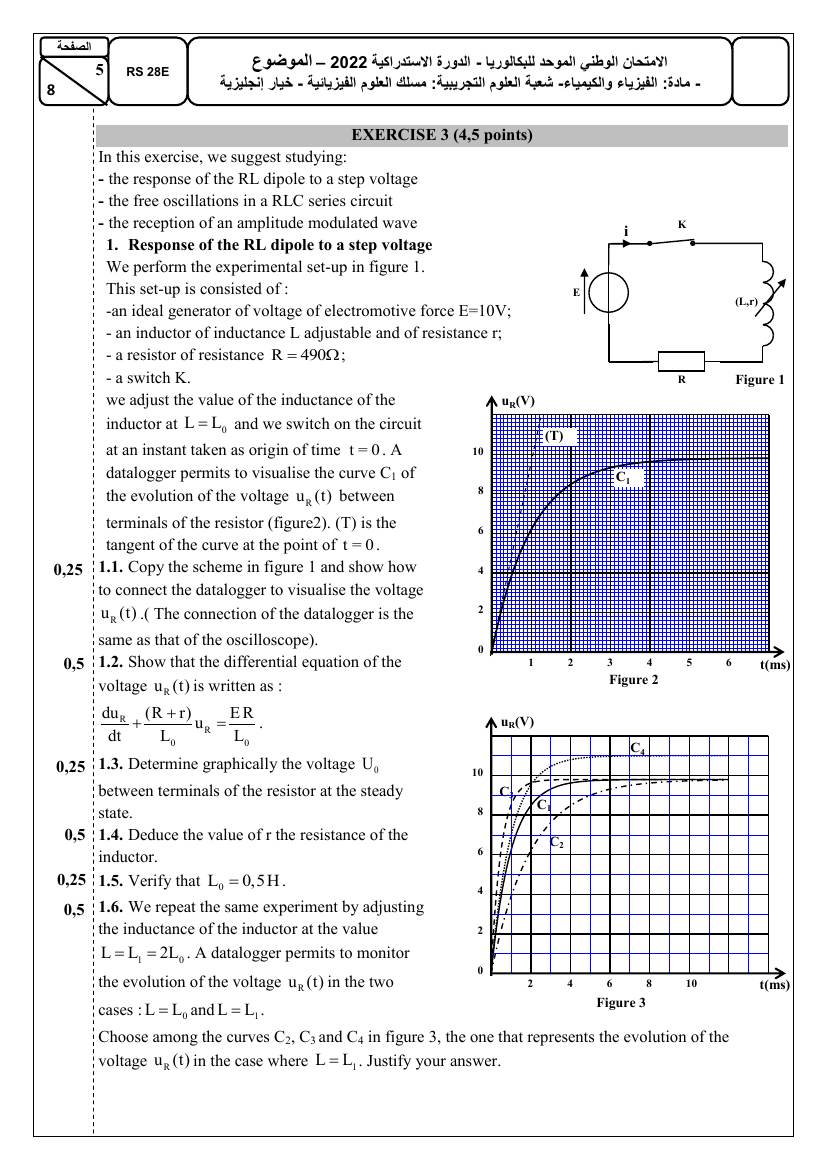
In this exercise, we suggest studying:

- the response of the RL dipole to a step voltage

- the free oscillations in a RLC series circuit

- the reception of an amplitude modulated wave

1. Response of the RL dipole to a step voltage

We perform the experimental set-up in figure 1.

This set-up is consisted of :

-an ideal generator of voltage of electromotive force E=10 VE = 10\ \mathrm{V};

- an inductor of inductance LL adjustable and of resistance rr;

- a resistor of resistance R=490 ΩR = 490\ \Omega;

- a switch K.

Figure 1 : voir la page 5 du sujet

we adjust the value of the inductance of the inductor at L=L0L = L_0 and we switch on the circuit at an instant taken as origin of time t=0t = 0. A datalogger permits to visualise the curve C1C_1 of the evolution of the voltage uR(t)u_R(t) between terminals of the resistor (figure2). (T) is the tangent of the curve at the point of t=0t = 0.

Figure 2 : voir la page 5 du sujet

1.1.Copy the scheme in figure 1 and show how to connect the datalogger to visualise the voltage uR(t)u_R(t). (The connection of the datalogger is the same as that of the oscilloscope).0,25 pt

1.2.Show that the differential equation of the voltage uR(t)u_R(t) is written as : duRdt+(R+r)L0uR=ERL0\dfrac{du_R}{dt} + \dfrac{(R+r)}{L_0}u_R = \dfrac{ER}{L_0}.0,5 pt

1.3.Determine graphically the voltage U0U_0 between terminals of the resistor at the steady state.0,25 pt

1.4.Deduce the value of rr the resistance of the inductor.0,5 pt

1.5.Verify that L0=0,5 HL_0 = 0{,}5\ \mathrm{H}.0,25 pt

1.6.We repeat the same experiment by adjusting the inductance of the inductor at the value L=L1=2L0L = L_1 = 2L_0. A datalogger permits to monitor the evolution of the voltage uR(t)u_R(t) in the two cases : L=L0L = L_0 and L=L1L = L_1. Choose among the curves C2C_2, C3C_3 and C4C_4 in figure 3, the one that represents the evolution of the voltage uR(t)u_R(t) in the case where L=L1L = L_1. Justify your answer.0,5 pt

Figure 3 : voir la page 5 du sujet

2. Free oscillations in a RLC series circuit

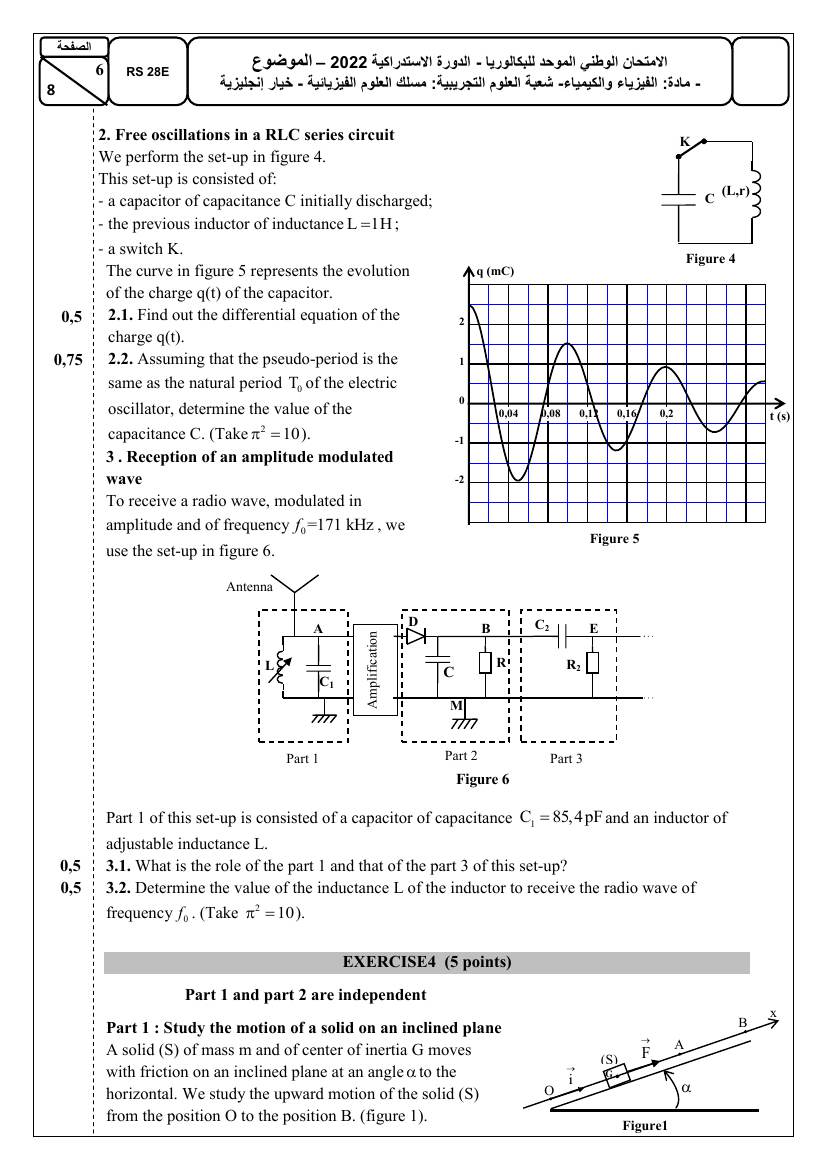
We perform the set-up in figure 4.

This set-up is consisted of:

- a capacitor of capacitance CC initially discharged;

- the previous inductor of inductance L=1 HL = 1\ \mathrm{H};

- a switch K.

Figure 4 : voir la page 6 du sujet

The curve in figure 5 represents the evolution of the charge q(t)q(t) of the capacitor.

Figure 5 : voir la page 6 du sujet

2.1.Find out the differential equation of the charge q(t)q(t).0,5 pt

2.2.Assuming that the pseudo-period is the same as the natural period T0T_0 of the electric oscillator, determine the value of the capacitance CC. (Take π2=10\pi^2 = 10).0,75 pt

3 . Reception of an amplitude modulated wave

To receive a radio wave, modulated in amplitude and of frequency f0=171 kHzf_0 = 171\ \mathrm{kHz}, we use the set-up in figure 6.

Figure 6 : voir la page 6 du sujet

Part 1 of this set-up is consisted of a capacitor of capacitance C1=85,4 pFC_1 = 85{,}4\ \mathrm{pF} and an inductor of adjustable inductance LL.

3.1.What is the role of the part 1 and that of the part 3 of this set-up?0,5 pt

3.2.Determine the value of the inductance LL of the inductor to receive the radio wave of frequency f0f_0. (Take π2=10\pi^2 = 10).0,5 pt

Exercice 45 pts

Part 1 and part 2 are independent

Part 1 : Study the motion of a solid on an inclined plane

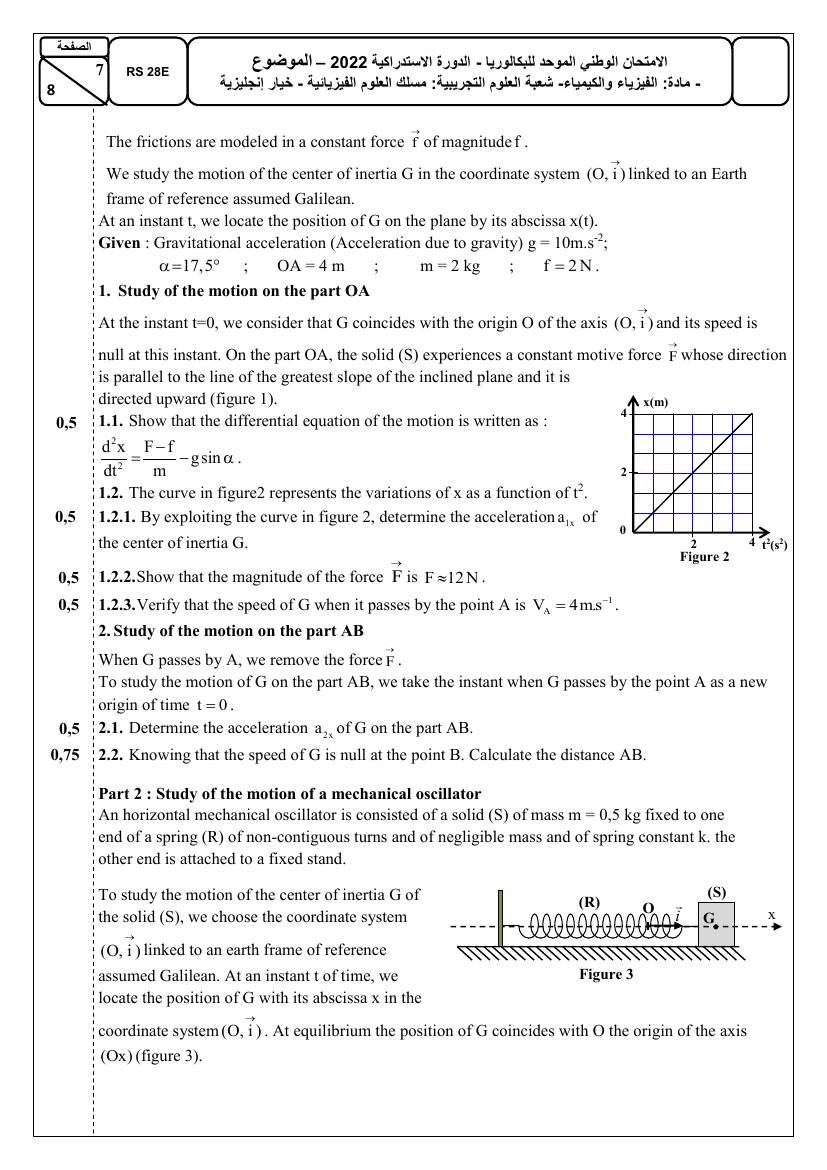
A solid (S) of mass mm and of center of inertia G moves with friction on an inclined plane at an angle α\alpha to the horizontal. We study the upward motion of the solid (S) from the position O to the position B. (figure 1).

Figure1 : voir la page 7 du sujet

The frictions are modeled in a constant force f⃗\vec{f} of magnitude ff.

We study the motion of the center of inertia G in the coordinate system (O,i⃗)(O, \vec{i}) linked to an Earth frame of reference assumed Galilean.

At an instant t, we locate the position of G on the plane by its abscissa x(t).

Given : Gravitational acceleration (Acceleration due to gravity) g=10 m⋅s−2g = 10\ \mathrm{m\cdot s^{-2}};

α=17,5∘\alpha = 17{,}5^\circ ; OA=4 mOA = 4\ \mathrm{m} ; m=2 kgm = 2\ \mathrm{kg} ; f=2 Nf = 2\ \mathrm{N}.

1. Study of the motion on the part OA

At the instant t=0, we consider that G coincides with the origin O of the axis (O,i⃗)(O, \vec{i}) and its speed is null at this instant. On the part OA, the solid (S) experiences a constant motive force F⃗\vec{F} whose direction is parallel to the line of the greatest slope of the inclined plane and it is directed upward (figure 1).

1.1.Show that the differential equation of the motion is written as : d2xdt2=F−fm−gsin⁡α\dfrac{d^2x}{dt^2} = \dfrac{F-f}{m} - g\sin\alpha.0,5 pt

1.2. The curve in figure2 represents the variations of x as a function of t2t^2.

Figure 2 : voir la page 7 du sujet

1.2.1.By exploiting the curve in figure 2, determine the acceleration a1xa_{1x} of the center of inertia G.0,5 pt

1.2.2.Show that the magnitude of the force F⃗\vec{F} is F≈12 NF \approx 12\ \mathrm{N}.0,5 pt

1.2.3.Verify that the speed of G when it passes by the point A is VA=4 m⋅s−1V_A = 4\ \mathrm{m\cdot s^{-1}}.0,5 pt

2. Study of the motion on the part AB

When G passes by A, we remove the force F⃗\vec{F}.

To study the motion of G on the part AB, we take the instant when G passes by the point A as a new origin of time t=0t = 0.

2.1.Determine the acceleration a2xa_{2x} of G on the part AB.0,5 pt

2.2.Knowing that the speed of G is null at the point B. Calculate the distance AB.0,75 pt

Part 2 : Study of the motion of a mechanical oscillator

An horizontal mechanical oscillator is consisted of a solid (S) of mass m=0,5 kgm = 0{,}5\ \mathrm{kg} fixed to one end of a spring (R) of non-contiguous turns and of negligible mass and of spring constant kk. the other end is attached to a fixed stand.

To study the motion of the center of inertia G of the solid (S), we choose the coordinate system (O,i⃗)(O, \vec{i}) linked to an earth frame of reference assumed Galilean. At an instant t of time, we locate the position of G with its abscissa xx in the coordinate system (O,i⃗)(O, \vec{i}). At equilibrium the position of G coincides with O the origin of the axis (Ox) (figure 3).

Figure 3 : voir la page 7 du sujet

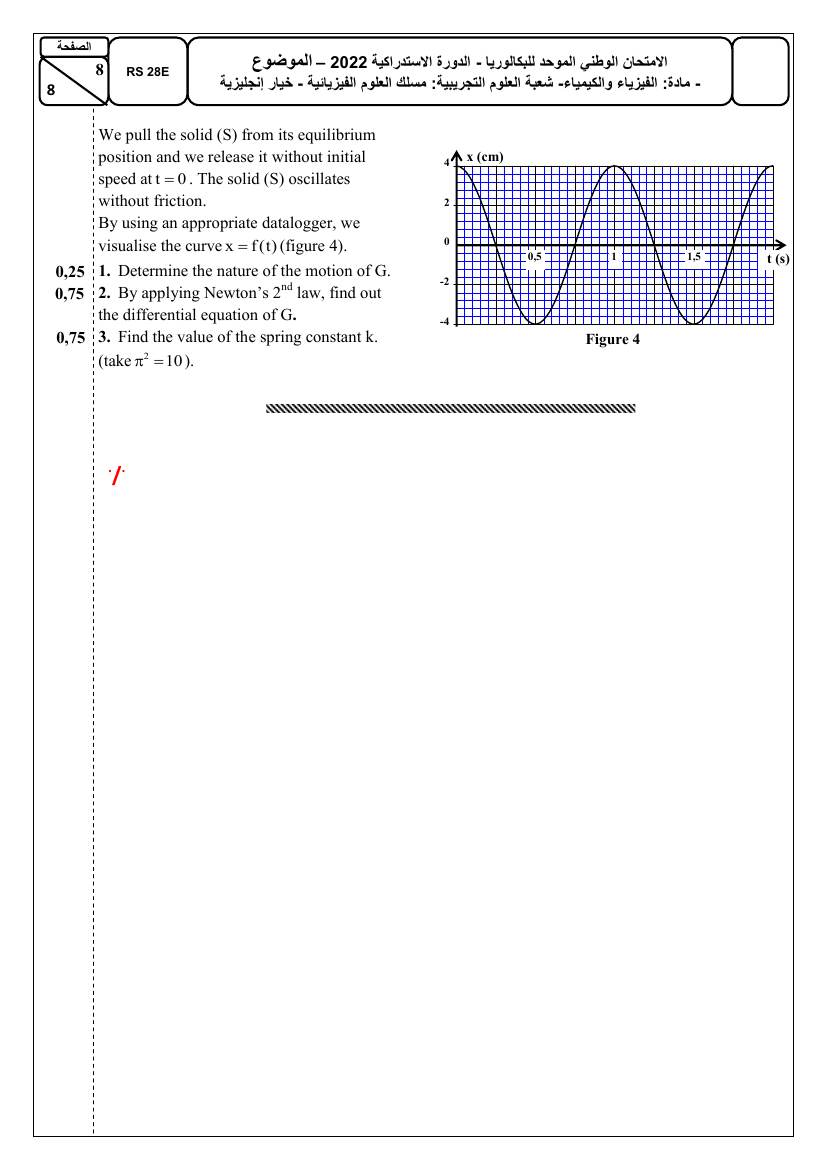
We pull the solid (S) from its equilibrium position and we release it without initial speed at t=0t = 0. The solid (S) oscillates without friction.

By using an appropriate datalogger, we visualise the curve x=f(t)x = f(t) (figure 4).

Figure 4 : voir la page 8 du sujet

1.Determine the nature of the motion of G.0,25 pt

2.By applying Newton’s 2nd law, find out the differential equation of G.0,75 pt

3.Find the value of the spring constant kk. (take π2=10\pi^2 = 10).0,75 pt

Entraîne-toi sur ces chapitres avec Kresco, gratuitement

Yallah, wa7d l-khtwa.

Le sujet, tu l’as. Maintenant, prépare-le.

Crée ton compte gratuit : une leçon offerte dans chaque chapitre, les quiz et ton suivi, matière par matière, jusqu’au national.