Jerreb rassek f l-national.

Examen national SVT 2Bac PC (option anglaise) 2020, session de rattrapage

SVT · Sciences Physiques · 8 pages

Le sujet en bref

  1. Partie I5 pts

    Le muscle strié squelettique · Consommation de la matière organique et flux d’énergie

  2. Partie II – Exercice 13 pts

    Consommation de la matière organique et flux d’énergie · Le muscle strié squelettique

    La synthèse mitochondriale d’ATP et le renouvellement de l’ATP dans le muscle

  3. Partie II – Exercice 24 pts

    Nature et expression de l’information génétique

    Une mutation du gène EGFR et le cancer du poumon

  4. Partie II – Exercice 34 pts

    Lois statistiques de la transmission des caractères

    La couleur et la forme de la corolle chez le muflier

  5. Partie II – Exercice 44 pts

    Utilisation des matières organiques et inorganiques

    Le trou de la couche d’ozone et les composés CFC

  6. Partie II – Exercice 54 pts

    Formation des chaînes de montagnes

    Le magmatisme de la chaîne de subduction des Andes

    Au choix avec la partie précédente.

Total : 20 points

Le sujet, page par page

  1. Examen national SVT 2Bac PC (option anglaise) 2020, session de rattrapage, page 1 sur 8
  2. Examen national SVT 2Bac PC (option anglaise) 2020, session de rattrapage, page 2 sur 8
  3. Examen national SVT 2Bac PC (option anglaise) 2020, session de rattrapage, page 3 sur 8
  4. Examen national SVT 2Bac PC (option anglaise) 2020, session de rattrapage, page 4 sur 8
  5. Examen national SVT 2Bac PC (option anglaise) 2020, session de rattrapage, page 5 sur 8
  6. Examen national SVT 2Bac PC (option anglaise) 2020, session de rattrapage, page 6 sur 8
  7. Examen national SVT 2Bac PC (option anglaise) 2020, session de rattrapage, page 7 sur 8
  8. Examen national SVT 2Bac PC (option anglaise) 2020, session de rattrapage, page 8 sur 8

Sujet officiel de l’examen national unifié du baccalauréat, tel que publié par le Centre national de l’évaluation et des examens (Ministère de l’Éducation nationale).

L’énoncé en texte

Transcription du sujet officiel, pour le lire et le rechercher sur téléphone. Les figures restent sur les pages du sujet ; en cas de différence, le PDF officiel fait foi.

Partie I5 pts

Section I : Knowledge Retrieval (5 pts)

I.Define the following notions: - Krebs Cycle - Phosphocreatine1 pt

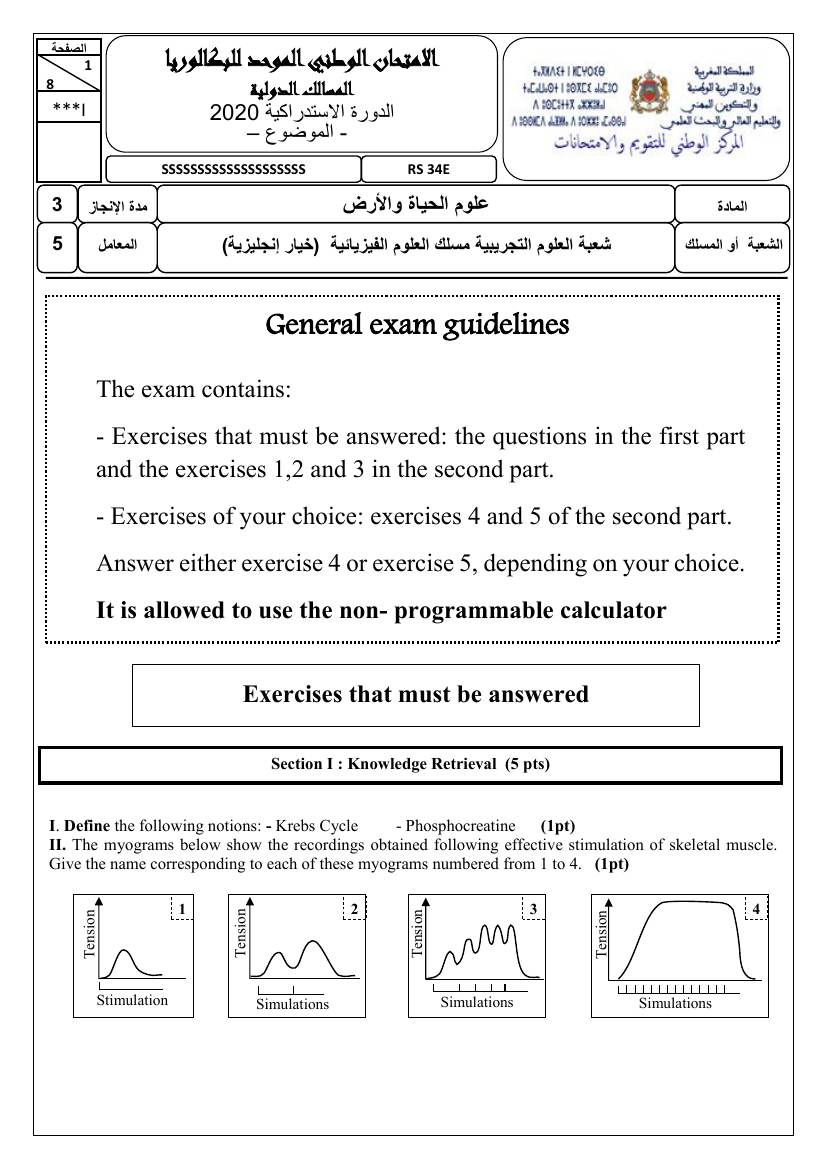
II.The myograms below show the recordings obtained following effective stimulation of skeletal muscle. Give the name corresponding to each of these myograms numbered from 1 to 4.1 pt

Figure : voir la page 1 du sujet

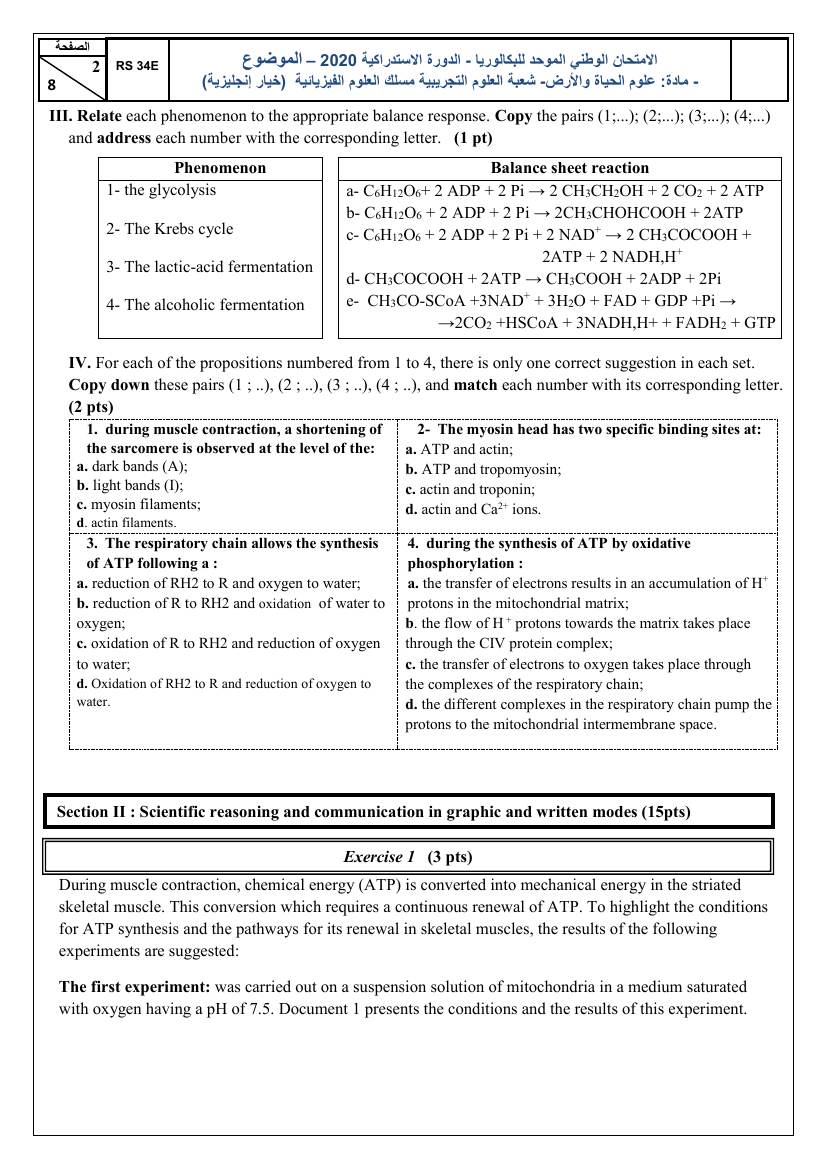
III.Relate each phenomenon to the appropriate balance response. Copy the pairs (1;...); (2;...); (3;...); (4;...) and address each number with the corresponding letter.1 pt

PhenomenonBalance sheet reaction
1- the glycolysisa- C6H12O6+2 ADP+2 Pi→2 CH3CH2OH+2 CO2+2 ATP\mathrm{C_6H_{12}O_6 + 2\ ADP + 2\ Pi \rightarrow 2\ CH_3CH_2OH + 2\ CO_2 + 2\ ATP}
2- The Krebs cycleb- C6H12O6+2 ADP+2 Pi→2 CH3CHOHCOOH+2 ATP\mathrm{C_6H_{12}O_6 + 2\ ADP + 2\ Pi \rightarrow 2\ CH_3CHOHCOOH + 2\ ATP}
3- The lactic-acid fermentationc- C6H12O6+2 ADP+2 Pi+2 NAD+→2 CH3COCOOH+2 ATP+2 NADH,H+\mathrm{C_6H_{12}O_6 + 2\ ADP + 2\ Pi + 2\ NAD^+ \rightarrow 2\ CH_3COCOOH + 2\ ATP + 2\ NADH,H^+}
4- The alcoholic fermentationd- CH3COCOOH+2 ATP→CH3COOH+2 ADP+2 Pi\mathrm{CH_3COCOOH + 2\ ATP \rightarrow CH_3COOH + 2\ ADP + 2\ Pi}
e- CH3CO-SCoA+3 NAD++3 H2O+FAD+GDP+Pi→2 CO2+HSCoA+3 NADH,H++FADH2+GTP\mathrm{CH_3CO\text{-}SCoA + 3\ NAD^+ + 3\ H_2O + FAD + GDP + Pi \rightarrow 2\ CO_2 + HSCoA + 3\ NADH,H^+ + FADH_2 + GTP}

IV.For each of the propositions numbered from 1 to 4, there is only one correct suggestion in each set. Copy down these pairs (1 ; ..), (2 ; ..), (3 ; ..), (4 ; ..), and match each number with its corresponding letter.2 pts

1. during muscle contraction, a shortening of the sarcomere is observed at the level of the:

a. dark bands (A); b. light bands (I); c. myosin filaments; d. actin filaments.

2- The myosin head has two specific binding sites at:

a. ATP and actin; b. ATP and tropomyosin; c. actin and troponin; d. actin and Ca2+\mathrm{Ca^{2+}} ions.

3. The respiratory chain allows the synthesis of ATP following a :

a. reduction of RH2 to R and oxygen to water; b. reduction of R to RH2 and oxidation of water to oxygen; c. oxidation of R to RH2 and reduction of oxygen to water; d. Oxidation of RH2 to R and reduction of oxygen to water.

4. during the synthesis of ATP by oxidative phosphorylation :

a. the transfer of electrons results in an accumulation of H+\mathrm{H^+} protons in the mitochondrial matrix; b. the flow of H+\mathrm{H^+} protons towards the matrix takes place through the CIV protein complex; c. the transfer of electrons to oxygen takes place through the complexes of the respiratory chain; d. the different complexes in the respiratory chain pump the protons to the mitochondrial intermembrane space.

Revoir le cours : Le muscle strié squelettique · Consommation de la matière organique et flux d’énergie

Partie II – Exercice 13 pts

Section II : Scientific reasoning and communication in graphic and written modes (15pts) – Exercise 1 (3 pts)

During muscle contraction, chemical energy (ATP) is converted into mechanical energy in the striated skeletal muscle. This conversion which requires a continuous renewal of ATP. To highlight the conditions for ATP synthesis and the pathways for its renewal in skeletal muscles, the results of the following experiments are suggested:

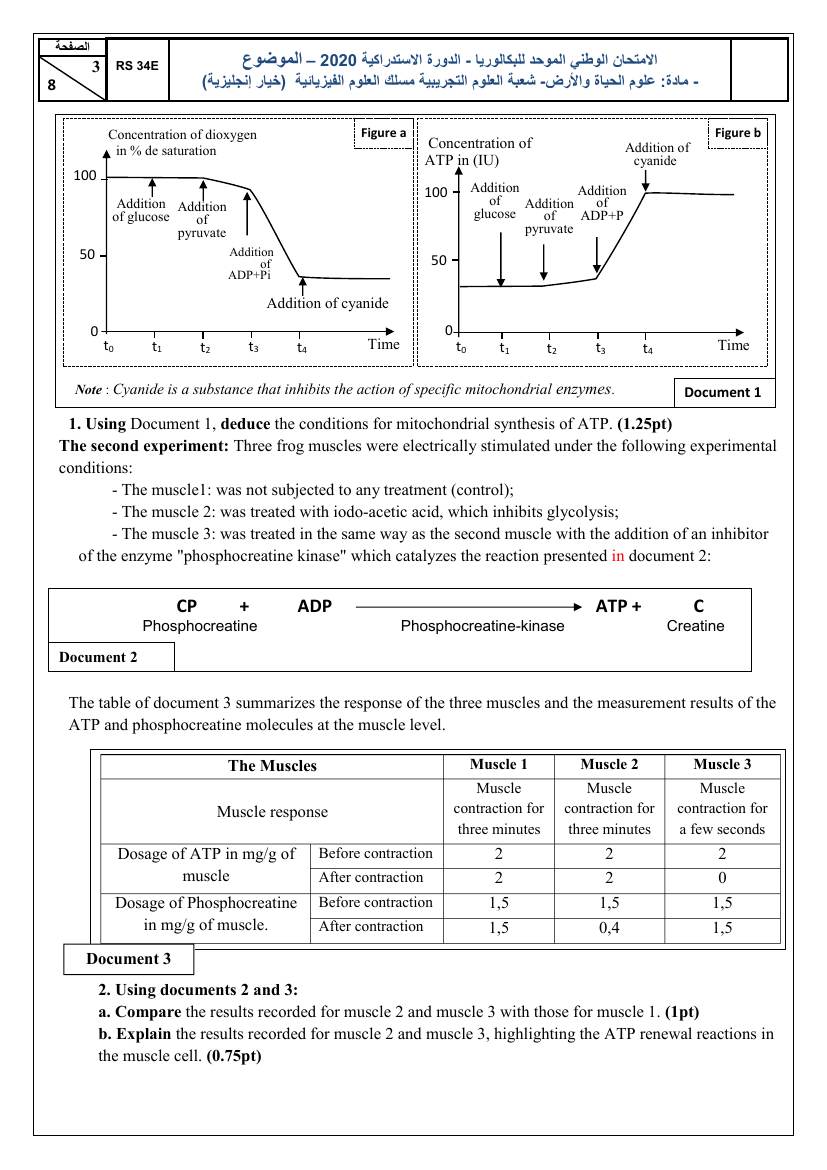
The first experiment: was carried out on a suspension solution of mitochondria in a medium saturated with oxygen having a pH of 7.5. Document 1 presents the conditions and the results of this experiment.

Document 1 : voir la page 3 du sujet

Note : Cyanide is a substance that inhibits the action of specific mitochondrial enzymes.

1.Using Document 1, deduce the conditions for mitochondrial synthesis of ATP.1,25 pts

The second experiment: Three frog muscles were electrically stimulated under the following experimental conditions:

- The muscle1: was not subjected to any treatment (control);

- The muscle 2: was treated with iodo-acetic acid, which inhibits glycolysis;

- The muscle 3: was treated in the same way as the second muscle with the addition of an inhibitor of the enzyme "phosphocreatine kinase" which catalyzes the reaction presented in document 2:

CP + ADP → ATP + C (CP: Phosphocreatine; catalyst: Phosphocreatine-kinase; C: Creatine). Document 2

The table of document 3 summarizes the response of the three muscles and the measurement results of the ATP and phosphocreatine molecules at the muscle level.

The MusclesMuscle 1Muscle 2Muscle 3
Muscle responseMuscle contraction for three minutesMuscle contraction for three minutesMuscle contraction for a few seconds
Dosage of ATP in mg/g of muscleBefore contraction222
Dosage of ATP in mg/g of muscleAfter contraction220
Dosage of Phosphocreatine in mg/g of muscle.Before contraction1,51,51,5
Dosage of Phosphocreatine in mg/g of muscle.After contraction1,50,41,5

Document 3

2. Using documents 2 and 3:

2.a.Compare the results recorded for muscle 2 and muscle 3 with those for muscle 1.1 pt

2.b.Explain the results recorded for muscle 2 and muscle 3, highlighting the ATP renewal reactions in the muscle cell.0,75 pt

Revoir le cours : Consommation de la matière organique et flux d’énergie · Le muscle strié squelettique

Partie II – Exercice 24 pts

Exercise 2 : (4 pts)

Lung cancer is an increasingly common disease. It is caused by the appearance of cancer cells that eventually form a lung tumor. The proliferation of lung cells is controlled by the EGFR gene, located at chromosome 7 in humans. To understand the causes of this disease, we propose the following data:

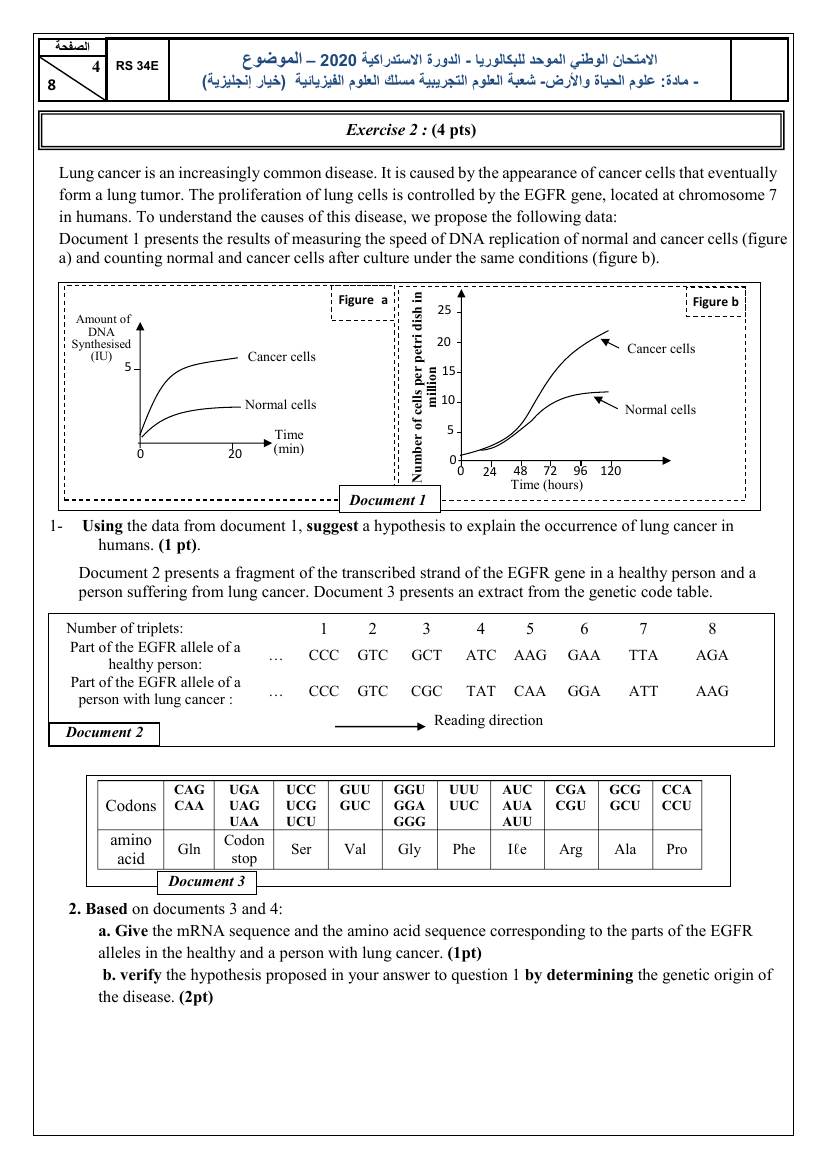
Document 1 presents the results of measuring the speed of DNA replication of normal and cancer cells (figure a) and counting normal and cancer cells after culture under the same conditions (figure b).

Document 1 : voir la page 4 du sujet

1.Using the data from document 1, suggest a hypothesis to explain the occurrence of lung cancer in humans.1 pt

Document 2 presents a fragment of the transcribed strand of the EGFR gene in a healthy person and a person suffering from lung cancer. Document 3 presents an extract from the genetic code table.

Number of triplets:12345678
Part of the EGFR allele of a healthy person:…CCCGTCGCTATCAAGGAATTAAGA
Part of the EGFR allele of a person with lung cancer :…CCCGTCCGCTATCAAGGAATTAAG

Reading direction (left to right). Document 2

CodonsCAG CAAUGA UAG UAAUCC UCG UCUGUU GUCGGU GGA GGGUUU UUCAUC AUA AUUCGA CGUGCG GCUCCA CCU
amino acidGlnCodon stopSerValGlyPheIleArgAlaPro

Document 3

2. Based on documents 3 and 4:

2.a.Give the mRNA sequence and the amino acid sequence corresponding to the parts of the EGFR alleles in the healthy and a person with lung cancer.1 pt

2.b.verify the hypothesis proposed in your answer to question 1 by determining the genetic origin of the disease.2 pts

Partie II – Exercice 34 pts

Exercise 3 : (4 pts)

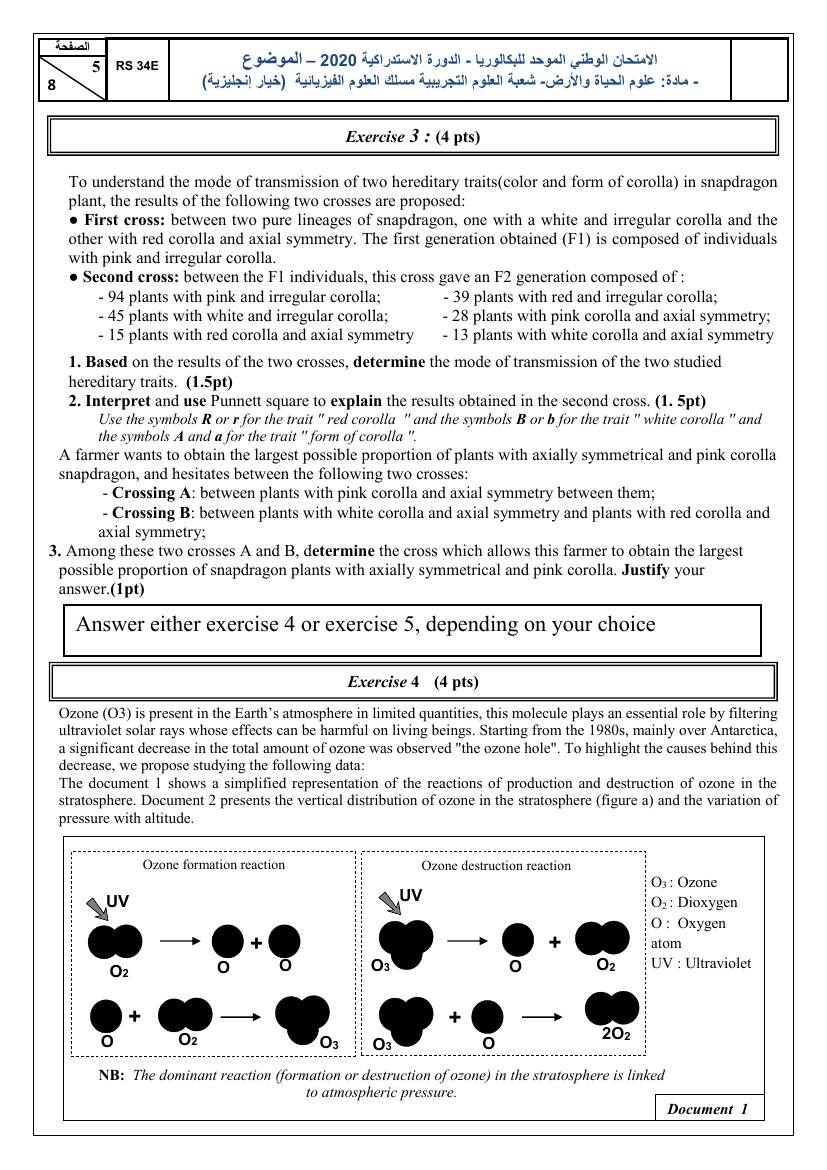
To understand the mode of transmission of two hereditary traits(color and form of corolla) in snapdragon plant, the results of the following two crosses are proposed:

● First cross: between two pure lineages of snapdragon, one with a white and irregular corolla and the other with red corolla and axial symmetry. The first generation obtained (F1) is composed of individuals with pink and irregular corolla.

● Second cross: between the F1 individuals, this cross gave an F2 generation composed of :

- 94 plants with pink and irregular corolla;

- 39 plants with red and irregular corolla;

- 45 plants with white and irregular corolla;

- 28 plants with pink corolla and axial symmetry;

- 15 plants with red corolla and axial symmetry

- 13 plants with white corolla and axial symmetry

1.Based on the results of the two crosses, determine the mode of transmission of the two studied hereditary traits.1,5 pts

2.Interpret and use Punnett square to explain the results obtained in the second cross.1,5 pts

Use the symbols RR or rr for the trait " red corolla " and the symbols BB or bb for the trait " white corolla " and the symbols AA and aa for the trait " form of corolla ".

A farmer wants to obtain the largest possible proportion of plants with axially symmetrical and pink corolla snapdragon, and hesitates between the following two crosses:

- Crossing A: between plants with pink corolla and axial symmetry between them;

- Crossing B: between plants with white corolla and axial symmetry and plants with red corolla and axial symmetry;

3.Among these two crosses A and B, determine the cross which allows this farmer to obtain the largest possible proportion of snapdragon plants with axially symmetrical and pink corolla. Justify your answer.1 pt

Partie II – Exercice 44 pts

Answer either exercise 4 or exercise 5, depending on your choice – Exercise 4 (4 pts)

Ozone (O3\mathrm{O_3}) is present in the Earth’s atmosphere in limited quantities, this molecule plays an essential role by filtering ultraviolet solar rays whose effects can be harmful on living beings. Starting from the 1980s, mainly over Antarctica, a significant decrease in the total amount of ozone was observed "the ozone hole". To highlight the causes behind this decrease, we propose studying the following data:

The document 1 shows a simplified representation of the reactions of production and destruction of ozone in the stratosphere. Document 2 presents the vertical distribution of ozone in the stratosphere (figure a) and the variation of pressure with altitude.

Document 1 : voir la page 5 du sujet

O3\mathrm{O_3} : Ozone; O2\mathrm{O_2} : Dioxygen; O : Oxygen atom; UV : Ultraviolet

NB: The dominant reaction (formation or destruction of ozone) in the stratosphere is linked to atmospheric pressure.

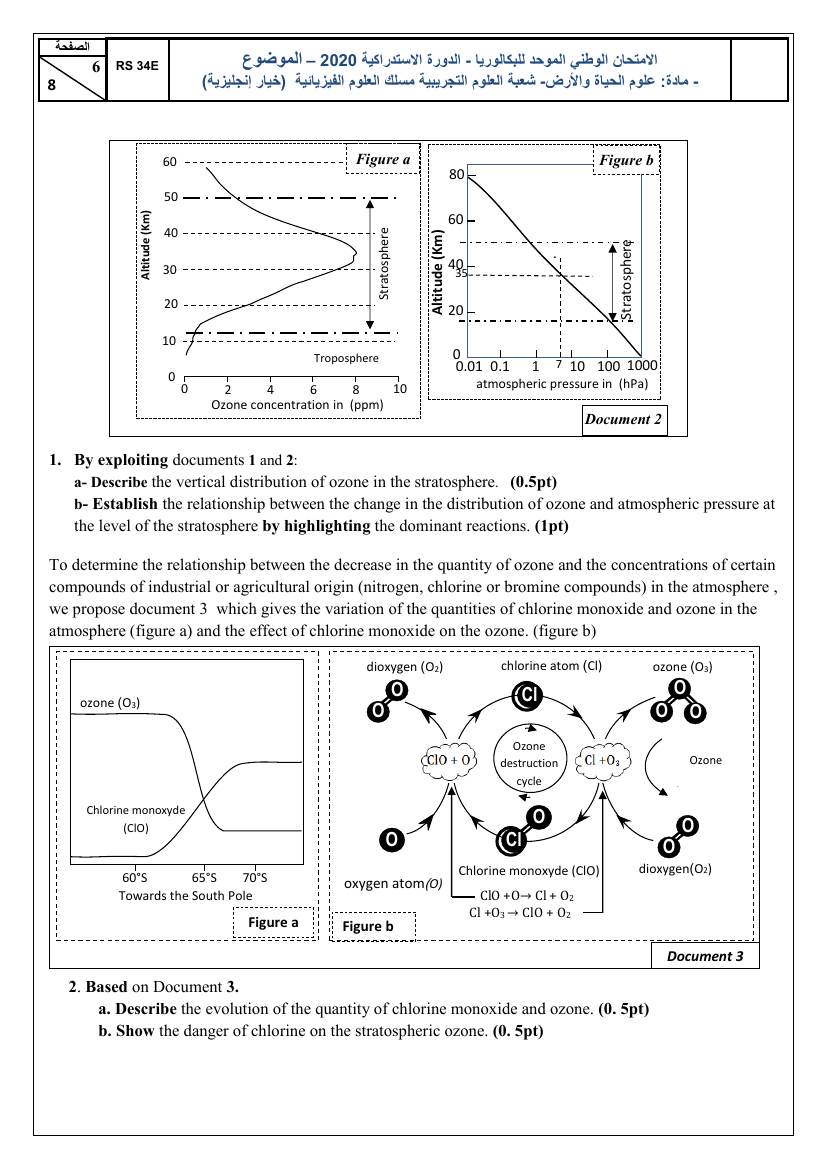
Document 2 : voir la page 6 du sujet

1. By exploiting documents 1 and 2:

1.a.Describe the vertical distribution of ozone in the stratosphere.0,5 pt

1.b.Establish the relationship between the change in the distribution of ozone and atmospheric pressure at the level of the stratosphere by highlighting the dominant reactions.1 pt

To determine the relationship between the decrease in the quantity of ozone and the concentrations of certain compounds of industrial or agricultural origin (nitrogen, chlorine or bromine compounds) in the atmosphere , we propose document 3 which gives the variation of the quantities of chlorine monoxide and ozone in the atmosphere (figure a) and the effect of chlorine monoxide on the ozone. (figure b)

Document 3 : voir la page 6 du sujet

ClO+O→Cl+O2\mathrm{ClO + O \rightarrow Cl + O_2} ; Cl+O3→ClO+O2\mathrm{Cl + O_3 \rightarrow ClO + O_2}

2. Based on Document 3.

2.a.Describe the evolution of the quantity of chlorine monoxide and ozone.0,5 pt

2.b.Show the danger of chlorine on the stratospheric ozone.0,5 pt

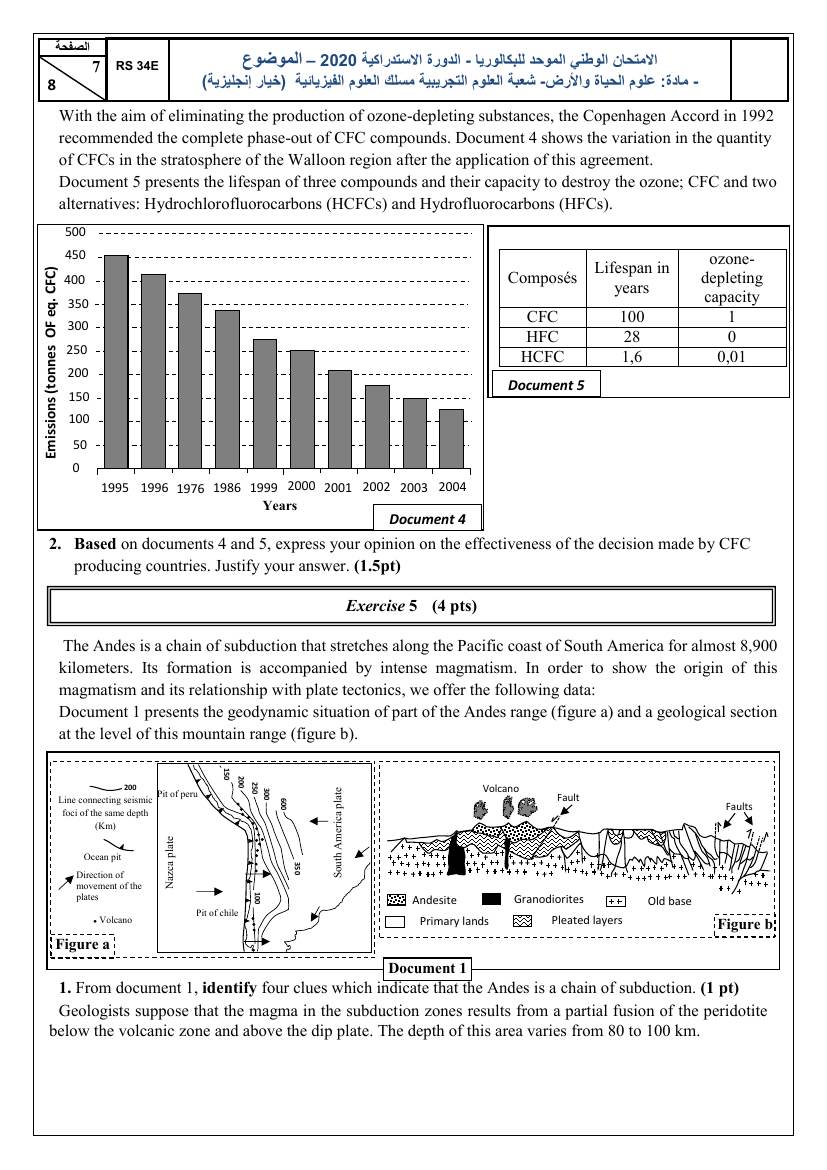
With the aim of eliminating the production of ozone-depleting substances, the Copenhagen Accord in 1992 recommended the complete phase-out of CFC compounds. Document 4 shows the variation in the quantity of CFCs in the stratosphere of the Walloon region after the application of this agreement.

Document 5 presents the lifespan of three compounds and their capacity to destroy the ozone; CFC and two alternatives: Hydrochlorofluorocarbons (HCFCs) and Hydrofluorocarbons (HFCs).

Document 4 : voir la page 7 du sujet

ComposésLifespan in yearsozone-depleting capacity
CFC1001
HFC280
HCFC1,60,01

Document 5

2.Based on documents 4 and 5, express your opinion on the effectiveness of the decision made by CFC producing countries. Justify your answer.1,5 pts

Partie II – Exercice 54 pts

Exercise 5 (4 pts)

The Andes is a chain of subduction that stretches along the Pacific coast of South America for almost 8,900 kilometers. Its formation is accompanied by intense magmatism. In order to show the origin of this magmatism and its relationship with plate tectonics, we offer the following data:

Document 1 presents the geodynamic situation of part of the Andes range (figure a) and a geological section at the level of this mountain range (figure b).

Document 1 : voir la page 7 du sujet

1.From document 1, identify four clues which indicate that the Andes is a chain of subduction.1 pt

Geologists suppose that the magma in the subduction zones results from a partial fusion of the peridotite below the volcanic zone and above the dip plate. The depth of this area varies from 80 to 100 km.

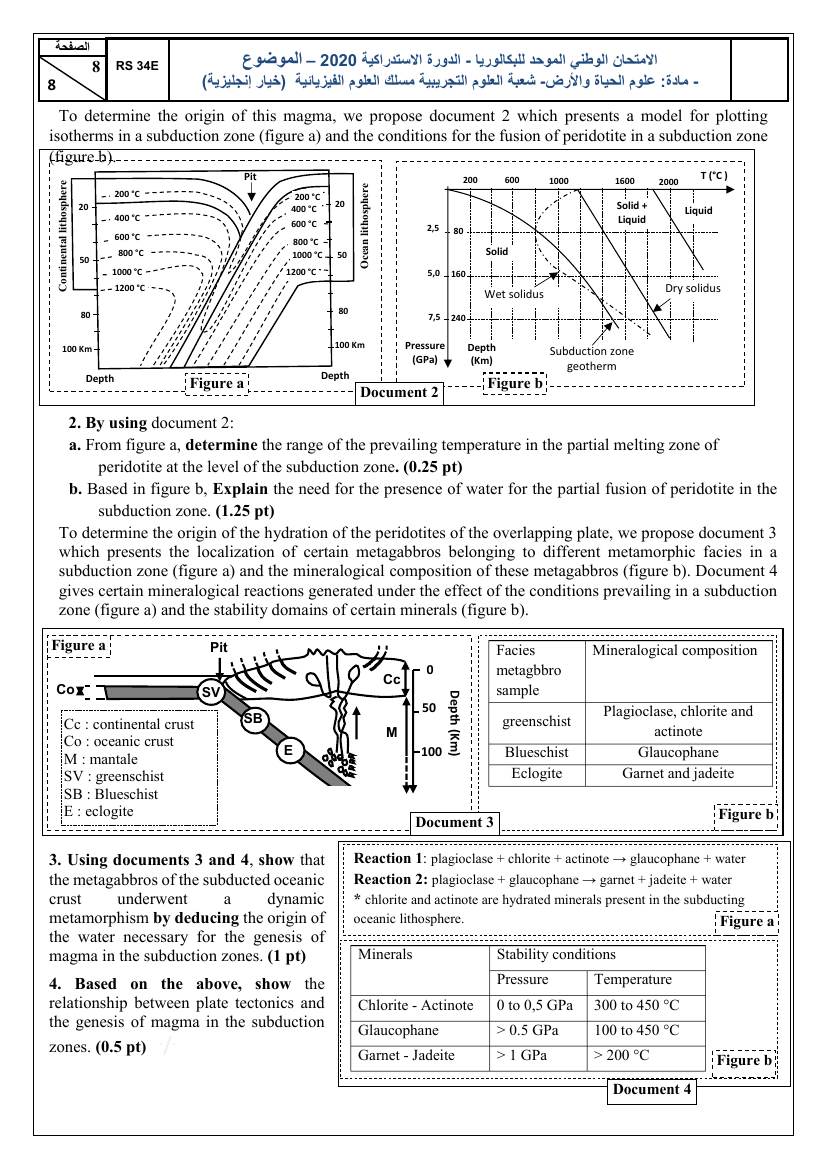
To determine the origin of this magma, we propose document 2 which presents a model for plotting isotherms in a subduction zone (figure a) and the conditions for the fusion of peridotite in a subduction zone (figure b).

Document 2 : voir la page 8 du sujet

2. By using document 2:

2.a.From figure a, determine the range of the prevailing temperature in the partial melting zone of peridotite at the level of the subduction zone.0,25 pt

2.b.Based in figure b, Explain the need for the presence of water for the partial fusion of peridotite in the subduction zone.1,25 pts

To determine the origin of the hydration of the peridotites of the overlapping plate, we propose document 3 which presents the localization of certain metagabbros belonging to different metamorphic facies in a subduction zone (figure a) and the mineralogical composition of these metagabbros (figure b). Document 4 gives certain mineralogical reactions generated under the effect of the conditions prevailing in a subduction zone (figure a) and the stability domains of certain minerals (figure b).

Document 3 : voir la page 8 du sujet

Cc : continental crust; Co : oceanic crust; M : mantale; SV : greenschist; SB : Blueschist; E : eclogite

Facies metagbbro sampleMineralogical composition
greenschistPlagioclase, chlorite and actinote
BlueschistGlaucophane
EclogiteGarnet and jadeite

Reaction 1: plagioclase + chlorite + actinote → glaucophane + water

Reaction 2: plagioclase + glaucophane → garnet + jadeite + water

* chlorite and actinote are hydrated minerals present in the subducting oceanic lithosphere.

MineralsStability conditions
PressureTemperature
Chlorite - Actinote0 to 0,5 GPa300 to 450 °C
Glaucophane> 0.5 GPa100 to 450 °C
Garnet - Jadeite> 1 GPa> 200 °C

Document 4

3.Using documents 3 and 4, show that the metagabbros of the subducted oceanic crust underwent a dynamic metamorphism by deducing the origin of the water necessary for the genesis of magma in the subduction zones.1 pt

4.Based on the above, show the relationship between plate tectonics and the genesis of magma in the subduction zones.0,5 pt

Entraîne-toi sur ces chapitres avec Kresco, gratuitement

Yallah, wa7d l-khtwa.

Le sujet, tu l’as. Maintenant, prépare-le.

Crée ton compte gratuit : une leçon offerte dans chaque chapitre, les quiz et ton suivi, matière par matière, jusqu’au national.