Jerreb rassek f l-national.

Examen national Physique-Chimie 2Bac SVT (option anglaise) 2018, session normale

Physique-Chimie · Sciences de la Vie et de la Terre · 6 pages

Le sujet en bref

  1. Chimie7 pts

    Dosage acido-basique · Piles · Transformations non totales et état d’équilibre

    L’ibuprofène en solution aqueuse et une pile zinc-cuivre

  2. Physique – Exercice 12,5 pts

    Ondes mécaniques progressives · Ondes mécaniques progressives périodiques

    La propagation d’ultrasons dans l’eau puis dans un autre liquide

  3. Physique – Exercice 25 pts

    Oscillations libres d’un circuit RLC série · Dipôle RC

    La charge d’un condensateur à courant constant puis sa décharge dans une bobine

  4. Physique – Exercice 35,5 pts

    Lois de Newton · Systèmes mécaniques oscillants · Aspects énergétiques des oscillations

    Un solide sur un plan incliné puis un oscillateur horizontal solide-ressort

Total : 20 points

Le sujet, page par page

  1. Examen national Physique-Chimie 2Bac SVT (option anglaise) 2018, session normale, page 1 sur 6
  2. Examen national Physique-Chimie 2Bac SVT (option anglaise) 2018, session normale, page 2 sur 6
  3. Examen national Physique-Chimie 2Bac SVT (option anglaise) 2018, session normale, page 3 sur 6
  4. Examen national Physique-Chimie 2Bac SVT (option anglaise) 2018, session normale, page 4 sur 6
  5. Examen national Physique-Chimie 2Bac SVT (option anglaise) 2018, session normale, page 5 sur 6
  6. Examen national Physique-Chimie 2Bac SVT (option anglaise) 2018, session normale, page 6 sur 6

Sujet officiel de l’examen national unifié du baccalauréat, tel que publié par le Centre national de l’évaluation et des examens (Ministère de l’Éducation nationale).

L’énoncé en texte

Transcription du sujet officiel, pour le lire et le rechercher sur téléphone. Les figures restent sur les pages du sujet ; en cas de différence, le PDF officiel fait foi.

Chimie7 pts

The two parts are independent.

Part 1: study the ibuprofen like a carboxylic acid

Ibuprofen is a molecule of brut-formula C13H18O2\mathrm{C_{13}H_{18}O_2}. It constitutes the active principle of many medicines of anti-inflammatory category.

This part aims at:

- Studying an aqueous solution of Ibuprofen;

- Titration of an aqueous solution of Ibuprofen.

Data: M(C13H18O2)=206 g⋅mol−1M(\mathrm{C_{13}H_{18}O_2}) = 206\ \mathrm{g\cdot mol^{-1}}

1. Studying an aqueous solution of Ibuprofen.

The pHpH of an aqueous solution of Ibuprofen, of molar concentration C=5,0⋅10−2 mol⋅L−1C = 5{,}0\cdot 10^{-2}\ \mathrm{mol\cdot L^{-1}}, is pH=2,7pH = 2{,}7 at 25∘C25^\circ\mathrm{C}.

The equation of reaction between the Ibuprofen and water is:

C13H18O2(aq)+H2O(l)⇄C13H17O2(aq)−+H3O(aq)+\mathrm{C_{13}H_{18}O_{2(aq)} + H_2O_{(l)} \rightleftarrows C_{13}H_{17}O_{2(aq)}^{-} + H_3O^{+}_{(aq)}}

1.1.Prove that this transformation is limited.0,5 pt

1.2.Calculate the value of the quotient of reaction Qr,eˊqQ_{r,\text{éq}} of this system in equilibrium.0,75 pt

1.3.Deduce the value of pKApK_A for the pair (C13H18O2(aq)/C13H17O2(aq)−)(\mathrm{C_{13}H_{18}O_{2(aq)}} / \mathrm{C_{13}H_{17}O_{2(aq)}^{-}}).0,25 pt

2. Titration of an aqueous solution of Ibuprofen

A tag of a medicine provides this information “Ibuprofen … 400mg”.

We dissolve a pill that contains the Ibuprofen in a precise protocol to prepare an aqueous solution (S)(S) of Ibuprofen of volume VS=100 mLV_S = 100\ \mathrm{mL}.

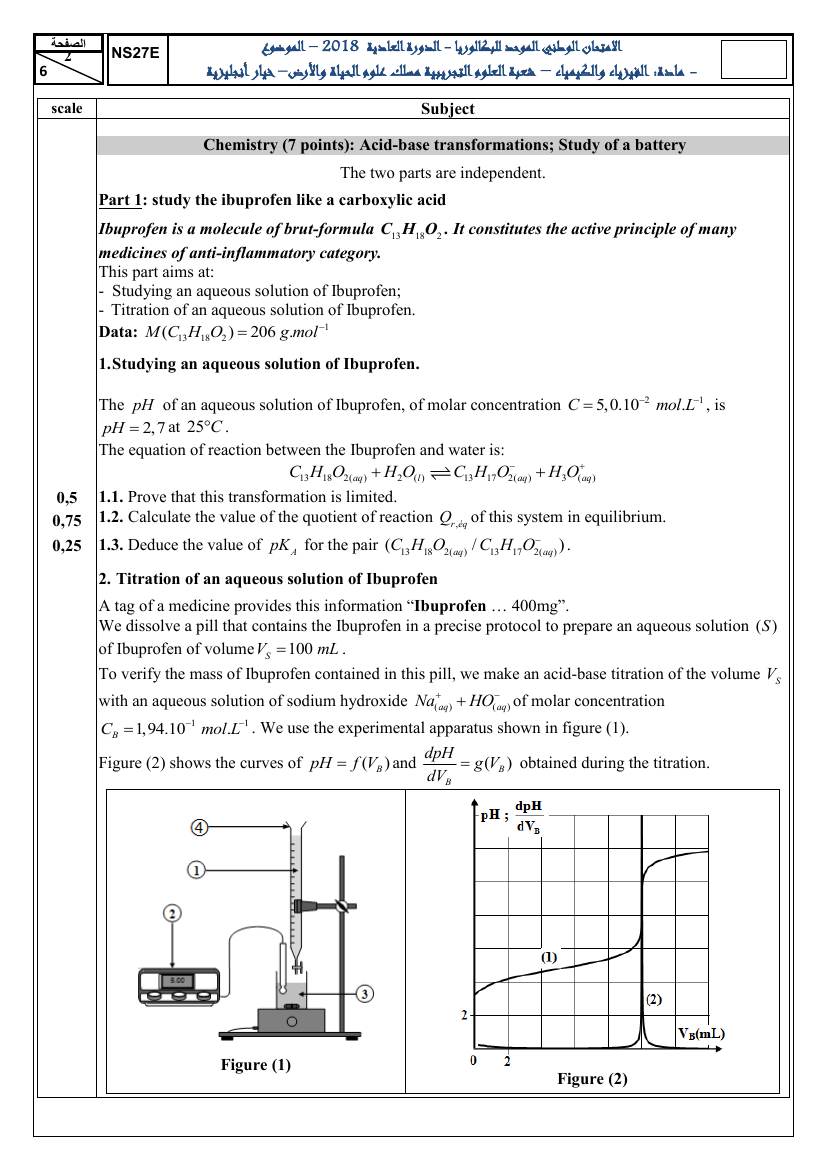
To verify the mass of Ibuprofen contained in this pill, we make an acid-base titration of the volume VSV_S with an aqueous solution of sodium hydroxide Na(aq)++HO(aq)−\mathrm{Na^{+}_{(aq)} + HO^{-}_{(aq)}} of molar concentration CB=1,94⋅10−1 mol⋅L−1C_B = 1{,}94\cdot 10^{-1}\ \mathrm{mol\cdot L^{-1}}. We use the experimental apparatus shown in figure (1).

Figure (2) shows the curves of pH=f(VB)pH = f(V_B) and dpHdVB=g(VB)\dfrac{dpH}{dV_B} = g(V_B) obtained during the titration.

Figure (1) : voir la page 2 du sujet

Figure (2) : voir la page 2 du sujet

2.1.Give the names of the elements of the experimental apparatus 1,2,3 and 4 shown in figure(1).1 pt

2.2.Among the curves (1) and (2) shown in figure (2), which one represents pH=f(VB)pH = f(V_B) ?0,25 pt

2.3.Determine, graphically, the value of the volume VB,EV_{B,E} poured in equivalence.0,5 pt

2.4.Write the equation of reaction of titration (it’s a total reaction).0,5 pt

2.5.Calculate the value of the amount of matter nAn_A of the Ibuprofen in the solution (S)(S).0,5 pt

2.6.Deduce the value of the mass mm of the Ibuprofen contained in the pill, and compare it with the value indicated in the tag.0,75 pt

Part 2: Study of a battery

Batteries are chemical systems that function with redox reactions. The study of these systems allows us to predict their sense of evolution and their functioning.

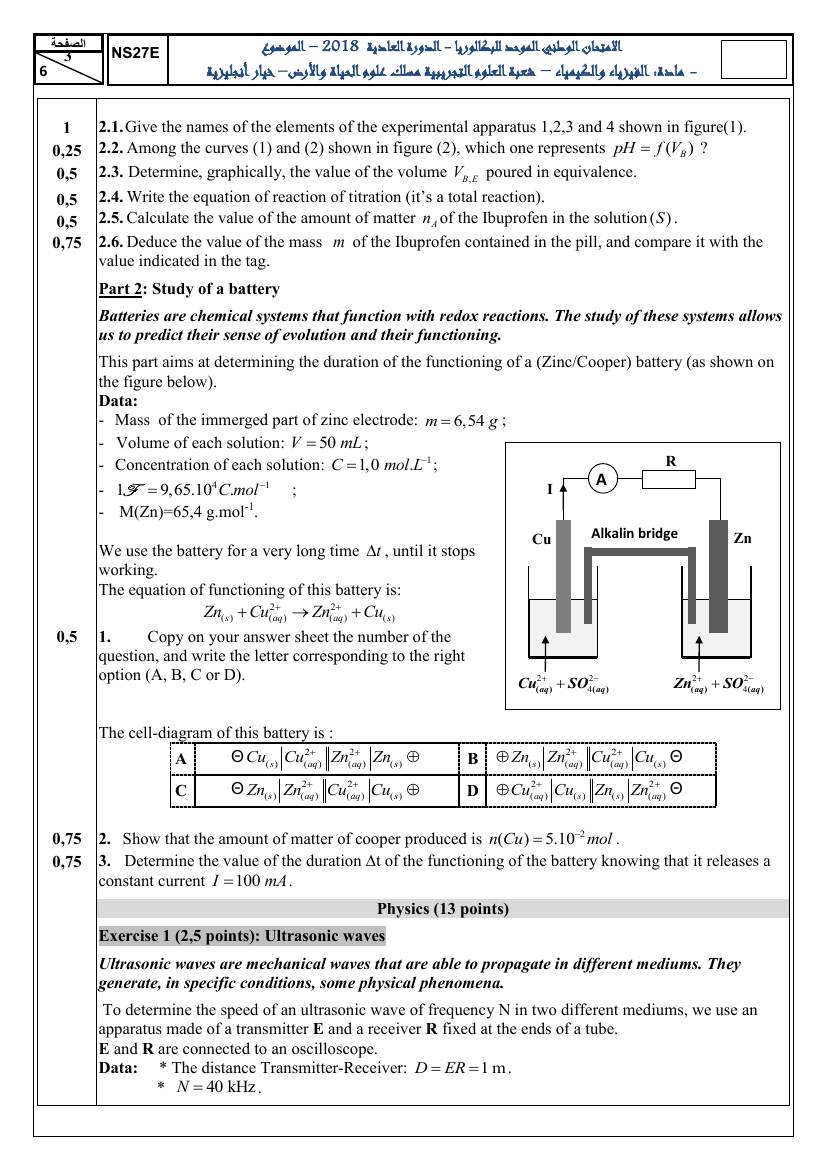
This part aims at determining the duration of the functioning of a (Zinc/Cooper) battery (as shown on the figure below).

Data:

- Mass of the immerged part of zinc electrode: m=6,54 gm = 6{,}54\ \mathrm{g} ;

- Volume of each solution: V=50 mLV = 50\ \mathrm{mL} ;

- Concentration of each solution: C=1,0 mol⋅L−1C = 1{,}0\ \mathrm{mol\cdot L^{-1}} ;

- 1F=9,65⋅104 C⋅mol−11\mathscr{F} = 9{,}65\cdot 10^{4}\ \mathrm{C\cdot mol^{-1}} ;

- M(Zn)=65,4 g⋅mol−1M(\mathrm{Zn}) = 65{,}4\ \mathrm{g\cdot mol^{-1}}.

Figure : voir la page 3 du sujet

We use the battery for a very long time Δt\Delta t, until it stops working.

The equation of functioning of this battery is:

Zn(s)+Cu(aq)2+→Zn(aq)2++Cu(s)\mathrm{Zn_{(s)} + Cu^{2+}_{(aq)} \rightarrow Zn^{2+}_{(aq)} + Cu_{(s)}}

1.Copy on your answer sheet the number of the question, and write the letter corresponding to the right option (A, B, C or D).0,5 pt

The cell-diagram of this battery is :

A⊖ Cu(s) ∣ Cu(aq)2+ ∥ Zn(aq)2+ ∣ Zn(s) ⊕\ominus\ \mathrm{Cu_{(s)}\,|\,Cu^{2+}_{(aq)}\,\|\,Zn^{2+}_{(aq)}\,|\,Zn_{(s)}}\ \oplusB⊕ Zn(s) ∣ Zn(aq)2+ ∥ Cu(aq)2+ ∣ Cu(s) ⊖\oplus\ \mathrm{Zn_{(s)}\,|\,Zn^{2+}_{(aq)}\,\|\,Cu^{2+}_{(aq)}\,|\,Cu_{(s)}}\ \ominus
C⊖ Zn(s) ∣ Zn(aq)2+ ∥ Cu(aq)2+ ∣ Cu(s) ⊕\ominus\ \mathrm{Zn_{(s)}\,|\,Zn^{2+}_{(aq)}\,\|\,Cu^{2+}_{(aq)}\,|\,Cu_{(s)}}\ \oplusD⊕ Cu(aq)2+ ∣ Cu(s) ∥ Zn(s) ∣ Zn(aq)2+ ⊖\oplus\ \mathrm{Cu^{2+}_{(aq)}\,|\,Cu_{(s)}\,\|\,Zn_{(s)}\,|\,Zn^{2+}_{(aq)}}\ \ominus

2.Show that the amount of matter of cooper produced is n(Cu)=5⋅10−2 moln(\mathrm{Cu}) = 5\cdot 10^{-2}\ \mathrm{mol}.0,75 pt

3.Determine the value of the duration Δt\Delta t of the functioning of the battery knowing that it releases a constant current I=100 mAI = 100\ \mathrm{mA}.0,75 pt

Physique – Exercice 12,5 pts

Exercise 1 (2,5 points): Ultrasonic waves

Ultrasonic waves are mechanical waves that are able to propagate in different mediums. They generate, in specific conditions, some physical phenomena.

To determine the speed of an ultrasonic wave of frequency N in two different mediums, we use an apparatus made of a transmitter E and a receiver R fixed at the ends of a tube.

E and R are connected to an oscilloscope.

Data: * The distance Transmitter-Receiver: D=ER=1 mD = ER = 1\ \mathrm{m}.

* N=40 kHzN = 40\ \mathrm{kHz}.

1.Is the ultrasonic wave a longitudinal or transversal wave?0,5 pt

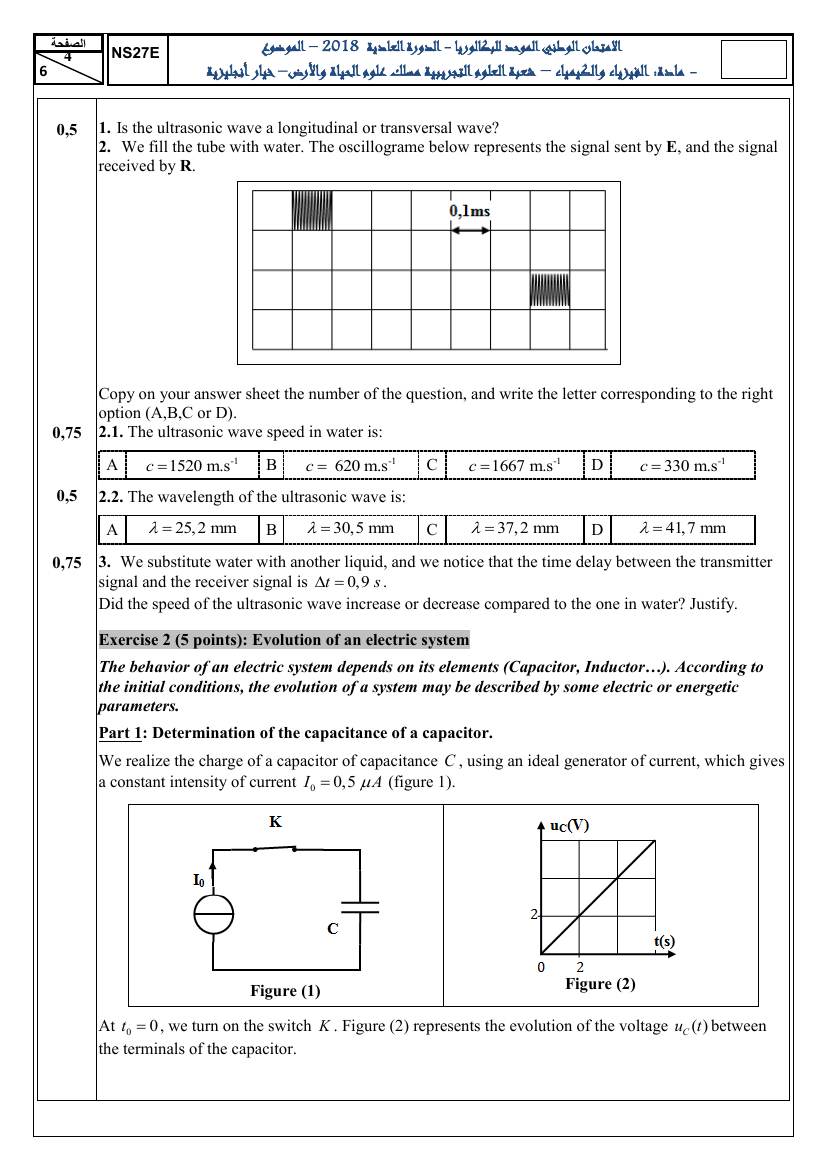
2. We fill the tube with water. The oscillograme below represents the signal sent by E, and the signal received by R.

Figure : voir la page 4 du sujet

Copy on your answer sheet the number of the question, and write the letter corresponding to the right option (A,B,C or D).

2.1.The ultrasonic wave speed in water is:0,75 pt

Ac=1520 m⋅s−1c = 1520\ \mathrm{m\cdot s^{-1}}Bc=620 m⋅s−1c = 620\ \mathrm{m\cdot s^{-1}}Cc=1667 m⋅s−1c = 1667\ \mathrm{m\cdot s^{-1}}Dc=330 m⋅s−1c = 330\ \mathrm{m\cdot s^{-1}}

2.2.The wavelength of the ultrasonic wave is:0,5 pt

Aλ=25,2 mm\lambda = 25{,}2\ \mathrm{mm}Bλ=30,5 mm\lambda = 30{,}5\ \mathrm{mm}Cλ=37,2 mm\lambda = 37{,}2\ \mathrm{mm}Dλ=41,7 mm\lambda = 41{,}7\ \mathrm{mm}

3.We substitute water with another liquid, and we notice that the time delay between the transmitter signal and the receiver signal is Δt=0,9 s\Delta t = 0{,}9\ \mathrm{s}. Did the speed of the ultrasonic wave increase or decrease compared to the one in water? Justify.0,75 pt

Revoir le cours : Ondes mécaniques progressives · Ondes mécaniques progressives périodiques

Physique – Exercice 25 pts

Exercise 2 (5 points): Evolution of an electric system

The behavior of an electric system depends on its elements (Capacitor, Inductor…). According to the initial conditions, the evolution of a system may be described by some electric or energetic parameters.

Part 1: Determination of the capacitance of a capacitor.

We realize the charge of a capacitor of capacitance CC, using an ideal generator of current, which gives a constant intensity of current I0=0,5 μAI_0 = 0{,}5\ \mu\mathrm{A} (figure 1).

Figure (1) : voir la page 4 du sujet

Figure (2) : voir la page 4 du sujet

At t0=0t_0 = 0, we turn on the switch KK. Figure (2) represents the evolution of the voltage uC(t)u_C(t) between the terminals of the capacitor.

1.Copy on your answer sheet the number of the question, and write the letter corresponding to the right option (A,B,C or D). The expression of uCu_C is:0,5 pt

AuC=CI0 tu_C = \dfrac{C}{I_0}\,tBuC=I0C tu_C = \dfrac{I_0}{C}\,tCuC=I0 C tu_C = I_0\,C\,tDuC=C tu_C = C\,t

2.Verify that C=0,5 μFC = 0{,}5\ \mu\mathrm{F}.0,5 pt

Part 2: Study the discharge of a capacitor through an inductor.

At t0=0t_0 = 0, we connect the previous capacitor (charged) to the terminals of an inductor of inductance LL and a neglected resistance.

1.Find the differential equation verified by the charge q(t)q(t) of the capacitor.0,75 pt

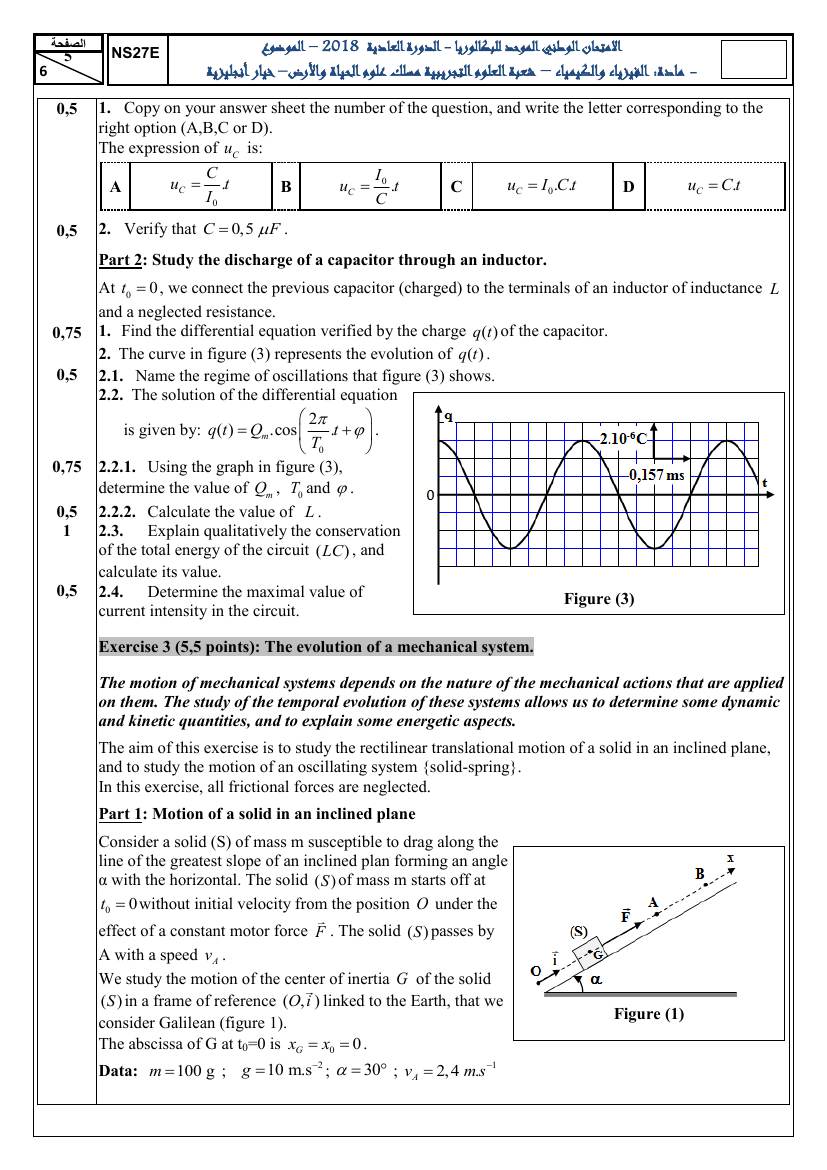
2. The curve in figure (3) represents the evolution of q(t)q(t).

Figure (3) : voir la page 5 du sujet

2.1.Name the regime of oscillations that figure (3) shows.0,5 pt

2.2. The solution of the differential equation is given by: q(t)=Qm⋅cos⁡ ⁣(2πT0 t+φ)q(t) = Q_m\cdot\cos\!\left(\dfrac{2\pi}{T_0}\,t + \varphi\right).

2.2.1.Using the graph in figure (3), determine the value of QmQ_m, T0T_0 and φ\varphi.0,75 pt

2.2.2.Calculate the value of LL.0,5 pt

2.3.Explain qualitatively the conservation of the total energy of the circuit (LC)(LC), and calculate its value.1 pt

2.4.Determine the maximal value of current intensity in the circuit.0,5 pt

Physique – Exercice 35,5 pts

Exercise 3 (5,5 points): The evolution of a mechanical system.

The motion of mechanical systems depends on the nature of the mechanical actions that are applied on them. The study of the temporal evolution of these systems allows us to determine some dynamic and kinetic quantities, and to explain some energetic aspects.

The aim of this exercise is to study the rectilinear translational motion of a solid in an inclined plane, and to study the motion of an oscillating system {solid-spring}.

In this exercise, all frictional forces are neglected.

Part 1: Motion of a solid in an inclined plane

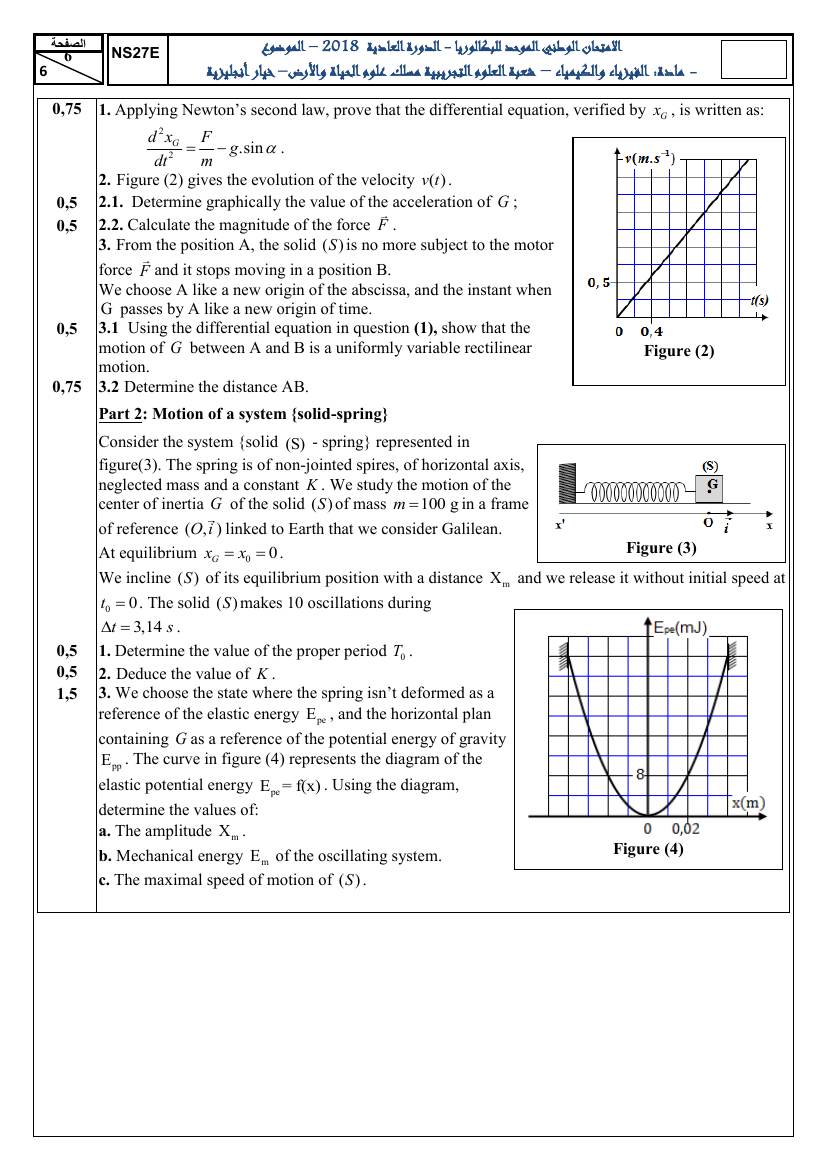
Consider a solid (S) of mass m susceptible to drag along the line of the greatest slope of an inclined plan forming an angle α\alpha with the horizontal. The solid (S)(S) of mass m starts off at t0=0t_0 = 0 without initial velocity from the position OO under the effect of a constant motor force F⃗\vec{F}. The solid (S)(S) passes by A with a speed vAv_A.

We study the motion of the center of inertia GG of the solid (S)(S) in a frame of reference (O,i⃗)(O,\vec{i}) linked to the Earth, that we consider Galilean (figure 1).

The abscissa of G at t0=0t_0=0 is xG=x0=0x_G = x_0 = 0.

Data: m=100 gm = 100\ \mathrm{g} ; g=10 m⋅s−2g = 10\ \mathrm{m\cdot s^{-2}} ; α=30∘\alpha = 30^\circ ; vA=2,4 m⋅s−1v_A = 2{,}4\ \mathrm{m\cdot s^{-1}}

Figure (1) : voir la page 5 du sujet

1.Applying Newton’s second law, prove that the differential equation, verified by xGx_G, is written as: d2xGdt2=Fm−g⋅sin⁡α\dfrac{d^2 x_G}{dt^2} = \dfrac{F}{m} - g\cdot\sin\alpha.0,75 pt

2. Figure (2) gives the evolution of the velocity v(t)v(t).

Figure (2) : voir la page 6 du sujet

2.1.Determine graphically the value of the acceleration of GG ;0,5 pt

2.2.Calculate the magnitude of the force F⃗\vec{F}.0,5 pt

3. From the position A, the solid (S)(S) is no more subject to the motor force F⃗\vec{F} and it stops moving in a position B. We choose A like a new origin of the abscissa, and the instant when G passes by A like a new origin of time.

3.1.Using the differential equation in question (1), show that the motion of GG between A and B is a uniformly variable rectilinear motion.0,5 pt

3.2.Determine the distance AB.0,75 pt

Part 2: Motion of a system {solid-spring}

Consider the system {solid (S)(S) - spring} represented in figure(3). The spring is of non-jointed spires, of horizontal axis, neglected mass and a constant KK. We study the motion of the center of inertia GG of the solid (S)(S) of mass m=100 gm = 100\ \mathrm{g} in a frame of reference (O,i⃗)(O,\vec{i}) linked to Earth that we consider Galilean.

Figure (3) : voir la page 6 du sujet

At equilibrium xG=x0=0x_G = x_0 = 0.

We incline (S)(S) of its equilibrium position with a distance XmX_m and we release it without initial speed at t0=0t_0 = 0. The solid (S)(S) makes 10 oscillations during Δt=3,14 s\Delta t = 3{,}14\ \mathrm{s}.

1.Determine the value of the proper period T0T_0.0,5 pt

2.Deduce the value of KK.0,5 pt

3.We choose the state where the spring isn’t deformed as a reference of the elastic energy EpeE_{pe}, and the horizontal plan containing GG as a reference of the potential energy of gravity EppE_{pp}. The curve in figure (4) represents the diagram of the elastic potential energy Epe=f(x)E_{pe} = f(x). Using the diagram, determine the values of:1,5 pts

Figure (4) : voir la page 6 du sujet

a.The amplitude XmX_m.

b.Mechanical energy EmE_m of the oscillating system.

c.The maximal speed of motion of (S)(S).

Entraîne-toi sur ces chapitres avec Kresco, gratuitement

Yallah, wa7d l-khtwa.

Le sujet, tu l’as. Maintenant, prépare-le.

Crée ton compte gratuit : une leçon offerte dans chaque chapitre, les quiz et ton suivi, matière par matière, jusqu’au national.