Jerreb rassek f l-national.

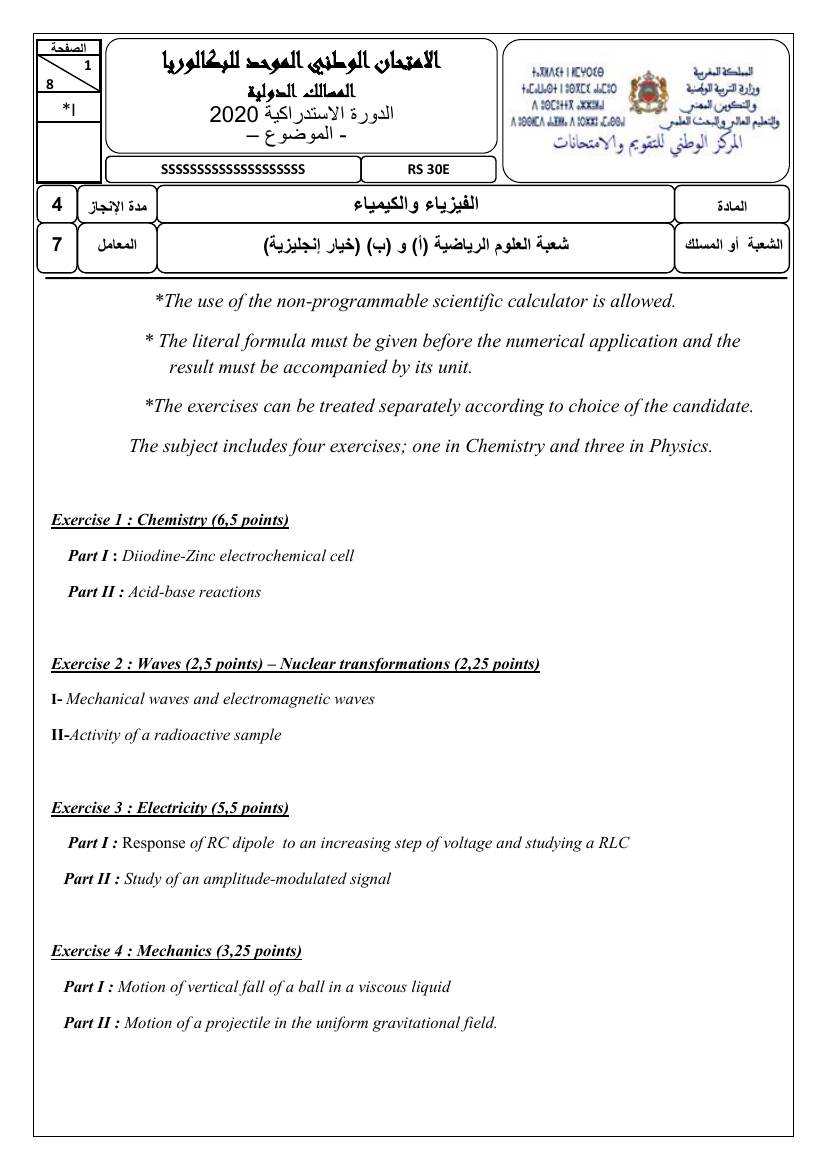
Examen national Physique-Chimie 2Bac SM (option anglaise) 2020, session de rattrapage

Physique-Chimie · Sciences Mathématiques A, Sciences Mathématiques B · 8 pages

Le sujet en bref

  1. Exercice 16,5 pts

    Piles · Réactions acide-base · Dosage acido-basique

    Une pile diiode-zinc et les acides méthanoïque et éthanoïque

  2. Exercice 24,75 pts

    Décroissance radioactive · Propagation des ondes lumineuses · Ondes mécaniques progressives

    Les ultrasons, la diffraction d’un laser par une fente et le polonium 210

  3. Exercice 35,5 pts

    Dipôle RC · Ondes électromagnétiques et modulation d’amplitude · Oscillations libres d’un circuit RLC série

  4. Exercice 43,25 pts

    Mouvements plans · Chute verticale d’un solide

    Une bille dans un liquide visqueux et un projectile

Total : 20 points

Le sujet, page par page

  1. Examen national Physique-Chimie 2Bac SM (option anglaise) 2020, session de rattrapage, page 1 sur 8
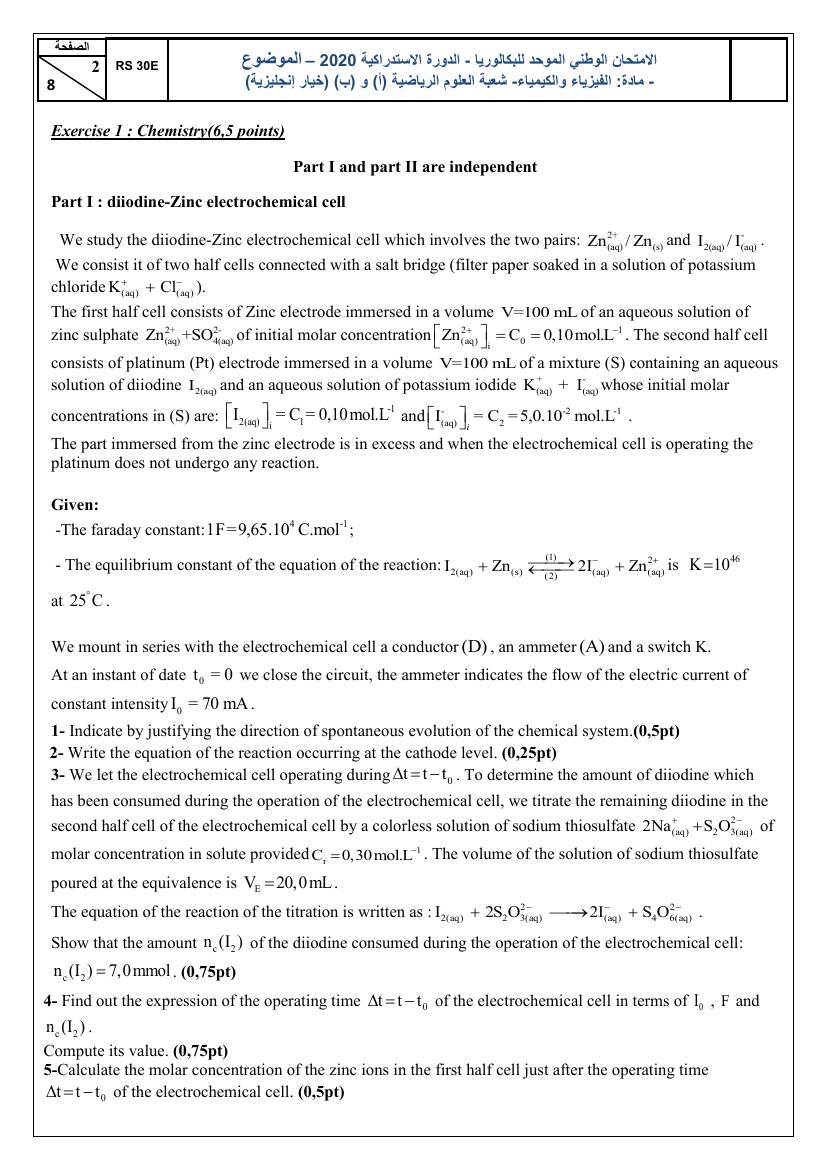
  2. Examen national Physique-Chimie 2Bac SM (option anglaise) 2020, session de rattrapage, page 2 sur 8
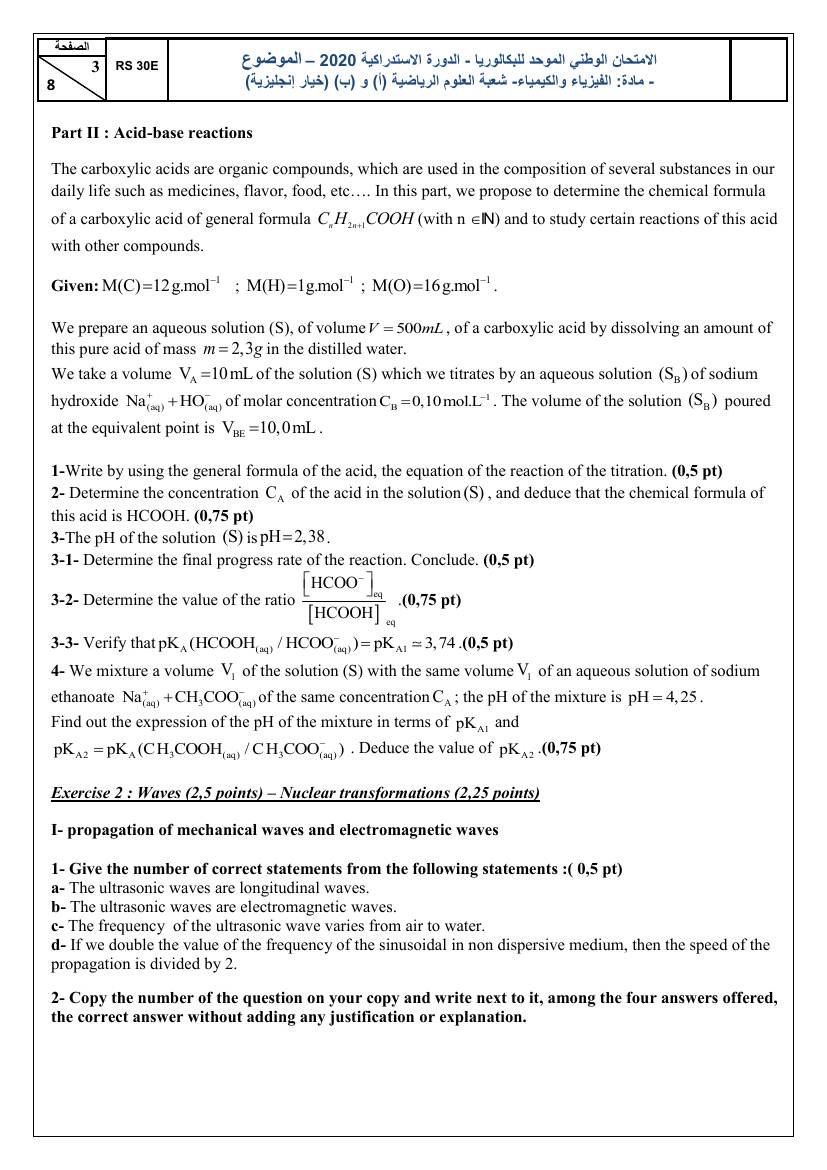
  3. Examen national Physique-Chimie 2Bac SM (option anglaise) 2020, session de rattrapage, page 3 sur 8
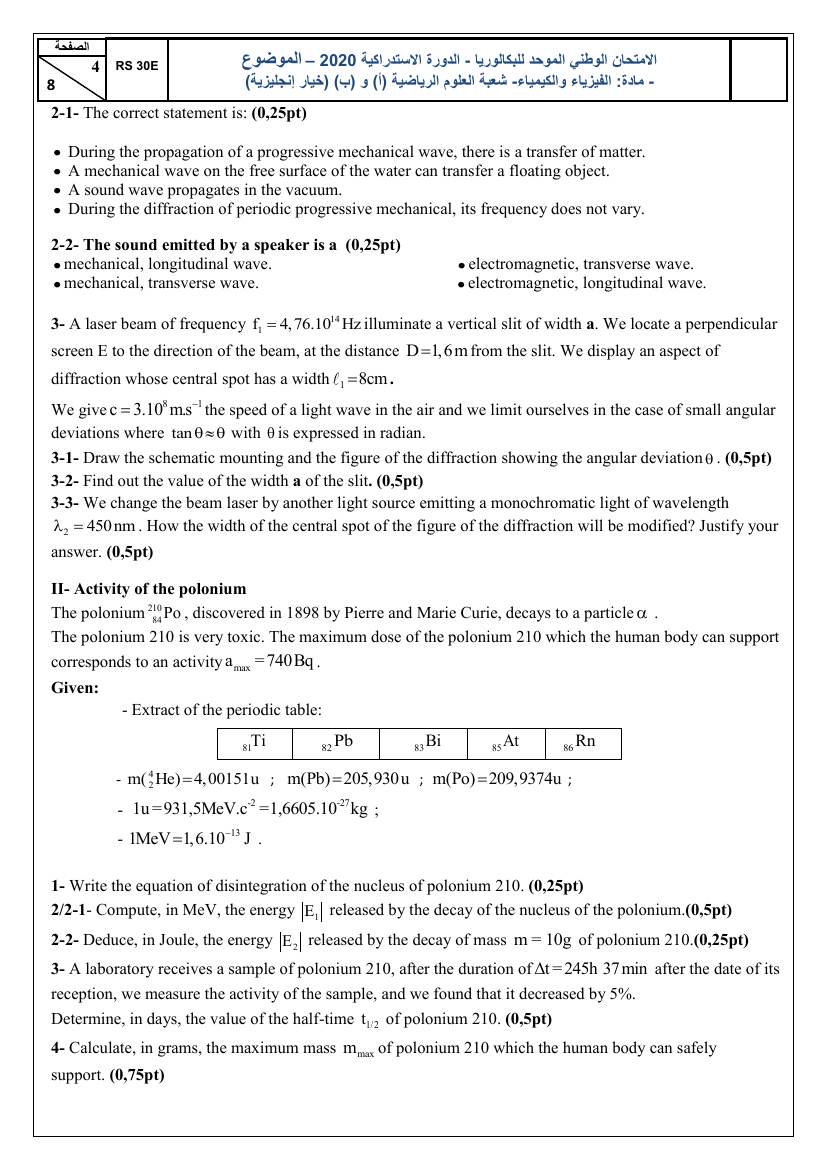
  4. Examen national Physique-Chimie 2Bac SM (option anglaise) 2020, session de rattrapage, page 4 sur 8
  5. Examen national Physique-Chimie 2Bac SM (option anglaise) 2020, session de rattrapage, page 5 sur 8
  6. Examen national Physique-Chimie 2Bac SM (option anglaise) 2020, session de rattrapage, page 6 sur 8
  7. Examen national Physique-Chimie 2Bac SM (option anglaise) 2020, session de rattrapage, page 7 sur 8
  8. Examen national Physique-Chimie 2Bac SM (option anglaise) 2020, session de rattrapage, page 8 sur 8

Sujet officiel de l’examen national unifié du baccalauréat, tel que publié par le Centre national de l’évaluation et des examens (Ministère de l’Éducation nationale).

L’énoncé en texte

Transcription du sujet officiel, pour le lire et le rechercher sur téléphone. Les figures restent sur les pages du sujet ; en cas de différence, le PDF officiel fait foi.

Exercice 16,5 pts

Exercise 1 : Chemistry (6,5 points)

Part I and part II are independent

Part I : diiodine-Zinc electrochemical cell

We study the diiodine-Zinc electrochemical cell which involves the two pairs: Zn(aq)2+/Zn(s)\mathrm{Zn^{2+}_{(aq)}/Zn_{(s)}} and I2(aq)/I(aq)−\mathrm{I_{2(aq)}/I^-_{(aq)}}.

We consist it of two half cells connected with a salt bridge (filter paper soaked in a solution of potassium chloride K(aq)++Cl(aq)−\mathrm{K^+_{(aq)} + Cl^-_{(aq)}}).

The first half cell consists of Zinc electrode immersed in a volume V=100 mLV=100\ \mathrm{mL} of an aqueous solution of zinc sulphate Zn(aq)2++SO4(aq)2−\mathrm{Zn^{2+}_{(aq)} + SO^{2-}_{4(aq)}} of initial molar concentration [Zn(aq)2+]i=C0=0,10 mol⋅L−1[\mathrm{Zn^{2+}_{(aq)}}]_i = C_0 = 0{,}10\ \mathrm{mol\cdot L^{-1}}. The second half cell consists of platinum (Pt) electrode immersed in a volume V=100 mLV=100\ \mathrm{mL} of a mixture (S) containing an aqueous solution of diiodine I2(aq)\mathrm{I_{2(aq)}} and an aqueous solution of potassium iodide K(aq)++I(aq)−\mathrm{K^+_{(aq)} + I^-_{(aq)}} whose initial molar concentrations in (S) are: [I2(aq)]i=C1=0,10 mol⋅L−1[\mathrm{I_{2(aq)}}]_i = C_1 = 0{,}10\ \mathrm{mol\cdot L^{-1}} and [I(aq)−]i=C2=5,0⋅10−2 mol⋅L−1[\mathrm{I^-_{(aq)}}]_i = C_2 = 5{,}0\cdot 10^{-2}\ \mathrm{mol\cdot L^{-1}}.

The part immersed from the zinc electrode is in excess and when the electrochemical cell is operating the platinum does not undergo any reaction.

Given:

-The faraday constant: 1F=9,65⋅104 C⋅mol−11\mathrm{F} = 9{,}65\cdot 10^{4}\ \mathrm{C\cdot mol^{-1}};

- The equilibrium constant of the equation of the reaction: I2(aq)+Zn(s)⇄2I(aq)−+Zn(aq)2+\mathrm{I_{2(aq)} + Zn_{(s)} \rightleftarrows 2I^-_{(aq)} + Zn^{2+}_{(aq)}} (sens 1 : →\rightarrow, sens 2 : ←\leftarrow) is K=1046K = 10^{46} at 25 ∘C25\,^\circ\mathrm{C}.

We mount in series with the electrochemical cell a conductor (D), an ammeter (A) and a switch K.

At an instant of date t0=0t_0 = 0 we close the circuit, the ammeter indicates the flow of the electric current of constant intensity I0=70 mAI_0 = 70\ \mathrm{mA}.

1.Indicate by justifying the direction of spontaneous evolution of the chemical system.0,5 pt

2.Write the equation of the reaction occurring at the cathode level.0,25 pt

3- We let the electrochemical cell operating during Δt=t−t0\Delta t = t - t_0. To determine the amount of diiodine which has been consumed during the operation of the electrochemical cell, we titrate the remaining diiodine in the second half cell of the electrochemical cell by a colorless solution of sodium thiosulfate 2Na(aq)++S2O3(aq)2−\mathrm{2Na^+_{(aq)} + S_2O^{2-}_{3(aq)}} of molar concentration in solute provided Cr=0,30 mol⋅L−1C_r = 0{,}30\ \mathrm{mol\cdot L^{-1}}. The volume of the solution of sodium thiosulfate poured at the equivalence is VE=20,0 mLV_E = 20{,}0\ \mathrm{mL}.

The equation of the reaction of the titration is written as : I2(aq)+2S2O3(aq)2−→2I(aq)−+S4O6(aq)2−\mathrm{I_{2(aq)} + 2S_2O^{2-}_{3(aq)} \rightarrow 2I^-_{(aq)} + S_4O^{2-}_{6(aq)}}.

3.Show that the amount nc(I2)n_c(\mathrm{I_2}) of the diiodine consumed during the operation of the electrochemical cell: nc(I2)=7,0 mmoln_c(\mathrm{I_2}) = 7{,}0\ \mathrm{mmol}.0,75 pt

4.Find out the expression of the operating time Δt=t−t0\Delta t = t - t_0 of the electrochemical cell in terms of I0I_0, FF and nc(I2)n_c(\mathrm{I_2}). Compute its value.0,75 pt

5.Calculate the molar concentration of the zinc ions in the first half cell just after the operating time Δt=t−t0\Delta t = t - t_0 of the electrochemical cell.0,5 pt

Part II : Acid-base reactions

The carboxylic acids are organic compounds, which are used in the composition of several substances in our daily life such as medicines, flavor, food, etc…. In this part, we propose to determine the chemical formula of a carboxylic acid of general formula CnH2n+1COOH\mathrm{C_nH_{2n+1}COOH} (with n∈Nn \in \mathbb{N}) and to study certain reactions of this acid with other compounds.

Given: M(C)=12 g⋅mol−1M(\mathrm{C}) = 12\ \mathrm{g\cdot mol^{-1}} ; M(H)=1 g⋅mol−1M(\mathrm{H}) = 1\ \mathrm{g\cdot mol^{-1}} ; M(O)=16 g⋅mol−1M(\mathrm{O}) = 16\ \mathrm{g\cdot mol^{-1}}.

We prepare an aqueous solution (S), of volume V=500 mLV = 500\ \mathrm{mL}, of a carboxylic acid by dissolving an amount of this pure acid of mass m=2,3 gm = 2{,}3\ \mathrm{g} in the distilled water.

We take a volume VA=10 mLV_A = 10\ \mathrm{mL} of the solution (S) which we titrates by an aqueous solution (SB)(S_B) of sodium hydroxide Na(aq)++HO(aq)−\mathrm{Na^+_{(aq)} + HO^-_{(aq)}} of molar concentration CB=0,10 mol⋅L−1C_B = 0{,}10\ \mathrm{mol\cdot L^{-1}}. The volume of the solution (SB)(S_B) poured at the equivalent point is VBE=10,0 mLV_{BE} = 10{,}0\ \mathrm{mL}.

1.Write by using the general formula of the acid, the equation of the reaction of the titration.0,5 pt

2.Determine the concentration CAC_A of the acid in the solution (S), and deduce that the chemical formula of this acid is HCOOH.0,75 pt

3-The pH of the solution (S) is pH=2,38\mathrm{pH} = 2{,}38.

3-1.Determine the final progress rate of the reaction. Conclude.0,5 pt

3-2.Determine the value of the ratio [HCOO−]eq[HCOOH]eq\dfrac{[\mathrm{HCOO^-}]_{eq}}{[\mathrm{HCOOH}]_{eq}}.0,75 pt

3-3.Verify that pKA(HCOOH(aq)/HCOO(aq)−)=pKA1≃3,74\mathrm{p}K_A(\mathrm{HCOOH_{(aq)}/HCOO^-_{(aq)}}) = \mathrm{p}K_{A1} \simeq 3{,}74.0,5 pt

4.We mixture a volume V1V_1 of the solution (S) with the same volume V1V_1 of an aqueous solution of sodium ethanoate Na(aq)++CH3COO(aq)−\mathrm{Na^+_{(aq)} + CH_3COO^-_{(aq)}} of the same concentration CAC_A ; the pH of the mixture is pH=4,25\mathrm{pH} = 4{,}25. Find out the expression of the pH of the mixture in terms of pKA1\mathrm{p}K_{A1} and pKA2=pKA(CH3COOH(aq)/CH3COO(aq)−)\mathrm{p}K_{A2} = \mathrm{p}K_A(\mathrm{CH_3COOH_{(aq)}/CH_3COO^-_{(aq)}}). Deduce the value of pKA2\mathrm{p}K_{A2}.0,75 pt

Exercice 24,75 pts

Exercise 2 : Waves (2,5 points) – Nuclear transformations (2,25 points)

I- propagation of mechanical waves and electromagnetic waves

1.Give the number of correct statements from the following statements :0,5 pt

a- The ultrasonic waves are longitudinal waves.

b- The ultrasonic waves are electromagnetic waves.

c- The frequency of the ultrasonic wave varies from air to water.

d- If we double the value of the frequency of the sinusoidal in non dispersive medium, then the speed of the propagation is divided by 2.

2- Copy the number of the question on your copy and write next to it, among the four answers offered, the correct answer without adding any justification or explanation.

2-1.The correct statement is:0,25 pt

• During the propagation of a progressive mechanical wave, there is a transfer of matter.

• A mechanical wave on the free surface of the water can transfer a floating object.

• A sound wave propagates in the vacuum.

• During the diffraction of periodic progressive mechanical, its frequency does not vary.

2-2.The sound emitted by a speaker is a0,25 pt

• mechanical, longitudinal wave.

• mechanical, transverse wave.

• electromagnetic, transverse wave.

• electromagnetic, longitudinal wave.

3- A laser beam of frequency f1=4,76⋅1014 Hzf_1 = 4{,}76\cdot 10^{14}\ \mathrm{Hz} illuminate a vertical slit of width aa. We locate a perpendicular screen E to the direction of the beam, at the distance D=1,6 mD = 1{,}6\ \mathrm{m} from the slit. We display an aspect of diffraction whose central spot has a width ℓ1=8 cm\ell_1 = 8\ \mathrm{cm}.

We give c=3⋅108 m⋅s−1c = 3\cdot 10^{8}\ \mathrm{m\cdot s^{-1}} the speed of a light wave in the air and we limit ourselves in the case of small angular deviations where tan⁡θ≈θ\tan\theta \approx \theta with θ\theta is expressed in radian.

3-1.Draw the schematic mounting and the figure of the diffraction showing the angular deviation θ\theta.0,5 pt

3-2.Find out the value of the width aa of the slit.0,5 pt

3-3.We change the beam laser by another light source emitting a monochromatic light of wavelength λ2=450 nm\lambda_2 = 450\ \mathrm{nm}. How the width of the central spot of the figure of the diffraction will be modified? Justify your answer.0,5 pt

II- Activity of the polonium

The polonium 84210Po\mathrm{^{210}_{84}Po}, discovered in 1898 by Pierre and Marie Curie, decays to a particle α\alpha.

The polonium 210 is very toxic. The maximum dose of the polonium 210 which the human body can support corresponds to an activity amax=740 Bqa_{max} = 740\ \mathrm{Bq}.

Given:

- Extract of the periodic table:

81Ti\mathrm{_{81}Ti}82Pb\mathrm{_{82}Pb}83Bi\mathrm{_{83}Bi}85At\mathrm{_{85}At}86Rn\mathrm{_{86}Rn}

- m(24He)=4,00151 um(\mathrm{^4_2He}) = 4{,}00151\ \mathrm{u} ; m(Pb)=205,930 um(\mathrm{Pb}) = 205{,}930\ \mathrm{u} ; m(Po)=209,9374 um(\mathrm{Po}) = 209{,}9374\ \mathrm{u} ;

- 1u=931,5 MeV⋅c−2=1,6605⋅10−27 kg1\mathrm{u} = 931{,}5\ \mathrm{MeV\cdot c^{-2}} = 1{,}6605\cdot 10^{-27}\ \mathrm{kg} ;

- 1MeV=1,6⋅10−13 J1\mathrm{MeV} = 1{,}6\cdot 10^{-13}\ \mathrm{J}.

1.Write the equation of disintegration of the nucleus of polonium 210.0,25 pt

2/2-1.Compute, in MeV, the energy ∣E1∣|E_1| released by the decay of the nucleus of the polonium.0,5 pt

2-2.Deduce, in Joule, the energy ∣E2∣|E_2| released by the decay of mass m=10 gm = 10\ \mathrm{g} of polonium 210.0,25 pt

3.A laboratory receives a sample of polonium 210, after the duration of Δt=245h 37 min\Delta t = 245\mathrm{h}\ 37\ \mathrm{min} after the date of its reception, we measure the activity of the sample, and we found that it decreased by 5%. Determine, in days, the value of the half-time t1/2t_{1/2} of polonium 210.0,5 pt

4.Calculate, in grams, the maximum mass mmaxm_{max} of polonium 210 which the human body can safely support.0,75 pt

Revoir le cours : Décroissance radioactive · Propagation des ondes lumineuses · Ondes mécaniques progressives

Exercice 35,5 pts

Exercise3 : Electricity (5,5 points)

Part I and part II are independent

In part I of this exercise, we propose to determine the characteristic quantities of the elements of an electrical circuit, by studying the charge of a capacitance and its discharge through an inductor. In the part II, we will study an amplitude-modulated signal.

Part I : Response of RC dipole to an increasing step of voltage and studying a RLC dipole

1- Response of RC dipole to an increasing step of voltage

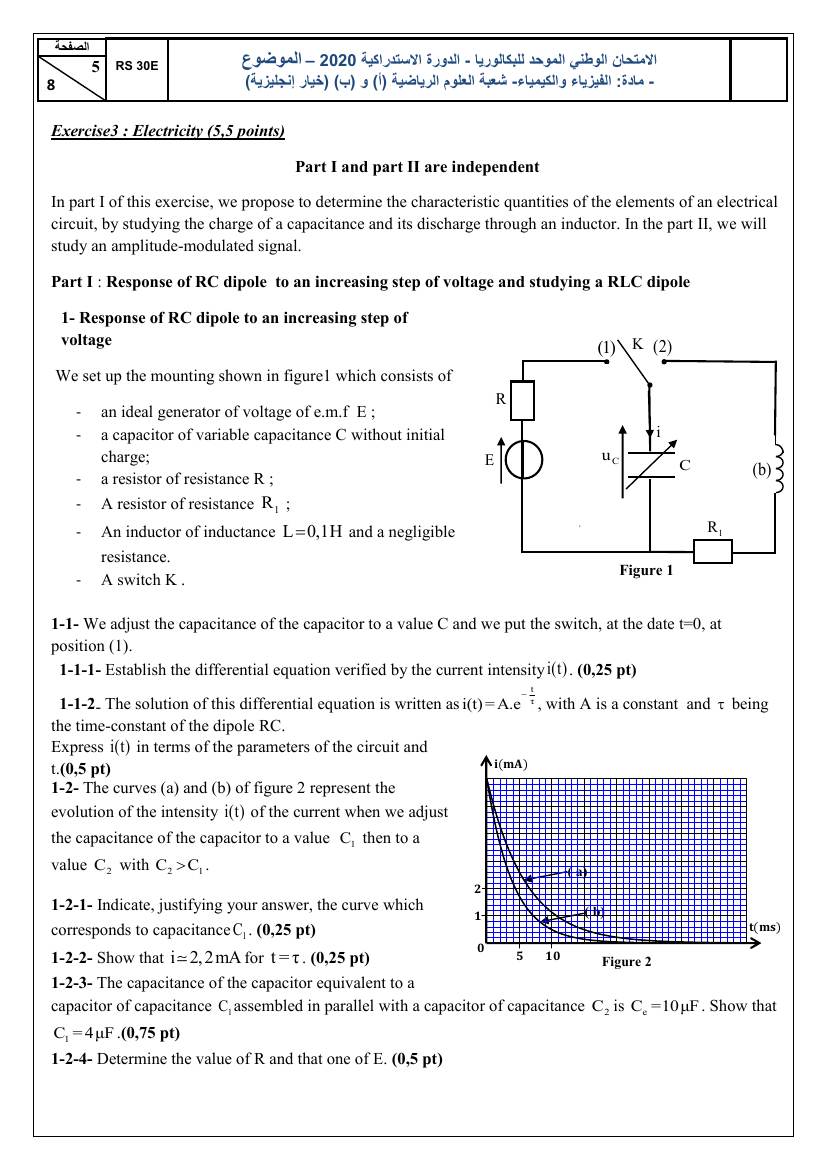
We set up the mounting shown in figure1 which consists of

- an ideal generator of voltage of e.m.f EE ;

- a capacitor of variable capacitance C without initial charge;

- a resistor of resistance RR ;

- A resistor of resistance R1R_1 ;

- An inductor of inductance L=0,1 HL = 0{,}1\ \mathrm{H} and a negligible resistance.

- A switch K .

Figure 1 : voir la page 5 du sujet

1-1- We adjust the capacitance of the capacitor to a value C and we put the switch, at the date t=0, at position (1).

1-1-1.Establish the differential equation verified by the current intensity i(t)i(t).0,25 pt

1-1-2.The solution of this differential equation is written as i(t)=A⋅e−tτi(t) = A\cdot e^{-\frac{t}{\tau}}, with A is a constant and τ\tau being the time-constant of the dipole RC. Express i(t)i(t) in terms of the parameters of the circuit and t.0,5 pt

1-2- The curves (a) and (b) of figure 2 represent the evolution of the intensity i(t)i(t) of the current when we adjust the capacitance of the capacitor to a value C1C_1 then to a value C2C_2 with C2>C1C_2 > C_1.

Figure 2 : voir la page 5 du sujet

1-2-1.Indicate, justifying your answer, the curve which corresponds to capacitance C1C_1.0,25 pt

1-2-2.Show that i≃2,2 mAi \simeq 2{,}2\ \mathrm{mA} for t=τt = \tau.0,25 pt

1-2-3.The capacitance of the capacitor equivalent to a capacitor of capacitance C1C_1 assembled in parallel with a capacitor of capacitance C2C_2 is Ce=10 μFC_e = 10\ \mu\mathrm{F}. Show that C1=4 μFC_1 = 4\ \mu\mathrm{F}.0,75 pt

1-2-4.Determine the value of R and that one of E.0,5 pt

2- Discharge of a capacitor through an inductor

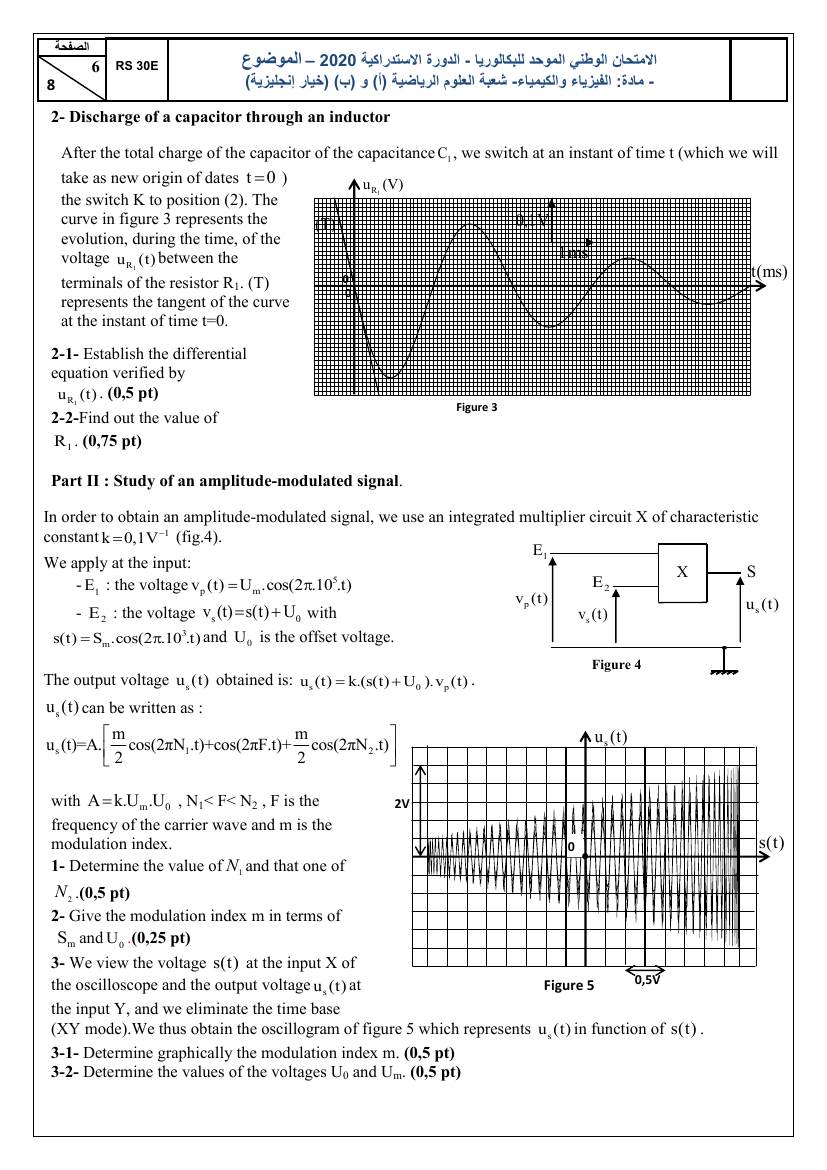
After the total charge of the capacitor of the capacitance C1C_1, we switch at an instant of time t (which we will take as new origin of dates t=0t = 0) the switch K to position (2). The curve in figure 3 represents the evolution, during the time, of the voltage uR1(t)u_{R_1}(t) between the terminals of the resistor R1R_1. (T) represents the tangent of the curve at the instant of time t=0.

Figure 3 : voir la page 6 du sujet

2-1.Establish the differential equation verified by uR1(t)u_{R_1}(t).0,5 pt

2-2.Find out the value of R1R_1.0,75 pt

Part II : Study of an amplitude-modulated signal.

In order to obtain an amplitude-modulated signal, we use an integrated multiplier circuit X of characteristic constant k=0,1 V−1k = 0{,}1\ \mathrm{V^{-1}} (fig.4).

Figure 4 : voir la page 6 du sujet

We apply at the input:

- E1E_1 : the voltage vp(t)=Um⋅cos⁡(2π⋅105⋅t)v_p(t) = U_m\cdot\cos(2\pi\cdot 10^5\cdot t)

- E2E_2 : the voltage vs(t)=s(t)+U0v_s(t) = s(t) + U_0 with s(t)=Sm⋅cos⁡(2π⋅103⋅t)s(t) = S_m\cdot\cos(2\pi\cdot 10^3\cdot t) and U0U_0 is the offset voltage.

The output voltage us(t)u_s(t) obtained is: us(t)=k⋅(s(t)+U0)⋅vp(t)u_s(t) = k\cdot(s(t) + U_0)\cdot v_p(t).

us(t)u_s(t) can be written as :

us(t)=A⋅[m2cos⁡(2πN1⋅t)+cos⁡(2πF⋅t)+m2cos⁡(2πN2⋅t)]u_s(t) = A\cdot\left[\frac{m}{2}\cos(2\pi N_1\cdot t) + \cos(2\pi F\cdot t) + \frac{m}{2}\cos(2\pi N_2\cdot t)\right]

with A=k⋅Um⋅U0A = k\cdot U_m\cdot U_0 , N1<F<N2N_1 < F < N_2 , F is the frequency of the carrier wave and m is the modulation index.

1.Determine the value of N1N_1 and that one of N2N_2.0,5 pt

2.Give the modulation index m in terms of SmS_m and U0U_0.0,25 pt

3- We view the voltage s(t)s(t) at the input X of the oscilloscope and the output voltage us(t)u_s(t) at the input Y, and we eliminate the time base (XY mode).We thus obtain the oscillogram of figure 5 which represents us(t)u_s(t) in function of s(t)s(t).

Figure 5 : voir la page 6 du sujet

3-1.Determine graphically the modulation index m.0,5 pt

3-2.Determine the values of the voltages U0U_0 and UmU_m.0,5 pt

Exercice 43,25 pts

Exercise 4 : Mechanics (3,25 points)

Part I and part II are independent

Part I : Motion of vertical fall of a ball in a viscous liquid

In this part, we study the motion of the center of inertia G of a homogeneous spherical ball, of mass m and radius r, in oil contained in a glass tube.

We study the motion of the center of inertia G in the orthonormal frame of reference (O,k⃗)(O,\vec{k}) linked to the earth assumed Galilean.

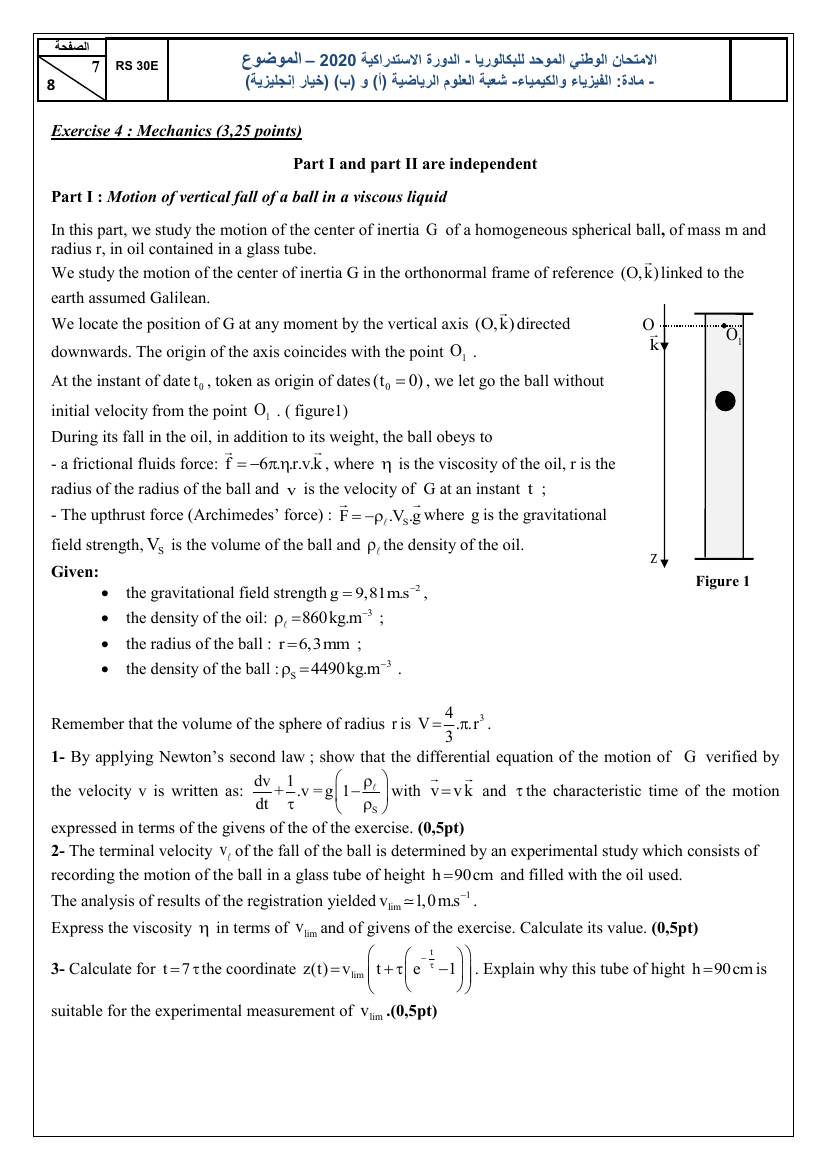
We locate the position of G at any moment by the vertical axis (O,k⃗)(O,\vec{k}) directed downwards. The origin of the axis coincides with the point O1O_1.

At the instant of date t0t_0, token as origin of dates (t0=0)(t_0 = 0), we let go the ball without initial velocity from the point O1O_1. ( figure1)

Figure 1 : voir la page 7 du sujet

During its fall in the oil, in addition to its weight, the ball obeys to

- a frictional fluids force: f⃗=−6π⋅η⋅r⋅v⋅k⃗\vec{f} = -6\pi\cdot\eta\cdot r\cdot v\cdot\vec{k}, where η\eta is the viscosity of the oil, r is the radius of the radius of the ball and vv is the velocity of G at an instant tt ;

- The upthrust force (Archimedes’ force) : F⃗=−ρℓ⋅VS⋅g⃗\vec{F} = -\rho_\ell\cdot V_S\cdot\vec{g} where gg is the gravitational field strength, VSV_S is the volume of the ball and ρℓ\rho_\ell the density of the oil.

Given:

• the gravitational field strength g=9,81 m⋅s−2g = 9{,}81\ \mathrm{m\cdot s^{-2}} ,

• the density of the oil: ρℓ=860 kg⋅m−3\rho_\ell = 860\ \mathrm{kg\cdot m^{-3}} ;

• the radius of the ball : r=6,3 mmr = 6{,}3\ \mathrm{mm} ;

• the density of the ball : ρS=4490 kg⋅m−3\rho_S = 4490\ \mathrm{kg\cdot m^{-3}} .

Remember that the volume of the sphere of radius r is V=43⋅π⋅r3V = \dfrac{4}{3}\cdot\pi\cdot r^3.

1.By applying Newton’s second law ; show that the differential equation of the motion of G verified by the velocity v is written as: dvdt+1τ⋅v=g(1−ρℓρS)\dfrac{dv}{dt} + \dfrac{1}{\tau}\cdot v = g\left(1 - \dfrac{\rho_\ell}{\rho_S}\right) with v⃗=vk⃗\vec{v} = v\vec{k} and τ\tau the characteristic time of the motion expressed in terms of the givens of the of the exercise.0,5 pt

2.The terminal velocity vℓv_\ell of the fall of the ball is determined by an experimental study which consists of recording the motion of the ball in a glass tube of height h=90 cmh = 90\ \mathrm{cm} and filled with the oil used. The analysis of results of the registration yielded vlim≃1,0 m⋅s−1v_{lim} \simeq 1{,}0\ \mathrm{m\cdot s^{-1}}. Express the viscosity η\eta in terms of vlimv_{lim} and of givens of the exercise. Calculate its value.0,5 pt

3.Calculate for t=7τt = 7\tau the coordinate z(t)=vlim(t+τ(e−tτ−1))z(t) = v_{lim}\left(t + \tau\left(e^{-\frac{t}{\tau}} - 1\right)\right). Explain why this tube of hight h=90 cmh = 90\ \mathrm{cm} is suitable for the experimental measurement of vlimv_{lim}.0,5 pt

Part II : Motion of a projectile in the uniform gravitational field

In this part, we study the free fall of a projectile, of center of inertia G and mass m in a frame of reference R(O,i⃗,j⃗)R(O,\vec{i},\vec{j}) linked to a geocentric frame of reference assumed Galilean. We suppose that during the motion, the gravitational field is uniform.

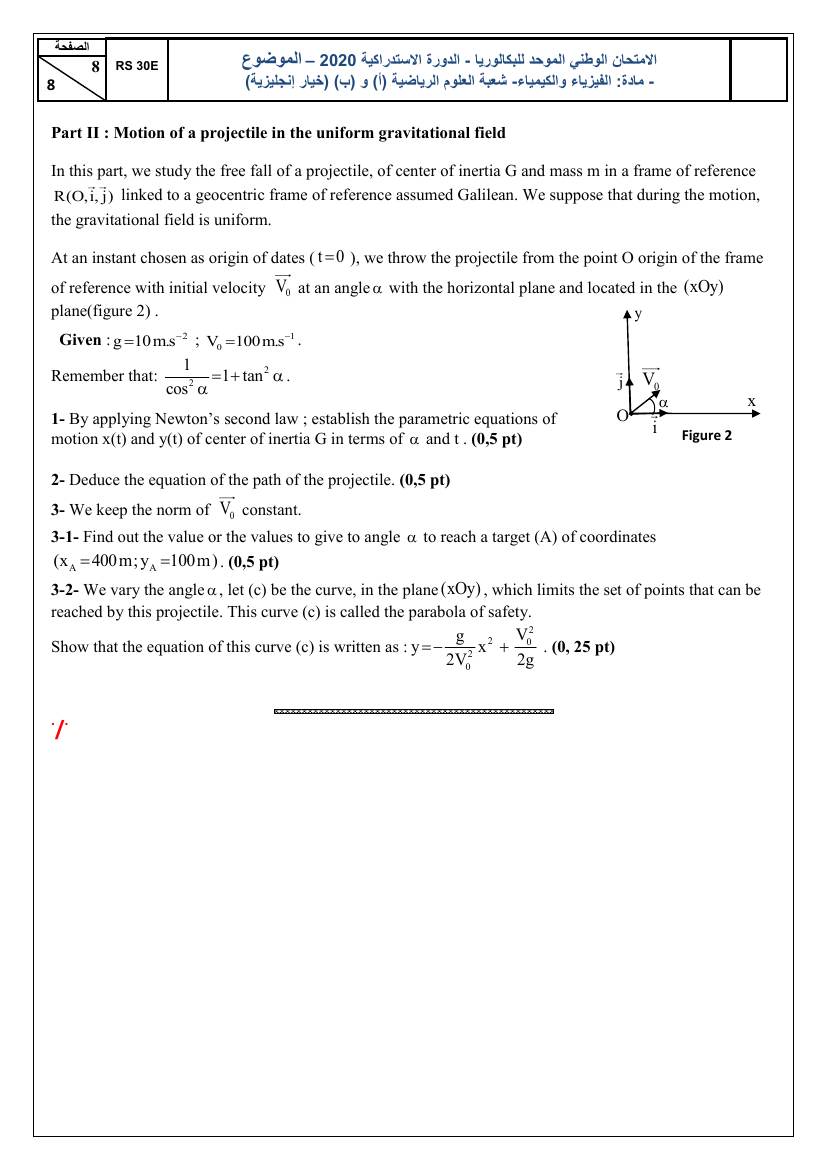
At an instant chosen as origin of dates (t=0t = 0), we throw the projectile from the point O origin of the frame of reference with initial velocity V0⃗\vec{V_0} at an angle α\alpha with the horizontal plane and located in the (xOy)(xOy) plane(figure 2).

Figure 2 : voir la page 8 du sujet

Given : g=10 m⋅s−2g = 10\ \mathrm{m\cdot s^{-2}} ; V0=100 m⋅s−1V_0 = 100\ \mathrm{m\cdot s^{-1}}.

Remember that: 1cos⁡2α=1+tan⁡2α\dfrac{1}{\cos^2\alpha} = 1 + \tan^2\alpha.

1.By applying Newton’s second law ; establish the parametric equations of motion x(t)x(t) and y(t)y(t) of center of inertia G in terms of α\alpha and tt.0,5 pt

2.Deduce the equation of the path of the projectile.0,5 pt

3- We keep the norm of V0⃗\vec{V_0} constant.

3-1.Find out the value or the values to give to angle α\alpha to reach a target (A) of coordinates (xA=400 m; yA=100 m)(x_A = 400\ \mathrm{m};\ y_A = 100\ \mathrm{m}).0,5 pt

3-2- We vary the angle α\alpha, let (c) be the curve, in the plane (xOy)(xOy), which limits the set of points that can be reached by this projectile. This curve (c) is called the parabola of safety.

3-2.Show that the equation of this curve (c) is written as : y=−g2V02x2+V022gy = -\dfrac{g}{2V_0^2}x^2 + \dfrac{V_0^2}{2g}.0,25 pt

Entraîne-toi sur ces chapitres avec Kresco, gratuitement

Yallah, wa7d l-khtwa.

Le sujet, tu l’as. Maintenant, prépare-le.

Crée ton compte gratuit : une leçon offerte dans chaque chapitre, les quiz et ton suivi, matière par matière, jusqu’au national.